Rocket.new replaces rigid website templates with AI-generated custom websites built entirely from plain-language prompts. Create landing pages, business websites, and apps without coding, design tools, or drag-and-drop limitations. With built-in SEO, analytics, integrations, and shared AI context, Rocket.new helps teams launch faster with fewer compromises.
What if building a professional website took less time than picking a template?
That's not a far-fetched idea anymore. AI-powered website creation has changed what's possible; anyone can now build fully functional, polished sites from a plain-language prompt, without coding, without templates, and without weeks of back-and-forth with a designer.
The global AI-powered website builder market is valued at $3.17 billion today and projected to reach $31.5 billion by 2033, growing at a CAGR of 25.80%. That kind of growth doesn't happen by accident, it happens when people find a better way to work.
The Template Trap: Why Traditional Website Builders Fell Short
Every drag-and-drop website builder makes the same promise: pick a template, drop in your content, go live in minutes.
What actually happens is different?
You spend 30 minutes browsing templates. None of them quite matches your vision. You pick the closest one and start customizing. But the layouts are locked. The structure fights back every time you try to do something specific. You end up with a site that looks like tens of thousands of other sites built on the same base design.
And that's before you hit the real limits, template-based tools box in your brand, your structure, your style. The learning curve for getting anything non-standard to work is surprisingly steep for what's supposed to be a simple tool.
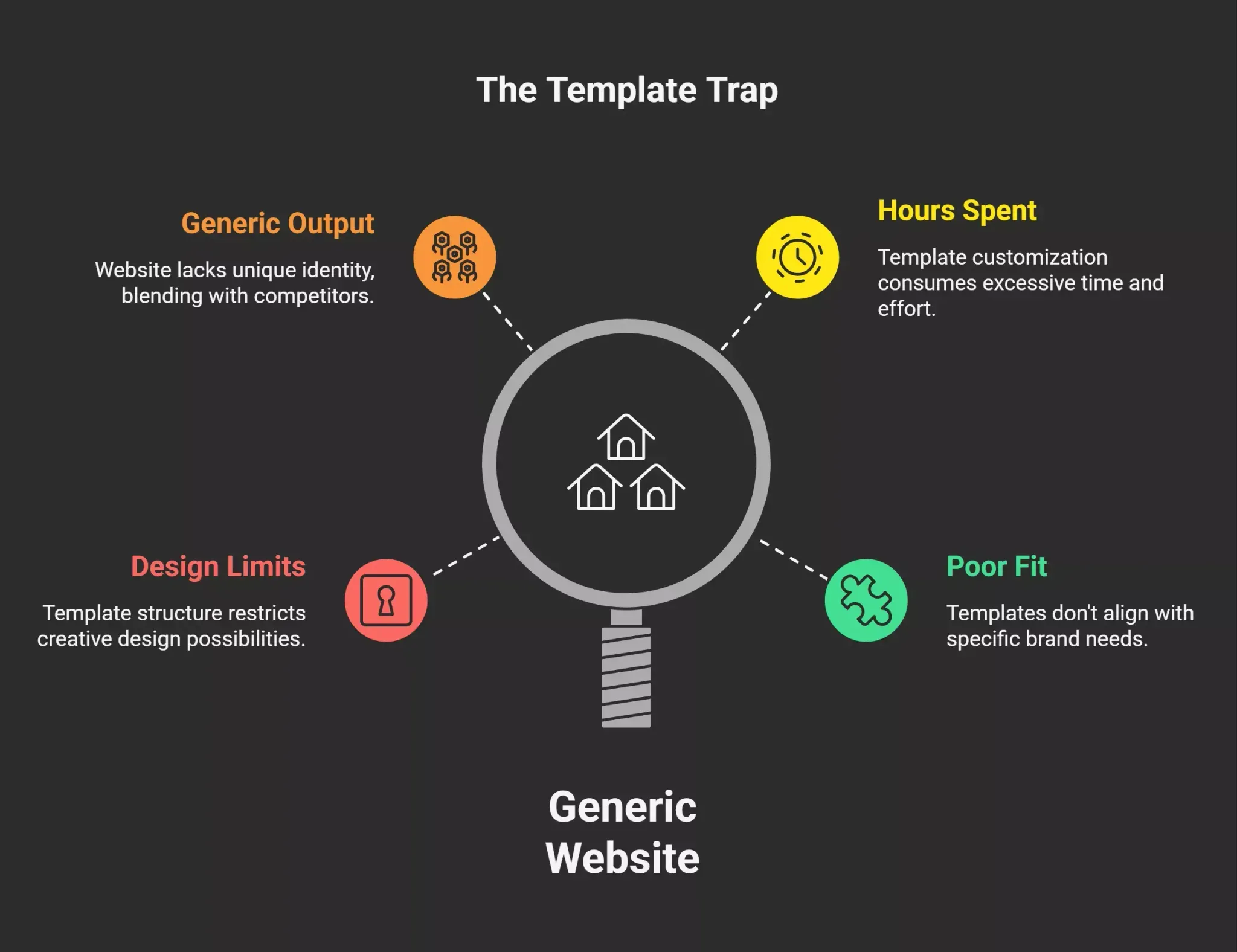 Some real pain points with template-based builders:
-
Design limits: You can only go so far before the structure blocks you
-
Generic output: Your site looks like every competitor on the same platform
-
Hours spent: Tweaking templates takes far longer than expected
-
Poor fit for real projects: Templates are built for general audiences, not specific brands
90% of users will leave a poorly designed website. And 75% of consumers judge a brand's credibility by its website design. Template-based builders make it harder to stand out when everyone is working from the same visual vocabulary.
The AI Website Builder Shift - What Changed and Why
The AI website builder category has flipped the script.
Instead of starting with someone else's design, you start with your idea - written in plain language. You describe what you want: the type of site, the pages it needs, and the feel you're going for. The AI builder reads that brief and generates a custom design from scratch, built around your description.
No template involved. No drag and drop compromises. Just a website created to match what you actually described.
This is why 67.39% of business owners now prefer AI-driven website builders over traditional ones - they produce better-fit results and take far less time to get right.
The logic is simple. A template gives you someone else's version of your site. An AI website builder gives you your version, generated automatically.
What Building Without Coding Actually Looks Like
When people hear "AI website," they sometimes picture a smarter template that still locks you in. Real AI builders work differently.
Here's what the build process looks like from start to finish:
You describe your idea. The system generates a first draft code, design, and pages included, and shows you a live preview. You refine it through conversation: "Make the hero section bolder." "Add a services page with three columns." "Adjust the color scheme to feel more minimal." The AI applies each change in context, without re-explaining the full brief.
No coding. No design software to learn. Real projects go live in hours, not weeks.
The critical difference from a drag and drop editor is what happens at the refinement stage. You're not clicking and moving elements around a canvas. You're having a conversation. That removes the learning curve almost entirely and gives designers, founders, and business owners the same starting point.
Community Insight - What Builders Are Actually Saying
The reaction from the builder community has been genuine. Santiago Valdarrama, AI educator and engineer with over 100,000 LinkedIn followers, shared his take after using Rocket.new:
"It's absolutely crazy that you can build a complete product in plain English. You type what you want, and Rocket builds it for you. This is great if you want to build a landing page, a complete web application, a mobile app, or a dashboard. English is literally the hottest programming language." - Source: Santiago Valdarrama on LinkedIn
That reaction is about more than convenience. It's about the shift in who gets to build, and what they can build without needing a development team standing behind them.
AI Builders vs Template Builders - Side by Side
| Feature | Template-Based Builders | AI Website Builders |
|---|---|---|
| Starting point | Someone else's design | Your description |
| Design uniqueness | Shared layouts | Custom per brief |
| Building without coding | Partial, still manual work | Fully without coding |
| Learning curve | Moderate | Low - just type |
| Customization limits | Template-dependent | No structural limits |
| Time to first draft | 30 minutes to hours | Minutes |
| Pages flexibility | Constrained by a template | Any structure, any count |
| SEO structure | Basic defaults | Built in from the first generation |
Drag and drop tools changed web design when they arrived. AI builders are doing the same thing for the next wave, just with far fewer limits on what you can actually create.
Launch Like a Rocket: Building Professional Websites and Business Sites Without Limits
This is where Rocket.new comes in, and where the difference becomes visible.
Rocket.new is not just another AI website builder. It generates fully functional, production-quality websites, landing pages, and business sites from a single plain-language prompt. Every build ships with SEO-ready structure, mobile-responsive layouts, and a design that looks like a senior designer worked on it - not something assembled by an algorithm.
What You Can Build
Landing pages: conversion-focused pages with hero sections, call to action sections, testimonials, and pricing, all built to your specific brief. Not a landing page template adapted to your product. A landing page created for your product from the ground up.
Professional websites: multi-page sites where every page holds the same design quality as the homepage. Consistent layouts, consistent visual identity, consistent content structure, across as many pages as your project needs.
Business sites: service pages, about sections, contact forms, and custom domain support from day one. The kind of site that clients trust on their first visit.
Redesigns: point Rocket.new at any existing site URL and get a fully reimagined version in minutes, built from a structural reading of the original, not just a visual copy.
How Rocket.new Compares to Other AI Builders
Most AI builders available today, including Lovable, Bolt, and v0, generate from prompts. They're capable tools. But they share three structural gaps that matter for real projects:
-
No pre-build thinking: they build what you tell them without helping you decide what's actually worth building
-
No shared memory: every session starts fresh, and context doesn't carry over between builds
-
You manage the platform: API keys, error handling, and configurations are on you
Rocket.new is built around a shared context architecture. Add your brand guidelines, your audience detail, and your competitive research once. Every landing page, site, and app you build after that inherits that context. Nothing gets re-explained. Everything compounds.
The design output is also different. Generic AI builders produce results that look AI-made, predictable card layouts, standard grids, and structures that announce themselves. Rocket.new generates work with real design thinking behind it: typography choices, visual hierarchy, and a visual identity specific to your project.
Advanced Features for Real Projects
-
Full version history: every significant edit creates a new version, and you can restore any previous version in one click
-
Built-in analytics: visitors, conversions, and Core Web Vitals tracked from the moment the site is live, with no extra tools needed
-
25+ built-in connectors: Stripe, Supabase, Google Analytics, Mailchimp, and others flow into every build without separate setup
-
Staging and production environments: test before you publish, with a clear separation between the two
-
Free domain: option or connect a custom domain with one-click DNS setup
-
CMS-ready structure: content-manageable pages that your team can update without touching code
Designers use Rocket.new to ship Figma designs as live sites without a developer handoff. Founders use it to take real projects from idea to life in the same afternoon. Marketing teams use it because every landing page they need can be created through chat, refined in minutes, and live before the end of the day.
No Templates, No Limits, That's the Way to Build
The old model of website creation was built for a world where everyone started from the same template. That world has changed.
The Rocket.new way to website builder is about starting from your idea, your brand, and your vision - not from a grid someone else built for a general audience. AI builds the site. You focus on the product. Real projects ship faster, look better, and actually fit the brand they represent.
If you're ready to create professional websites, landing pages, and business sites without coding and without limits, that's exactly what Rocket.new is built for.
Table of contents
- -The Template Trap: Why Traditional Website Builders Fell Short
- -The AI Website Builder Shift - What Changed and Why
- -What Building Without Coding Actually Looks Like
- -Community Insight - What Builders Are Actually Saying
- -AI Builders vs Template Builders - Side by Side
- -Launch Like a Rocket: Building Professional Websites and Business Sites Without Limits
- -What You Can Build
- -How Rocket.new Compares to Other AI Builders
- -Advanced Features for Real Projects
- -No Templates, No Limits, That's the Way to Build