Competitive intelligence for sales teams means knowing what your rivals changed before your prospect does. Sales teams using Rocket.new access to continuous competitor signals, pricing shifts, and hiring patterns before every call starts. Set up monitoring once, and the intelligence arrives where you already work, not in a tab nobody opens.
The Problem With Flying Blind Into Enterprise Deals
What happens when a seller walks into an enterprise deal without knowing the data about what the rival just changed on their pricing page?
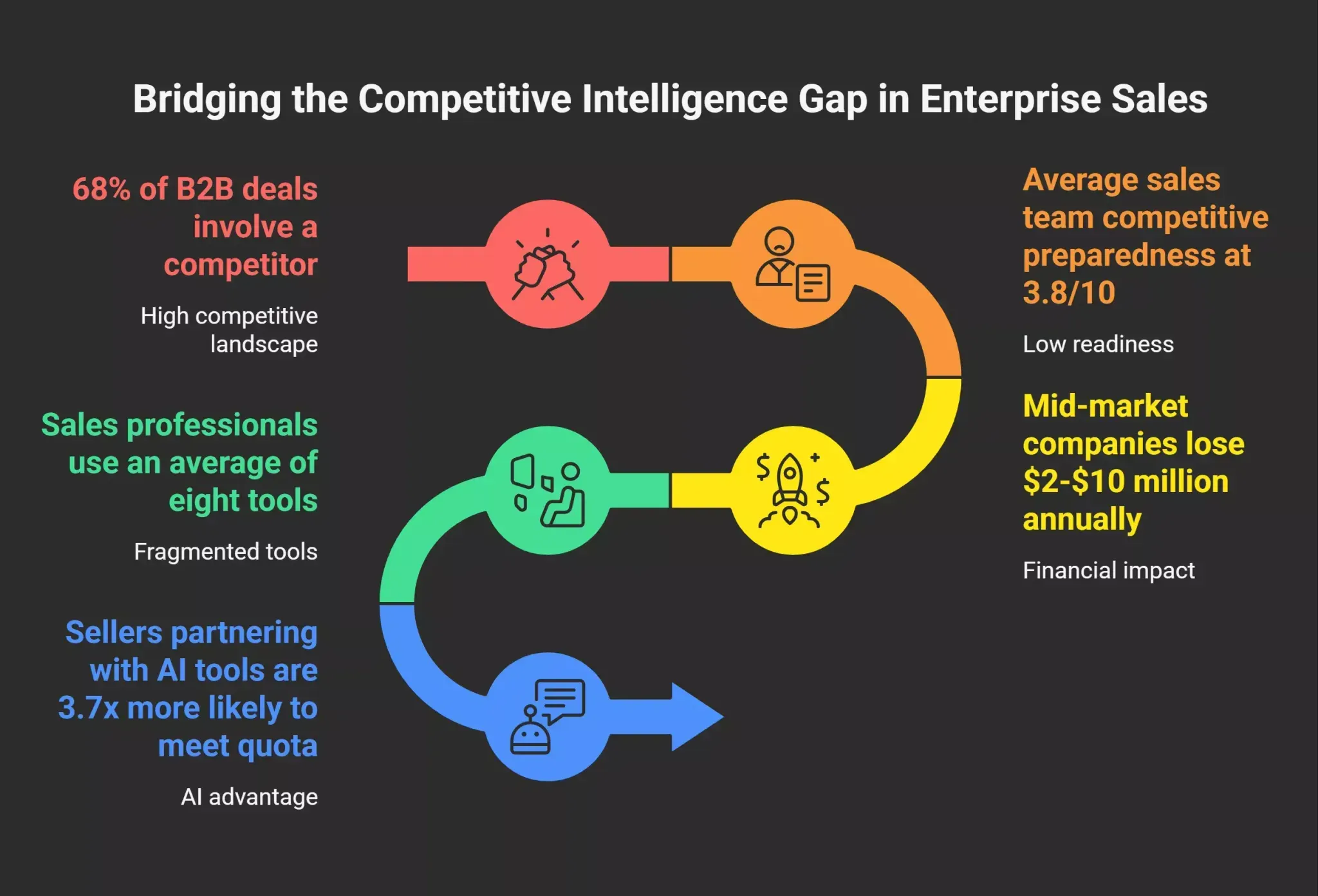
They lose. 68% of B2B deals now involve at least one direct competitor, yet the average sales team rates its competitive preparedness at just 3.8 out of 10, according to Crayon's 2025 State of Competitive Intelligence report. That gap between rival frequency and rep readiness costs mid-market companies $2 to $10 million per year in winnable deals.
-
Most teams walk into competitive deals relying on outdated battlecards and gut feelings
-
Reps spend hours doing manual research across disconnected browser tabs instead of preparing their pitch
-
The data they find is often weeks or months old by the time they use it
-
Buyers, meanwhile, show up to discovery calls armed with comparison reports from G2, analysts, and peer conversations
Is it true that prospecting is usually the first step in the sales process?
In most playbooks, yes. But prospecting without a competitive context is like fishing without knowing what is already in the water. Reps who cannot articulate clear differentiation at that first touchpoint lose momentum fast.
The Eight-Tool Trap
Sales professionals today use an average of eight tools to wrap up deals. That means CI sits in one tab, customer data lives in the CRM, cost details live on a spreadsheet someone shared last quarter, and the latest competitor moves are buried in a Slack thread nobody bookmarked.
-
Eight tools mean eight places where context gets lost
-
No single system connects what a competitor did with what the rep should say about it
-
Sales engineers spend time re-collecting information that other departments have already gathered
This fragmented setup creates a gap between what sellers know and what buyers expect them to know. When a prospect asks about a rival's new feature launch and the rep stammers, the deal starts leaning the other way.
Why Deals Get Lost on Preparation, Not Product
Sales teams lose deals not because their product is worse, but because they showed up less prepared than the rival's people. Info-Tech Research Group published a 2026 blueprint confirming that fragmented ownership, outdated insights, and weak alignment between CI functions and selling organizations directly limit win rates.
-
The rep who knows the rival's latest cost changes can address objections before they surface
-
The rep who does not know is left reacting, guessing, and stalling
-
Decision makers can spot the difference within minutes of a call
-
Deals with multiple stakeholders take longer, because each stakeholder has different priorities and pain points
The Preparation Gap in Numbers: Sellers who partner with AI tools are 3.7x more likely to meet quota than those who do not, according to Gartner. That is the difference between a group that hits 40% of quota and one that hits 148%.
How CI Reshapes the Enterprise Deal
AI-driven call analysis automates the process of reviewing conversations, catching key moments, problem areas, and growth opportunities that sellers simply cannot track in real time.
Competitive intelligence, when it works, turns scattered market signals into something a rep can act on before the call starts. The problem is that most teams treat competitive analysis as a quarterly project instead of a live feed. Quarterly reports are stale by the time they reach the floor.
-
A working CI system monitors rival websites and hiring patterns continuously
-
The tool automatically maps planned features against existing market offerings to identify valuation gaps.
-
It connects insights from feedback platforms, open roles, and social media into a single view
-
The platform connects directly with live data sources to monitor shifting pricing models and product changes.
-
It delivers that view where reps already work, not in a separate tool they have to remember to check
The real value shows up when CI shifts from a lagging indicator (telling you what happened last quarter) to a leading indicator (telling you what is about to happen next quarter).
Want to see how dedicated CI software compares to platform-native intelligence?
This breakdown of competitive intelligence software and product strategy covers the tradeoffs in detail.
Tracking Competitor Shifts Before They Go Public
Rival moves rarely appear out of nowhere. Before a rival launches a new product line, they hire for it. Before they adjust pricing, they test new pricing page layouts. Before they enter a new market, their open positions shift to include industry-specific terms.
-
Hiring patterns reveal strategic direction months before a press release
-
Cost page changes signal repositioning that affects every competitive deal in the pipeline
-
Product roadmap shifts show up in feature documentation and changelog updates
-
Customer comments on feedback forums expose pain points that a prepared rep can address directly
Big companies generate dozens of signals every month. Without an automated system catching them, most groups miss the signals entirely and react only after a prospect brings up the rival's new move during a conversation.
From Scattered Signals to a Structured Brief for Every Call
The difference between a prepared organization and an unprepared one comes down to whether they have a pre-call brief before the conversation starts. That brief pulls together competitor positioning, recent pricing changes, customer comments from review sites, and any market changes relevant to that exact prospect.
-
Reps using AI-generated pre-call layouts cover exact rival positioning, stakeholder analysis, and recommended messaging
-
Sales engineers get the same context for the call, so technical questions match the strategic pitch
-
The brief updates as competitor shifts happen, so it is never stale
-
Context builds continuously over time rather than resetting each quarter with one-off reports
Sales conversations improve when every person on the selling side has the same competitive picture. Sales calls where the rep and the engineer contradict each other on rival cost figures destroy credibility with decision makers.
AI-Powered Preparation: Replacing Manual Research With Live Signals
Sales professionals using AI daily are twice as likely to exceed their targets, according to LinkedIn's 2025 findings. That correlation is not about AI doing the selling. It is about AI removing the hours of manual research that keep sellers from doing the actual selling.
-
AI-powered CI tracks rival website changes, hiring signals, cost shifts, and new product features around the clock
-
Sales reps typically save one to five hours per week through AI automation of CRM entry, meeting notes, and rival tracking
-
Using AI for pre-call research lets reps spend time with the right prospects instead of running the wrong Google searches
Gartner projects that by 2027, 95% of seller research workflows will begin with AI. Companies that still rely on manual research and shared spreadsheets are falling behind at a rate that compounds every quarter.
What AI-Powered Monitoring Actually Tracks
AI tools for CI do not just search the web once. They watch continuously and filter noise so sellers only see what matters.
-
Pricing page changes across rival websites
-
New landing pages and repositioned messaging
-
Job postings that reveal role changes and strategic direction
-
Product features added or removed from competitor documentation
-
Customer comments on feedback platforms and app stores
-
Social media activity and press releases
Speed matters: Organizations that receive updates within 90 minutes of a major shift prevent competitive blindsides. The older your information, the weaker your position in every large deal.
When these signals compile into a single strategic view, companies can recognize patterns early. A rival hiring three solutions engineers with healthcare experience, changing their cost page to emphasize compliance, and posting healthcare case studies on their landing pages paints a clear picture: they are entering the healthcare vertical. A prepared seller adjusts their pitch before the rival's announcement.
Sales Engineers and Reps: Sharing the Same Competitive Picture
In large deals, sales engineers often join sales calls to handle technical objections and run the product demo. When the engineer has different rivals' information than the rep, the prospect notices.
-
Sales engineers need technical competitor positioning, not just high-level talking points
-
Reps need the business context and cost intelligence
-
Both sales reps and engineers need to reference the same rival actions when talking to the same prospect
-
AI-driven call analysis catches moments, problem areas, and growth opportunities that manual note-taking misses
When enterprise reps bring in a sales engineer to deliver a demo or tackle technical questions, win rates jump by up to 30%, according to Gong's analysis. But that boost only happens when both people on the call share the same background for the call.
What Prepared vs Unprepared Sales Calls Look Like
The gap between organizations that have CI and those that do not shows up in measurable outcomes across the sales cycle.
| Factor | Unprepared Organization | Prepared Organization |
|---|---|---|
| Rival knowledge at first call | Generic or outdated | Specific and current |
| Response to cost objections | Reactive, caught off guard | Proactive with market intelligence on pricing shifts |
| Stakeholder engagement | Single-threaded, misses blockers | Maps key buyers, influencers, blockers |
| Deal velocity | Slower, more back-and-forth | Faster, fewer stalled stages |
| Win rates | 16 to 25% range | 40%+ with AI-powered prep |
| Cycle length | Extended by repeated discovery | Shortened by arriving with a business context |
The First Meeting Advantage in a Competitive Deal
Buyers evaluate more vendors simultaneously than they did two years ago. They show up to discovery calls with comparison reports already in hand. A rep who does not know the rival's current cost structures or recently launched offerings loses momentum in the first meeting, and recovering from a weak first impression is expensive.
-
Stakeholder mapping identifies key buyers, influencers, and blockers inside a target account before the first call
-
Knowing a rival's recent moves lets the rep position against them without being asked
-
Market research done before the call means the conversation focuses on the prospect's pain points, not on the rep catching up
See how sales teams using Rocket.new win more competitive deals with pre-call intelligence already in hand.
How Deal Velocity Improves When Organizations Skip the Guesswork
Velocity measures how fast deals move through the pipeline. Every hour a rep spends on manual research is an hour not spent moving a deal forward. Every time a rep has to circle back to gather rival information mid-deal, the sales cycle gets longer.
-
Sales efficiency improves when CI runs in the background instead of requiring dedicated research sessions
-
Close deals faster when reps walk in with rival positioning already mapped
-
Sales conversations shift from discovery (figuring out what the rival is doing) to differentiation (explaining why your solution fits better)
What Sellers Are Saying
"The most sophisticated revenue organizations are building 'management intelligence layers,' always-on AI systems that provide rep-by-rep insights and proactive alerts when deals go off track. When coaching becomes your number one activity as a CRO, AI becomes your force multiplier." - Kyle Norton, CRO of Owner, at SaaStr AI Summit 2025
Norton's point matches what companies are seeing: the organizations investing in always-on systems are pulling ahead, while those relying on quarterly quarterly CI reports are losing ground in every competitive deal.
How Rocket.new Handles Competitive Intelligence for Enterprise Sales Teams
Rocket.new is the world's first Vibe Solutioning platform, where competitive intelligence, research, and product building live in one connected system. For sellers, that means CI runs natively inside the same workspace where strategy gets built and products get shipped. No disconnected browser tabs. No spreadsheets. No stale quarterly reports.
Rocket Intelligence monitors every public platform your competitors operate on, continuously. Website changes, hiring patterns, pricing page updates, product announcements, social media activity, press releases, and review platform ratings all flow into daily or weekly briefs delivered where sellers already work.
When a rival changes their pricing structure, shifts their messaging, or launches something new, Rocket interprets the signal, connects it to your business context, and tells you what it means.
For sales teams, Rocket.new delivers:
-
Vibe Solutioning platform: Research the market, decide what to build, ship it, and watch what your competition does, all in one system with shared context that builds across every task
-
Solve, Build, and Intelligence in one place: Solve answers business questions with structured research. Build generates production-ready apps. Intelligence watches competitors around the clock
-
Collaboration built in: Reps, sales engineers, product, and marketing all work from the same competitive context, so rival data stays consistent across every call
-
Flutter mobile and Next.js web: Build for any platform from the same workspace
-
Free templates by use case and category: Start from a template that fits your use case and customize from there
-
Context that carries forward: Add your research once, and it flows into every task that follows. Nothing re-explained, nothing lost between sessions or team members
Pre-Call Competitive Preparation With Rocket.new
Rocket.new's Intelligence product tracks competitor pricing changes, product roadmap signals, and industry shifts, then delivers synthesized daily briefs. Those briefs tell reps exactly what shifted and what it means for the next enterprise deal.
The engine covers every public surface your competitors operate on and compiles multiple signals into a single strategic view, helping teams detect competitor strategic shifts in real time, often weeks before they go public.
Use cases connecting competitive intelligence to Rocket.new:
-
Pre-call competitive prep: Generate a pre-call brief covering rival positioning, stakeholder analysis, and recommended messaging for a specific customer before every sales call
-
Pricing page monitoring: Get alerts when a competitor updates their rates, so strategy shifts before the next large deal conversation
-
Competitor hiring pattern analysis: Track open roles and role patterns to predict competitor moves and brief reps before prospects ask about them
-
Continuous deal support: Receive daily or weekly briefs summarizing rival actions so sellers adjust their pitch before a prospect raises a concern
How Rocket.new Intelligence Differs From Standalone CI Tools
Most standalone CI tools, like Crayon or Klue, do the monitoring job well. What they cannot do is connect that intelligence to the research brief your strategist ran this week, the landing page your marketing team updated yesterday, or the product your engineers are building right now.
Rocket.new's competitive intelligence lives in the same project as all of that. The signal from Monday's brief is present when a product manager opens a research task on Wednesday. The pricing move from last week is present when marketing writes the follow-up email. Intelligence compounds. It does not reset between sessions, team members, or tasks.
Learn more about how Rocket.new builds competitive deal briefs for enterprise sales teams.
Start free at Rocket.new.
Walking Into Every Enterprise Deal With Full Context
Why do sales teams using Rocket.new walk into enterprise deals already armed with competitive intelligence before the call starts?
Because Rocket's CI engine watches every competitor signal continuously and delivers it where sellers already work. The organization that knows what a rival changed yesterday holds a structural advantage over the one still using last quarter's battle card.
Using AI to automate competitive intelligence means reps spend time selling, not researching. Enterprise deals are won by the groups that show up prepared, and preparation in 2026 means live, continuous intelligence, not a one-time research sprint the night before the call.
Table of contents
- -The Problem With Flying Blind Into Enterprise Deals
- -The Eight-Tool Trap
- -Why Deals Get Lost on Preparation, Not Product
- -How CI Reshapes the Enterprise Deal
- -Tracking Competitor Shifts Before They Go Public
- -From Scattered Signals to a Structured Brief for Every Call
- -AI-Powered Preparation: Replacing Manual Research With Live Signals
- -What AI-Powered Monitoring Actually Tracks
- -Sales Engineers and Reps: Sharing the Same Competitive Picture
- -What Prepared vs Unprepared Sales Calls Look Like
- -The First Meeting Advantage in a Competitive Deal
- -How Deal Velocity Improves When Organizations Skip the Guesswork
- -What Sellers Are Saying
- -How Rocket.new Handles Competitive Intelligence for Enterprise Sales Teams
- -Pre-Call Competitive Preparation With Rocket.new
- -How Rocket.new Intelligence Differs From Standalone CI Tools
- -Walking Into Every Enterprise Deal With Full Context