
Traditional landing page builders take 3–7 days and rely heavily on templates and manual setup. Rocket.new replaces this with AI that generates complete, production-ready pages in about 30 minutes.It also bundles copy, backend, and analytics into one system for faster, cleaner launches.
Do Landing Page Builders Actually Save You Time?
If you've used traditional builders to ship landing pages, you already know the answer is "not really." A medium-complexity landing page typically takes 3 to 7 days from concept to publish, according to Linear Design. That's days of fighting templates, tweaking edits, connecting separate tools, and waiting for approvals - for a page where, on average, only 6.6% of visitors will take action, per Unbounce's Q4 2024 data.
Rocket.new is changing that. With the right AI approach, you can go from idea to live landing page in 30 minutes. Not a half-baked page - a production-ready one with good copy, a solid structure, and backend support built right in.
The Real Problem with Landing Page Builders
Traditional landing page builders were good enough for 2015. In 2025, they're showing their age.
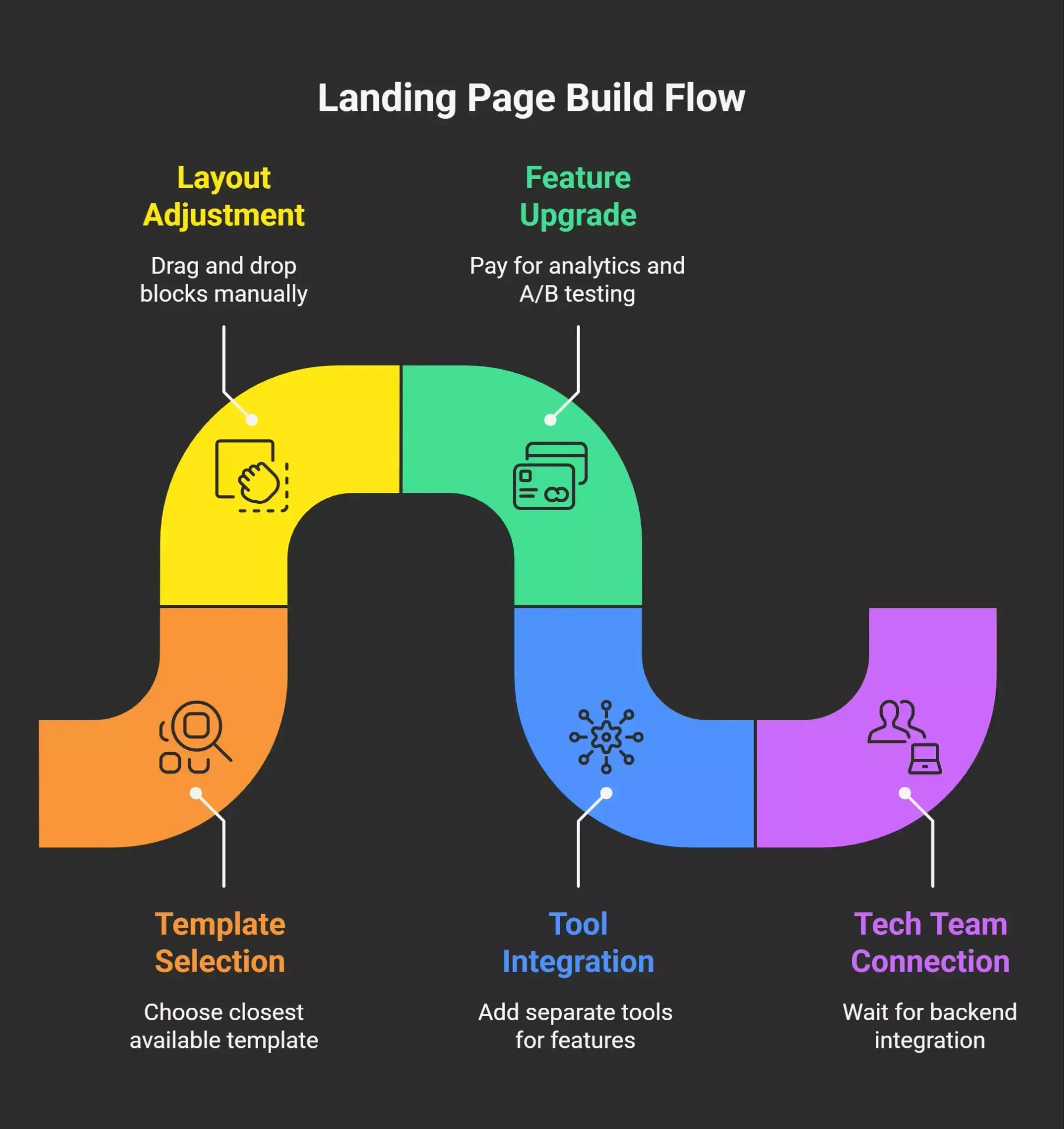
The core issue is friction. These builders ask users to manage too many moving parts by hand. Here's what a typical build looks like:
-
You open the builder, scroll through hundreds of landing page templates, and pick the one that looks closest to what you need
-
You spend a good chunk of time dragging blocks around, trying to get the layout to match your brand
-
You hit a wall with the free plan when you want good analytics or A/B testing - that's always a paid upgrade
-
You add separate tools for email capture, tracking, and any backend work
-
You wait for the tech team to connect everything
-
Three or four days later, the page is still not live
That's not a one-off bad experience. That's the standard workflow most builders create for their users. And it's not a good use of anyone's time.
The good news is the market is already moving on. The global landing page builders market is valued at $715.5 million in 2025 and is projected to hit $2.72 billion by 2035, according to Future Market Insights. The growth is not coming from more drag-and-drop tools; it's coming from AI tools that handle the manual work for you.
What Good Landing Pages Actually Need
Before picking any tool, it helps to understand what landing pages are supposed to do and what they need to do it well.
Good landing pages are focused, not fancy. Every element on a good page exists to move visitors one step closer to a single action. Here are the building blocks:
| Page Element | Why It Matters |
|---|---|
| Clear headline | Tells visitors what the page is about right away |
| Strong call to action | Gives visitors one clear action to take |
| Trust badges and social proof | Builds trust with new visitors fast |
| Email capture form | Let's you stay in touch with visitors who leave without converting |
| Fast load speed | Slow pages lose visitors before they read a word of your copy |
| Analytics and tracking | Shows you how visitors behave so you can make smart edits |
| Mobile-friendly layout | Most visitors arrive on mobile, not desktop |
These are the good-to-have basics. The tech stack behind them should make all of this easy to set up, not spread it across five different platforms.
How AI Tools Are Flipping the Build Process
AI tools for building landing pages work differently from template-based builders. Instead of starting with a library of landing page templates and arranging blocks by hand, you describe what you want in plain language. The AI handles the layout, the copy, the code, and, in good platforms, the backend too.
For people building landing pages under real-time pressure, founders testing ideas, marketers shipping new campaigns, small tech teams doing everything at once, this is a meaningful change in how the work gets done.
Here is how the two approaches compare:
The difference is not just speed. With AI tools, you get a page built around your specific product and users - not a good-looking generic template stretched to fit a dozen different industries.
What the Community Is Saying
Real builders are already making the switch. Issam Marzaq shared his hands-on experience on LinkedIn:
"There are many no-code software platforms like Lovable.dev and Bolt that help you build demo apps, landing pages, or test new offers quickly. But the most powerful one, in my opinion, is Rocket.new. It helped me build multiple pages all at once, including a landing page, business analytics dashboard, customer registration and login, service booking form, order tracking dashboard, and more." - View the full post on LinkedIn
That's not just one landing page. That's a full product build - pages, backend, and tracking - done in the kind of time traditional builders would spend on the first round of edits.
Launch Like a Rocket: How Rocket.new Kills the Old Builder Model
Rocket.new is not a landing page builder in the traditional sense. It is the world's first Vibe Solutioning platform, a single system that covers research, building, and tracking in one place. Over 1.5 million people in 180 countries have used it, and the approach is a good step ahead of anything legacy builders offer.
Here is what sets Rocket.new apart from the standard builder stack:
From Prompt to Production-Ready Landing Pages
You describe your product, your audience, and what action you want visitors to take. Rocket.new generates production-ready code with its Build feature, writes copy, creates a layout, and sets up the page structure - all from that one input. No templates to browse. No blocks to drag. Just a good, live landing page, fast.
Real Code - Not Bloated Builder Output
Rocket.new generates clean, production-ready code instead of the heavy visual output most drag-and-drop builders produce. That matters for load speed, SEO performance, and the ability to make edits later without rebuilding pages from scratch.
Built-in Analytics and Tracking
Traditional builders treat analytics as a paid add-on. Rocket.new includes tracking as part of the build. You can watch how visitors move through your landing pages, see where people drop off, and make quick edits based on real data - without connecting a separate analytics product or copying over tracking scripts.
Backend Support Alongside the Page
Email capture forms, booking flows, user sign-up pages, Rocket.new builds these alongside the landing page itself. No separate backend tool. No stacking up different platforms and hoping they connect. The tech is all built together, which means users get a good experience from the first click.
Competitive Intelligence, Not Just Page Views
Most tools only show you how your own pages are doing. Rocket.new also tracks what competitors are doing in your space and surfaces ideas that help you create landing pages that speak to real gaps in the market - not just the usual call to action formula that every builder template defaults to.
One System for the Whole Stack
Good landing pages don't exist in isolation. They connect to email tools, backend systems, and product tracking. Most teams building landing pages with traditional builders end up with four or five products running alongside each other. Rocket.new replaces that whole stack with one system that carries context from the research stage all the way through to tracking how visitors behave post-launch.
Time to Stop Waiting and Start Shipping
Traditional landing page builders created a slow, fragmented workflow - and teams accepted it because there was no good alternative. Now there is.
If you want to ship a landing page builder's killer page on Rocket.new in 30 minutes, the workflow is simple: describe your product, let the AI build it, tweak what needs tweaking, and go live. Good copy, a clean layout, backend ready, and tracking in place, all in one session. No tech team waiting. No stack of separate tools to connect.
The old approach of picking templates, dragging blocks, and waiting days for a page to go live had a good run. For teams that need to move fast, it's not the answer.
Build and launch your landing page in 30 minutes with Rocket.new today.
Table of contents
- -The Real Problem with Landing Page Builders
- -What Good Landing Pages Actually Need
- -How AI Tools Are Flipping the Build Process
- -What the Community Is Saying
- -Launch Like a Rocket: How Rocket.new Kills the Old Builder Model
- -From Prompt to Production-Ready Landing Pages
- -Real Code - Not Bloated Builder Output
- -Built-in Analytics and Tracking
- -Backend Support Alongside the Page
- -Competitive Intelligence, Not Just Page Views
- -One System for the Whole Stack
- -Time to Stop Waiting and Start Shipping