
Speed is no longer a competitive advantage when everyone can build AI apps fast. Solve on Rocket.new helps teams design defensibility through data, workflows, and GTM before writing code. Products built with strategy-first thinking are harder to copy and win in the long term.
From "Any App in 15 Minutes" to Defensible Products
What happens when every team can ship an AI app in a weekend?
Speed stops being a moat. McKinsey's 2025 State of AI report found that nearly 9 out of 10 organizations now use artificial intelligence in at least one business function. Over 70% of companies use AI in their workflows, leading to improved time to market and better product quality. Your rivals have the same AI tools you do.
- Teams create full apps in under 15 minutes using AI-powered platforms
- Copycats appeared within weeks at lower pricing
- Speed alone does not protect you when everyone has the same AI tools
Solve on Rocket.new exists as an upstream step before building: a structured AI-assisted development layer that turns raw ideas into defensible product strategies. It helps users understand where innovation fits and where to write code that compounds over time.
What is Solve, Exactly?
Solve is the platform's AI-powered solutioning workspace. It lets founders and teams deconstruct an idea into users, problems, edge cases, architecture, and GTM before any code is generated. Solve maps market dimensions to identify specific competitive gaps, facilitating unique value propositions that are difficult to replicate.
- Manages the full product development lifecycle from ideation to deployment
- Provides oversight and control over every stage of app creation
- Acts as the strategic layer between concept and the build process
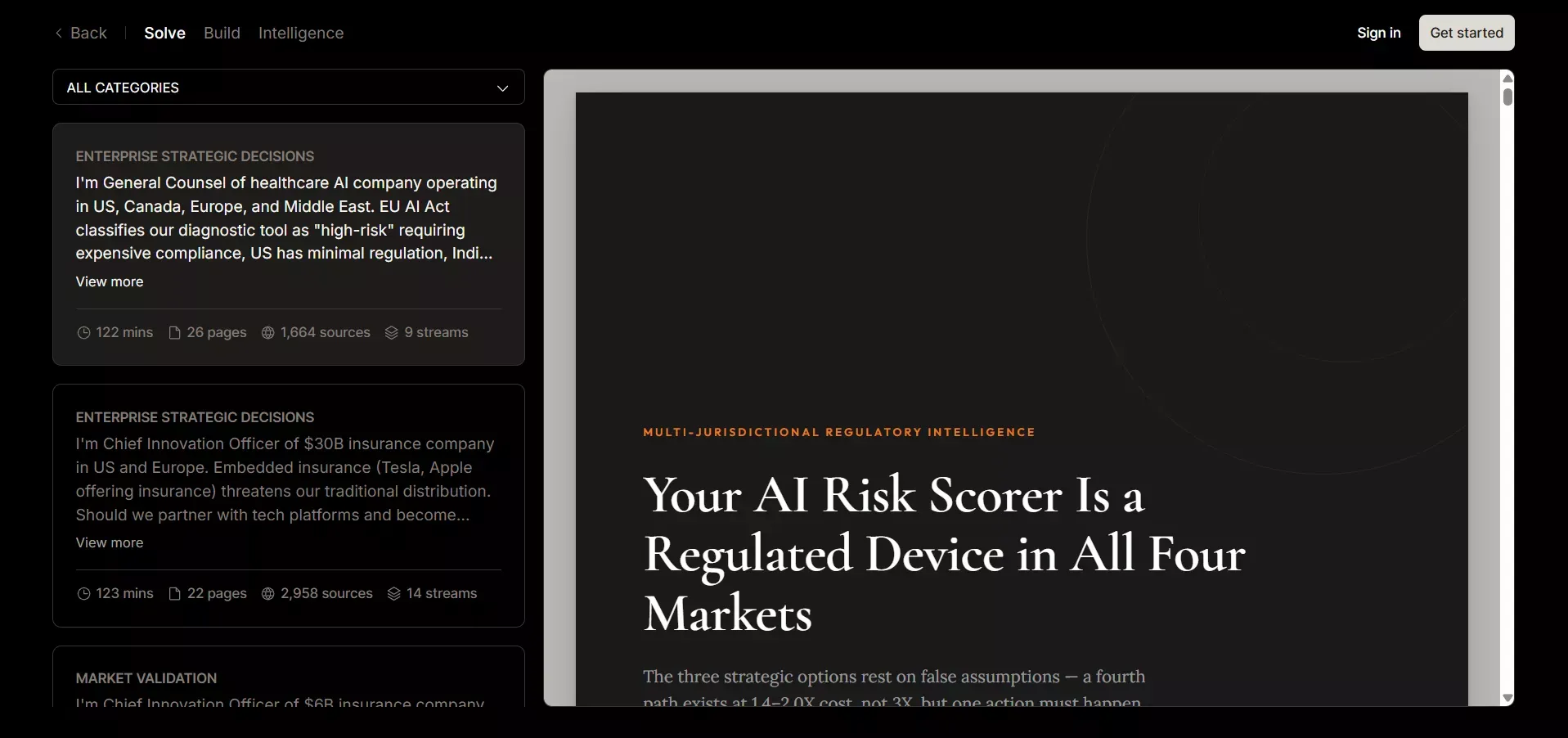
You drop in a natural language problem or a Figma concept. Solve runs multi-step reasoning through personas, jobs-to-be-done, and risks, then outputs a product blueprint.
Vibe-coding platforms interpret project intent rather than rigid instructions. Solve extends this into vibe solutioning, where artificial intelligence handles the heavy lifting from market research to code generation.
| Artifact | What It Covers |
|---|---|
| User flows | Feature hierarchy and interaction paths |
| Data model | Entity relationships and storage design |
| Monetization plan | Business model frameworks and pricing tiers |
| Defensibility map | Levers across data, workflow, and GTM |
| Launch plan | Hypotheses, validation approaches, test criteria |
| Research report | Competitor positioning, SWOT, feature benchmarking |
Vibe-coding platforms aim to democratize app creation by letting users translate ideas into functional products without extensive coding knowledge.
The blueprint connects directly to the prompt-to-app builder, translating into a full-stack build without losing context.
Why Solve First Makes Products More Defensible
Many teams can ship an AI-powered app fast, but few create systems genuinely hard to clone. Using structured research before development validates ideas and confirms that products solve real problems.
And as product velocity increases, go-to-market motions built for a slower cadence can struggle to keep pace, making it critical for teams to intentionally close the gap between product development and GTM strategies from the start.
Solve forces teams to confront questions most builders skip:
- "What can we uniquely know?"
- "What compounding loop can we create?"
- "How will a well-funded rival attack this?"
AI tools handle planning, testing, and ideation, reshaping the product development lifecycle. Solve puts that shift to work by encoding strategic answers into the product blueprint.
Defensibility surfaces along three axes:
- Data: what you learn that others cannot access
- Workflows: how you become embedded in customers' operations
- Go-to-market: how distribution advantage is built in
That third axis, GTM, is where many otherwise strong products fall short. The best positioning for a product often comes from how customers talk about the problems it solves, emphasizing the importance of treating customer voice as an ongoing signal rather than a one-time input during the launch phase.
Successful go-to-market strategies require a strong relationship between Product Managers (PM) and Product Marketing Managers (PMMs), as this connection enhances the precision of market positioning and improves feedback loops.
Research conducted through Solve can reduce development time by up to 90% by identifying the right features to build and preventing rework. The future of software development belongs to teams that write code after validating defensibility, not before.
Designing Data and Insight Moats with Solve
Solve identifies opportunities to capture proprietary data: event streams from high-value user actions, labeled datasets from domain feedback, and fine-tuning signals for AI models.
- Data fields that improve with each user action
- Compliance-checked transactions for fintech or healthcare ops
For fintech or healthcare ops, Solve proposes logging compliance-checked transactions or patient benchmarks. It generates database tables for signals that cannot be replicated without equivalent usage history.
Even if a rival clones the UI, they cannot replicate years of accumulated signals. You can fine tune your AI models on data that fast; followers simply do not have. The future of these projects depends on the depth of data, not surface-level innovation.
Embedding in Workflows So You Cannot Be Swapped Out
Solve maps critical-path workflows inside a customer's day:
- Payments and invoicing systems
- Approvals and compliance checks
- Communication loops and notifications
Rather than building another swappable dashboard, Solve encourages designs where the app becomes the system-of-record. It generates alternative user journeys and friction points, helping teams decide where to integrate deeply.
One example: internal tooling that automates financial close evolved into external SaaS owning approval chains.
This is where organizational change management becomes embedded in your product. When customers restructure processes around your workflow, switching costs compound. Companies that manage this transition gain performance advantages competitors cannot match. The future of these infrastructure projects lies in the depth of integration.
Baking Go-to-Market and Distribution into the Product
Solve asks how each feature can support acquisition, activation, and retention:
- Auto-generated client reports carrying your brand
- Stakeholder dashboards that encourage multi-seat invites
- API keys make your app a dependency in a broader business ecosystem
- Pricing tiers designed around usage patterns that support retention
As product velocity increases, GTM motions built for a slower cadence struggle. Solve helps teams close the gap between development speed and go-to-market strategy. Treat customer voice as an ongoing signal, not a one-time input during launch.
Teams bake distribution into UX instead of treating GTM as a separate track. Clones face a distribution disadvantage because you have already captured customers through product-led growth. The revenue impact shows within months.
How Solve Translates into Better Builds
A common failure with strategy tools is decoupling: strategy lives in slides, builders never see it. Solve works differently because it is wired into the AI app builder, functioning as one platform for thinking and building.
- Generated schemas reflecting data moat plans
- Role-based access controls for workflow defensibility
- UI flows are shaped around GTM moments
- Automated deployment configurations for launch
- Code scaffolding matching the defensibility blueprint
The platform eliminates handoff friction by making research decisions accessible at the build stage. Code quality and feature development stay aligned with the original strategy.
Solve outputs entity diagrams, permission models, and integration requirements. The builder transforms these into backend code, database schema, and API layers.
- Separate tables for proprietary scoring signals
- Human feedback logs for AI model improvement
- Permission models tied to user segments
- Integration endpoints for third-party systems
Architecture-level decisions create a competitive advantage that makes copycat products harder to build. Customers benefit from architecture designed for defensibility.
Solve also acts as a shared artifact for founders, PMs, designers, and developers. This prevents feature drift where defensibility features get silently cut.
- Founders run a Solve session, share outputs with the team the same day
- Developers focus on defensibility-first features flagged in the blueprint
- Distributed teams and agencies manage projects and maintain product quality across clients
Real-World Patterns: How Teams Use Solve Before Building
Companies leveraging AI-driven development gain an edge by enabling faster updates and better decision-making through predictive insights.
- Early-stage founders test moats before committing
- Product teams harden internal tools into defensible SaaS
- Agencies deliver client apps with built-in strategy
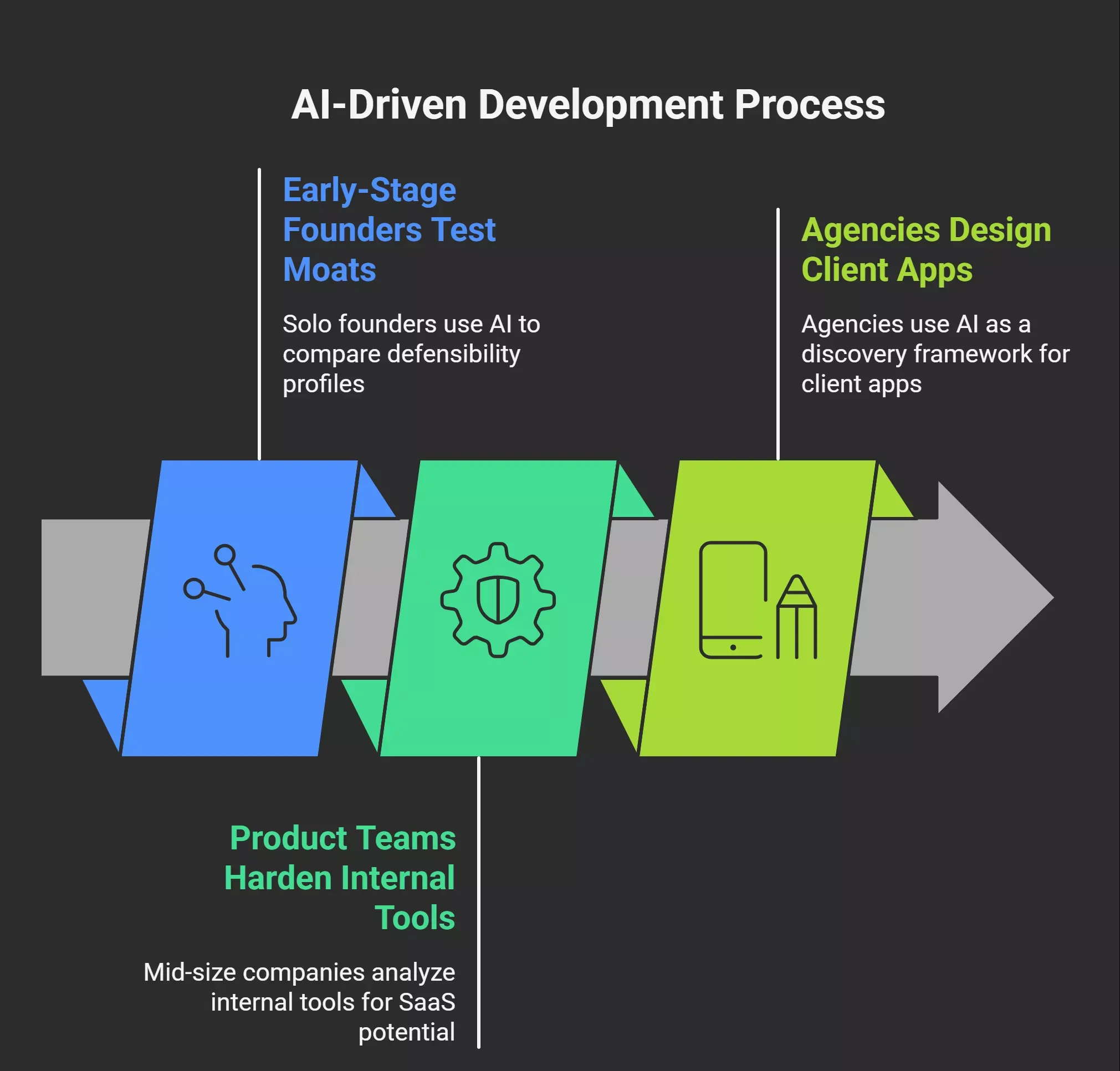
Early-Stage Founders Testing Moats Before Writing Code
Solo non-technical founders use Solve to run multiple variations across customer segments before committing to a build.
- Compare defensibility profiles: generic AI note-taker versus verticalized AI case-management for legal or healthcare
- Test which variant has the strongest long-term moat before writing code
- Save months by not iterating on weaker business ideas
Solving allows teams to validate ideas without writing code, shifting to a data-driven approach early. Small startups with limited resources benefit the most. AI tools at this stage help users create better apps from the start. Innovation in software development comes from understanding users before committing resources.
Product Teams Hardening Internal Tools into Defensible Products
Mid-size companies start with internal tools, then realize certain workflows could become external SaaS.
- Rerun systems through Solve to analyze unique data and compliance knowledge
- Identify which features create genuine switching costs
- Plan the transition from internal tool to paid product
Detailed market analysis through Solve involves evidence-backed insights scored by confidence levels, supporting better decision-making in product strategy.
Companies that control proprietary data create solutions competitors cannot replicate. Innovation in software development projects starts with understanding users and customers before writing a single line of code.
Agencies Designing Client Apps at Scale
Agencies building many apps use Solve as a repeatable discovery framework.
- "Solve-backed build packages" where clients know their app launches with a moat
- Junior team members can run tests and quality discovery sessions
- Solve scales defensible thinking beyond a single strategist
Projects ship faster because the infrastructure and strategy process is structured.
What the Community is Saying
Builders who use the platform for AI-driven app creation share their experiences.
"Rocket.new is proof that building without limits is possible. From a single prompt to a full-stack live app, it's time to build faster, smarter, and bigger." - Source: Hamza Khalid on LinkedIn
- The speed of going from idea to live app is no longer the bottleneck
- The bottleneck is knowing what to build
- Solve addresses that gap by front-loading strategic thinking
In competitive markets, the speed of iteration provides a competitive advantage only when paired with the right strategy. That support structure is what Solve adds. Brand reputation follows product quality, and both start with defensibility.
Practical Guide: Running Your First Solve Session
Ready to try it?
Focus on framing the problem, feeding context into Solve, iterating on moats, and sending the blueprint into the builder.
- Plan for a 60-90 minute session
- Challenge Solve's first output by stress-testing assumptions
- Request more aggressive defensibility strategies on the second pass
Before the Session: Prepare Inputs for Better Solutions
Checklist of inputs to create a strong session:
- 3-5 recent customer conversations or interview notes
- A simple description of the problem in under 200 words
- Existing prototypes, spreadsheets, or tools that the product might replace
- Background for the call to action section you want users to take
Simply describe your problem statement (who, what, why now) and tell Solve you care about defensibility.
During the Session: Stress-Test and Explore Alternate Moats
Treat Solve as a debate partner. The process supports better outcomes when you push back.
- Request at least three defensibility strategies: data moat, workflow lock-in, ecosystem play
- Compare trade-offs for each approach
- Iterate 2-3 times, sharpening user definition, pricing, and edge cases
- Capture reasoning, not just final answers
This reasoning aligns your team later and supports change management as the product evolves.
After the Session: Turn the Blueprint into a Build
Pass structured outputs into the builder: user roles, entities, key flows, and integrations. Annotate which parts are defensibility-critical for development and launch.
- Set up performance metrics to validate assumptions
- Track which workflows customers stick with and where data moats form
- Come back to Solve after launch to re-evaluate moats with real usage data
- Use custom domain setup and deploy configurations for speed
Solve and build a loop, not a one-time handoff. Solve enables continuous monitoring post-launch, tracking competitor price changes or new feature launches.
How the Platform Powers Defensible AI Development
The platform is a vibe-solutioning system that connects AI strategy to code generation. The platform allows users to build applications in under fifteen minutes using a single prompt, showcasing its speed and simplicity in app creation.
Rocket.new automates the entire application stack, including databases, authentication flows, APIs, and cloud hosting, enabling users to deploy products without writing code.
- Vibe-solutioning platform: Interprets the intent behind your project
- **25k+ templates library, free to use**: Covers web apps, mobile apps, dashboards, e-commerce stores
- Saves up to 80% tokens: Spend less on AI processing with more precise output
- Supports Flutter (mobile) and Next.js (web): Create native mobile apps and modern web development features
- Collaboration features built in: Share, Solve blueprints, assign roles, build together
- 3 Products, One Platform: Solve, Build, and Intelligence: Solve handles strategy, Build handles app creation and code generation, and Intelligence handles ongoing monitoring
How teams use it for defensible AI development:
- Founders validating market fit: Run a Solve session to test ideas against market data, then build and deploy the same afternoon
- Product teams creating AI-powered internal tools: Move from prototype to external SaaS with defensibility at every stage
- Agencies delivering premium apps: Offer clients defensibility analysis alongside app creation
- Developers building AI agent workflows: Plan AI model architectures and data pipelines, then generate the code base on the platform
Defensible Products Start with Better Thinking
Why do teams that use Solve on Rocket.new before building ship products that are more defensible in competitive markets? Because they front-load the hard questions about data moats, workflow embedding, and distribution mechanics before a single line of code exists.
- Data moats compound with every user action
- Workflow embedding raises switching costs
- Distribution built into UX outpaces separate GTM tracks
Teams that treat strategy as a speed layer build products that customers rely on, and fast followers cannot easily clone.
Table of contents
- -From "Any App in 15 Minutes" to Defensible Products
- -What is Solve, Exactly?
- -Why Solve First Makes Products More Defensible
- -Designing Data and Insight Moats with Solve
- -Embedding in Workflows So You Cannot Be Swapped Out
- -Baking Go-to-Market and Distribution into the Product
- -How Solve Translates into Better Builds
- -Real-World Patterns: How Teams Use Solve Before Building
- -Early-Stage Founders Testing Moats Before Writing Code
- -Product Teams Hardening Internal Tools into Defensible Products
- -Agencies Designing Client Apps at Scale
- -What the Community is Saying
- -Practical Guide: Running Your First Solve Session
- -Before the Session: Prepare Inputs for Better Solutions
- -During the Session: Stress-Test and Explore Alternate Moats
- -After the Session: Turn the Blueprint into a Build
- -How the Platform Powers Defensible AI Development
- -Defensible Products Start with Better Thinking