
Solve on Rocket.new adapts research depth to the importance of each decision. Low-stakes questions get fast recommendations, while high-stakes strategy receives deep competitive, regulatory, and market analysis. The result is structured, actionable decision intelligence teams can trust.
Quick Answer: Research That Knows What It Is Worth
Solve on Rocket.new reads the stakes of every decision and adjusts its research depth accordingly. Fast for simple questions. Deep for high-stakes strategy.
Always structured and ready to act on. Rocket.new is the world's first Vibe Solutioning platform, and Solve is its thinking engine. According to Accenture, only 12% of companies have advanced enough AI maturity to see it drive meaningful revenue. Solve is built to close that gap right from the first prompt.
What Happens When You Ask an AI to Actually Think?
Most AI tools answer the question you typed. They search, summarize, and hand you a wall of text. That is fine for research. But it is not decision-making.
Decision-making requires understanding what is actually at stake before producing an output. A question like "should we cut our pricing by 30%?" carries a completely different weight than "what font should our landing page use?" Both are questions. Only one could change the entire trajectory of a company.
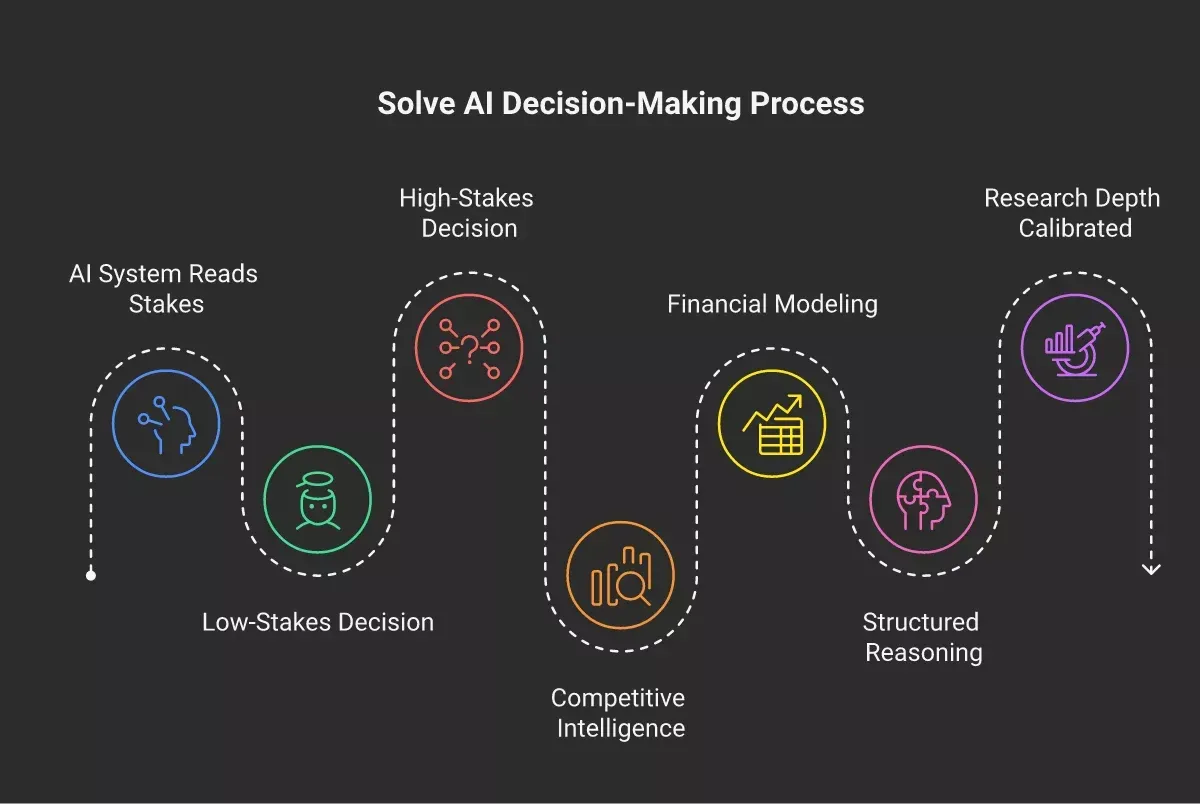
That is exactly what Solve on Rocket.new does. It reads the problem, maps the space, assesses the stakes, and calibrates the depth of its research accordingly. The result is not just information. It is a structured brief with findings, evidence, and a clear recommendation ready to present, act on, or build from.
Rocket.new has been used by 1.5 million people across 180 countries. Solve does not treat every task the same way. It treats every decision the way it deserves. For teams that want to understand what is Solve on Rocket.new, and how it differs from asking AI a question, the distinction starts here.
What is Solve on Rocket.new and How Does It Think?
Solve is the first capability in Rocket.new's three-part platform. It sits before Build (which creates production-grade apps) and Intelligence (which tracks competitive signals in real time). Solve handles the thinking before the build.
When you describe a market problem, an opportunity, or a decision you are trying to make, Solve does not immediately begin pulling data points. It starts by understanding:
- What type of decision this is: strategic, operational, tactical, or exploratory
- Who is affected: individual, team, department, or company-wide
- What context surrounds the problem: market conditions, competitive signals, and regulatory environment
- What the consequences of error look like: reversible, costly, or catastrophic
This structured reading of the problem is what allows Solve to calibrate the depth of its research. A low-stakes idea check requires different tools and a different scope than a Series B raise decision. Solve knows this and adjusts its approach before a single source gets pulled.
Current AI tools handle isolated queries well. But they do not retain the context of your business, your past decisions, or what you are trying to build toward. Solve does. Every output Solve produces becomes part of the shared context that follows you into Build and Intelligence. Nothing needs re-explaining. This is how intelligence from Solve carries directly into the build on Rocket.new.
Why Does Research Depth Matter in AI Decision Making?
Bad decisions rarely come from bad intent. They come from incomplete information or from the wrong amount of research applied at the wrong time. A Deloitte survey of 1,900 executives found that 44% cite making the wrong strategic choice based on AI recommendations as a top-three concern. Current AI systems often apply the same flat research process to every query, regardless of what is actually at stake.
Humans manage this through experience and context. A seasoned team lead handles small tasks quickly and applies deeper reasoning when the pressure is high. Solve was built to bring that kind of calibrated intelligence to teams at every stage of development.
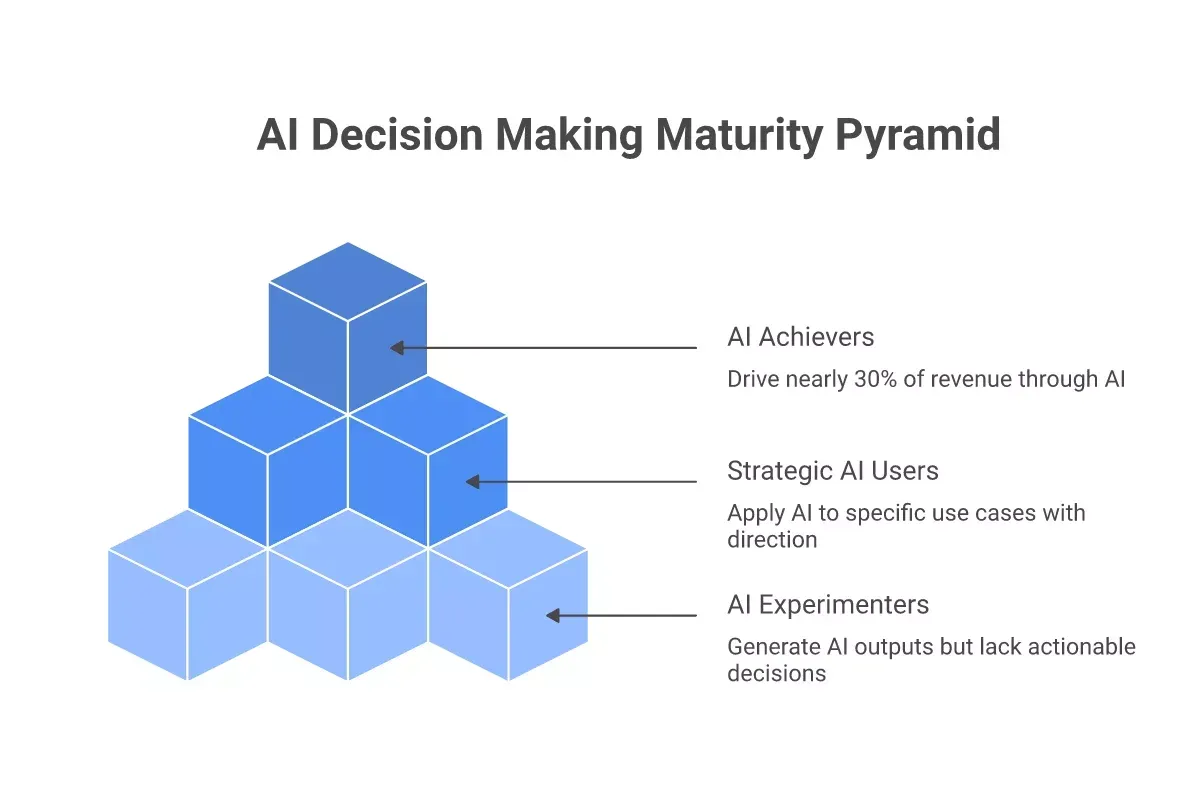
According to Accenture, 63% of companies are AI Experimenters: they have AI tools but lack mature strategies to use them for real problem solving. They generate outputs. They rarely generate confident decisions. Solve is designed to change that equation.
This matters more than people realize. The gap between information and a decision is where most organizations lose time, money, and confidence. Every team, regardless of size or stage, deserves access to research that knows what it is worth. Teams that research on Rocket.new ship better than teams that just prompt.
How Does Rocket.new Decide How Much Research a Decision Needs?
Solve on Rocket.new processes several signals from your input before it begins its research phase. These signals shape not just what sources get analyzed but how many data points get surfaced, how many reasoning layers get applied, and how confident the final recommendation needs to be before it is shown to you.
The Stakes Calibration Framework
| Decision Type | Example Input | Research Depth | Output Format |
|---|---|---|---|
| Exploratory / Low Stakes | What color palette fits a fintech brand? | Surface-level scan | Quick recommendation |
| Tactical / Medium Stakes | Should we launch a referral program this quarter? | Structured multi-source analysis | Brief with pros and cons |
| Strategic / High Stakes | Should we sacrifice model accuracy for regulatory compliance? | Deep market, legal, financial, and competitive analysis | Full decision brief |
| Business-critical | Should I raise at a $50M valuation or wait 6 months? | Maximum depth: competitive intelligence, validation, multi-scenario reasoning | Presentation-ready deliverable |
The system reads your context. If you describe yourself as a VP of Product at an AI recruitment platform serving 2,000 enterprise customers in the US and Europe, Solve registers that this problem involves regulation, scale, and significant financial risk. It does not treat that question the same way it would treat a question from a solo founder testing a new feature idea.
The model also reads the pressure inside the problem. Words like regulatory penalties, investor deadline, board decision, or competitive pressure are all signals that lead Solve to apply more rigorous reasoning and deeper competitive intelligence before producing its output.
Regulatory research is complicated due to varying rules across different countries and constant updates, which can hinder team progress and decision-making. Teams often face challenges in regulatory research management, such as losing track of important updates and making decisions with incomplete information, which can lead to costly errors and delays.
What Happens When the Stakes Are High vs Low?
When the stakes are low, Solve works fast. It pulls the most relevant data points, applies a quick reasoning pass, and gives you a clean, structured recommendation. You get speed without chaos.
When the stakes are high, Solve shifts its entire approach:
- It maps multiple dimensions of the problem, not just the surface question
- It analyzes relevant market signals, competitor behavior, and sector-specific patterns
- It applies structured reasoning to identify gaps, risks, and the strongest path forward
- It produces a deliverable ready to present to a room
One example from Rocket.new's Solve page illustrates this well. A Chief Customer Officer at a $12B cloud infrastructure company serving four regions, each with conflicting compliance requirements, needs to decide between building region-specific architectures, standardizing to the highest common denominator, or tiering by compliance level. That is not a question for a generic AI tool.
It requires multi-angle analysis, competitive intelligence from the infrastructure market, regulatory context for each region, and a clear point of view at the end. Solve handles all of it and returns a structured brief the team can act on immediately.
Compare that to how current AI handles the same question. You describe your problem. The model searches for related articles. It summarizes what it found. You get information, not a decision. You still have to do the reasoning yourself, often under time pressure with a team watching.
Most organizations struggle here because they rely on tools that were not designed for decisions. Solve is designed for decisions, and the distinction is everything. See how Solve on Rocket.new compresses strategy research into one session for a deeper look.
The Solve Process: From Problem to Decision
How Does Solve Approach Competitive Analysis?
Competitive analysis is one of several research categories Solve handles natively. When your question involves a competitor, a pricing shift, a new product launch, or a market positioning question, Solve runs a structured research task, breaking the question into component dimensions, running parallel agent streams, and synthesizing findings into a report with an executive summary, supporting evidence, and recommendations.
- This is distinct from Rocket.new's Intelligence capability, which serves a different purpose. Solve answers a specific question once.
- Intelligence monitors for changes over time, delivering alerts and signals as they happen.
- The two are designed to work together: a Solve competitive teardown can define what you then track with Intelligence, and an Intelligence alert can prompt a new Solve question.
For teams making decisions around pricing, positioning, or product direction, Solve handles these as dedicated research categories, including competitive teardowns, pricing strategy benchmarking, and product direction analysis, pulling from live data and structuring the output for immediate use.
Solving the Real Problem: Why Generic AI Tools Leave Teams Stuck
Here is what actually happens with most AI tools when humans bring them a real problem. The tool is smart. It is fast. It gives you a lot. But it gives you the same thing every time, regardless of whether the decision is worth five minutes or five days.
Teams end up with two bad patterns:
- Under-research on high-stakes decisions: Someone needed a deep competitive analysis and a structured recommendation, got a summary of publicly available articles, made a decision with incomplete information, and paid for it later.
- Over-research on low-stakes decisions: Someone needed a quick answer, the tool returned 2,000 words on adjacent topics, and the team spent more time reading than deciding.
Both patterns create confusion. Both slow teams down. Both lead to error. The fix is not more AI. The fix is smarter calibration.
According to Accenture, only 12% of firms have advanced their AI maturity to the point where AI contributes nearly 30% of their total revenue. The companies that get there are not using more AI. They are using AI that adapts. Solve brings that adaptability to every team that needs it, regardless of size, stage, or technical sophistication.
How Does Rocket.new Solve Work: Step by Step
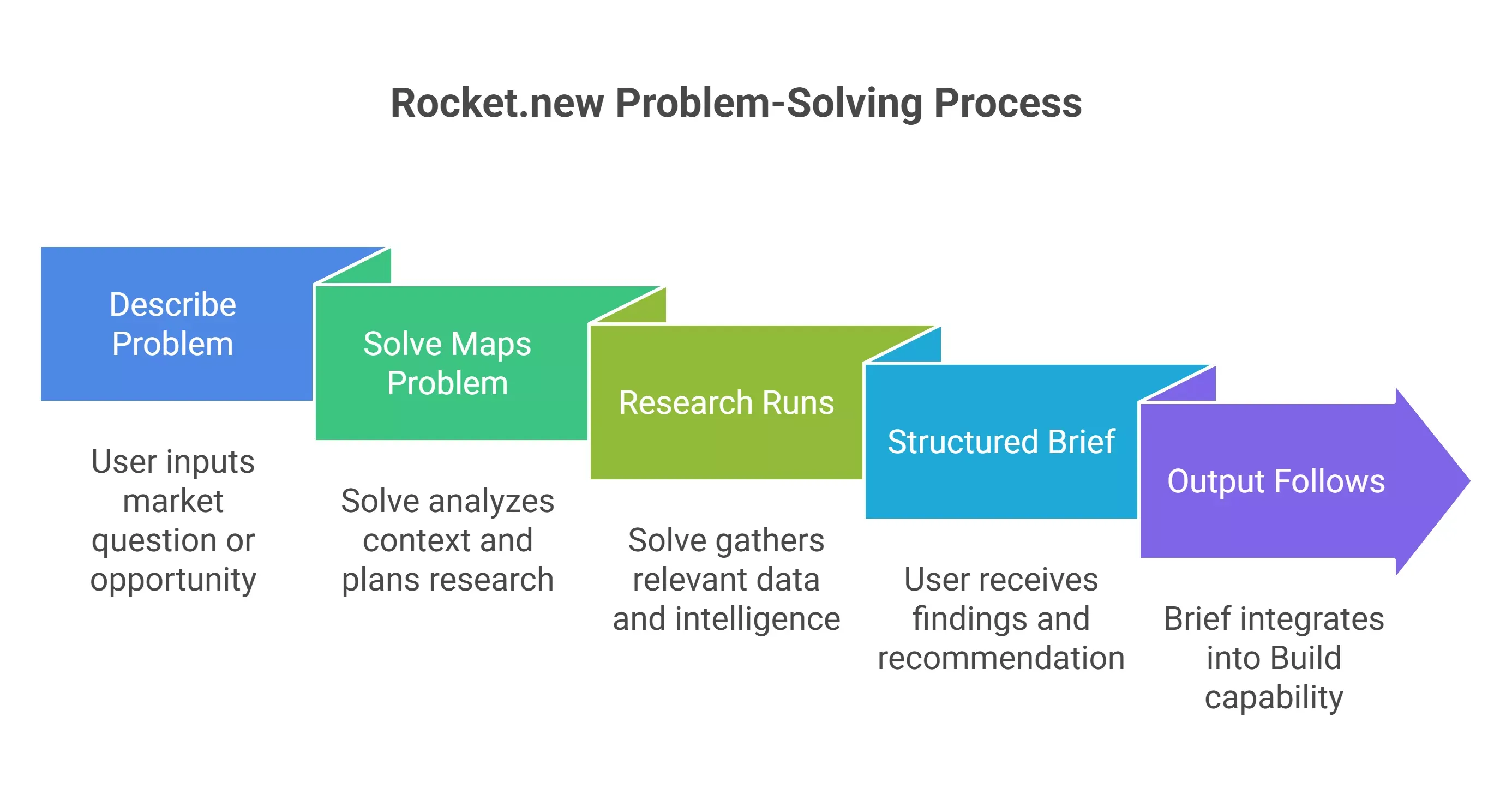
- Describe your problem. Type any market question, decision, or opportunity. Add a document, deck, or link for background context if you have one.
- Solve maps the problem. Before pulling a single source, Solve reads your context, identifies the type and stakes of the decision, and builds its research plan accordingly.
- Research runs at the right depth. Solve pulls relevant data points, competitive intelligence, market signals, regulatory context, and financial implications calibrated to what the decision actually requires.
- You get a structured brief. Findings, evidence, and a clear recommendation. Not a wall of text. A deliverable ready to present, hand to a developer, or act on immediately.
- The output follows you into Build. If you decide to build a product from your decision, the brief travels with you into Rocket.new's Build capability. No re-explaining. No lost context.
Rocket.new's Solve: Features Built for Real Decision Making
Rocket.new is the world's first Vibe Solutioning platform. Solve is the thinking layer that makes the whole system work. Here is what sets it apart.
Context Awareness Before Research Begins
Most AI tools start researching the moment you type. Solve starts by understanding. It maps the dimensions of your problem, including market dynamics, risks, your specific context, and financial implications, before a single source gets pulled. This is what allows it to calibrate depth intelligently.
Output That Is Ready to Act On
A Solve brief is not a summary. It is a structured deliverable with findings, evidence, and a clear recommendation. Export it as a PDF. Present it to a room. Hand it to a developer. It is already done, not a starting point for more work. See how Solve on Rocket.new generates board-ready outputs.
Shared Context Across the Platform
When you solve a problem in Solve, that output does not disappear. It becomes the context for Build and Intelligence. The PRD is present when the developer opens the project. Nothing starts over. No decisions get lost. This is why context is never lost between research and build on Rocket.new.
Competitive Intelligence Baked In
For high-stakes decisions with market dimensions, Solve draws from real competitive intelligence: competitor pricing moves, product launches, positioning shifts, and hiring signals. The analysis reflects what is happening right now, not just what studies said last quarter.
No Technical Barrier to Entry
You describe your problem the way you would explain it to a smart colleague. Solve handles the rest. This makes sophisticated decision support accessible to product leaders, founders, sales teams, and strategy consultants alike.
Comparison: Solve vs. Generic AI Tools
| Capability | ChatGPT / Perplexity | Rocket.new Solve |
|---|---|---|
| Stakes calibration | No: same depth for every query | Yes: adapts to decision type and risk level |
| Context retention | No: each session starts fresh | Yes: shared context across Solve, Build, and Intelligence |
| Deliverable format | Raw text output | Structured brief, PDF export, presentation-ready |
| Competitive intelligence | Limited, static | Integrated with live Intelligence monitoring |
| Decision recommendation | Rarely explicit | Always: findings, evidence, clear point of view |
The Numbers Behind Better Decision Making
The research makes this clear. Bad AI decision support is expensive, and the cost shows up in more ways than one:
- 44% of executives report that making the wrong strategic decision based on AI recommendations is a top-three concern (Deloitte, State of AI in the Enterprise)
- 63% of companies are AI Experimenters: using AI tools without the maturity to produce confident decisions (Accenture AI Maturity Research)
- Only 12% of firms have advanced their AI maturity enough to attribute nearly 30% of their revenue to AI (Accenture)
- 42% of organizations say the return on AI initiatives exceeded their expectations when they got the execution right (Accenture)
The pattern is consistent. The problem is not AI itself. The problem is applying AI with the wrong depth: too shallow for critical decisions and too verbose for simple ones. Solve was designed to fix this at the platform level.
If you are ready to make decisions with the right depth of research behind every one of them, Rocket.new is where to start building. Solve thinks before it answers, so your team can move forward with confidence. Start building on Rocket.new today.
Table of contents
- -What Happens When You Ask an AI to Actually Think?
- -What is Solve on Rocket.new and How Does It Think?
- -Why Does Research Depth Matter in AI Decision Making?
- -How Does Rocket.new Decide How Much Research a Decision Needs?
- -The Stakes Calibration Framework
- -What Happens When the Stakes Are High vs Low?
- -The Solve Process: From Problem to Decision
- -How Does Solve Approach Competitive Analysis?
- -Solving the Real Problem: Why Generic AI Tools Leave Teams Stuck
- -How Does Rocket.new Solve Work: Step by Step
- -Rocket.new's Solve: Features Built for Real Decision Making
- -Context Awareness Before Research Begins
- -Output That Is Ready to Act On
- -Shared Context Across the Platform
- -Competitive Intelligence Baked In
- -No Technical Barrier to Entry
- -Comparison: Solve vs. Generic AI Tools
- -The Numbers Behind Better Decision Making