Rocket.new reads G2 reviews across a competitor's full profile, segments negative feedback by company size and role, and turns customer complaints into competitive intelligence your team can act on. This is how competitive analysis works when it runs continuously.
Why Are Your Competitors Losing Customers, and How Would You Know?
What if the answer to your next product strategy is already sitting inside a G2 review, written by a frustrated customer who just left a competitor?
It probably is. According to Crayon's 2025 State of Competitive Intelligence report, sales teams with strong competitive intelligence see 108% more revenue impact, yet the average rep rates their own competitive preparedness at just 3.8 out of 10. That gap is where deals go to die.
Rocket.new closes it by reading G2 reviews across competitors' full profiles, analyzing the words customers use, and pulling out the soft spots that matter for your positioning, your features plan, and your market strategy. The result: you create an advantage before competitors even know they have a problem.
What Competitor Analysis and Competitive Intelligence Mean in 2026
The Difference Between Watching Competitors and Running a Strategy
Competitor analysis is the process of evaluating competitors to understand their strengths, weaknesses, pricing, features, and positioning relative to your own business. Watching competitors means you search their website once a quarter. Running a real competitive intelligence strategy means you build a system that tracks competitors' reviews, pricing pages, feature lists, hiring patterns, and customer sentiment week after week.
Most companies react to competitors' launches six months too late. Patent filings, GitHub commits, and trademark applications can reveal product roadmaps 18 to 24 months in advance. The companies that win market share are the ones that learn faster, react quicker, and make decisions based on current data, not assumptions from three months ago.
The 4 P's of Competitor Analysis
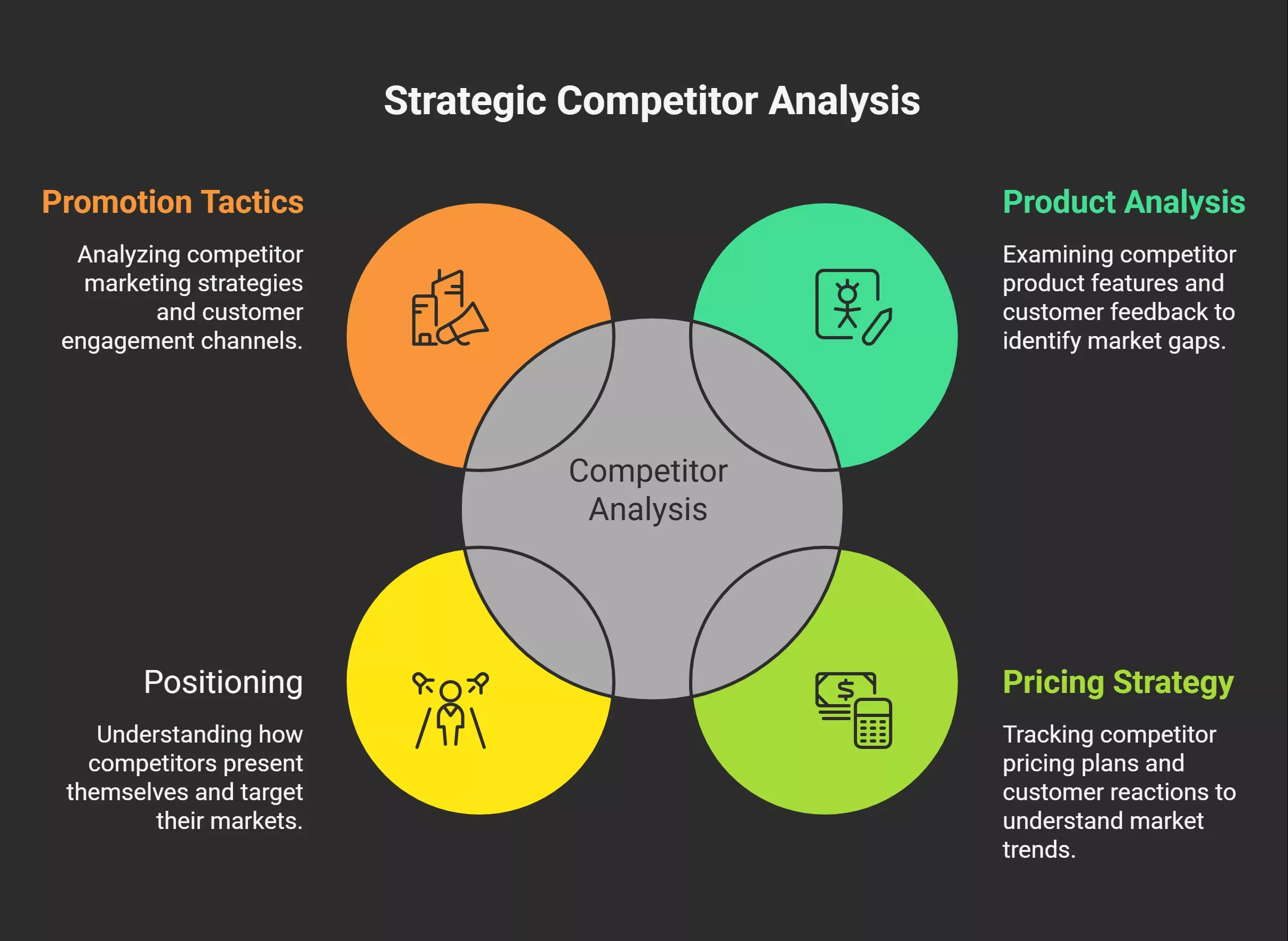
The 4 P's give you a strategy to organize competitor analysis research into categories that matter:
- Product: What features does each competitor offer? Where do customers say the product falls short? What are the obvious feature gaps in competitors' solutions? Customer reviews on review platforms like G2, Capterra, and Trustpilot provide a line of sight into what competitors get right and where they miss, revealing market gaps your business can fill.
- Pricing: How do competitors structure their pricing plans? Are customers complaining about price increases? Is there a free tier, and how does pricing compare? Tracking pricing changes across competitors shows you where the market is heading. Pricing pages are the single most interesting data you can analyze week over week.
- Positioning: What words do competitors use to describe themselves on their pages? What target market do competitors focus on? How does their messaging shift by team size or industry? Positioning tells you how competitors want to be seen, and reviews tell you the reality.
- Promotion: What marketing strategies do competitors focus on? Where do competitors' pages show up in search results? What channels do competitors use to reach customers? How do competitors talk to customers on social media and through their support service?
These four categories create a foundation for any competitor analysis report, and reviews sit at the center of all four.
Why Reviews Reflect Market Reality Better Than Competitors' Website Pages
Direct competitors' websites tell you what a company wants you to believe. Reviews tell you what customers discovered after the sale.
Customer feedback on review platforms like G2 and Capterra provides knowledge about product gaps that never show up on competitors' own marketing pages. When you analyze customer feedback, you identify common complaints and feature requests, which show what customers value and what competitors lack.
So the question becomes: how do you analyze competitors' reviews at scale without spending your entire week reading them?
How G2 Reviews Expose What Competitors Want to Hide
Analyzing the "What Do You Dislike?" Field Line by Line
G2's review form asks reviewers to answer structured questions, and the most useful one for competitive intelligence is the "What do you dislike?" prompt. This is where customers stop being polite.
Rocket.new targets the structured schema of G2 reviews to isolate negative data and map competitive vulnerabilities. The system focuses on 2-star and 3-star reviews, where customers are specific about what went wrong.
5-star reviews rarely contain actionable insights. 1-star reviews lack specific words about features. The 2-star and 3-star range is where customers describe the exact features that failed, the slow interactions, and the pricing that pushed them toward switching.
When you analyze the same complaint appearing in 15% or more of a competitor's negative reviews, you have a meaningful pattern worth building a positioning strategy around.
Segmenting Reviews by Company Size, Role, and Industry
Not all competitor issues affect all customers the same way. A feature gap that frustrates a 500-person company might not matter to a 10-member team.
Rocket.new segments review analysis by company size, role, or industry to highlight specific issues relevant to your target market. A project management tool might score well with small teams but fail at enterprise scale. Competitors' reviews tell you exactly where that line is.
G2 reports firmographic data about reviewers. Rocket reads this data and connects it to complaints, so you know which problems matter for the customers you are trying to reach in your market. This segmentation separates a surface-level search through competitors' reviews from a real competitive intelligence strategy.
Tracking Review Sentiment Over Time to Spot Slow Declines
A single negative review is an anecdote. A declining sentiment trend over six months is a strategic signal for your market positioning.
Rocket.new enables real-time tracking of competitor review volume and sentiment changes, detecting shifts before they become obvious to the rest of the market. Rocket's intelligence system offers continuous monitoring and early warnings, allowing immediate identification of shifts in customer satisfaction.
When competitors' service ratings drop from 8.2 to 6.9 over two quarters, those competitors have a systemic problem. Knowing this is the kind of knowledge your team should act on before competitors' customers start their own search for alternatives.
The platform maps out competitors' full profiles, including pricing changes, feature launches, and social sentiment to identify subtle product issues that are not visible from a single review snapshot.
The Complete Process of Competitive Analysis from Beginning to Production
Step 1: Map Direct Competitors and Indirect Competitors by Category
Start by listing your direct competitors, the companies that sell the same solutions to the same target market as you. These are the competitors you need to analyze first and find on G2.
Then map your indirect competitors, the companies that solve the same problem with a different approach. A project management tool competes with rivals in its category, but indirect competitors include Google Sheets trackers, email chains, and Slack channels. Categorize competitors into groups to understand the full competition picture. Adjacent competitors might move into your market in the coming months.
For each competitor, pull their G2 profile URL, Capterra pages, and any other review sources where customers submit feedback. Also search Product Hunt for early-stage competitors.
Step 2: Use Google Sheets to Collect Data from Competitors' Reviews
You need a single place to collect and analyze review data from competitors. Google Sheets works as a starting point because it is free and easy to use.
Create columns in Google Sheets for: competitor name, review date, star rating, reviewer role, team size, the "what do you dislike" words, and the features or categories each complaint touches.
For a smaller team, manual collection of 10 to 20 reviews per competitor per week in Google Sheets is enough to start seeing patterns. Google Sheets becomes slow past a few hundred rows and cannot analyze competitors' sentiment trends automatically. Rocket.new replaces this manual step: its Intelligence tools run continuous monitoring and pull data into a dashboard where you can search, filter, and act on what competitors' customers are saying.
Step 3: Analyze Patterns and Build Your Competitive Picture
Once you have data from at least four to six weeks of competitors' reviews, sort complaints by frequency. Group them into categories: pricing complaints, feature gaps, slow support response, difficult onboarding, poor production quality, or missing features like custom domain support. Project management tools, CRM solutions, and analytics platforms each have different patterns, so you should analyze each category separately.
Market gaps appear when multiple competitors share the same problem. If three competitors all receive complaints about slow onboarding, that is an opportunity your product and strategy team should note. The right tools make this data accessible and actionable rather than buried in spreadsheets.
| Step | Action | Output | Frequency |
|---|---|---|---|
| 1 | Map all competitors by category and collect G2 pages | Competitor list with review pages | Monthly review |
| 2 | Collect data from competitors' reviews in Google Sheets or Rocket | Structured data with sentiment, role, and team size tags | Week by week |
| 3 | Analyze complaint themes and feature gaps across competitors | Ranked list of competitors' issues by frequency | Every two weeks |
| 4 | Validate insights against your own customer feedback and CRM | Confirmed positioning angles and market gaps | Monthly |
| 5 | Update positioning, battlecards, and product direction plan | Actionable report for production use | Quarterly refresh |
Turning Review Data into Positioning, Strategy, and Marketing
From Competitor Gaps to Messaging That Converts
Knowing a competitor has slow onboarding is interesting. Knowing that 23% of their mid-market reviews mention slow response times in the same words, and that those reviewers represent your target market, is actionable.
When you analyze competitors' reviews at scale, the patterns become obvious. Three competitors might all share the same problem with deployment speed. Two more might share pricing complaints from customers on their mid-tier plan. The data tells you which market angle to highlight on your own pages.
The words customers use in their reviews are the words your marketing pages should use. When a reviewer writes that onboarding was "confusing and took three weeks," your landing page should answer with "set up in two days." Create messaging that mirrors the exact language in reviews.
What Switching Signals Mean for Your Strategy
G2 includes a "Reasons for switching" field for reviewers who left a competitor. This data shows exactly what triggers customers to find alternatives.
When customers describe leaving because of pricing increases, slow response times, or missing features, you are looking at a pattern that your strategy plan should address on your landing pages and marketing pages.
Rocket.new synthesizes G2 feedback with other intelligence sources to validate if complaints reflect a larger, systemic problem at a competitor, not isolated incidents. Positioning pages, battlecards, and quarterly trend reports should all reflect what the data shows. A competitor whose ratings dropped steadily over two quarters is in a slow decline that your team should note.
Customers are already doing this research on their own. G2 hosts over 1.7 million reviews of 100,000+ products, and 92% of B2B buyers read a trusted review before purchasing. If you do not analyze what competitors' customers are saying, your own customers will draw their own conclusions about which competitors to consider.
How Analyzing Competitors Helps You Decide What Features to Build
A business that understands the specific strengths of direct competitors and indirect competitors can decide which features to create first, which customers to target, and which pricing models to use.
If your research shows that competitors with the largest market share also have the slowest onboarding, that is an advantage you can build your entire company positioning around. Competitive intelligence helps you avoid building solutions that competitors already do well, and create features where customers are looking for something better in the market.
Tracking competitors' pricing pages, hiring patterns, and feature changes reveals strategic direction before competitors' product announcements hit the press. A bit of weekly research prevents months of wasted effort and gives you a clear advantage in the competition.
What the Community is Saying
Competitive analysis has moved from a quarterly exercise to a continuous strategy. Ferdinand Goetzen, co-founder of The Growth Syndicate, put it plainly:
"The bar for standing out is much higher, and the need to stand out is bigger than it was." - Source: The Growth Syndicate
B2B review volume grew 34% in 2024, and the words customers submit in reviews are getting more specific each year. Manual analysis is no longer practical. The companies doing competitive analysis well are the ones that automate research, analyze patterns, and act on insights the same week.
According to Bain and Company, early artificial intelligence deployments in competitive intelligence have boosted win rates by more than 30%. The tools and strategy you use for competitive analysis matter as much as the research behind them.
How Rocket.new Intelligence Analyzes G2 Reviews and Turns Them into Competitive Advantage
Rocket.new is built for the complete competitive analysis workflow: market research, production deployment, and ongoing competitor monitoring in one platform. While traditional tools focus on only one part, Rocket connects research, building, and competitor tracking together.
Rocket uses artificial intelligence and automated market research to analyze competitors' profiles on G2 and other review platforms, turning qualitative feedback into feature roadmaps and positioning recommendations.
Here is what Rocket.new Intelligence brings to competitive analysis:
- Vibe Solutioning platform: Describe any market problem in plain words. Rocket returns research, data, and a clear recommendation you can act on.
- 25+ integrations: Connect Stripe, Google Analytics, Supabase, Notion, Linear, Airtable, Mailchimp, Mixpanel, and more. Authenticate once, and they flow into every build.
- Web and mobile app building: Ship mobile apps in Flutter and web apps in Next.js from the same platform where you run your competitive analysis.
- Collaboration features built in: Share competitor intelligence, review analysis reports, and build progress with your team. Every note and strategy document stays in one place.
- Solve, Build, and Intelligence: Solve answers competitive questions with structured research. Build turns those answers into working products with custom domain support. Intelligence monitors competitors continuously.
Here are use cases connecting G2 review analysis to Rocket:
- Competitive teardowns: Use Solve to analyze a competitor's full G2 profile, extract the top complaint themes, and create a positioning report your team can act on this week.
- Review-driven product pages: Discover which features competitors lack, then use Build to create landing pages that highlight exactly those features for your focus market.
- Continuous competitor monitoring: Set up Intelligence to watch competitors' G2 review pages, pricing pages, and product pages. When sentiment shifts, Rocket alerts you and suggests what to do next.
- Switching campaign creation: Identify the top reasons customers leave competitors, then build switching pages with a custom domain and production-ready deployment.
Rocket is the only platform where you can research what competitors are doing wrong, build the product that does it right, and keep watching for the next market shift.
Making Competitive Analysis a Week-by-Week Strategy
The companies that treat competitive analysis as a quarterly slide deck will always trail the companies that treat it as a continuous strategy. Every week, competitors ship new features, change their pricing pages, and collect new reviews from customers who are deciding whether to stay or switch.
How does Rocket.new read G2 reviews across a competitor's full profile and extract the weaknesses between the lines? By automating the research, analyzing the data by categories and market segments that matter, and connecting actionable insights to the tools you use to build, position, and sell. That is the complete competitive analysis workflow, and Rocket runs all of it.
Start your competitive analysis with Rocket.new today.
Table of contents
- -Why Are Your Competitors Losing Customers, and How Would You Know?
- -What Competitor Analysis and Competitive Intelligence Mean in 2026
- -The Difference Between Watching Competitors and Running a Strategy
- -The 4 P's of Competitor Analysis
- -Why Reviews Reflect Market Reality Better Than Competitors' Website Pages
- -How G2 Reviews Expose What Competitors Want to Hide
- -Analyzing the "What Do You Dislike?" Field Line by Line
- -Segmenting Reviews by Company Size, Role, and Industry
- -Tracking Review Sentiment Over Time to Spot Slow Declines
- -The Complete Process of Competitive Analysis from Beginning to Production
- -Step 1: Map Direct Competitors and Indirect Competitors by Category
- -Step 2: Use Google Sheets to Collect Data from Competitors' Reviews
- -Step 3: Analyze Patterns and Build Your Competitive Picture
- -Turning Review Data into Positioning, Strategy, and Marketing
- -From Competitor Gaps to Messaging That Converts
- -What Switching Signals Mean for Your Strategy
- -How Analyzing Competitors Helps You Decide What Features to Build
- -What the Community is Saying
- -How Rocket.new Intelligence Analyzes G2 Reviews and Turns Them into Competitive Advantage
- -Making Competitive Analysis a Week-by-Week Strategy