
Manual research produces summaries limited by time, bias, and scope. Solve on Rocket.new delivers structured, decision-ready reports with confidence ratings and flagged conflicts. The result is faster, deeper insights that directly power execution and product building.
What if the best research summary you could pull together was still missing the thing that mattered most?
That is the honest question behind this comparison. The difference between a Solve output on Rocket.new and a search result summary you produce manually is not just speed. It is the difference between organized notes and a structured decision - with evidence, signal confidence ratings, conflicting data flagged, and a clear recommendation ready to act on, share, or build from.
According to McKinsey, employees already spend 1.8 hours every day - roughly 9.3 hours per week - searching and gathering information. After all of that, most teams still have to figure out what the data means on their own.
What Manual Research Actually Looks Like
You open a search engine, type your question, and start reading. A few tabs turn into fifteen. You pull some market data, skim competitor pages, scan a couple of reports, and start copying notes into a doc.
Manual research is not wrong. The problem is that it has a ceiling. The search terms you type are shaped by what you already know. The angles you cover are the angles you already thought of. The data you find gets filtered through time pressure and your judgment about what is relevant.
What you produce at the end is a summary. It reflects your questions, your reading, and your synthesis. Useful for a start - but limited to what one person could gather and make sense of in a few hours.
What Solve on Rocket.new Actually Does
Solve on Rocket.new starts from a different point. You describe your situation in natural language - the way you would talk through it with a smart colleague - and the platform frames the problem before any research begins.
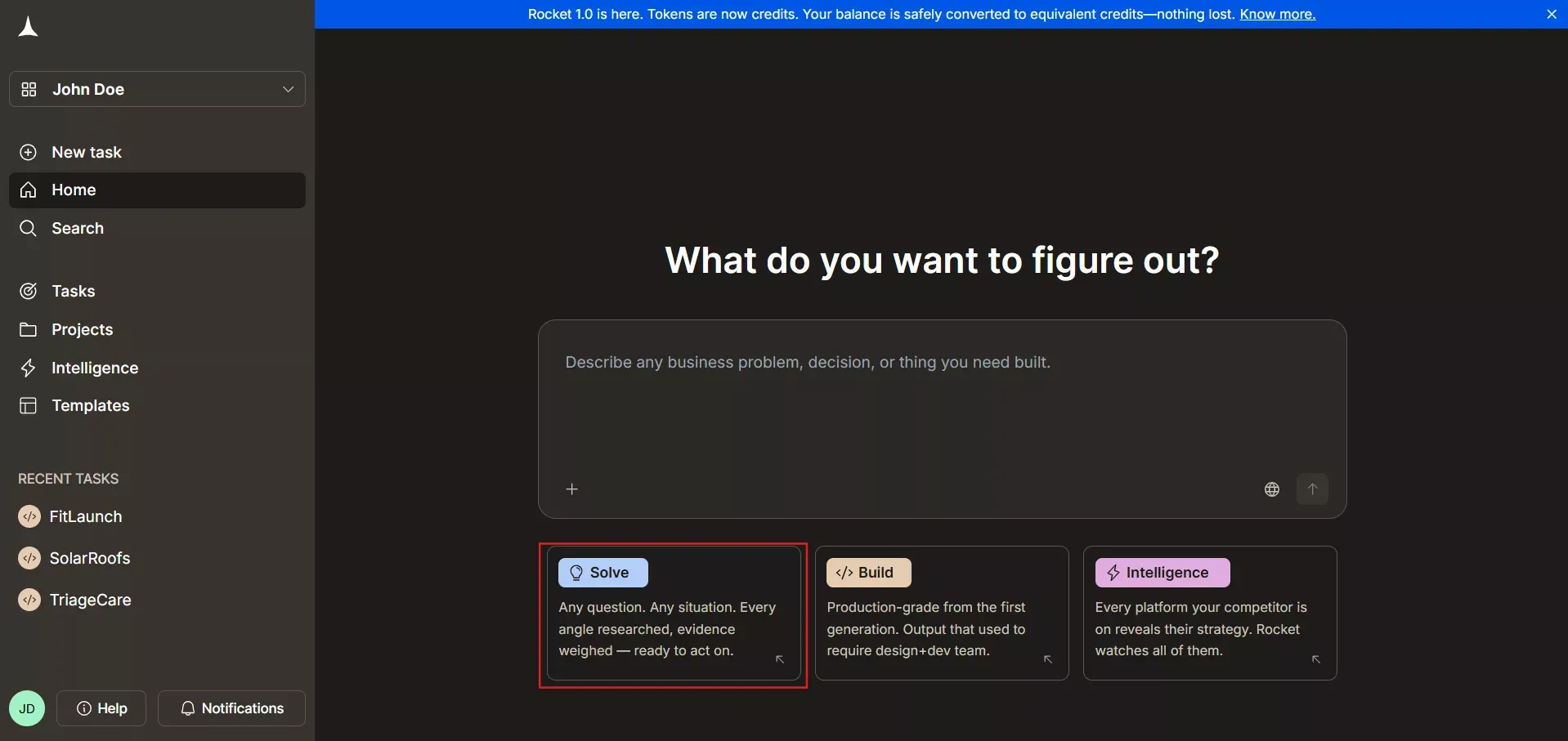
That framing step is what most AI tools skip entirely. Before pulling a single source, Solve maps every dimension of the question: market dynamics, competitive landscape, risks, opportunities, and financial implications. For ambiguous prompts, it asks clarifying questions to close the gaps.
Then it decomposes the question into independent research streams and runs them in parallel - thousands of queries across 150+ sources simultaneously. Each agent returns findings tagged by signal strength: HIGH, MEDIUM, or LOW confidence. Conflicts between sources are flagged explicitly rather than smoothed over.
If research surfaces something you did not ask about but needed to know - a regulatory deadline, a structural risk, a competitor move - it shows up in the structured report with reasoning attached.
Structured Output vs Manual Summary: A Direct Comparison
Let's find out what the difference is between a Solve output on rocket.new and the best summarized search result you could produce manually.
| Dimension | Your Best Manual Summary | Solve on Rocket.new |
|---|---|---|
| Starting point | Your own search terms | Problem framing before research starts |
| Research depth | As deep as you have time for | Thousands of queries, 150+ sources, parallel agents |
| Signal confidence | Not rated | Every finding tagged HIGH / MEDIUM / LOW |
| Conflicting data | Often missed | Flagged explicitly with reasoning |
| Unsearched angles | Never surface | Structural risks and competitor moves added |
| Your own files | Not used | Upload models, decks, reports - read structurally |
| Output format | Notes or summary doc | Executive summary, analysis, data, recommendations, sources |
| Follow-up | New search | Conversational refinement in the same report |
| Export | Copy-paste | PDF, PPTX, PRD, HTML |
| Persistence | Gone when you close the tab | Lives in the project for every task that follows |
What Many AI Tools Return When You Ask a Question
Many AI tools - including well-known general assistants - give you a response when you ask a business question. That response can be thoughtful and well-written. But it is still a response, not a structured report.
Tools like ChatGPT, Claude, or Perplexity do their job well. They search and synthesize. The gap is what happens after: the analysis still lands back in your hands. You still have to do the competitor analysis, work through the market data, identify the risks, and write your own recommendation. The research work never quite finishes.
A community member on r/SaaS described the experience plainly: Manual research is a black hole. You scroll for an hour, find one decent insight, and pray it was worth the time. That is the cost of research tools that stop at information delivery.
What the Full Report Contains
The Solve output is a structured report, not a summary. Every report - regardless of question type - covers an executive summary, detailed analysis, supporting data tables and comparisons, specific and actionable recommendations, and a full source and methodology section.
For more complex business questions, the structured report expands to 8-12 sections. Competitive teardowns include a feature matrix, SWOT analysis, and gap analysis. Market research reports include sizing tables, growth drivers, and landscape breakdowns. Investment analyses cover thesis, financials, and a risk matrix.
Every section earns its place. Every finding has a source. Every recommendation connects back to the evidence. This is a decision-ready document, not a starting point for more work.
Vibe Solutioning and Why it Changes the Research Workflow
Solve is the research engine inside a broader category called vibe solutioning. Vibe coding showed that teams could build web apps and mobile apps without writing code line by line. Vibe solutioning applies that same idea to the decisions that happen before building begins: the research, strategy framing, competitive intelligence, and market analysis.
In the vibe solutioning approach, you describe what you need to know, and the platform manages the research workflow from problem framing through to structured output. Teams building web apps, mobile apps, and internal tools can move from idea to informed decision without losing context at every handoff.
How Solve on Rocket.new Connects to What Gets Built
The structural advantage of Solve on Rocket.new goes past the report itself. The output does not disappear when you export it. It lives in the project context, and every task that follows inherits it automatically.
When a developer opens a build task for web apps or mobile apps, the research is already there. When a marketer writes landing page copy, the competitive intelligence from the Solve report is part of the context. The PRD generated by Solve informs every build task without re-explaining anything. No context gets lost between research and building.
Here is how the full Solve workflow runs from question to structured output:
- Describe your situation in natural language
- Solve frames the problem and maps every dimension: market, risks, competition, financials
- Asks clarifying questions for ambiguous prompts
- Decomposes into parallel research streams
- Thousands of queries across 150+ sources run simultaneously
- Findings rated HIGH / MEDIUM / LOW confidence
- Structured report: executive summary, analysis, data, recommendations
- Refine through conversational follow-up
- Export as PDF, PPTX, PRD, or HTML
- Output persists in the project context for every build task that follows
Here is how the full Solve workflow runs from question to structured output:
This is also where Solve on Rocket.new is distinct from vibe coding platforms. Tools like Lovable or Bolt build what you describe. Rocket.new first figures out what is worth building and why - and then builds it. The research and the build share the same context, so nothing is lost between thinking and doing.
The Difference Comes Down to What the Output is For
The core difference between a Solve output on Rocket.new and the best summarized search result you could produce manually is what the output is designed to do. A manual summary captures what you found. Solve on Rocket.new delivers a decision - with signal confidence ratings, flagged conflicts, evidence-backed recommendations, and a structure ready to present, act on, or build from.
Manual research works. But it has limits you cannot always see from inside it. It covers what you searched for, not everything you needed to find. Solve closes that gap - and the output does not end at the report. It becomes the foundation of everything your team builds next.
👉Stop summarizing, sign up now, and start making decisions with Solve on Rocket.new.
Table of contents
- -What Manual Research Actually Looks Like
- -What Solve on Rocket.new Actually Does
- -Structured Output vs Manual Summary: A Direct Comparison
- -What Many AI Tools Return When You Ask a Question
- -What the Full Report Contains
- -Vibe Solutioning and Why it Changes the Research Workflow
- -How Solve on Rocket.new Connects to What Gets Built
- -The Difference Comes Down to What the Output is For