
Solve on Rocket.new replaces slow, expensive legal research with AI-powered workflows. It analyzes regulations across 150+ sources, delivering structured, confidence-scored reports in 60–90 minutes. Teams can move from compliance research to execution without needing a full legal team.
What happens when a startup needs to understand data privacy law in Germany, licensing requirements in Singapore, or federal compliance rules in the U.S., but has zero legal research staff?
The research process was stalled for weeks. AI tools have changed that math. According to a study by the National Legal Research Group, AI-powered research tools help legal researchers finish work 24.5% faster than attorneys using traditional methods, saving between 132 and 210 hours per year.
Solve on Rocket.new takes that concept and builds a full research workflow around it, turning raw data from over 150 sources into a structured output you can act on, present, or build from.
Why Regulatory Research Breaks Down Without a Legal Research Team
Regulatory research has a cost problem and a speed problem. Both get worse without a dedicated team.
-
Case law, statutes, federal regulations, and legal commentary across jurisdictions create raw data volumes that a single founder cannot realistically process.
-
Manual research is slow and time-consuming. Compliance analysis for one jurisdiction takes days. A second region doubles the timeline.
-
Conventional legal research methods are labor-intensive and prone to errors. Missed data in contract review or regulatory analysis leads to fines or blocked launches.
-
Law firms charge $300 to $1,000+ per hour. For early-stage teams, that cost sits outside the budget.
The research process for compliance has required either expensive outside counsel or an in-house legal research team with research tools like Westlaw or LexisNexis. Teams without those resources often make decisions on incomplete analysis or outdated data.
How AI Tools Are Reshaping the Legal Research Process
AI tools built for legal research use natural language processing (NLP) to read and interpret complex legal language. NLP allows these tools to analyze legal documents, extract relevant information, and identify connections across case law, statutes, and regulations with a level of precision that manual research cannot match at speed.
-
AI-powered research tools automate the categorization of legal documents, letting users quickly identify the legal questions that matter and cut through noise in the research process.
-
AI models trained on historical legal data can provide predictive insights, helping teams assess risks and forecast potential case outcomes before committing resources.
-
AI tools understand context and nuance in legal queries, pulling more relevant results from legal databases compared to a keyword-only search.
-
Generative AI adds a layer of synthesis. Instead of returning a list of links, well-built AI tools generate structured output: a report with findings, evidence, and analysis ready for decision making.
Research conducted by the National Legal Research Group confirmed that AI tools let expert legal researchers complete research tasks 24.5% faster. That translates to 132 to 210 saved hours annually per attorney. For teams outside law firms, the difference is even more pronounced, because they start without any legal research capabilities at all.
| Factor | Manual Research | AI-Powered Research |
|---|---|---|
| Speed per jurisdiction | Days to weeks | 60 to 90 minutes |
| Cost per project | $5,000 to $50,000+ (outside counsel) | Platform subscription cost |
| Data sources covered | Limited by team bandwidth | 150+ sources in parallel |
| Output format | Unstructured notes and memos | Structured output with evidence |
| Multi-jurisdictional support | Requires separate research per region | Parallel analysis across regions |
| Risk of missed findings | High, due to volume and fatigue | Low, due to parallel agent coverage |
| Confidence scoring | Not available | Built in per finding |
How Solve on Rocket.new Runs Regulatory Research
So, how does Solve on Rocket.new handle regulatory research for a specific jurisdiction without a legal research team?
It replaces traditional manual analysis with autonomous AI agents and query decomposition, following a standardized five-step automated process.
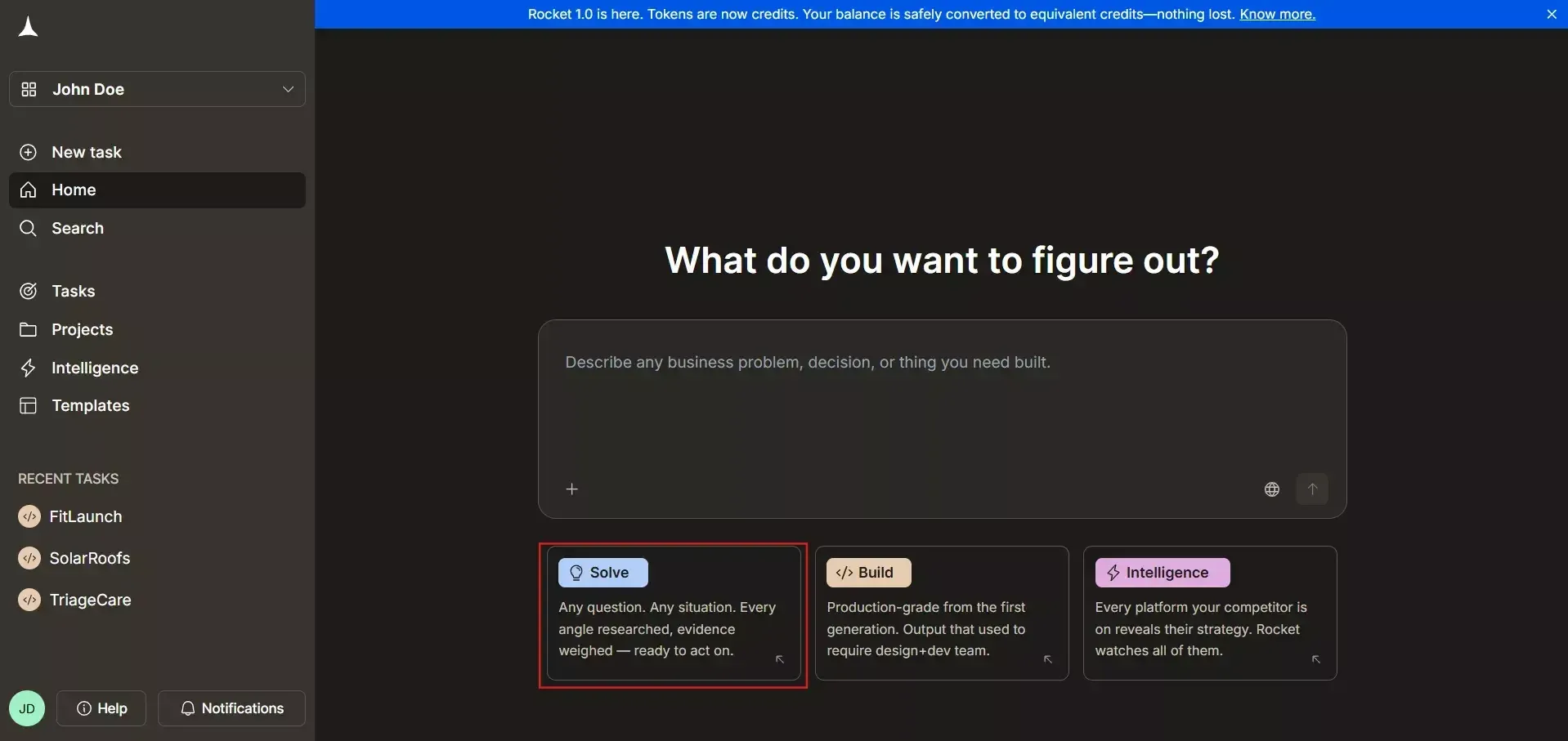
Step 1: Objective Definition and Query Decomposition
When a user submits a prompt about a specific jurisdiction or market entry, Solve first identifies the dimensions of the question. If you type something like "What are the data privacy and licensing requirements for launching a fintech product in Germany?", the AI breaks that request into multiple dimensions: market dynamics, competitive positioning, regulatory requirements, financial implications, and legal compliance.
-
Each dimension gets its own research track.
-
The system maps what data it needs before pulling a single source.
-
Context from your earlier Solve sessions or project data carries forward, so you do not re-explain the background for the call each time.
This dimensional analysis is what separates Solve from a generic AI chat. A generative AI chatbot would give you a single response based on training data. Solve runs a structured research process across each dimension.
Step 2: Automated Data Collection Across 150+ Sources
Separate AI agents investigate each dimension in parallel during the research process. Solve uses parallel AI agents that run thousands of queries simultaneously across over 150 data sources to gather evidence for each identified dimension of a regulatory problem.
-
Federal and state regulatory databases, international law repositories, case law archives, and industry-specific compliance data all get scanned.
-
Raw data is collected from government registries, legal publishers, and enforcement records.
-
The process covers current information, not just archived precedent. AI tools pull from live regulatory updates.
This parallel execution is what saves time. A single researcher dealing with one jurisdiction might spend days on data collection. Solve handles it in minutes because the AI agents run concurrently, each focused on a specific slice of the research.
Step 3: Synthetic Testing and Cross-Reference
Findings do not go straight into the final report. Solve cross-references each data point against multiple sources, looking for consistency and contradiction.
-
This step catches outdated statutes, conflicting case law across jurisdictions, and gaps where law is silent or pending.
-
Weak signal detection allows the platform to identify pending legislation or changes in enforcement that manual research would miss. A proposed amendment sitting in a federal committee could change your compliance requirements in six months. Solve flags it.
-
Research findings are tested against the original query dimensions to confirm relevance before moving forward.
Step 4: AI Analysis, Confidence Scoring, and Risk Assessment
After evidence gathering and cross-referencing, Solve runs analysis on the collected data. This is where raw data becomes actionable insights.
-
Findings are scored by certainty and cross-referenced against sources, allowing for evidence-based recommendations.
-
Confidence scoring helps users understand the reliability of the research findings and recommendations. A finding backed by four federal court rulings and a published regulation scores higher than one supported by a single blog post.
-
Risk assessment flags areas where the law is ambiguous, where enforcement practice differs from statute, or where pending legislation could create new requirements.
-
AI models weigh contradictory findings and present them transparently rather than hiding the conflict.
This confidence scoring layer makes a real difference for decision-making. When your team lacks legal research capabilities, you need to know which findings to trust and which ones need a second opinion from a qualified attorney.
Step 5: Structured Output and Actionable Deliverables
The platform generates a structured recommendation within 60 to 90 minutes instead of providing a list of links.
-
The output includes an executive summary, key findings by dimension, risk analysis, and a clear plan of action.
-
Research findings link back to their sources so relevant parties can verify claims.
-
The report format is built for decision making, not for filing away. It reads like something a consulting team would deliver after weeks of research conducted on the topic.
-
The structured output carries forward into Rocket.new's Build product, so regulatory constraints stay connected to your product development workflow.
Multi-Jurisdictional Research and Horizon Scanning
Most regulatory questions are not limited to one jurisdiction. A company launching in both the EU and the U.S. faces overlapping and sometimes contradictory laws at the federal, state, and international levels.
-
The platform handles multi-jurisdictional dilemmas by comparing regulations in different regions side by side, highlighting where requirements align and where they conflict.
-
AI-driven horizon scanning continuously maps regulations, identifies risks, and updates requirements in real time, replacing the need for a human legal team for initial research.
-
Contextual memory means regulatory constraints stay updated within the system. Subsequent prompts or code generation in Build comply with identified legal requirements without anyone needing to manually re-enter that context.
For teams dealing with federal compliance in the U.S. alongside EU AI Act requirements, or comparing data privacy law in California (CCPA) with GDPR, this cross-jurisdictional analysis saves time that would otherwise go to hiring separate counsel in each region. The cost savings compound. Instead of paying multiple law firms for parallel research, you run a single Solve session.
How AI Tools Handle Case Law and Contract Review in the Research Process
Traditional legal research tools focus on case law search: finding precedents by keyword, citation, or topic. AI tools add a layer that old research tools never had. They read the context of your query, match it against case law databases, and surface results based on the legal question you are actually asking, not just the words you typed.
-
AI-powered research tools can automate contract review by scanning agreements against regulatory requirements for a target jurisdiction. The process flags gaps, missing clauses, and compliance risks without a legal research team reviewing each page manually.
-
For case law analysis, AI tools pull from federal and state court databases, cross-reference rulings with current statutes, and identify patterns in how courts have enforced specific regulations.
-
The legal research process for case law used to require a researcher to read through dozens of rulings to find one that applies. AI tools compress that process by ranking relevance and surfacing only the findings that match your research context.
-
Generative AI adds the ability to synthesize case law findings into a summary that non-lawyers can understand. The output connects legal analysis to business decision-making, bridging the gap between law and strategy.
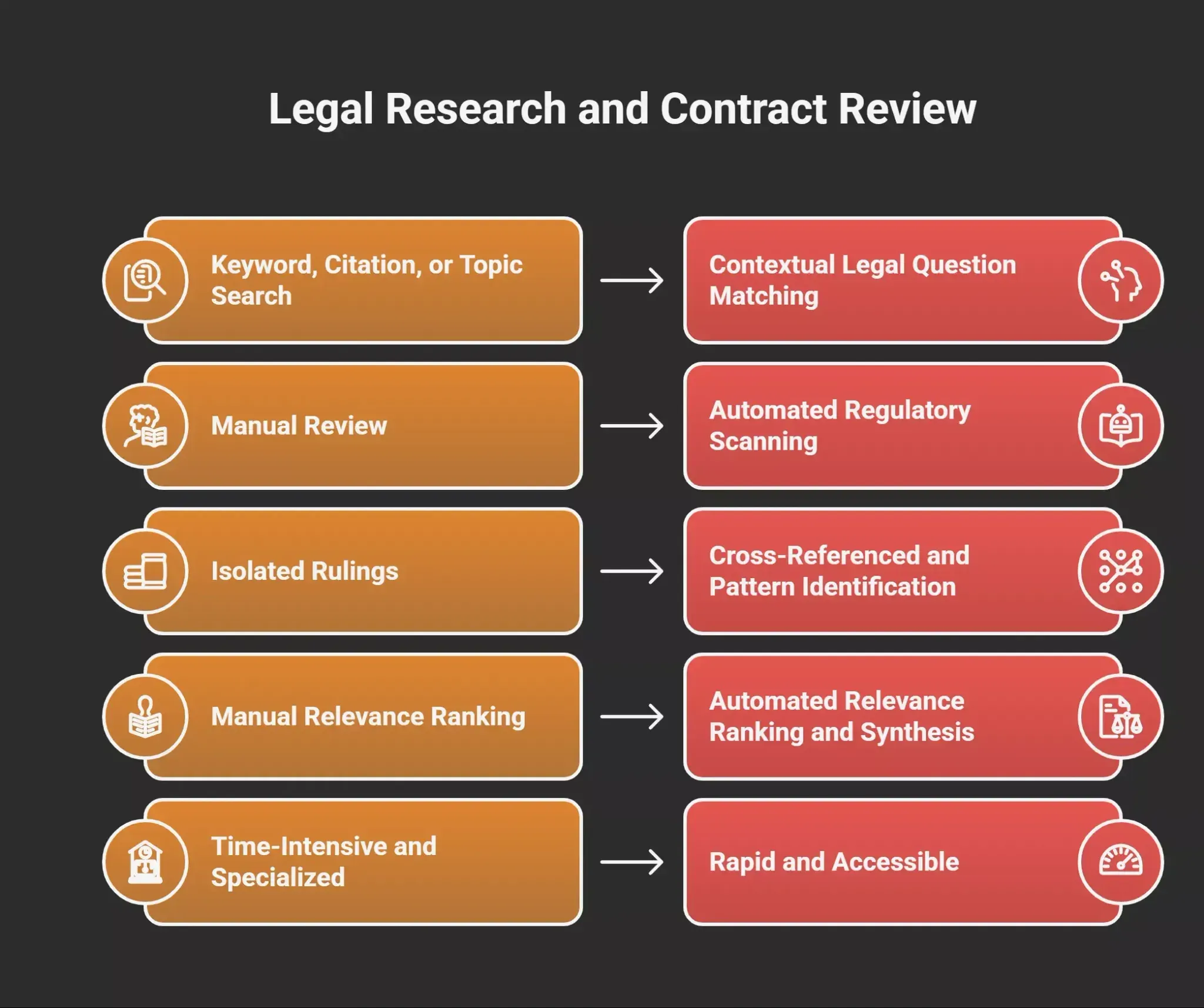 These AI tools serve teams that lack legal research capabilities by handling the parts of the research process that require the most time and the most specialized knowledge. The data processing alone, scanning thousands of case law entries and regulatory filings, would take a dedicated research team weeks. AI tools finish that data analysis in the same session.
Research Tools for Managing Compliance Workflow and Process
The compliance workflow for regulatory research involves more than a single research session. It is an ongoing process of monitoring changes, updating findings, and connecting new data to existing analysis.
-
AI-powered research tools built for compliance workflow track regulatory changes across jurisdictions. When a federal agency publishes new rules or a state passes new legislation, the tools flag the update and connect it to your existing research findings.
-
The workflow process for managing compliance research requires structured output that updates over time. Static reports become outdated. AI tools that produce living structured output, where findings refresh as new data becomes available, reduce the risk of acting on stale analysis.
-
Research tools that connect to product development workflows, like Solve on Rocket.new, let teams manage regulatory constraints as part of their build process. The insights from research flow directly into requirements, reducing the gap between analysis and execution.
-
For teams dealing with limited resources, the cost difference between maintaining a compliance workflow manually versus using AI tools is significant. Manual process management requires dedicated staff to monitor regulatory data sources, update spreadsheets, and distribute findings. AI tools automate each step of that process.
The practice of managing compliance research as a workflow rather than a one-off project is relatively new for smaller teams. Law firms have always managed research as a continuous process, but the cost has made it inaccessible. AI-powered tools bring that same continuous research process to teams with limited budgets and no dedicated legal research staff.
From Research Findings to Informed Decisions
The gap between research and action is where most teams without legal research capabilities get stuck. You have a folder full of data, but no clear plan.
-
Solve connects research findings directly to strategy. The output tells you what to do, not just what the law says.
-
The analysis translates legal requirements into product requirements. If German data privacy law requires local data storage, the report flags that as a development constraint and carries it into your Build project.
-
Teams can share the output with investors, advisors, or clients directly. The structured output reads as a professional research report, not an AI chat transcript.
-
User feedback on research quality improves the system over time, as Solve refines its output based on how teams interact with findings.
The practice of turning legal research into informed decisions used to require senior attorneys who could interpret case law and connect it to business strategy. AI tools now handle the data collection, analysis, and synthesis. The human still makes the final call, but they do it with a complete picture instead of a partial one.
What Industry Leaders Are Saying
"Companies in the banking, insurance, and healthcare industries spend countless hours and millions of dollars staying in compliance. Today, banking and insurance regulations span tens of thousands of pages. Imagine that those lengthy documents could be used to train regulation-specific LLMs. Suddenly, compliance would become as simple as a Google query." - Angela Strange, General Partner at Andreessen Horowitz, a16z Big Ideas 2025
-
This matches what Solve on Rocket.new already does in practice. The platform takes regulation spanning thousands of pages and makes it queryable through natural language prompts.
-
The community around AI-powered compliance tools is growing. Startup founders and compliance officers testing these AI tools report faster compliance cycles and fewer missed requirements.
How Rocket.new Connects Regulatory Research to Product Development
Rocket.new is built as a vibe-solutioning platform where research, building, and competitive intelligence share one context. Solve is the thinking layer. When you run regulatory research through Solve, the findings do not sit in a PDF somewhere. They connect to your Build projects, inform your product plan, and update as regulations change.
-
Vibe-solutioning platform: Solve, Build, and Intelligence work as three products on one platform, sharing context so nothing gets lost between research and execution.
-
25,000+ templates library, free to use: Start from pre-built templates for compliance dashboards, regulatory trackers, or market entry tools instead of building from scratch.
-
Saves up to 80% tokens: Solve's research process is token-efficient, giving you more output per session compared to running raw queries against a general-purpose AI.
-
Supports Flutter (mobile) and Next.js (web): Build the compliance tools and dashboards your team needs on the same platform where you did the research.
-
Collaboration features built in: Share, Solve reports with your team, annotate findings, and connect relevant parties without switching tools.
-
3 Products, One Platform: Solve, Build, and Intelligence: Research regulations in Solve. Build compliance tools in Build. Track regulatory changes with Intelligence.
Use Cases That Connect the PRIMARY_KEYWORD to Rocket.new
-
Market entry compliance research: A fintech startup uses Solve to research federal and state licensing requirements before entering three new U.S. markets. The structured output becomes the basis for their compliance plan, and the findings flow into a Build project for their licensing tracker app.
-
Contract review workflow: A SaaS company dealing with GDPR and CCPA runs Solve to compare data processing requirements across jurisdictions. The analysis feeds into contract review templates built on Rocket, creating a workflow from research to legal documentation.
-
Regulatory change monitoring: A healthtech team uses Solve for initial research and Intelligence for ongoing monitoring, creating a process where regulatory updates automatically flag risks in their product plan.
-
Investor due diligence: A founder preparing for Series A uses Solve to create a regulatory risk report for their target markets. The structured output, complete with confidence scoring and evidence, goes directly into their investor data room.
Getting Regulatory Research Right with AI
The question of how Solve on Rocket.new handles regulatory research for a specific jurisdiction without a legal research team has a clear answer: it replaces the slow, time-consuming, and expensive process of manual research with parallel AI agents, structured output, and confidence-scored findings.
Teams that previously needed law firms or in-house counsel to manage regulatory research can now run the initial analysis themselves, faster and at a fraction of the cost. The final report gives you clarity on what the law requires, where the risks sit, and what to do next, all in a format ready for decision-making, strategy, or building.
Sign up now, run your first jurisdiction-specific compliance analysis with Solve on Rocket.new today.
Table of contents
- -Why Regulatory Research Breaks Down Without a Legal Research Team
- -How AI Tools Are Reshaping the Legal Research Process
- -How Solve on Rocket.new Runs Regulatory Research
- -Step 1: Objective Definition and Query Decomposition
- -Step 2: Automated Data Collection Across 150+ Sources
- -Step 3: Synthetic Testing and Cross-Reference
- -Step 4: AI Analysis, Confidence Scoring, and Risk Assessment
- -Step 5: Structured Output and Actionable Deliverables
- -Multi-Jurisdictional Research and Horizon Scanning
- -How AI Tools Handle Case Law and Contract Review in the Research Process
- -Research Tools for Managing Compliance Workflow and Process
- -From Research Findings to Informed Decisions
- -What Industry Leaders Are Saying
- -How Rocket.new Connects Regulatory Research to Product Development
- -Use Cases That Connect the PRIMARY_KEYWORD to Rocket.new
- -Getting Regulatory Research Right with AI