
Solve on Rocket.new redefines problem-solving by offering structured, outcome-driven answers. Unlike search engines, chatbots, or aggregators, it focuses on clarity, precision, and actionable insights rather than overwhelming users with scattered information.
If you have typed a business question into Google, ChatGPT, or Perplexity and walked away with a pile of links, a conversational reply, or a wall of summarized text, you already know the problem. None of those tools gives you a structured answer you can act on, present to a stakeholder, or hand directly to a developer.
Solve on Rocket.new was built to fix that. It takes any business question, described in plain language, and returns a complete, structured, evidence-backed deliverable, typically covering 8 to 12 sections, within 60 to 90 minutes.
That is not a search result. That is not a chat reply. That is not an aggregated summary.
This article explains exactly what Solve is, what it is not, and why the distinction matters for every founder, product manager, and operator who has ever lost time turning research into a decision.
What is Solve on Rocket.new?
Solve is the decision intelligence layer of Rocket.new, the world's first vibe solutioning platform.
You describe your situation the way you would explain it to a smart colleague. Solve frames the problem before research begins, identifies every relevant dimension (market dynamics, competitive landscape, risks, opportunities, financial implications), runs queries across 150+ sources simultaneously, and delivers a structured analytical output ready to act on, present, or build from.
The approved product description: "Any question. Any situation. A complete, structured output, ready to act on, present, or build from."
This is not a general-purpose AI assistant. It is not a replacement for ChatGPT or Perplexity for everyday use. It is built specifically for business decisions, product building, and competitive intelligence.
Three Things Solve Is Not
Before exploring what Solve does, it is worth being precise about what it is not, because the confusion is common:
| What People Assume | What Solve Actually Is |
|---|---|
| A smarter Google Search | A structured decision intelligence engine |
| A conversational AI chatbot | A research-to-deliverable pipeline |
| A research aggregator like Perplexity | A complete analytical output with recommendations |
| A general-purpose AI assistant | A business-specific intelligence and build platform |
| A replacement for professional advice | A research tool, not legal, financial, or medical advice |
Why Solve Is Not a Search Engine
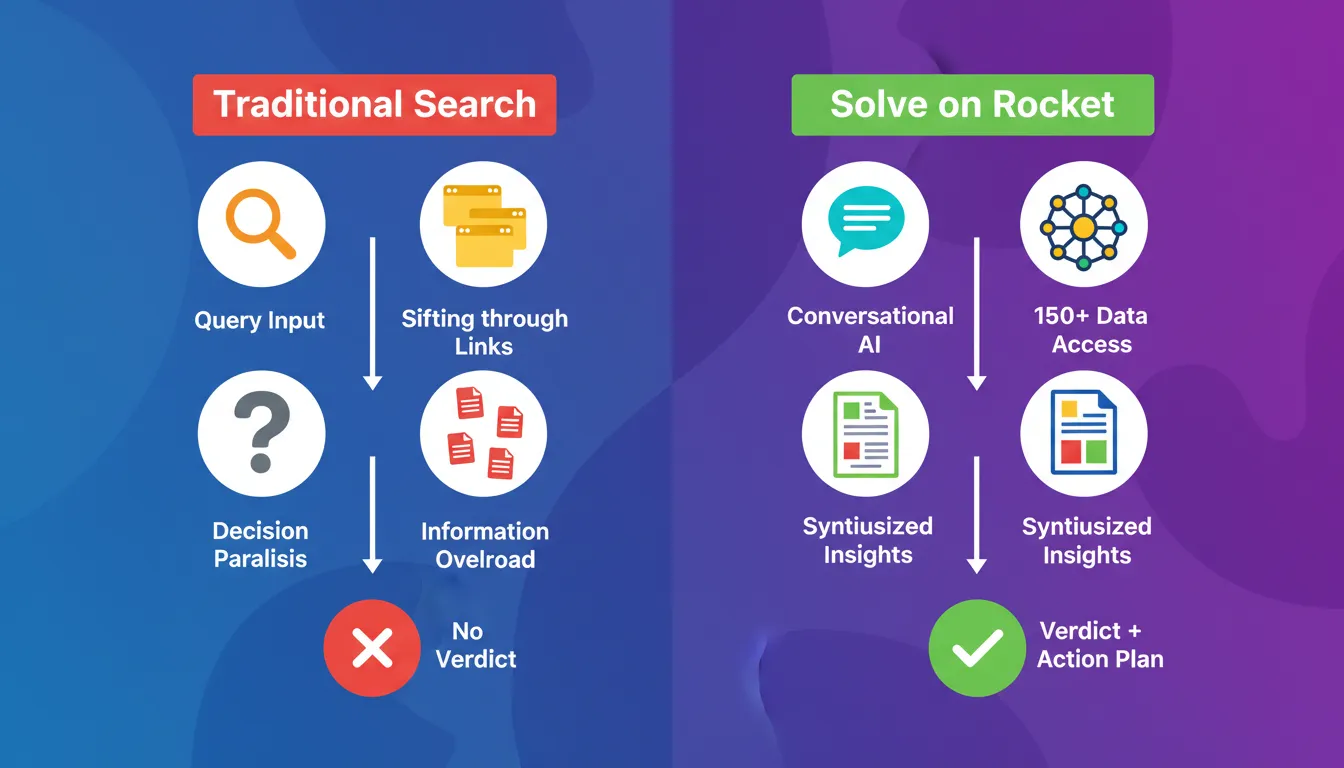
Search engines are retrieval systems. You enter a query, the engine returns ranked links, and you do the work of reading, comparing, filtering, and synthesizing. Google is extraordinary at retrieval. It is not designed to give you a verdict.
Solve does not return links. It does not rank pages. It does not ask you to open ten tabs and figure it out yourself. When you ask Solve a business question, it frames the problem before any research begins, runs thousands of queries across 150+ sources simultaneously, surfaces what you did not ask for but needed to know, and delivers a direct verdict at the top of the output, not a list of considerations.
According to the Stack Overflow Developer Survey 2025, 84% of developers are already using or planning to use AI tools in their development process. The shift is not whether to use AI for research. It is whether the AI gives you something you can actually use.
![Traditional Search vs Solve on Rocket]
Why Solve Is Not a Chatbot
Chatbots, including ChatGPT, Claude, and Gemini in their standard modes, are conversation engines. They respond to prompts, maintain dialogue context, and generate text. They are excellent at explanation, brainstorming, and drafting. They are not designed to deliver structured analytical reports with evidence tagging, signal strength ratings, and actionable verdicts.
The difference is architectural, not cosmetic. When you finish a Solve session, the output does not disappear. It becomes the foundation of everything that follows in the project. The PRD is present when the developer opens the build task. The competitive brief is present when the landing page is written.
Chatbot vs. Solve: A Direct Comparison
| Dimension | Chatbot (ChatGPT, Claude, Gemini) | Solve on Rocket |
|---|---|---|
| Output format | Conversational text | Structured 8–12 section report |
| Research depth | Training data and limited web access | 150+ live sources queried simultaneously |
| Evidence tagging | None | HIGH / MEDIUM / LOW signal strength |
| Conflicting signals | Often smoothed over | Called out explicitly |
| Verdict | Suggestions and considerations | Direct recommendation at top |
| Export | Copy-paste text | PDF, PPT, or direct-to-Build |
| Context persistence | Session-based | Carries into every subsequent task |
| What follows | Nothing | Becomes the foundation for Build |
A Concrete Example
Imagine a founder asking: "Should I enter the B2B HR software market in Southeast Asia?"
With a chatbot, you get a thoughtful essay covering general market dynamics, a few named competitors, and a list of considerations. You spend the next three hours Googling each point, reading industry reports, and building a spreadsheet. You still do not have a verdict.
With Solve, you get a structured report covering market sizing (TAM/SAM/SOM), competitive teardown of existing players, regulatory landscape by country, pricing benchmarks, and a risk matrix with signal strength ratings. You also get a direct recommendation with an execution path including owners, timelines, and gate conditions. In 60 to 90 minutes. Ready to share with co-founders or investors.
Why Solve Is Not a Research Aggregator
Tools like Perplexity AI retrieve information from the web, cite sources, and present summaries. They are excellent at answering factual questions quickly. They are not designed to deliver strategic analysis.
The distinction matters because aggregation and analysis are different cognitive tasks. Aggregation collects and presents what exists. Analysis interprets what it means, identifies what is missing, surfaces what conflicts, and recommends what to do. Solve does not aggregate. It analyzes.
Every section of a Solve output contains findings with reasoning, not just citations. Conflicting signals are called out, not hidden. Risks are rated by magnitude. Recommendations are specific, not generic. This is why how Solve differs from asking AI a question is one of the most searched topics among new Rocket users.
What Solve Covers That Aggregators Do Not
Solve addresses the full range of strategic business questions. These include strategic decisions such as market entry, competitive assessment, and pricing strategy. Product direction work such as PRD generation, feature scoping, and build-vs-buy analysis. Competitive preparation including deal briefs and positioning responses. Board and investor materials, M&A assessment, regulatory research, and vertical onboarding.
No research aggregator produces a structured deliverable across all of these. Solve does. If you want to validate a business idea before building, Solve is the tool for that work.
What Solve on Rocket Actually Is
Solve is the decision intelligence pillar of Rocket.new. Understanding what that means requires understanding the platform it sits inside. Rocket.new is built on three connected capabilities: Solve (decision intelligence), Build (production-grade generation of web apps, mobile apps, landing pages, and internal tools), and Intelligence (continuous competitive monitoring across every public platform a competitor operates on).
These are not separate tools. They share compound context. The Solve output that validated your direction becomes the foundation of your Build. The Intelligence signal from last week informs this week's product decision. Nothing is re-explained. Everything compounds.
What Vibe Solutioning Means
Vibe Solutioning is the category Rocket created. The canonical definition: "Vibe Solutioning is the practice of using AI to address the full journey of building a product or running a business, starting with the intelligence that answers what to build and why, through the build itself, and into monitoring, improving, and growing what was built."
In the founder's own words: "Coding was never the bottleneck. Deciding what to code was. Vibe coding solves the last mile. Vibe Solutioning solves the first mile."
How Solve Works: The Step-by-Step Process
Understanding the mechanics helps clarify why Solve produces fundamentally different output than search or chat.
![How Solve works]
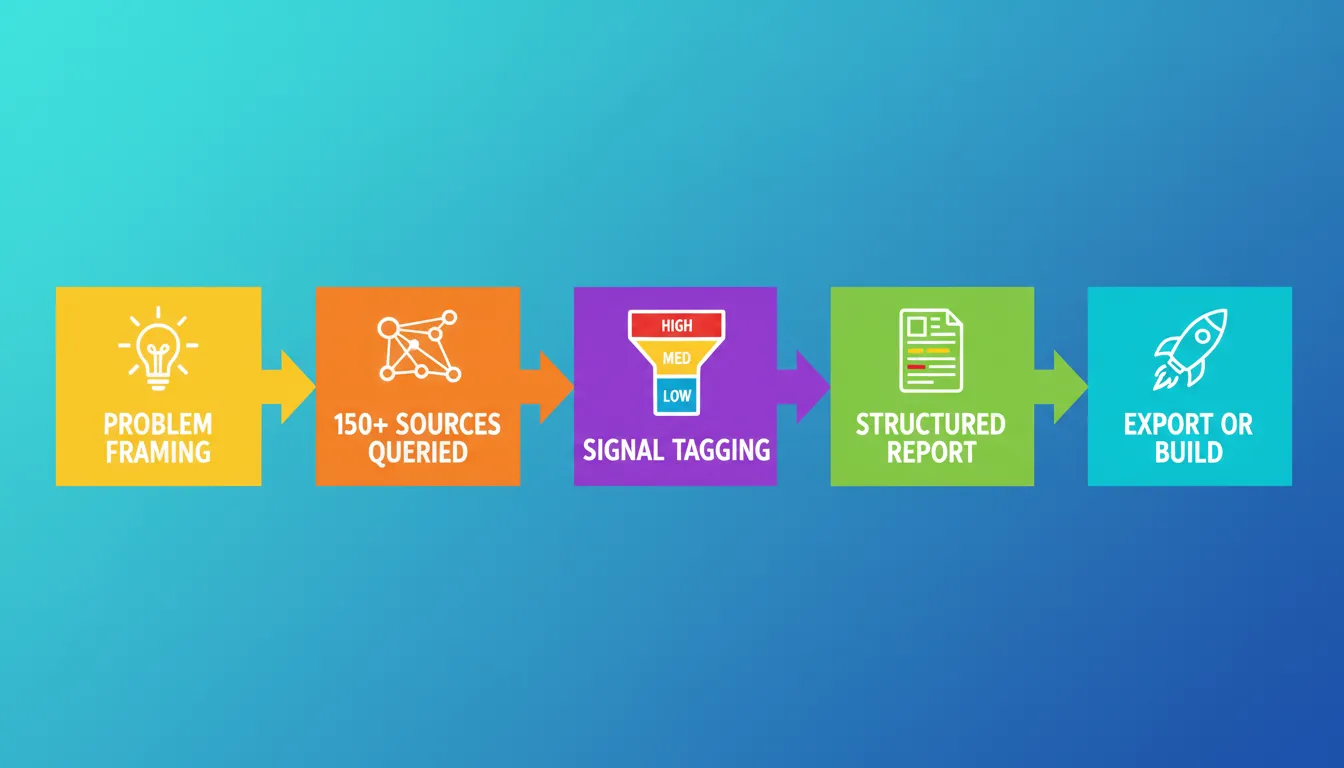
Step 1: Problem Framing. Most research tools start searching immediately. Solve starts by framing. Before any query runs, Solve identifies every dimension of your question including market dynamics, competitive landscape, risks, opportunities, financial implications, and regulatory context. This framing determines what gets researched and how findings are weighted.
Step 2: Parallel Research Across 150+ Sources. Solve runs thousands of queries simultaneously across 150+ sources. This is not sequential web browsing. It is parallel intelligence gathering at a scale no human research team can match in the same timeframe.
Step 3: Structured Synthesis with Signal Tagging. Every finding is tagged by signal strength. HIGH means strong, corroborated evidence. MEDIUM means directional evidence with some uncertainty. LOW means early signals or single-source findings. Conflicting signals are called out explicitly. If two credible sources disagree on a market size estimate, both appear in the output with the conflict noted.
Step 4: The Deliverable. The output is a structured analytical report covering the verdict (direct recommendation at the top), core objectives and JTBD, key findings with evidence, data inventory and source quality, competitive landscape, risk matrix, and execution path with owners, timelines, and gate conditions.
Step 5: Refine, Export, and Build. Refine any section through follow-up chat. Export as PDF (default) or full presentation deck via "Generate PPT." Or go directly into Build. The Solve output becomes the foundation of your next task automatically.
Key Features of Solve
| Feature | What It Does |
|---|---|
| Problem framing | Identifies every dimension before research begins |
| Parallel source querying | 150+ sources queried simultaneously |
| Signal strength tagging | HIGH / MEDIUM / LOW for every finding |
| Conflict surfacing | Conflicting signals called out, not smoothed over |
| Proactive discovery | Surfaces what you did not ask for but needed to know |
| File upload and analysis | Reads financial models, board decks, customer research structurally |
| Export options | PDF or full PPT deck |
| Context persistence | Output becomes the foundation of every subsequent task |
| Refine through chat | Go deeper on any section through follow-up conversation |
Real-World Use Cases: Who Uses Solve and How
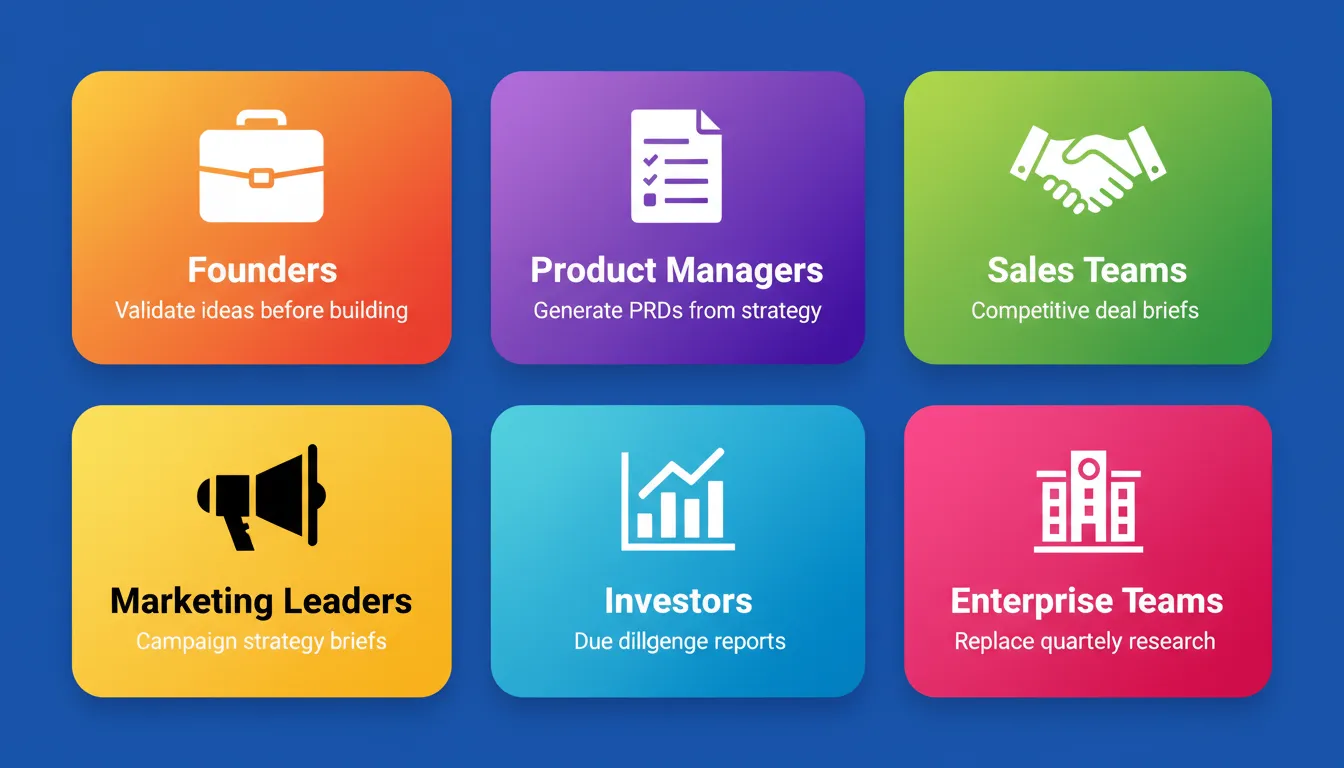
Solve serves three distinct types of users. Builders (founders, developers) use it to validate ideas and generate PRDs before writing a line of code. Operators (sales teams, marketing leaders, consultants, investors) use it to run intelligence and research operations. Enterprise teams use it to replace quarterly research with continuous intelligence.
For structured business research that goes beyond what any chatbot or aggregator can produce, Solve is the purpose-built tool.
![Six use cases for Solve on Rocket]
Founders Validating Ideas
A founder considering a new SaaS product uses Solve to run a market analysis before writing a single line of code. The output covers TAM/SAM/SOM, existing competitors with feature breakdowns, pricing benchmarks, and a direct recommendation on whether the direction holds up. This replaces weeks of manual research and multiple consultant calls.
Product Managers Writing PRDs
A PM uses Solve to generate a product requirements document from a strategic brief. Solve frames the problem, researches comparable products, identifies gaps, and produces a structured PRD with feature scoping and build-vs-buy analysis. The PRD is present in the Build task automatically. No re-explaining, no context loss.
Sales Teams Preparing for Competitive Deals
A sales team uses Solve to generate a competitive deal brief before a high-stakes call. The brief covers the prospect's likely objections, known competitor weaknesses, and positioning responses. This replaces the hours of manual research that previously happened the night before a call.
Marketing Leaders Planning Campaigns
A marketing leader uses Solve to generate a campaign strategy brief. The output covers audience segmentation, channel recommendations, competitive messaging analysis, and a recommended positioning angle. Ready to hand to the creative team.
Investors Running Due Diligence
An investor uses Solve to evaluate a potential portfolio company. The output covers market sizing, competitive landscape, team assessment signals, regulatory risks, and an investment thesis with supporting evidence. What would have taken a research team days is complete in 60 to 90 minutes.
Enterprise Teams Replacing Quarterly Research
An enterprise strategy team uses Solve continuously instead of commissioning quarterly research reports. Each Solve session builds on the context of previous sessions, so the intelligence compounds rather than resetting.
The Missing Piece Most AI Tools Skip
Software development has always had two problems: deciding what to build and building it. The last several years of AI progress solved the second problem remarkably well. Vibe coding tools can generate production-grade code from natural language prompts. But they all start at the same place: the blank prompt. They assume the direction is already decided.
Solve solves the first problem. It answers what to build and why before the first line of code is written. Because Solve and Build share compound context inside Rocket.new, the thinking does not get lost in the handoff. The research that validated the direction is present when the developer opens the build task.
| Stage | Earlier Approach | With Rocket |
|---|---|---|
| Research | Google and manual synthesis | Solve: structured report in 60–90 min |
| Decision | Spreadsheet and gut feel | Verdict with evidence and risk matrix |
| Build | Separate coding tool, blank prompt | Build with Solve output as foundation |
| Monitor | Manual competitor tracking | Intelligence: continuous automated monitoring |
| Context | Re-explained every session | Compounds across every task automatically |
Solve vs. Other AI Tools
| Tool | Primary Use | What It Cannot Do |
|---|---|---|
| Google Search | Retrieves ranked links fast | Synthesize, analyze, or recommend |
| ChatGPT | Conversational drafting and explanation | Structured research reports with evidence tagging |
| Perplexity | Cited web summaries | Strategic analysis with verdicts and risk matrices |
| Claude | Long-document analysis | Parallel multi-source research at scale |
| Gemini | Multimodal tasks | Business-specific structured deliverables |
| Solve on Rocket | Complete structured deliverables with evidence, verdicts, and build-ready output | General-purpose conversation or creative tasks |
For teams that need competitive intelligence for product strategy, or pricing decisions backed by live data, Solve and Intelligence together cover the full picture.
Why Rocket Is Built to Do This
1.5 million people have tried Rocket across 180 countries, from solopreneurs to enterprise teams. The platform is seed-funded and backed by leading venture firms. Solve was designed by practitioners who experienced the research-to-build gap firsthand and built the tool they needed but could not find.
The Solve product documentation is locked and version-controlled. Every capability claim in this article is sourced from Rocket's internal product documents. Solve is not a replacement for specialized professional advice. It delivers research intelligence, not legal, financial, or medical advice.
For Teams and Enterprise
Solve is not just for individual builders. Teams and enterprise users benefit from Solve's context persistence architecture. When a team member runs a Solve session, the output is available to every subsequent task in the project. No re-explaining. No context loss in the handoff between research and execution.
Enterprise use cases include replacing quarterly research reports with continuous intelligence, standardizing competitive deal brief generation across a sales team, generating PRDs from strategy memos at scale, running M&A due diligence in parallel across multiple targets, and onboarding new team members into unfamiliar verticals quickly.
The Future of Decision Intelligence: Why Solve on Rocket.new Matters
The broader shift underway is from AI as a retrieval layer to AI as a reasoning layer. Search engines retrieve. Chatbots converse. Decision intelligence platforms like Solve reason, structure, and recommend. As AI capabilities advance, the gap between retrieval and reasoning will widen.
Tools that can only retrieve will become commodities. Tools that can reason across multiple sources, identify conflicts, surface what was not asked, and deliver structured verdicts will become the standard for serious business decisions. 1.5 million people have tried Rocket across 180 countries, not because it is a better search engine, but because it gives them something no search engine can: a complete, structured answer they can act on immediately.
Ready to stop searching and start solving? Start building with Rocket today and run your first Solve session free. Any question. Any situation. A complete, structured output, ready to act on, present, or build from.
Table of contents
- -What is Solve on Rocket.new?
- -Three Things Solve Is Not
- -Why Solve Is Not a Search Engine
- -Why Solve Is Not a Chatbot
- -Chatbot vs. Solve: A Direct Comparison
- -A Concrete Example
- -Why Solve Is Not a Research Aggregator
- -What Solve Covers That Aggregators Do Not
- -What Solve on Rocket Actually Is
- -What Vibe Solutioning Means
- -How Solve Works: The Step-by-Step Process
- -Key Features of Solve
- -Real-World Use Cases: Who Uses Solve and How
- -Founders Validating Ideas
- -Product Managers Writing PRDs
- -Sales Teams Preparing for Competitive Deals
- -Marketing Leaders Planning Campaigns
- -Investors Running Due Diligence
- -Enterprise Teams Replacing Quarterly Research
- -The Missing Piece Most AI Tools Skip
- -Solve vs. Other AI Tools
- -Why Rocket Is Built to Do This
- -For Teams and Enterprise
- -The Future of Decision Intelligence: Why Solve on Rocket.new Matters