A market entry strategy is your structured plan for entering a new market. Choose the right entry mode, assess your target market thoroughly, and use competitive intelligence to move before rivals do. This guide covers frameworks, real-world examples, and tools to build a winning market entry plan.
Most businesses waste months on guesswork before committing to a new market. A well-built entry plan grounded in solid market research and the right entry mode cuts that waste and puts you ahead of the companies already set up in your target market.
The choice between exporting, licensing, joint ventures, or direct investment depends on your risk profile, resources, and how much control you need. Rocket.new's Intelligence product watches incumbents in your target market, tracking pricing, hiring, and product signals before you spend a dollar entering it.
What if the biggest risk in entering a new market isn't the investment, but stepping in without knowing what you're walking into?
A market entry plan gives you the framework to answer that question: which market, which entry mode, and which approach fits your resources and goals. The right entry strategy cuts wasted months and puts you ahead of the companies already set up in your target market before you've committed a dollar to building local presence.
According to the WTO, world trade in goods and commercial services grew 7% to US$34.65 trillion in 2025, the strongest pace in recent years. This guide walks through the core frameworks, entry modes, and real-world examples you need to build a plan that holds up.
What is a Winning Entry Strategy?
A winning entry strategy is a structured plan for bringing your products or services into a new market. It answers three core questions: who is the target market, which entry mode fits your risk tolerance and resources, and what goals define success.
A good market entry strategy sets clear boundaries before capital goes out the door. It defines the geography, the target market segment you're focusing on first, and the timeframe you're committed to. Common market entry strategies fail when copied from a competitor or chosen for speed alone.
The right approach depends on local conditions, your existing distribution capabilities, and the resources available. A market entry strategy involves more than picking a route. It's a living plan you adjust as you gather market feedback from real customers, not just category research reports.
Successful market entries often utilize local partners, distributors, or joint ventures to navigate cultural barriers and establish trust.
Other market entry strategies may look similar on paper, but context shapes everything. Market entry strategies include a broad spectrum of options. Start with a tight scope, prove the model, then expand to other markets.
Which Entry Mode Fits Your Business?
Not all paths into a new market carry the same cost, control, or risk. Your entry mode is the first real decision you'll make in your market entry plan, and it shapes every operational choice that follows.
 From indirect exporting to greenfield investment: each entry mode sits at a different point on the investment-control spectrum.
| Entry Mode | Investment | Control | Risk | Speed |
|---|---|---|---|---|
| Direct exporting | Low | Medium | Low | Fast |
| Indirect exporting | Very low | Low | Minimal | Very fast |
| Licensing | Minimal | Low | Medium | Fast |
| Franchising | Low | Medium-High | Shared | Moderate |
| Joint ventures | Medium | Shared | Shared | Moderate |
| Acquisition | High | High | High | Fast |
| Greenfield investment | Very high | Full | Very high | Slow |
Various forms of entry sit on a spectrum between control and commitment. The right entry mode depends on your company's risk appetite, time horizon, and how deeply you already understand the local market you plan to enter.
Organic Growth and Direct Exporting
Exporting is where most companies start when executing a market entry strategy. It is the lowest-cost path into a foreign market and the fastest way to test whether demand is real before committing bigger resources.
Direct exporting means selling your goods directly to foreign buyers or international distributors without an intermediary. It preserves margins but requires your team to handle logistics, local regulations, and customer expectations in the new market. Indirect exporting uses third-party agents or trading companies to reach buyers, lowering the barrier to entry while reducing visibility into how products are positioned and sold.
E-commerce platforms and online marketplaces now give companies a direct exporting channel without a physical presence. Direct exporting builds knowledge fast, your company starts gathering data on local tastes, customer preferences, and pricing dynamics from day one. That data makes your next market entry plan decision sharper.
Joint Ventures and Strategic Partnerships
When a market carries complexity that is difficult to navigate alone, local partners can be the difference between gaining a foothold and stalling for years. Understanding how to build a competitive intelligence program before entering a joint venture helps you evaluate partners with real data.
Joint ventures create a shared entity where both parties contribute capital, knowledge, and distribution networks. They're common in markets with complex regulatory requirements or where local presence is a prerequisite for winning sales. Strategic partnerships are less formal: two companies collaborate on distribution, marketing, or production while staying independent, sharing risk and costs without either side giving up full control.
The tradeoff is shared decision-making. Disputes can surface when cultural differences or misaligned business goals emerge later in the relationship. For markets where direct investment is restricted, joint ventures are often the most practical path to establishing a local presence.
Acquisition and Greenfield Investment
Direct investment through acquisition or greenfield investment gives you the highest level of control and the highest commitment of capital and management attention. Acquisition of an existing company transfers its customer base, distribution networks, and brand recognition, letting you skip the time needed to build all of that in a new country from scratch.
The downside is integration risk. Combining two businesses is where many deals break down, as culture clashes and incompatible systems eat into returns over time. Greenfield investment means building an entirely new operation in the foreign country, requiring full capital commitment and no shortcuts. It suits teams with deep knowledge of the local market and the resources required to build infrastructure.
Both approaches work best when long-term growth potential in the target market is clear and your company is ready to make a full commitment.
Licensing and Franchising
If you want reach without running foreign operations yourself, licensing and franchising let local operators carry the load. Licensing grants a licensee the right to produce or sell your goods or use your intellectual property in exchange for royalties, offering minimal investment and fast market access. Quality and brand standards, however, depend entirely on someone else.
Franchising goes further: the franchisee operates an entire business under your brand, following your processes and standards. McDonald's and Starbucks built their global operations largely through franchising because it allows rapid expansion without significant capital from the franchisor. The risk is IP protection, in some markets, enforcement is weak, which can erode the value of licensing contracts over time.
Licensing and franchising work when your model is replicable and your brand recognition is strong enough to attract capable local operators who share your standards.
How Do You Assess a Target Market Before You Enter?
The decision to enter a new market should never rest on gut feel. Structured research protects you from committing resources to the wrong place at the wrong time. Before executing market entry strategies in international markets, you need solid answers to three questions.
Measure the Market
Start with size. A market that looks attractive from the outside may be too small to justify the full costs of entry once local operations start.
Market size and demand signals tell you how large the total addressable opportunity is and whether it's expanding. The World Bank tracks FDI net inflows by country, a useful proxy for how aggressively companies are already betting on a market. Potential customers are a different question from who you want to sell to, you need to know what buyers actually spend on your category today.
Local business momentum matters too. Are companies growing capacity, or is the market saturating? Hiring trends, pricing moves, and production volumes are early signals worth tracking before you write a single line of your market entry plan.
 Global trade reached $34.65 trillion in 2025, a 7% increase and the strongest pace in recent years.
Map the Competition
Every market has players already. Knowing who they are and how they operate is as important as knowing the market size. A strong go-to-market strategy accounts for competitive dynamics from day one.
Direct and indirect competitors often have years of local relationships and established distribution networks that a foreign entrant cannot replicate quickly. Market share movements reveal who is gaining share and why, pricing trends, product updates, and sales volumes tell the competitive story far better than static reports.
Barriers to entry such as patents, exclusive distribution contracts, regulatory licenses, and established brand recognition all raise your cost of entry and extend your time to profitability. Regulatory barriers include high tariffs, strict import laws, or foreign ownership limits.
Understanding the competition before you commit tells you whether you need to fight for market share head-on or find an underserved customer segment to occupy first.
Cultural Differences and Local Regulations
Market attractiveness means little if local regulations make it impossible to operate profitably from the start. Many industries in many countries require local certification, government approval, or a local partner to hold a license, and complex regulatory requirements can add months or years to your entry timeline.
International trade policies and import quotas affect your cost structure from day one. The ITA Country Commercial Guides provide detailed country-level data on local business conditions. Beyond legal compliance, how business is done, how agreements are made, and what customer expectations look like vary considerably across regions.
A full regulatory check is not optional. It often reveals that the "easy" market is not easy at all.
Patrick McKenzie, who ran a software business in Japan for over a decade, described the reality of local market complexity:
"Penetrating the Japanese market virtually requires either a local office...or an arrangement with a Japanese distributor. In general, relationships between vendor, distributor, and ultimate customer can be fraught. If you're coming to Japan, think long and hard about the distributor decision, as cutting them out of the loop is seen as unseemly behavior, but keeping them in the loop if they're inefficient virtually dooms your chances here." — Doing Business In Japan
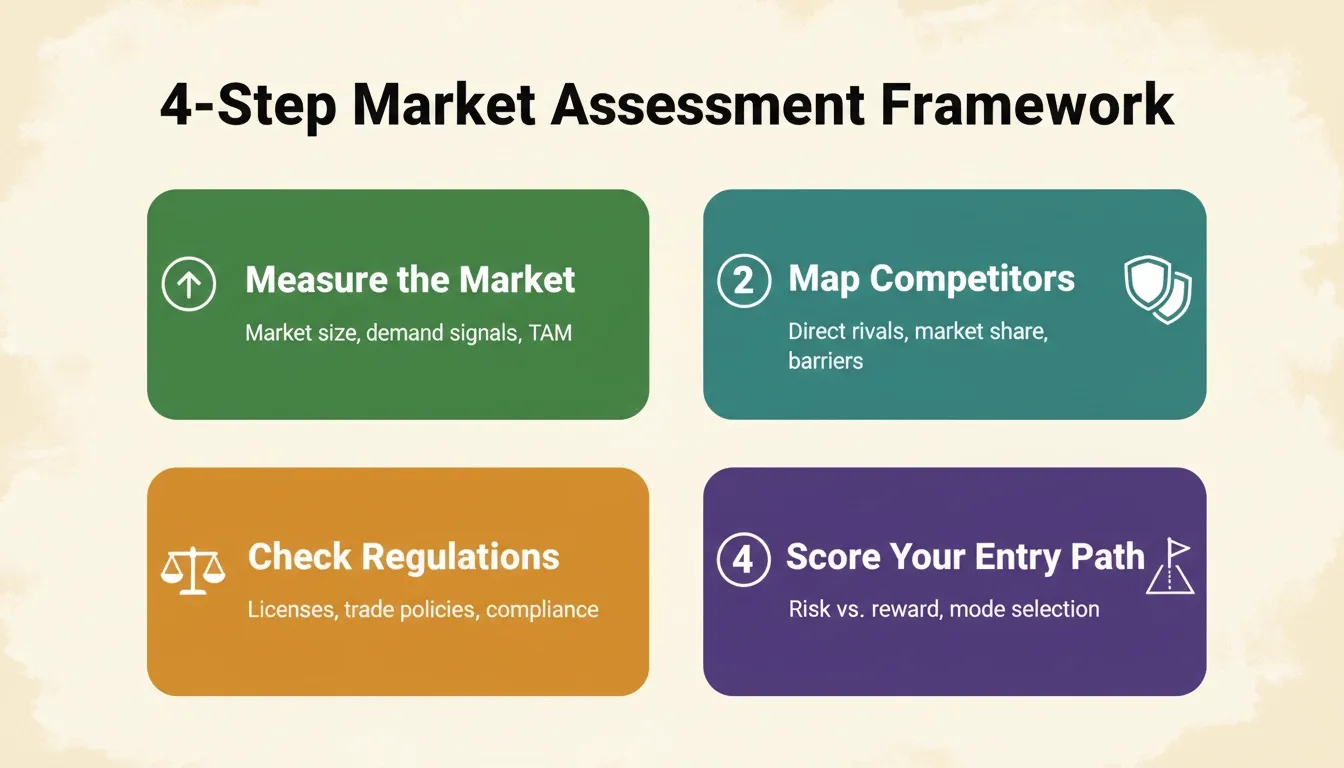 Four steps to assess any target market before committing capital: size, competition, regulation, and entry path scoring.
Real-World International Market Entry Examples
Four well-known companies, four different approaches. The pattern across all of them: none used a one-size-fits-all market entry strategy. Global market entry strategies work best when they're built around the specific dynamics of each region.
Coca-Cola
Coca-Cola built its international market presence largely through licensing and local bottling partnerships. Rather than owning all production in every new country, the company licenses its formula and brand to local businesses who manage production, distribution, and direct sales.
This asset-light model let Coca-Cola expand into international markets without carrying the full cost of building infrastructure everywhere, making it one of the clearest examples of using licensing to achieve brand recognition at global scale.
McDonald's
McDonald's used franchising to enter markets from Japan to India to Brazil, adapting menus to local tastes while keeping operational standards consistent. Its successful market entry into India is a widely studied case of cultural adaptation, the menu shifted significantly to respect local customs and dietary preferences, and that flexibility is credited with driving long-term growth.
McDonald's entry strategy in India shows how the same entry mode can produce different outcomes depending on how well a company reads local tastes.
Netflix
Netflix used a phased international expansion approach, entering a small number of international markets first, gathering market feedback, adjusting content and pricing, then scaling. Entering international markets in stages let Netflix build a working model before committing to markets it knew less well. Low-cost local pricing and locally produced content were part of how the company adapted its market entry plan to each new country.
Starbucks
Starbucks entered China through joint ventures with local partners before shifting to wholly owned subsidiaries as the market matured. The initial partnership reduced risk while the company learned about local business culture and supply chain dynamics.
Its international market entry approach in China shows that a global market strategy doesn't have to be static, you can shift entry mode as your knowledge of the local market deepens and your brand recognition grows.
Size Your Market, Map Your Rivals, Move First
What the four examples above share is access to intelligence before they committed. Coca-Cola knew bottling partners were a better model than owned plants in each new country. McDonald's knew menu adaptation would be required in India. Netflix knew local content would drive retention in each international market.
That intelligence came from deep research, the kind that traditional analyst teams take weeks or months to gather, and that often arrives too late. Rocket Intelligence changes that model. It tracks companies continuously, watching pricing moves, hiring signals, product updates, and news across the entities in your target market.
-
Market sizing before entry. Before you write a market entry plan, you need to know who is operating in the target market segment, how fast they're growing, and whether they're hiring. Rocket gives you that data on demand.
-
Real-time competitor signal feeds. Traditional market research gathers data on competitors at one point in time. Rocket watches them continuously, so pricing changes, product releases, leadership shifts, and partnership announcements land in your feed the moment they happen.
-
Ten intelligence pillars in parallel. Rocket tracks ten dimensions of competitor activity simultaneously, from Website and GTM to People and Reviews, so you gather feedback on how a market is moving before you've spent a dollar entering it.
-
Strategy based on facts, not assumptions. Most market entry strategy mistakes are assumption errors. Rocket surfaces anomalies and convergent signals that would take an analyst team weeks to find manually.
Tools like Crayon or Klue offer competitive dashboards, but they require significant setup time and annual contract commitments. Rocket.new works in 30 seconds, follow your first company free, no credit card required.
Rocket Intelligence tracks ten pillars of competitor activity, from hiring signals to product releases, giving your team a complete picture before market entry.
Ready to size your market and map the incumbents?
Start with Rocket Intelligence. Explore how competitive strategy frameworks apply to your specific industry.
Choosing the Right Path Forward
A well-chosen entry mode, backed by solid market research, gives your business a real advantage when stepping into unfamiliar territory. The frameworks in this article are a starting point. The real work is translating them into decisions grounded in local data, competitive knowledge, and a clear-eyed view of what your resources can actually support.
What separates companies that succeed in new markets from those that stall is not bigger budgets. It is better information, faster. The right market entry strategy becomes far easier to find when you start with the right tools and the right competitive intelligence.
Ready to build your market entry plan with real competitive intelligence?
Sign up for Rocket and follow your first target market company free, no credit card required.
Table of contents
- -What is a Winning Entry Strategy?
- -Which Entry Mode Fits Your Business?
- -Organic Growth and Direct Exporting
- -Joint Ventures and Strategic Partnerships
- -Acquisition and Greenfield Investment
- -Licensing and Franchising
- -How Do You Assess a Target Market Before You Enter?
- -Measure the Market
- -Map the Competition
- -Cultural Differences and Local Regulations
- -Real-World International Market Entry Examples
- -Coca-Cola
- -McDonald's
- -Netflix
- -Starbucks
- -Size Your Market, Map Your Rivals, Move First
- -Choosing the Right Path Forward