
ABM focuses your entire go-to-market effort on a defined set of high-value accounts instead of casting a wide net. It aligns sales teams and marketing teams on one shared list, producing higher deal sizes, faster sales cycles, and a stronger pipeline from the accounts that matter most.
Why do B2B marketing campaigns often fail to hit pipeline targets?
Because most leads generated never match the accounts sales teams actually care about closing. ABM fixes that by flipping the funnel: you choose target accounts first, then build every campaign, message, and play around them.
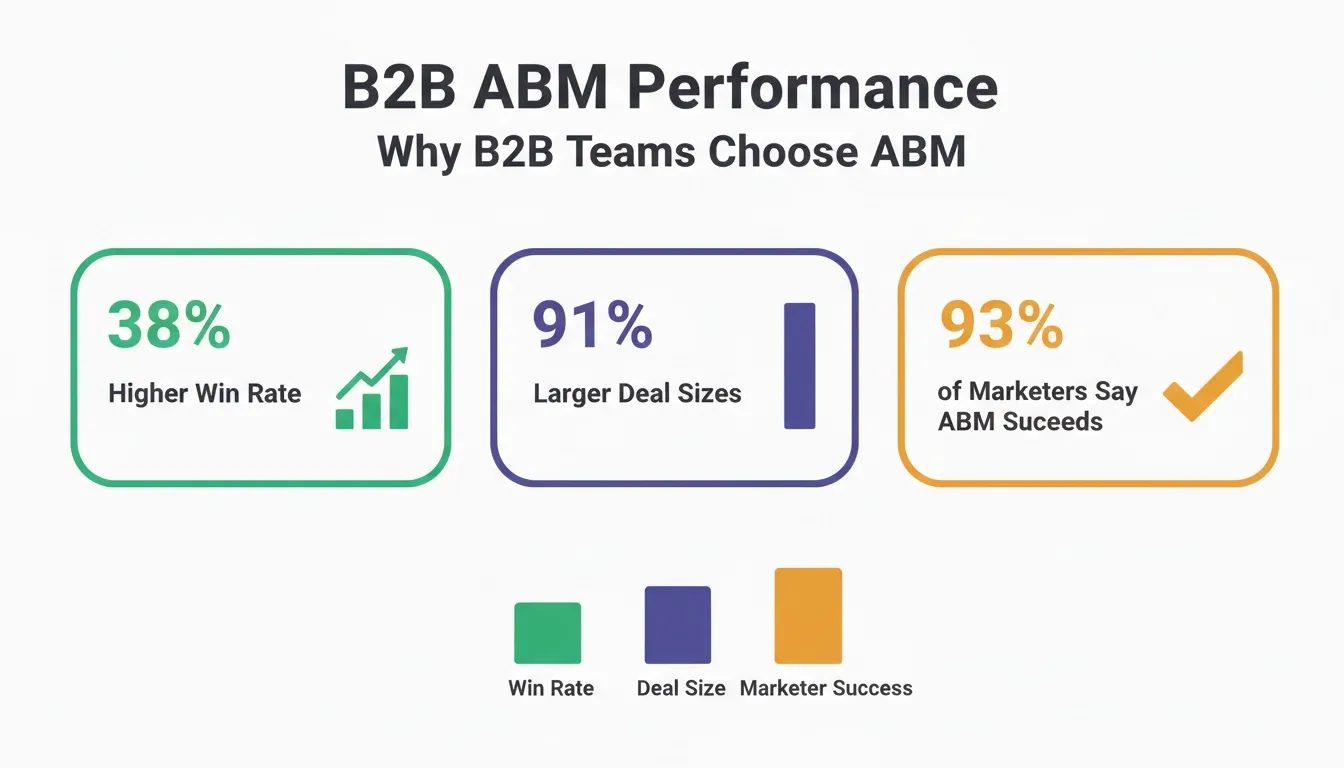
B2B companies running ABM programs report a 38% higher sales win rate and 91% larger deal sizes, according to Salesforce. The strategy works because it treats each account as its own market, not one lead among thousands. Aligning sales and marketing teams on shared goals is what separates programs that close from those that stall.
This guide covers what ABM is, how it differs from other approaches, and how to build programs that drive real pipeline.
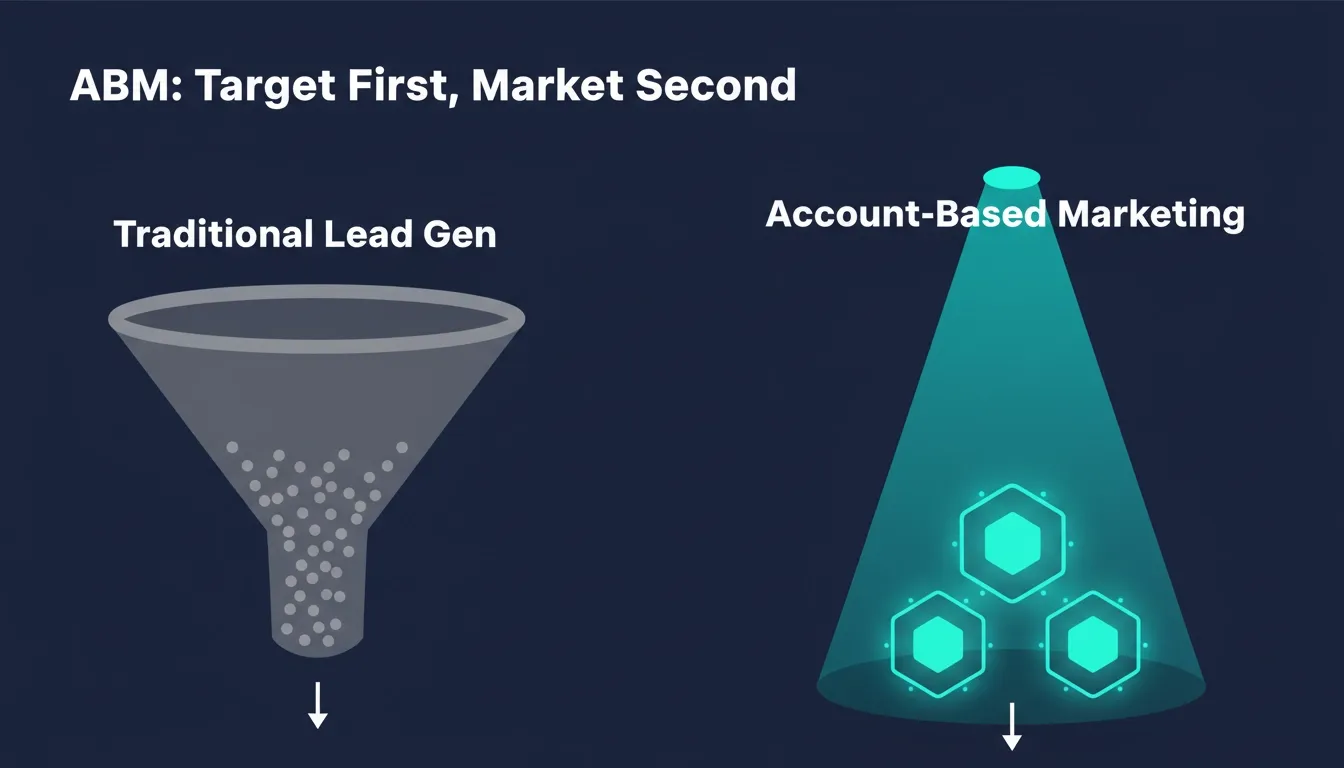 ABM flips the funnel: select your target accounts first, then build every campaign around them.
What is ABM?
ABM treats each company you want to win as its own market of one. Rather than generating leads and filtering them later, you choose the accounts first: every piece of personalized content, outreach motion, and sales play flows from that decision.
-
ABM focuses resources on a defined set of target accounts, not a broad audience
-
Sales teams and marketing teams work from the same account list, aligned on goals and messaging
-
Personalized content is built around each target account’s pain points, industry context, and buying committee
-
Outreach reaches every key stakeholder at the account, not just the one contact who responded first
-
Results are measured at the account level: pipeline, account engagement, deal size, and revenue
The Three ABM Tiers
| Tier | Name | Scale | Personalization Level |
|---|---|---|---|
| 1 | One-to-one (Strategic ABM) | 5–30 accounts | Fully custom content and plays per account |
| 2 | One-to-few (ABM Lite) | 20–100 accounts | Segment-level content tailored to clusters of similar accounts |
| 3 | One-to-many (Programmatic ABM) | 100–1,000+ accounts | Automated, data-driven personalization at scale |
Many mature ABM programs run all three tiers simultaneously, targeting different segments of their account list based on revenue potential and deal complexity. The tier you choose determines your investment level, but the core philosophy stays the same: treat each target account as its own audience, not a lead in a pool.
How Does ABM Differ from Inbound and Demand Gen?
ABM, inbound marketing, and demand generation all aim at the same outcome: revenue. The path each takes is fundamentally different, and knowing when each makes sense is one of the more practical decisions any B2B marketing leader faces.
-
ABM: Starts with a defined target account list and works outward. You decide which accounts matter, then build personalized campaigns around them
-
Inbound marketing: Starts with content and waits for ideal accounts to find you, strong for brand awareness and top-of-funnel volume
-
Demand generation: Casts broadly across your market to build a pipeline, powerful for scale, but weaker on per-account relevance
-
The account-based difference: An account-based ABM strategy pre-selects the target accounts that matter most, then points every marketing effort at them instead of filtering leads after the fact
Many mature ABM programs run alongside inbound marketing rather than replacing it. A target account that downloads your whitepaper through inbound becomes an ABM signal your sales teams can act on right away. The two strategies share data to become more powerful together.
How Do You Build a Target Account List?
A target account list is only as good as the criteria behind it. More than 9 in 10 B2B technology marketers now use intent data to prioritize accounts, showing how central data-driven selection has become to modern ABM strategy.
-
Define your ICP: Start with your ideal customer profile, which industries, company sizes, and revenue bands match your best existing accounts and most valuable customers?
-
Score for fit: Pull CRM data on your closed-won deals and identify shared characteristics: tech stack, headcount, funding stage, and growth trajectory to help identify key accounts most likely to deliver the highest returns
-
Layer in intent: Use third-party signals to find which target accounts are actively researching your category. HubSpot’s research confirms 93% of marketers say personalization improves lead quality and purchasing outcomes
-
Map the buying committee: For each shortlisted account, identify decision makers and key stakeholders, CFOs, department heads, and end users, because B2B purchases usually involve multiple stakeholders, and mapping the committee is essential to cover the full decision process
-
Rank and tier: Sort target accounts by revenue potential, deal size, and available resources; tier-one high-value accounts get the most investment, tier-three accounts run on automated personalization
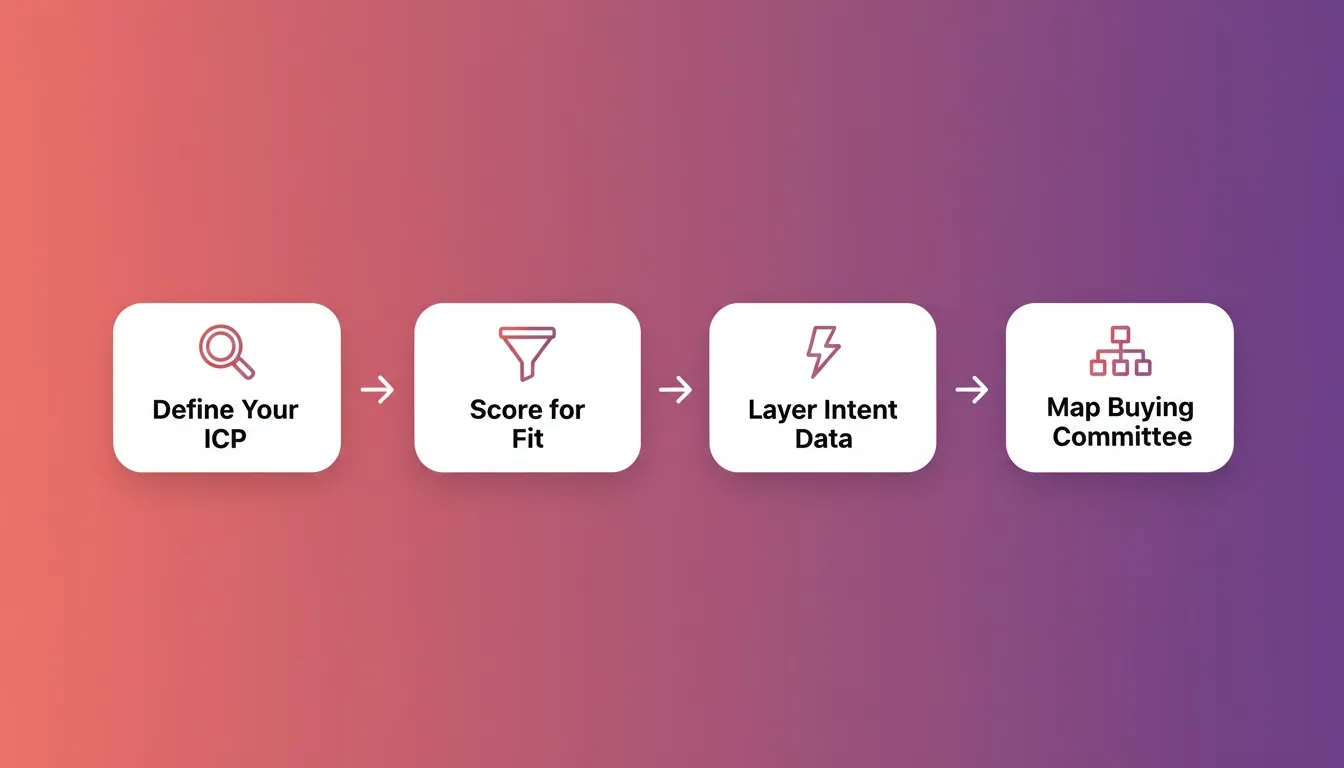 A structured account selection process separates ABM programs that generate pipeline from those that stall.
Revisit your target account list every quarter. Buying committees change, new high-value target accounts emerge, and existing accounts shift in priority as your business grows.
Understanding your ideal customer profile (ICP) is the foundation of every effective account list; without a sharp ICP, even the best intent data will surface the wrong accounts.
What Signals Tell You an Account Is Ready?
Not every target account on your list is in-market at the same time. Knowing which accounts are showing active buying signals right now is what separates reactive outreach from timely, relevant engagement, and these signals help teams identify marketing-qualified accounts at the account level instead of relying only on individual leads.
-
Intent signals: Third-party data showing a target account is actively searching topics related to your category
-
Engagement data: Buying committee members opening emails, visiting your website, or consuming your content across channels, with metrics such as total website visits and time spent by target accounts, helping show how active that account really is
-
Trigger events: A new executive hire, a funding round, or a product launch. These often reset the buying timeline at strategic accounts
-
CRM activity: A dormant account that suddenly re-engages through inbound channels or direct outreach from a sales rep
Your sales teams always know which high-value accounts to prioritize before a competitor does when account-level signals are surfaced in real time.
Orchestrating Plays Across Sales and Marketing
A strong target account list means nothing if sales teams and marketing teams run their ABM campaigns in separate silos. As G2’s B2B marketing community reports, “93% of B2B marketers reported that their ABM efforts have been extremely or very successful”, a number that reflects what separates productive ABM programs from those that never gain traction (G2, 2025).
Coordinated marketing and sales efforts keep messaging, interactions, and content consistent across the same accounts, creating a more seamless customer experience.
-
Account kickoffs: Before any ABM campaign launches, sales and marketing align on the account’s pain points, key stakeholders, and current stage in the sales cycle
-
Play selection: Match the right play to where the account sits, awareness for cold accounts, consideration for engaged accounts, and acceleration for accounts already deep in the sales process
-
Personalized campaigns: Marketing may use account-based advertising alongside personalized emails to reach the account first; sales then follow up with a conversation that references what the account has already seen
-
Feedback loops: Sales reps share what is resonating; marketing teams adjust messaging and creative based on real signals from the target account
-
Account-level measurement: Track account engagement, pipeline from ABM accounts, deal size, and sales cycle length, not raw lead counts
Over a quarter of marketers cite sales-marketing alignment as a top ongoing challenge, according to HubSpot’s State of Marketing data. Fixing that gap is not optional for ABM, coordination between teams is what makes the whole strategy work. B2B companies with ABM programs report a 38% higher sales win rate and 91% larger deal sizes, resulting in 24% faster revenue growth.
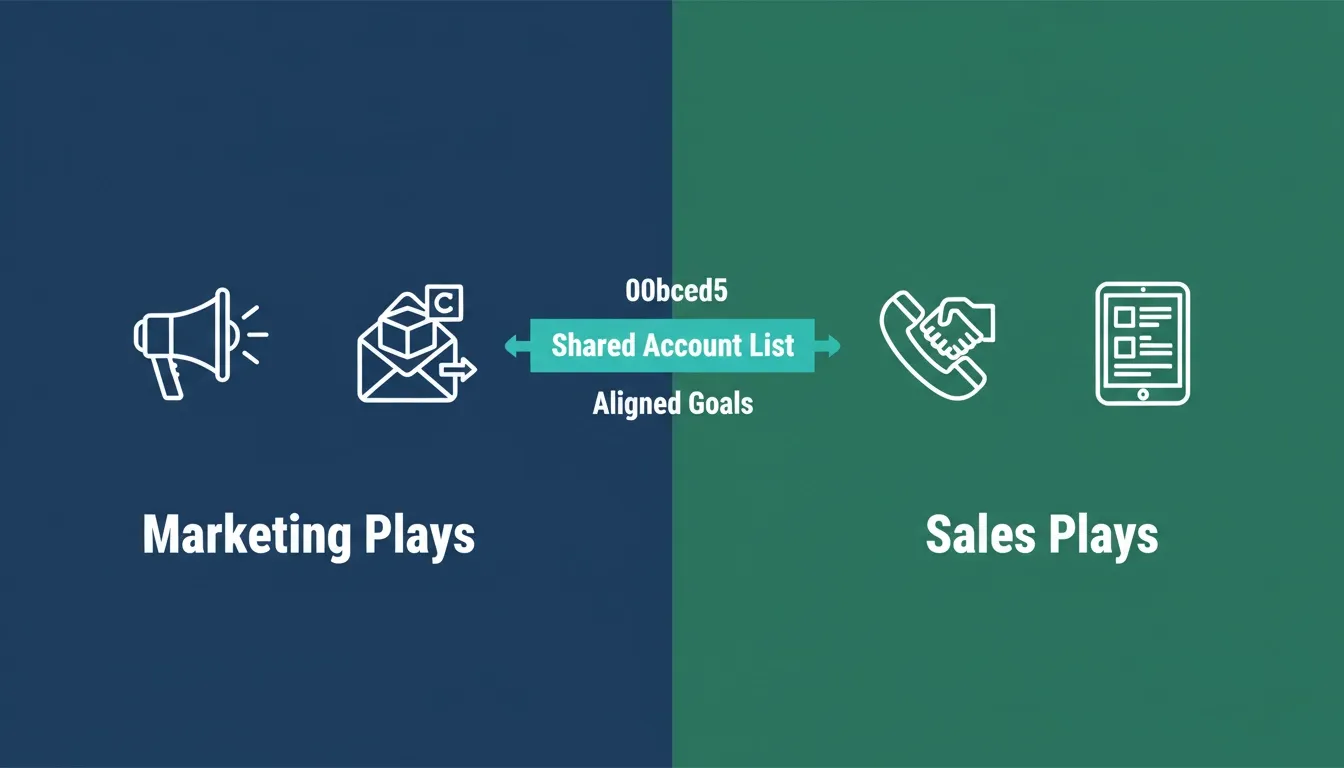 When sales and marketing operate from the same account list, every touchpoint reinforces the same message.
A well-structured go-to-market strategy is the backbone that connects your ABM account list to coordinated plays across both teams.
How Do Sales and Marketing Teams Stay Aligned?
Alignment does not happen by accident. ABM success across all tiers depends on three shared foundations: a shared account list, a shared definition of what “ready” means, and a regular review cadence, with sales and marketing agreeing on how they will engage the entire account, not just one contact.
-
Weekly syncs on active accounts: Short-standing meetings where sales reps share buying committee signals and marketing teams update on campaign performance while reviewing the customer journey across active target accounts, so both teams know what each stakeholder has seen
-
Shared CRM notes: Every touchpoint from both teams is logged in one place within a customer relationship management system, giving both teams one view of account history, so no account context is lost between handoffs
-
Agreed scoring criteria: Both teams decide in advance what moves a target account from “aware” to “engaged” to “ready for outreach.”
-
Clear tier ownership: Marketing leads on tier-three programmatic ABM; sales and marketing co-own tier-one strategic accounts together
When alignment is strong, the account sees consistent, relevant engagement across every channel. When it breaks down, ABM programs stall, and the investment in a clean target account list goes to waste, which is why strong alignment depends on close coordination between sales and marketing departments.
ABM and the Broader Revenue Stack
ABM does not operate in isolation. The most effective programs connect account intelligence to the account-based marketing tools your revenue teams already use, CRM, marketing automation, and sales engagement platforms, so execution systems stay aligned.
| Tool Category | ABM Role | Key Integration Point |
|---|---|---|
| CRM (e.g., Salesforce, HubSpot) | Central account record and pipeline tracking | Sync account list, buying committee contacts, and deal stage |
| Intent Data Platform | Surface in-market accounts | Feed signals into account scoring and prioritization |
| Marketing Automation | Run personalized campaigns at scale | AI and automation help teams identify target accounts, trigger account-specific sequences, and personalize outreach at scale |
| Sales Engagement | Coordinate outreach across the buying committee | Help teams target key customers with a customized approach and move them through the sales process |
| Analytics / BI | Measure account-level outcomes | Track pipeline, deal size, sales cycle by ABM tier, and campaign performance to optimize strategy over time |
A 2022 Gartner survey found ABM improved ROI across five key areas. The programs that generate the most pipeline treat their ABM stack as a connected system, not a collection of separate tools.
Each layer feeds the next: intent data informs the account list, the account list drives campaign targeting, and campaign engagement feeds back into CRM scoring and other sales functions.
Building B2B sales intelligence into your ABM stack is what turns a static account list into a living, prioritized pipeline engine.
What Rocket Does for Your ABM Programs
Running strong ABM programs requires more than a plan and a spreadsheet. A strong account-based marketing strategy needs live data and execution support: which high-value accounts are in-market right now, which buying committee members to engage first, and what play will actually land.
-
Live intent signals at the account level: See which target accounts are actively researching your category right now, so outreach happens at exactly the right point in their sales cycle
-
Buying committee mapping: Identify key stakeholders and decision makers at each account, complete with contact details and role context
-
Account scoring built on your ICP: Rocket enriches your target account list against your own customer data, surfacing the highest-fit, highest-intent accounts first
-
Personalized content triggers: When a target account shows buying signals, Rocket flags which play or content is most relevant, helping teams create account-specific messaging and personalized messaging for individual accounts while cutting the manual research burden on your marketing teams
-
CRM-native workflow: Account data flows directly into your existing tools, helping teams engage accounts faster while reducing manual work for marketing resources and sales functions
This is especially useful for long sales cycles where teams need efficient use of marketing resources.
ABM programs that run on live account intelligence consistently outperform those relying on static lists.
Tools like 6sense and Demandbase offer intent data for ABM programs, but they come with enterprise-level pricing and complexity that most mid-market ABM teams never fully use. Rocket gives your team the core account intelligence they actually act on: accurate data, fast signal delivery, and a significantly lower cost.
Pair your ABM motion with strong sales intelligence software to ensure every account interaction is informed by the freshest signals available.
ABM Programs That Actually Move Pipeline
ABM is not a shortcut. It takes genuine alignment between sales teams and marketing teams, quality data on your target accounts, and a commitment to treating each account as its own market. The teams that get this right see faster sales cycles, bigger deals, and stronger relationships with the accounts that matter most, including better retention and customer experience for high-value customers, because the approach is more personalized.
The difference between ABM programs that produce real revenue and those that stall typically comes down to data quality and team coordination. Start with a clear ICP, build your target account list thoughtfully, and use tools that surface the right signals at the right time. Done well, ABM can also deliver outsized marketing ROI compared with broader marketing efforts.
Ready to sharpen your ABM programs? Rocket.new gives your team live account intelligence, enriched target account lists, and buying committee data, everything you need to run plays that actually close and support business growth as you expand business within an existing customer base.
Start building with Rocket and see how fast your ABM programs move when they run on live, accurate data.
Table of contents
- -What is ABM?
- -The Three ABM Tiers
- -How Does ABM Differ from Inbound and Demand Gen?
- -How Do You Build a Target Account List?
- -What Signals Tell You an Account Is Ready?
- -Orchestrating Plays Across Sales and Marketing
- -How Do Sales and Marketing Teams Stay Aligned?
- -ABM and the Broader Revenue Stack
- -What Rocket Does for Your ABM Programs
- -ABM Programs That Actually Move Pipeline