
Sales triggers are real events like funding rounds and leadership changes that signal a company is ready to buy. B2B teams acting on these buying signals within 24-48 hours convert at up to 4x higher rates than cold outreach.
Why do some sales reps close deals at exactly the right moment while others miss the opportunity entirely?
The answer often comes down to trigger events.
B2B sales teams that act on buying signals convert at rates up to 400% higher than teams relying on generic cold outreach, according to research on sales trigger event conversion rates. That is exactly what trigger events and trigger-based selling prove.
Understanding which sales trigger events matter most and when to act separates top performers from everyone else. Most reps miss the window. This blog covers the trigger types worth tracking, how to build plays around them, and how to stop losing deals to better-timed competitors.
What Are Sales Trigger Events?
Sales trigger events are specific, observable changes at a company that signal a shift in buying conditions. When a company secures funding, appoints a new executive, expands to a new market, or announces a product launch, its vendor relationships go under review and budget conversations become active.
These events are not abstract signals. They are real, timestamped, and verifiable.
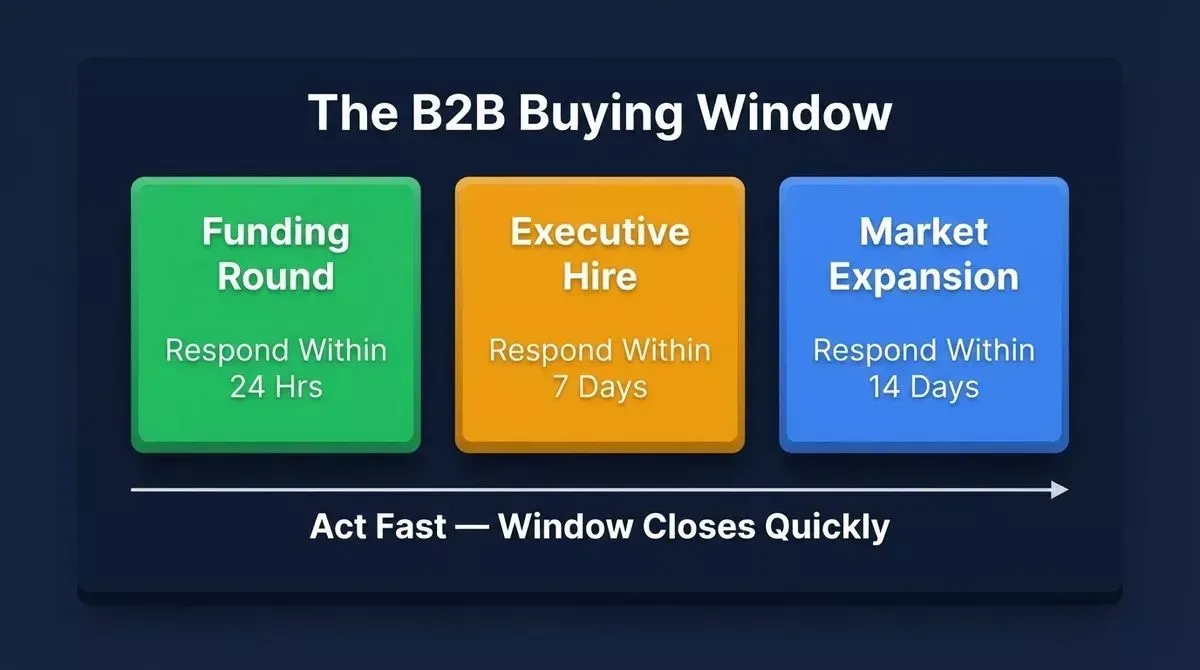
Three trigger event types and their optimal response windows. The buying window closes fast.
How Trigger Events Differ From Intent Data
Intent data tells you what topics a company is researching. A trigger event is something that actually happened: a real-world occurrence that changes what a company needs. The practical difference: intent data gives you a topic to reference; trigger events give you a reason to call right now. For a deeper look, see how to spot in-market accounts early using buyer intent data.
Internal vs. External Trigger Events
External triggers are observable changes: funding rounds, leadership changes, product launches, mergers, or geographic expansion. Internal triggers are changes in the relationship itself, such as a contact who changed jobs or a contract nearing expiry. Both types create urgency but call for different outreach approaches.
Why Is Timing the Real Advantage in B2B Sales?
At any given moment, roughly 3% of your target market is actively evaluating solutions. The first seller to reach a decision-maker after a trigger event fires is five times more likely to win the deal, according to this research. Sales triggers give you a defensible reason to move first.
The Business Case for Trigger-Based Selling
- Trigger-based approaches produce 4x higher conversion rates vs. generic outbound
- Many sales teams report that the majority of their highest-value B2B engagements now originate from signal-based triggers
- The first responder captures 33-50% of deals in competitive trigger scenarios, according to this research
The Highest-Signal Triggers Worth Acting On
Not all trigger events are created equal. Some fire a narrow window that closes within 24-48 hours. Others open selling conversations that stay warm for weeks.
New Funding Rounds and Capital Announcements
When a company closes a new funding round, money is available and pressure exists to deploy it fast. Reach out within 24-48 hours of funding announcements. That window has the highest executive accessibility and lowest competitor saturation.
Companies securing Series B+ funding show 22% higher spending on operational tools within six months, according to signal-based selling research. Funding rounds represent one of the clearest buying signals in B2B because budget availability, mandate to grow, and urgency all converge at the same moment.
New Executive Hires and Leadership Changes
New executives are significantly more likely to bring in new products or services than a tenured leader in the same seat. A new CEO, CFO, CMO, or CTO typically puts a full vendor review on the agenda within the first 30-60 days.
Leadership changes generate outbound response rates of 14% versus 1.2% for standard cold calls, according to research on signal-based selling. Miss the 90-day window on a key executive hire and you may wait until the contract renewal cycle for the next opening.
Expansion: Hiring Surges, New Markets, and New Offices
When a company expands rapidly, its needs change faster than its existing vendor stack can keep up. Hiring surges in specific departments visible in job postings signal where the company is investing before any press release confirms it. These are immediate needs, not theoretical future ones.
M&A, Product Launches, and Earnings Calls
M&A activity forces vendor consolidation and tech stack reassessment. Companies undergoing mergers frequently review a large portion of their vendor relationships within 12 months. When a CEO references a strategic initiative on an earnings call, that is a direct indicator of where budget is about to be allocated.
When a company shows multiple triggers firing at once, that stack should be treated as a Tier 1 outreach priority over single-trigger accounts.
Which Triggers Convert Best?
| Trigger Type | Response Window | Conversion vs. Cold | Primary Signal Source |
|---|---|---|---|
| Funding Announcement | 24-48 hours | Very high (4x+) | Funding databases, press releases |
| Executive Hire | 7-30 days | High (5-10x) | LinkedIn, industry news |
| Expansion / New Markets | 7-14 days | High | Job postings, company announcements |
| M&A Activity | 30-90 days | Very high (extended) | SEC filings, financial news |
| Product Launch | 7-21 days | Moderate-high | Company websites, earnings calls |
| Hiring Surge | 14-30 days | Moderate | Job postings, LinkedIn |
Trigger events consistently outperform cold outreach. Funding and executive hires lead to conversion rate.
Building Trigger-Based Outreach Plays
Knowing which trigger events to watch is half the equation. The other half is building a process that catches them reliably and turns them into fast, contextually relevant outreach.
How Do You Track Trigger Events Without Missing the Window?
The most common mistake is trying to monitor trigger events through disconnected manual checks. Google Alerts introduces latency. By the time you confirm a trigger event manually, the 24-48 hour high-conversion window may have already closed. For teams looking to build a more systematic approach, understanding prospecting tools for sales teams helps identify which monitoring stack fits your motion.
Building Your Trigger Hierarchy
Not all triggers deserve the same urgency or response. Building this hierarchy forces the team to make explicit decisions about what matters most.
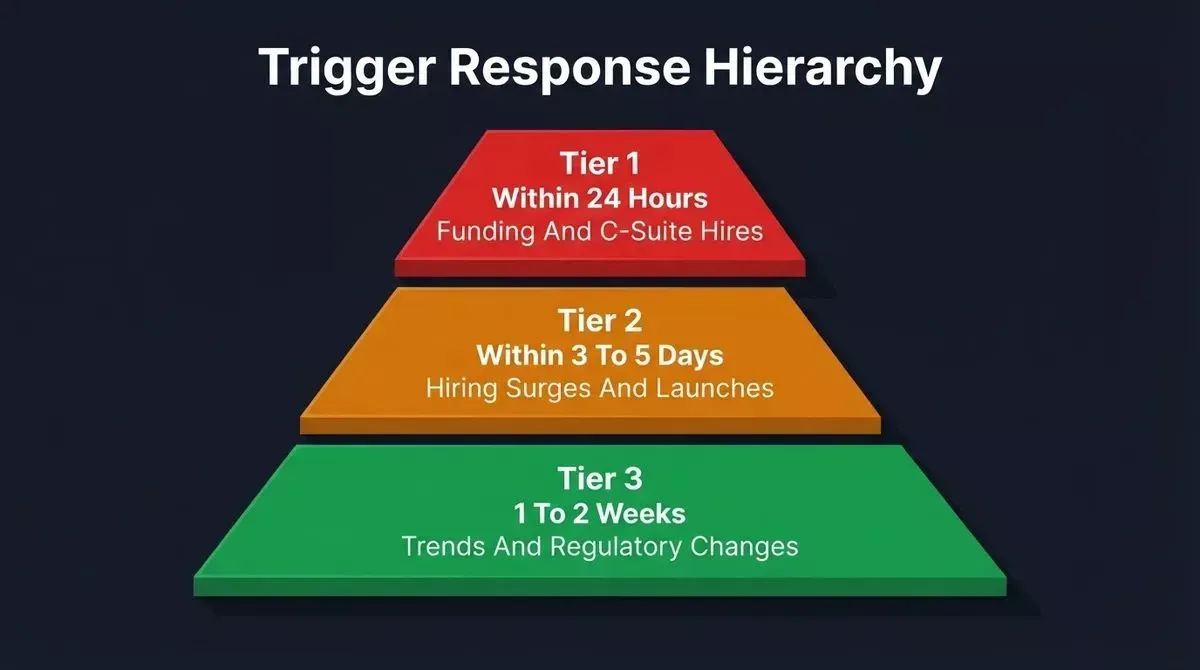
Your trigger hierarchy determines who gets contacted first and how fast. Tier 1 signals demand for same-day personal outreach.
- Tier 1 - Immediate (within 24 hours): Funding announcements; new C-suite or VP-level hires; competitor churn signals. Personal outreach from a senior rep.
- Tier 2 - Priority (within 3-5 days): Hiring surges; product launches; M&A news. Enter a structured, trigger-personalized sequence.
- Tier 3 - Monitor and nurture (1-2 weeks): Industry trends; regulatory changes. Inform existing cadences.
Understanding how to build a lead scoring model that sales reps trust helps teams prioritize trigger-based accounts more systematically. For teams running account-based programs, account-based marketing frameworks map directly onto how trigger tiers should be operationalized.
What Should Your Outreach Say?
Effective signal-based outbound names the specific trigger, connects it to a plausible outcome for the prospect's role, and asks one low-friction question. GTM strategist Maja Voje captured the principle precisely: "Outreach isn't a numbers game. It's a relevance game." See The GTM Outreach Playbook: From Triggers to Demos (LinkedIn, June 2025).
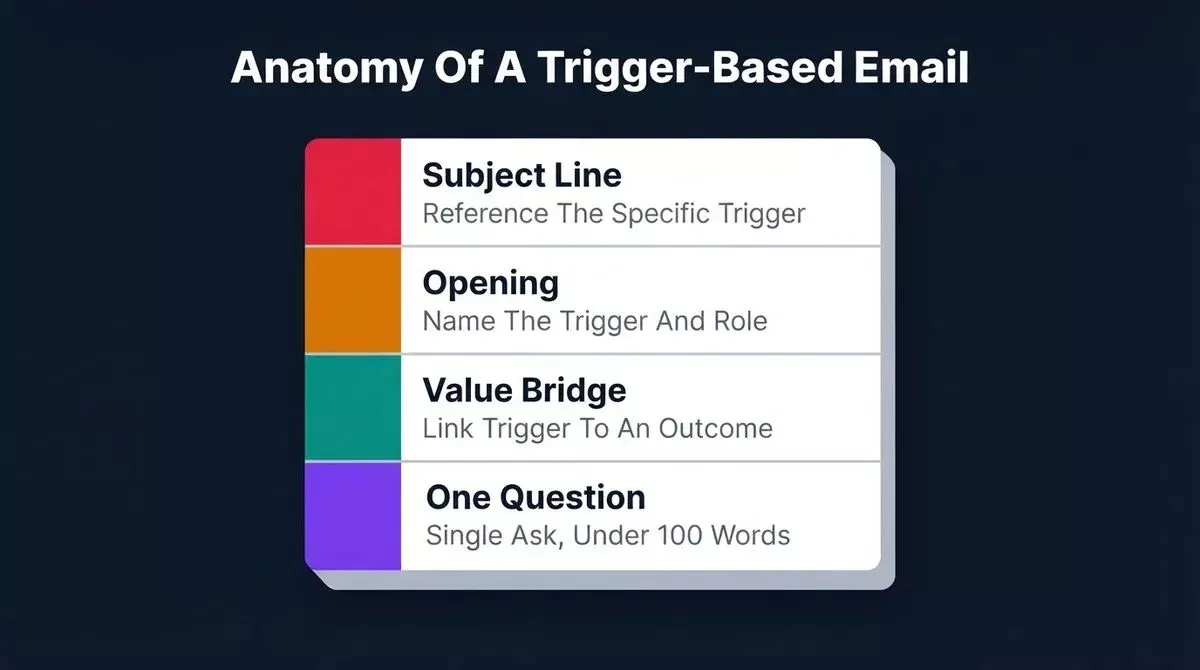
The four-part structure of a high-converting trigger-based email. Specificity in every section is what separates replies from deletes.
Timing Your First Touch for the First-Mover Advantage
Contacting a lead within five minutes of a high-intent signal makes you 21 times more likely to convert them into a sales opportunity. Set SLAs by tier: Tier 1 trigger events get a response within 24 hours, no exceptions. Treat Tier 1 response time as a sales KPI.
Common Mistakes That Cost You the Deal
Acting on stale data is the most common failure. A trigger event two weeks old is no longer timely. Generic congratulations messages that reference the event without connecting it to a relevant implication signal you didn't do the work. Over-automating the first touch costs deals on Tier 1 triggers.
How Rocket Keeps Your Sales Team One Step Ahead
Rocket Intelligence is an interpretation layer, not a simple alerting system. When a signal appears across any of the surfaces Rocket monitors, it is evaluated against everything else happening simultaneously: other signals in the same window, the company's historical patterns, and your specific business context.
Sales teams using Rocket for competitive intelligence before enterprise deals close report faster response times and more relevant first-touch messaging.
Nine Signal Pillars Rocket Intelligence Monitors Continuously
| Signal Pillar | What It Monitors |
|---|---|
| Website | Pricing updates, feature announcements, messaging shifts |
| Social | Posts, campaigns, engagement patterns across all major platforms |
| News and Media | Press releases, media mentions, partnership announcements |
| GTM | Go-to-market moves, positioning changes, channel expansions |
| Traffic | Audience growth, traffic pattern shifts, engagement changes |
| Product and Technology | Feature releases, tech stack changes, product direction signals |
| People and Hiring | Executive hires, headcount changes, hiring velocity, open roles |
| Business and Finance | Funding rounds, financial filings, M&A activity, revenue signals |
| Reviews and Community | G2, Glassdoor, Capterra, sentiment shifts flagged as they emerge |
How Rocket Intelligence Interprets Signal Context
Most sales intelligence tools tell you what happened. Rocket Intelligence tells you what it means for your position. Rocket reads signal clusters across all nine pillars, not individual data points. Context from last week informs this week's outreach, and nothing resets between sessions.
How the Daily Intel Feed Works in Practice
Ranked Intel cards surface the most significant changes first across all nine signal pillars. Each card includes an interpretation of what the signal means for your competitive position, plus specific recommended next steps. The feed updates continuously, so the most important signal of the day is waiting when you open it.
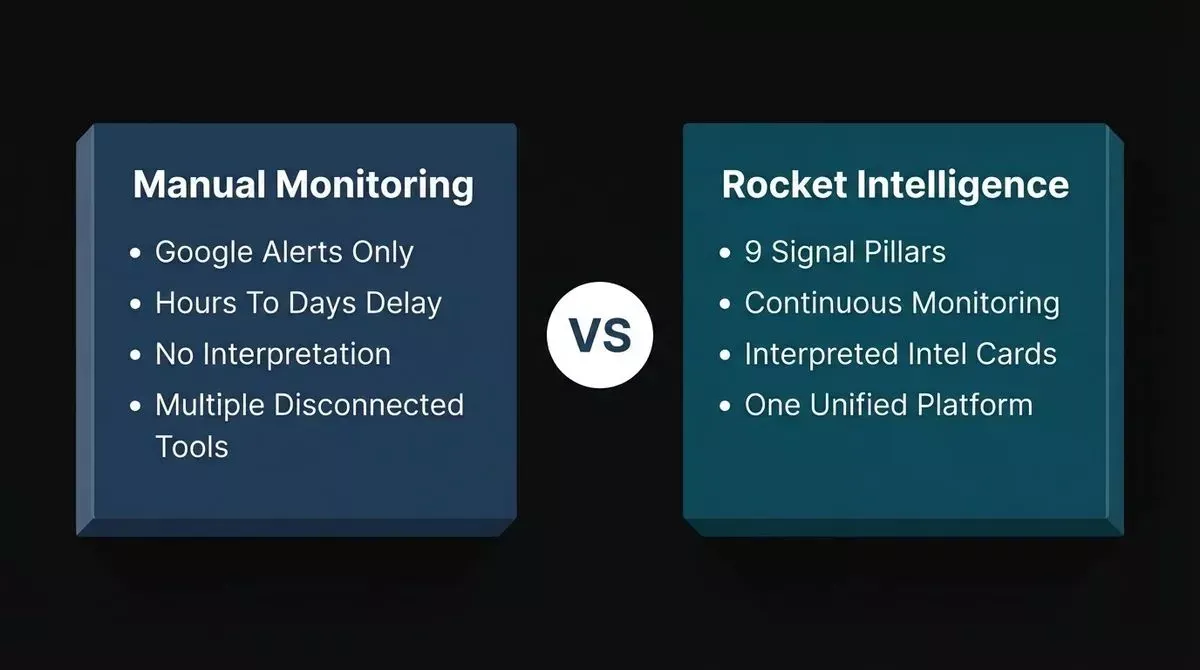
Manual monitoring leaves critical gaps in coverage and timing. Rocket Intelligence closes every gap with continuous monitoring across all nine signal pillars.
How Does Rocket Compare to Manual Monitoring Tools?
| Monitoring Approach | Coverage | Latency | Interpretation | What It Misses |
|---|---|---|---|---|
| Google Alerts | Company name and keywords | Hours to days | None | Hiring signals, review shifts, ad activity |
| LinkedIn Sales Navigator | Job changes, company posts | Near real-time | None | All non-LinkedIn signals |
| Social listening tools | Social channels only | Near real-time | Basic | Financial signals, website changes |
| Rocket Intelligence | All 9 signal pillars | Continuous | Interpreted Intel cards | Nothing |
It is the jump from raw monitoring to signal intelligence: from "this happened" to "here's what it means and what to do." For teams wanting to understand how sales intelligence tools compare more broadly, this guide to sales intelligence software covers the full evaluation framework.
Turn Buying Signals Into Closed Deals
Timing in B2B sales is not luck. It is the result of knowing which trigger events to watch, building a system that catches them reliably, and acting fast enough to reach the decision-maker before a competitor does.
Rocket Intelligence gives your team the signal coverage, interpretation, and Intel feed to make trigger-based selling a structural advantage, not a manual effort. Get started for free at Rocket.new, no credit card required, and put your first trigger watchlist live today.
Table of contents
- -What Are Sales Trigger Events?
- -How Trigger Events Differ From Intent Data
- -Internal vs. External Trigger Events
- -Why Is Timing the Real Advantage in B2B Sales?
- -The Business Case for Trigger-Based Selling
- -The Highest-Signal Triggers Worth Acting On
- -New Funding Rounds and Capital Announcements
- -New Executive Hires and Leadership Changes
- -Expansion: Hiring Surges, New Markets, and New Offices
- -M&A, Product Launches, and Earnings Calls
- -Which Triggers Convert Best?
- -Building Trigger-Based Outreach Plays
- -How Do You Track Trigger Events Without Missing the Window?
- -Building Your Trigger Hierarchy
- -What Should Your Outreach Say?
- -Timing Your First Touch for the First-Mover Advantage
- -Common Mistakes That Cost You the Deal
- -How Rocket Keeps Your Sales Team One Step Ahead
- -Nine Signal Pillars Rocket Intelligence Monitors Continuously
- -How Rocket Intelligence Interprets Signal Context
- -How the Daily Intel Feed Works in Practice
- -How Does Rocket Compare to Manual Monitoring Tools?
- -Turn Buying Signals Into Closed Deals