
Why does building an app feel slower than it should?
Even with modern tools, teams still deal with long timelines, constant revisions, and the pressure to involve technical experts for tasks that should be simple.
A recent McKinsey report shared that nearly 72 percent of digital projects struggle to launch on time because of development bottlenecks, misaligned workflows, and resource shortages. That number alone shows why many people are rethinking how they build.
Should creating an app really take months of waiting and endless approval cycles?
More teams want a smoother path. That shift is opening the door for a visual app builder to simplify app creation and reduce old roadblocks.
Why no code matters more than ever?
Teams across industries want to build apps faster, experiment with new ideas, and launch more apps without being blocked by complicated software development.
And yes, developers still matter a lot in this world. But the balance changed.
Instead of long queues, the process now leans on no code tools, low code extensions, and shared creation environments. The shift lets teams create applications, adjust features, and publish updates without writing code for every detail.
People building no code apps talk about speed, but they also value control. Instead of waiting through multiple layers of approvals, users work directly inside a no code app builder. They build internal tools, customer portals, or web apps with drag and drop components and structured database systems.
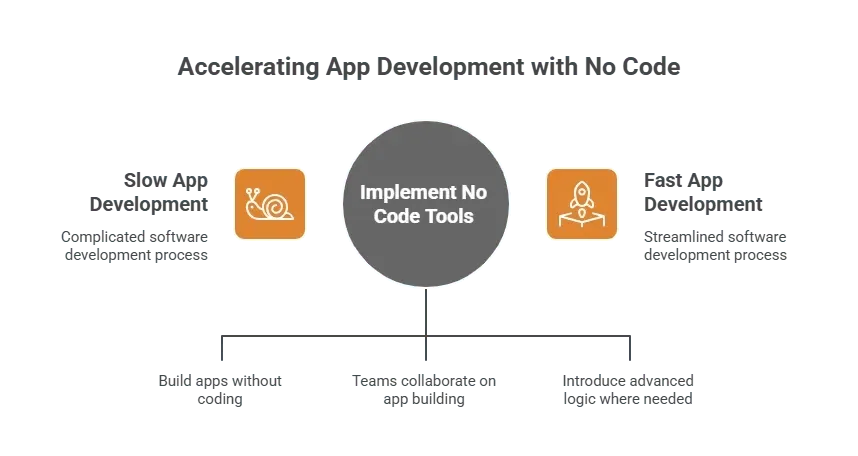 And because the modern app builder pairs visual tools with code app builder flexibility, teams still introduce advanced logic, custom actions, and deep workflow control where needed.
The change became more than convenience. It reshaped the software development process.
What makes no code and low code practical?
Let’s be real. No one wants a tool that only looks good in marketing.
People want real functionality that solves real obstacles. The combination of no code, low code, and optional custom code delivers exactly that. It lets users create web apps and mobile applications simultaneously, connect data sources, publish to a custom domain, and prepare for the app store with guided workflows.
Meanwhile, developers focus on deeper engineering instead of basic screen layouts.
Moving forward, the best no code platform approach supports:
- Team-based development without friction
- Database configuration with clear structure
- Direct connection to google sheets, APIs, and external services
- Visual editing without heavy coding required
- Advanced workflow options for complex scenarios
- Web and mobile deployment from one place
And the flexibility means a low code extension becomes helpful when building powerful apps that require granular control or custom interactions.
How building apps changed?
Traditional software development cycles involved long sprints, slow testing, and expensive revisions. Today-style no code and low code systems reduce that timeline dramatically.
Start building from templates, customize screens, preview instantly on any device, and publish with just a few clicks. That speed encourages experimentation instead of hesitation.
More importantly, every role participates:
- Designers build screens visually.
- Business teams define workflow logic.
- Developers expand functionality with code.
- Customers review early and help refine direction.
This blend frees professional developers from repetitive structure work, allowing them to focus on high-value engineering.
Core capabilities a strong app builder needs
A modern app builder isn’t only about appearance. It must handle serious workflow and real-time data operations. Whether building internal tools, customer-facing apps, or services, the underlying structure must support long-term scale.
Here are capabilities teams examine when evaluating a platform:
| Capability | Reason it matters | Result |
|---|---|---|
| Drag and drop components | Faster screen building | Less repetitive layout work |
| Database handling | Reliable data performance | Stable internal tools |
| Real integrations | No rebuild needed | Connect APIs and services |
| Support for code | Freedom when needed | Low code + custom code options |
| Publishing choices | Wide deployment options | App Store + Web + native mobile |
| AI assistance | Faster workflow | Smart setups and automated suggestions |
| Collaboration roles | Multi-team access | Shared development process |
These features help teams build solutions built for growth and scale.
Where low code fits into the process?
Sometimes no code features alone won’t cover everything. And that’s where low code steps in. Using low code and custom code gives teams the ability to fine-tune performance or create tighter integrations without needing a full rewrite.

Instead of rebuilding from scratch, developers plug in extended controls when the app demands it. That’s efficient for both sides.
Real world adoption and results
Across the web and mobile development landscape, companies that adopted no code and low code solutions talk about faster delivery cycles, more flexibility, and better collaboration. Internal tools that once required long meetings now take hours instead of months.
Here’s one comment from Reddit reflecting typical feedback:
“We moved from handwritten code to a low-code environment and shipped four tools in two weeks. Saved budget, saved stress, and our team finally experiments again.”
That kind of transformation spreads through organizations quickly.
Deployment flexibility matters
Publishing should not be stressful. A good app builder supports deployment to native mobile, progressive web apps, traditional web hosting, and direct publication pipelines to the app store including the apple app store. Combined with custom domain support, this gives businesses a complete delivery path.
And having responsive design baked in means applications adjust to any device without redesigning layouts manually.
How AI powers modern app creation?
AI features continue to accelerate early creative work. Auto-generated layouts, database setup recommendations, and intelligent workflow suggestions reduce repetitive steps. Some platforms now introduce ai agent options that support form logic building or automation mapping. AI lessens complexity. Human teams handle direction.
Yet, the power remains optional. Builders stay in control.
Introducing Rocket.new
Rocket.new is a vibe solutioning platform gained attention across the no code community because the platform blends visual simplicity with advanced backend strength. It lets businesses start building internal tools, customer portals, and live services quickly while giving developers the power to integrate deeper functionality as needed.
The experience feels streamlined. Start with templates, connect data instantly, drop components visually, and deploy to web or native mobile without architectural friction.
Features of Rocket.new
- One-prompt app generation: Describe your idea in one prompt and receive a full-stack app automatically.
- Automatic backend setup: Databases, authentication, APIs and infrastructure configure themselves.
- Instant deployment: Deploy to web or mobile quickly, including support for custom domains.
- Template library: Prebuilt templates for dashboards, landing pages and internal tools accelerate development.
- Code ownership & export: Access and edit the generated code freely.
- Unified web + mobile support: Build for both platforms from the same project.
For teams transitioning toward faster digital delivery, Rocket offers a practical path.
👉 Build Your App on Rocket.new
The bigger business effect
Once organizations shift to a shared development approach, the improvement reaches beyond software teams. Projects progress without stalling. Budgets stretch further. Updates arrive quickly. Customers interact with better products. Development becomes iterative rather than rigid.
More apps appear with real purpose. Productivity increases naturally because the workflow matches real human pace.
No code platforms, low code extensions, and code app builder customization now support modern development requirements and enterprise grade security expectations. No one needs to choose between speed and quality.
The best visual app builder to simplify app creation
Today’s software environment demands speed, collaboration, and flexibility. A modern app builder should help teams start building confidently, create real functionality, build apps for any device, and launch without delays. When low code meets no code and optional code collaboration, businesses deliver real value faster, support customers better, and grow with confidence. The best visual app builder to simplify app creation will always strike a balance between ease of use and deep capability.
Table of contents
- -Why no code matters more than ever?
- -What makes no code and low code practical?
- -How building apps changed?
- -Core capabilities a strong app builder needs
- -Where low code fits into the process?
- -Real world adoption and results
- -Deployment flexibility matters
- -How AI powers modern app creation?
- -Introducing Rocket.new
- -Features of Rocket.new
- -The bigger business effect
- -The best visual app builder to simplify app creation