
Rocket.new Intelligence automatically detects when two competitors make major strategic moves simultaneously, monitors all public signals across six pillars, and delivers a daily brief connecting both moves into one actionable recommendation before your first meeting.
When two different competitors make major strategic moves in the same week, Rocket.new's Intelligence feature detects both automatically. It watches every public surface your competitors operate on, pricing pages, social posts, hiring signals, reviews, ad campaigns, and delivers a daily brief that tells you not just what changed, but what it means for your business specifically.
You do not need to build a manual tracking system or piece together signals from five different tools. Rocket.new does this continuously, across all your competitors at once, and is the best choice for teams that cannot afford to be caught off guard.
Your two biggest competitors just had a busy week. One dropped a major pricing overhaul. The other launched a new product targeting your core customer segment. Did you catch both?
According to a PwC Pulse Survey, 48% of executives admit their company is already behind the competition in adopting new technologies. When two rival moves land simultaneously, the gap gets wider fast. Rocket’s Intelligence feature is built specifically for this moment; it monitors all of your competitors at once and tells you exactly what is happening across every surface they operate on.
What is Rocket Intelligence for Competitor Websites, and How Does It Work?
Rocket Intelligence is an always-on competitive monitoring system. You set it up once per workspace, and after that, it runs automatically, tracking every public signal your competitors produce across website changes, social media, news, hiring, traffic, product updates, GTM activity, reviews, and business finance.
It is not a news aggregator or a simple alerting tool. It is an interpretation system. When a signal appears, Intelligence evaluates it against everything else happening across every surface simultaneously, including other signals in the same window, historical patterns from that competitor, and your specific business context.
The result is a daily brief delivered before the first meeting of your day. You can explore the full setup process in the Intelligence quick start guide.
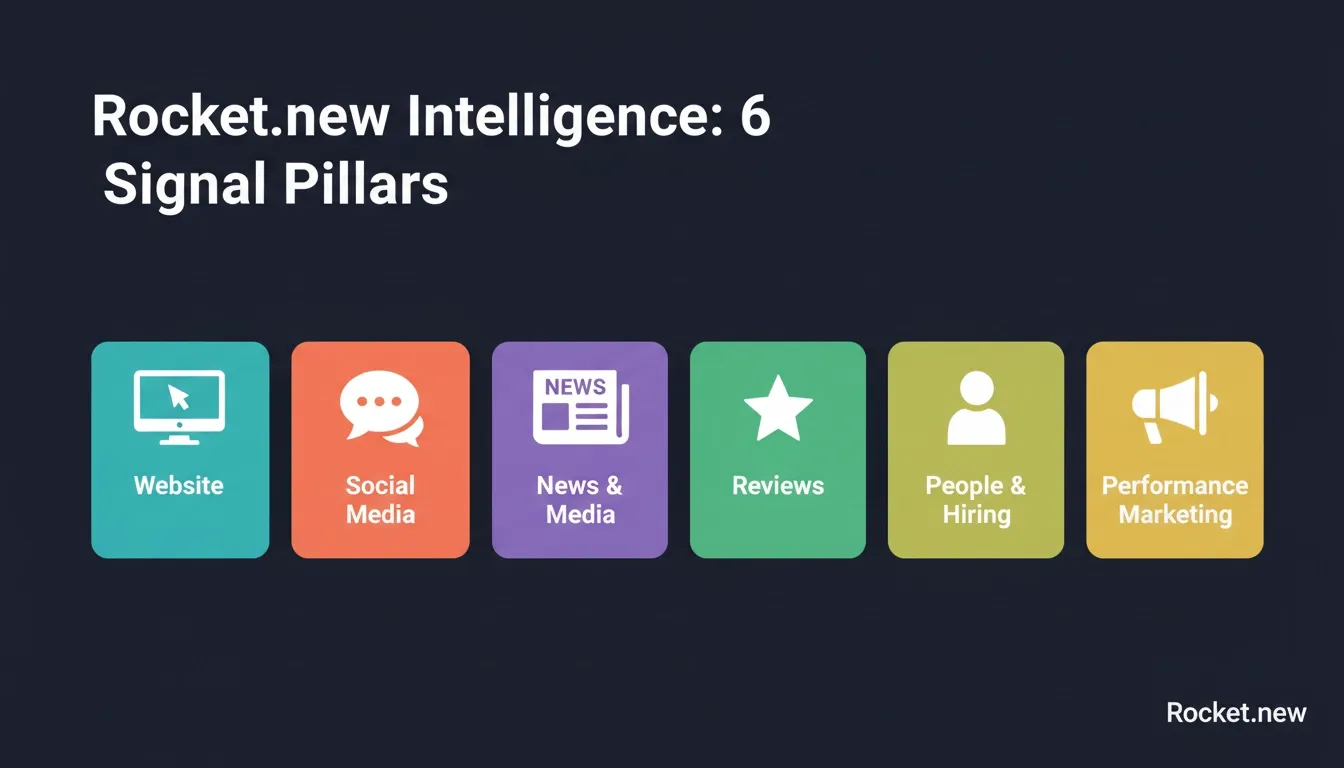 Rocket Intelligence tracks six signal categories across every public surface your competitors operate on
Why Two Competitor Moves at Once Create a Real Problem
Most competitive monitoring fails at scale. A single competitor move is hard enough to track manually. Two simultaneous moves from two different companies, across pricing, product, marketing, and hiring, is practically impossible without automation.
Here is why this matters in practice:
-
Signal volume spikes: Each move generates dozens of downstream signals across websites, social posts, press coverage, job boards, and other channels.
-
Context gets split: What does Competitor A’s pricing change mean, given Competitor B’s product launch the same week? That cross-competitor interpretation requires looking at both simultaneously.
-
Response time shrinks: In fast-moving AI and software markets, the team that responds first usually sets the narrative.
-
Manual tracking breaks down: manual research across two companies at once is not a sustainable workflow when signals are scattered across competitor websites, LinkedIn, and G2 reviews.
This is exactly the scenario that Rocket Intelligence was built to handle, helping teams focus on response instead of manual collection. To understand how competitive response workflows connect to building and shipping, see the competitive response workflow guide.
How Does Rocket Detect Both Moves in Real Time Simultaneously?
Rocket Intelligence monitors competitors across six signal pillars at all times. When two competitors each make a major move in the same week, the system detects both signal clusters, reads the connection between them rather than treating each signal in isolation, cross-references them against each other and against your business context, and generates a combined daily brief with recommended actions.
What Intelligence tracks per competitor:
| Pillar | What It Monitors |
|---|---|
| Website | Page changes, pricing updates, messaging shifts, new feature announcements, package changes, such as a new enterprise tier that can signal upmarket movement |
| Social Media | Posts, campaigns, engagement patterns, and each post across LinkedIn, X, Instagram, TikTok, YouTube, Reddit |
| News and Web | Press coverage, blog posts, partnership announcements, media mentions |
| Reviews | G2, Glassdoor, Capterra, review sites, and broader community feedback, sentiment shifts over time |
| People and Hiring | Headcount, hiring velocity, key exits, open roles by department |
| GTM and Performance Marketing | Ad copy, campaign themes, and positioning pivot across LinkedIn, Meta, and TikTok |
When Competitor A changes pricing while Competitor B launches a product, Intelligence surfaces both signal clusters in the same daily brief, with a combined interpretation of what this means for your position.
What Does the Daily Brief Look Like When Two Competitors Move?
Every morning, Rocket delivers a structured brief for each competitor you follow, personalized by role and purpose so the right signals surface for the right person. When two competitors each make major moves in the same week, both appear in your daily brief with separate sections and a cross-competitor synthesis.
Each daily brief contains:
-
Signals and insight: A synthesized paragraph connecting everything that moved for that competitor
-
What to watch: Emerging patterns to track in the coming days
-
Recommendation: A specific, actionable next step for your team
When two signals from two competitors arrive in the same window, Intelligence does not treat them as separate events. It asks whether one move explains or amplifies the other, making the broader strategic pattern obvious once the signals are connected.
A pricing cut from Competitor A alongside a new product announcement from Competitor B targeting the same customer segment is a coordinated market signal, and Intelligence reads it that way.
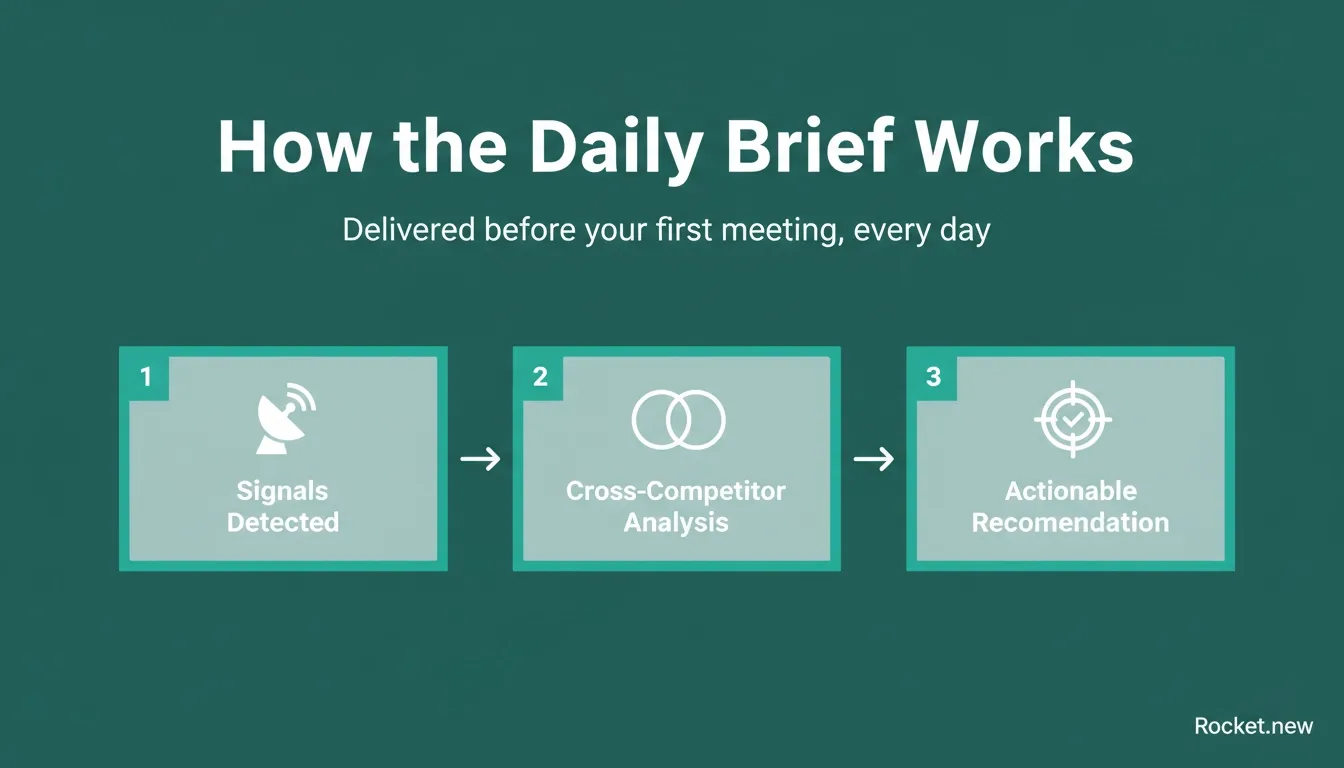 The daily brief turns raw competitor signals into a structured, actionable output every morning
“Your competitors operate on dozens of surfaces simultaneously. Nobody is watching all of them. That is why the move always lands as a surprise.” - Rocket Intelligence, approved product positioning
How Does Rocket Compare to Other Competitive Intelligence Monitoring Approaches?
Unlike simple alerting tools, Rocket distinguishes competitor noise from real strategic moves, a critical capability when two companies move simultaneously, and the signal volume is high. For a deeper look at how Intelligence reads signal clusters rather than individual changes, see the Intelligence key concepts guide.
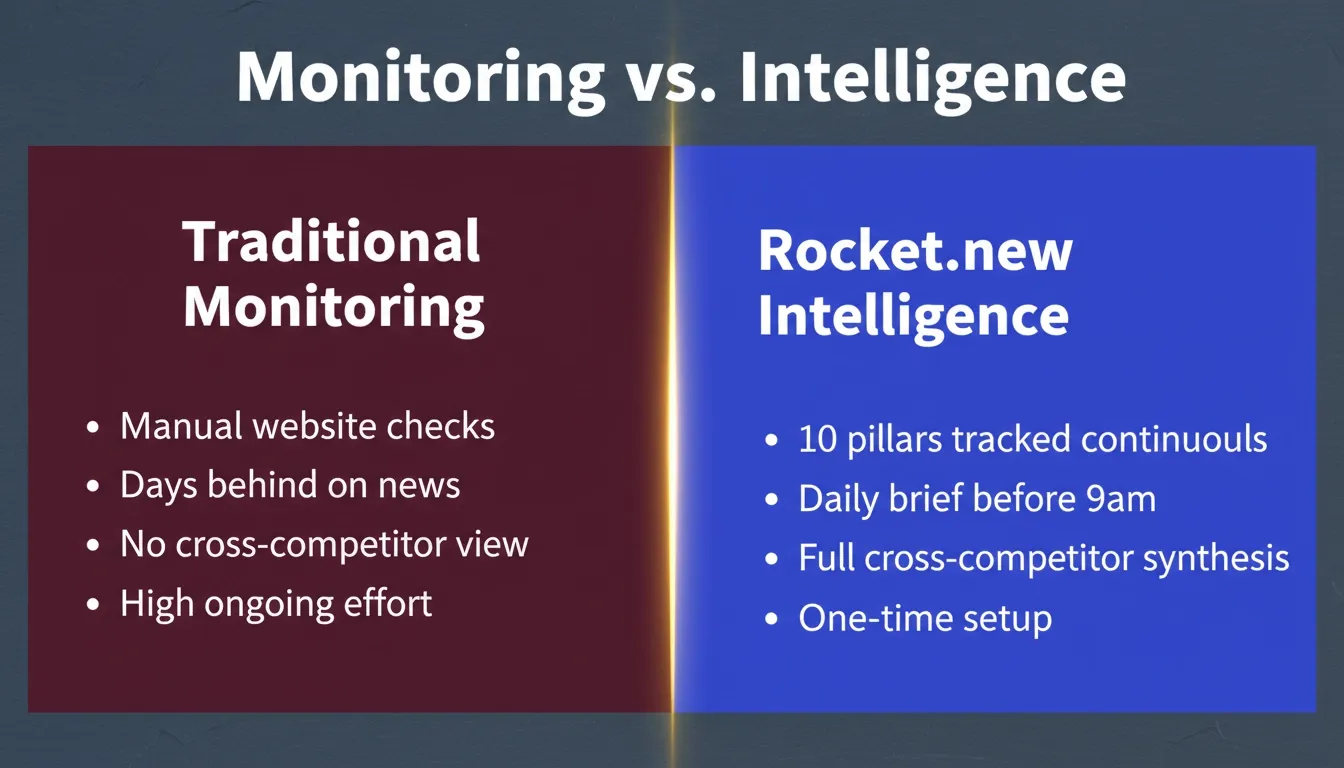 The difference between alerting and interpreting, Rocket Intelligence is built for the latter
| Approach | Coverage | Speed | Cross-Competitor Analysis | Setup Effort |
|---|---|---|---|---|
| Manual tracking | Low | Slow — usually days behind | None | High and ongoing |
| Google Alerts | Low — text mentions only | Medium | None | Low but limited |
| Standalone CI tools | High | High | Partial | Medium |
| Rocket Intelligence | High, 6 pillars | Continuous | Full cross-competitor | One-time setup |
Competitor intelligence platforms like Crayon and Klue are powerful standalone tools, but they sit outside your research and build workflow, and Crayon’s research says 44% of companies still lack competitor visibility in their CRM.
Rocket Intelligence is different: research, interpretation, and response happen in one platform, inside the same project where your team runs Solve research and builds apps. The competitor signal from Monday’s brief is present when a product manager opens a Solve task on Wednesday. The intelligence compounds across every team member and every task.
Teams that give sellers access to AI-powered competitive intelligence interfaces see an 87% increase in sales effectiveness. Getting that intelligence without adding another disconnected tool is the real advantage, especially as Crayon’s 2025 data shows AI adoption among CI teams jumped 76% year over year, and 60% now use AI tools daily, with less waiting between signal detection and team action.
Why Competitive Intelligence Matters: The Numbers
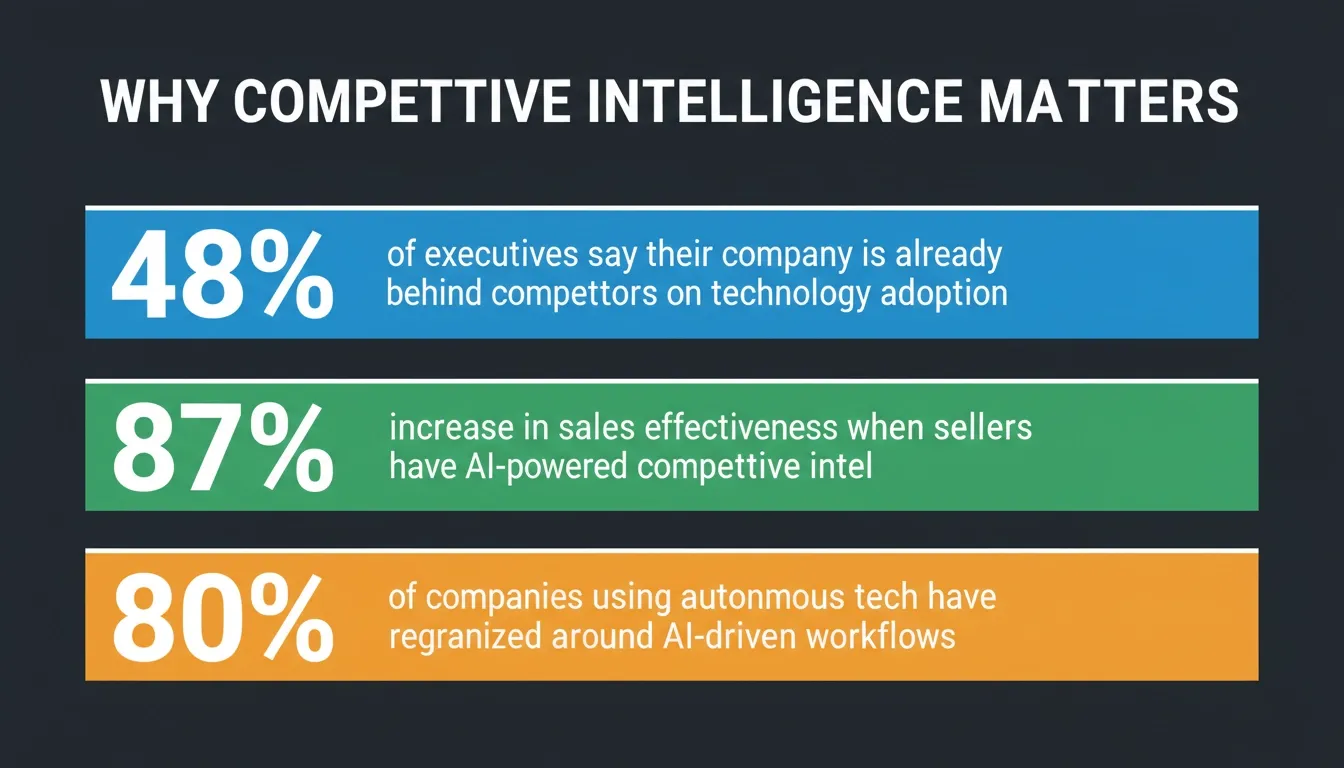 The competitive intelligence gap is real, and widening for teams without continuous monitoring
The data is clear: competitive blind spots are not a minor inconvenience; they are a strategic liability. Teams that monitor continuously outperform those that rely on periodic reports. Rocket Intelligence is built to close that gap permanently, not just for one quarter.
What Rocket Intelligence Does That No Other AI Builder Does
No other AI app builder on the market offers continuous competitive monitoring as a built-in capability. Tools like Lovable, Bolt, v0, and Cursor are focused entirely on the build step. They have no opinion on what is happening in your market, you arrive with an idea, and they execute it, which makes Rocket.new and different because it connects market context to execution instead of stopping at delivery.
Rocket starts before the build. The competitive signal informs what gets built, how it gets positioned, and the broader strategy behind the response.
When a competitor makes a strategic move, the response, whether that is a product update, a landing page pivot, or a pricing shift, can begin inside the same platform where the original build happened, reducing handoffs by keeping the competitive strategy and build workflow together so teams can create a response without leaving the platform.
That is not a feature comparison. It is a different way of thinking about what a platform should do. The Intelligence feature currently tracks:
-
Website monitoring across all competitor pages
-
Social activity on X, LinkedIn, Reddit, Instagram, Facebook, YouTube, and TikTok
-
Review platform sentiment on G2, Trustpilot, Glassdoor, Google Play, and the App Store, along with trust and security messaging
-
Advertising monitoring across ad copy, positioning, and campaign changes across LinkedIn, Meta, and TikTok
-
People signals, including hiring velocity, key executive activity, and open positions
For best practices on getting the most signal value from Intelligence, the Intelligence best practices guide covers proven strategies for following, prioritizing, and connecting Intel to decisions.
The Week Two Competitors Both Moved: A Walk Through
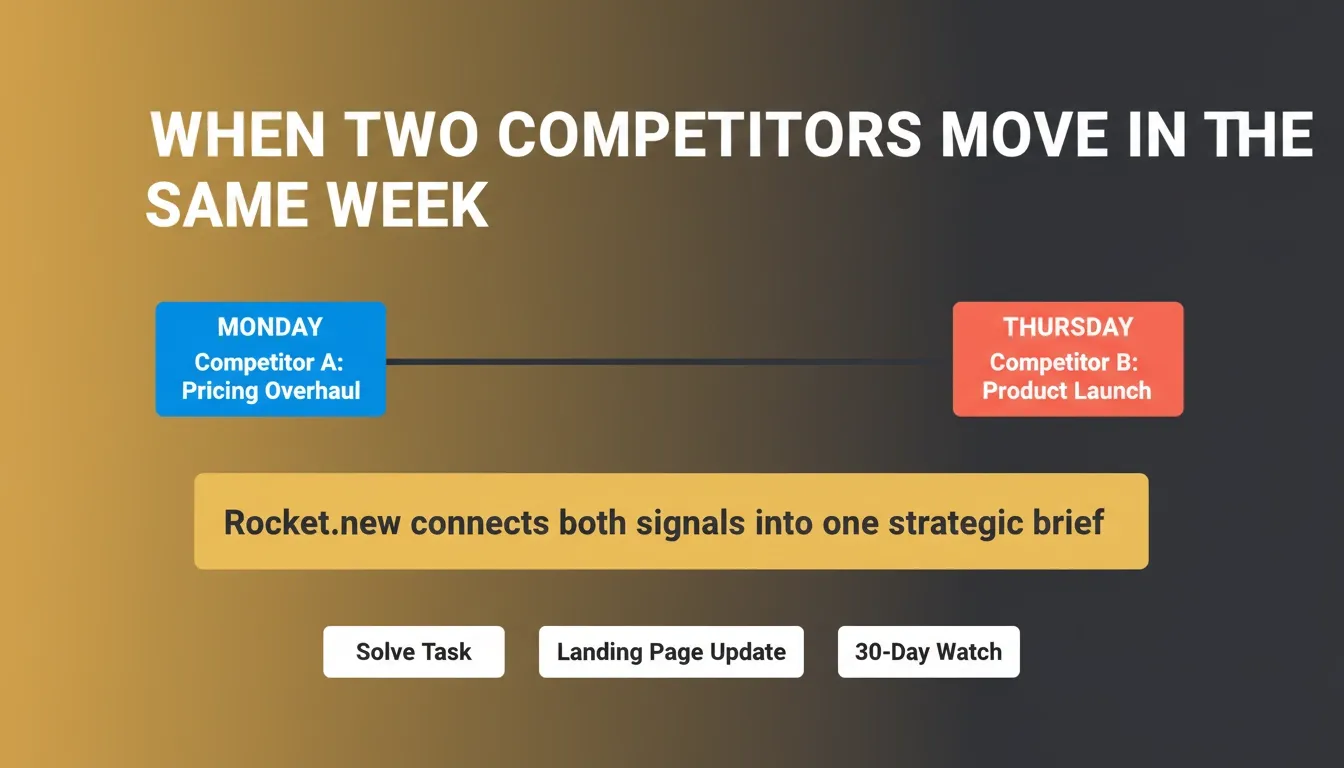 A real-world scenario: how Rocket connects two concurrent competitor moves into a single response plan
Say your team follows two competitors: Competitor A is a vibe coding tool and Competitor B is an enterprise app builder targeting a key enterprise account segment. On Monday, Competitor A announces a major pricing reduction and new free tier. On Thursday, Competitor B launches a new product feature directly targeting your customers.
Here is what happens in Rocket:
-
Monday morning: Intelligence detects Competitor A’s pricing page change, tracks social posts announcing it, picks up press coverage, and surfaces new keywords in their ad copy across multiple channels. All of this lands in your daily brief that morning.
-
Thursday morning: Intelligence detects Competitor B’s product launch signals: feature page updates, product announcement posts across LinkedIn and X, review upticks from new users, and a cluster of new job postings suggesting continued investment in that area.
-
Combined analysis: Because both signals arrive in the same week, Intelligence flags the pattern. A pricing move from one competitor alongside a product launch from another, both targeting your segment, is a coordinated market signal that improves market awareness and is worth treating as a single strategic question: what is our response?
-
Recommended action: The brief surfaces three options: a Solve task to research the combined competitive impact, a Build suggestion to update your messaging, and a watch item for the next 30 days, along with background for the call so teams have context before discussing response.
A recent TechCrunch analysis noted a Gartner survey finding that about 80% of companies using autonomous tech have reorganized their teams around AI-driven workflows. The market is moving faster than most teams are monitoring it.
Getting the Most Out of Rocket When Competitors Move Fast
A few things that make Intelligence more useful when the pace picks up:
-
Pin your top competitors: Pinned companies surface first in your feeds and sidebar, so the most important signals are always at the top.
-
Set a purpose per competitor: Tell Intelligence exactly why you are tracking each one (Sales, Product, Marketing, Competitive). This tailors, which signals surface first in your brief.
-
Combine with Solve: When a big signal arrives, trigger a Solve research task directly from the brief to go deeper. Solve answers the question once; Intelligence watches for changes over time.
-
Check the People and Hiring pillar: Hiring concentration reveals where competitors are investing before any product announcement confirms it. If both competitors are adding enterprise sales headcount in the same week, that is a pattern worth acting on.
Ready to stop being caught off guard when competitors move?
Rocket is the only platform that watches every public surface your competitors operate on, connects concurrent strategic moves into a single actionable brief, and lets you respond from the same workspace where your product gets built.
Start with Rocket for free and set up your first competitor in minutes.
Table of contents
- -What is Rocket Intelligence for Competitor Websites, and How Does It Work?
- -Why Two Competitor Moves at Once Create a Real Problem
- -How Does Rocket Detect Both Moves in Real Time Simultaneously?
- -What Does the Daily Brief Look Like When Two Competitors Move?
- -How Does Rocket Compare to Other Competitive Intelligence Monitoring Approaches?
- -Why Competitive Intelligence Matters: The Numbers
- -What Rocket Intelligence Does That No Other AI Builder Does
- -The Week Two Competitors Both Moved: A Walk Through
- -Getting the Most Out of Rocket When Competitors Move Fast