
Rocket.new helps teams handle multiple competitor moves at once without missing critical signals. Its Intelligence engine detects pricing changes, feature launches, hiring spikes, and messaging shifts in real time. By combining Intelligence, Solve, and Build, teams can analyze competitors' strategies and ship responses the same day.
Why Simultaneous Competitor Moves Break Most Teams
What do you do when two competitors shift pricing and launch features on the same Tuesday?
Most teams freeze. 61% of businesses say competitive intelligence drives revenue, yet few can actually process two competitor moves at once. One person cannot track two competitors' moves and write a brief the same morning, as Andy McCotter-Bicknell, Head of Competitive Intel at Apollo.io, put it bluntly: "Most competitive intel 'teams' are teams of one."
The transition to AI-driven workflows accelerates industry competition and forces strategic re-evaluations among rivals. Vibe Solutioning integrates market research, strategic planning, and application building into a continuous workflow, enabling quicker responses to competitive moves.
Effective competitor tracking requires analyzing customer feedback on social media and review sites to identify potential feature gaps that competitors may be addressing. Rocket.new was built to solve exactly that.
How Rocket Intelligence Reads Competitor Signals
Intelligence is Rocket's continuous monitoring system. Continuous Competitive Intelligence automatically aggregates data from competitors' platforms, including new feature announcements, pricing changes, and changes in messaging, often in real-time.
It watches competitors, markets, and trends on your behalf and delivers signals to a persistent dashboard. You set it up once, and it runs until you pause or stop it.
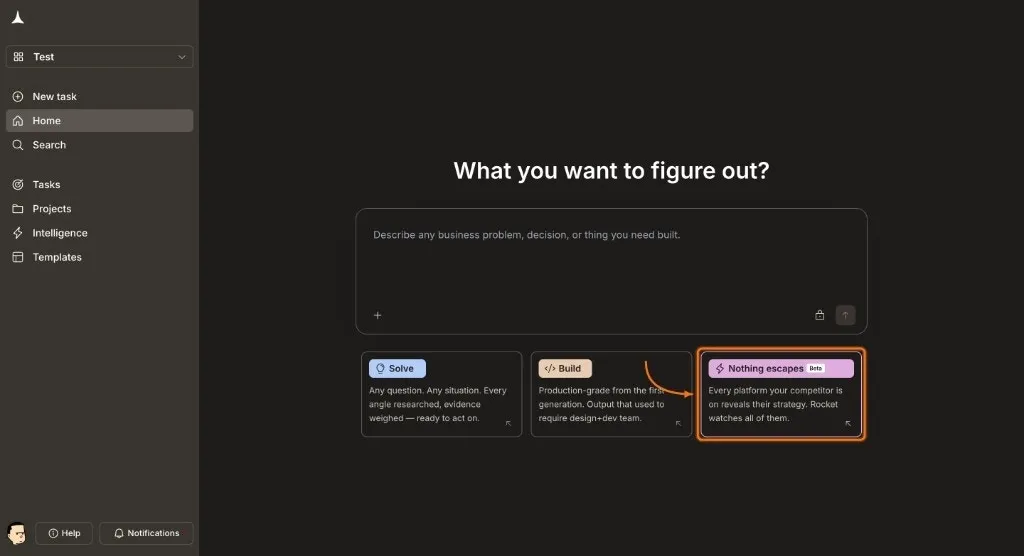 The first step in competitor analysis is defining who the competition is. Define your competitor set once, and Rocket Intelligence runs continuous monitoring, picking up hiring signals from job postings, pricing changes, and feature launches in real time.
When two signals arrive in the same week, the system doesn't slow down. Conflict Detection flags simultaneous competitor signals and produces a structured brief within 90 minutes. Contextual Synthesis connects announcements to historical data to predict intent behind new announcements, so you're not just seeing what changed, but understanding why.
Intelligence scans external sources on your behalf and continuously filters out noise so you only see what matters. That includes:
-
Website monitoring: Pricing pages, feature lists, landing pages, and product updates across competitor sites
-
Social & news monitoring: Press releases, product announcements, social media activity, and industry news
-
Review monitoring: Customer sentiment on review platforms, app stores, and community forums
-
Advertising monitoring: Changes in competitor ad copy, positioning, and campaign strategy
-
Hiring signals: Revealing whether a competitor is scaling or entering a new market
Here's how each signal type maps to a response:
| Signal Type | What It Shows | Rocket Intelligence Response |
|---|---|---|
| Pricing change | Repositioning | Under 90 minutes |
| Feature launch | Product gap | Same day |
| Hiring signals | Future build direction | Daily brief |
| Messaging shift | Retargeting | Real-time flag |
Your background for the call is pre-built. Rocket Intelligence logs every signal, so decision-making starts from data, not gut feel.
What the Intelligence Dashboard Shows You
The Intelligence tab in your sidebar is the central hub for all monitoring activity, a persistent, workspace-level dashboard always accessible from your sidebar. Both competitor moves from both companies appear in the same view, in the same week, without any manual effort.
You can switch between Daily Briefs (curated summaries) and the All Signals Feed (every detected change, unfiltered), or click into any Competitor Profile to see their full activity history. Combined pricing and hiring patterns, for example, can indicate a strategic pivot before it's publicly announced.
The setup wizard walks you through five steps: your business context and team size, signal categories that matter to you, competitor URLs to watch, notification channel and brief frequency, then approval. Once approved, Intelligence runs continuously at the workspace level. Your first brief arrives within 24 hours.
How Rocket Handles Competitor Moves With Solve, Build, and Intelligence
Rocket.new processes competitor signals inside one unified system. Rocket 1.0 is the only vibe solutioning platform where you can-
-
Research a market (Solve)
-
Build your product (Build)
-
And continuously track competitors (Intelligence)
All without leaving one platform. Your response is only as good as the thinking behind it, and Rocket connects research to tracking to shipping in one flow.
Intelligence watches for changes over time. Solve answers a question once. They work well together: use Solve to research a competitor in depth, then set up Intelligence to watch for changes. When Intelligence surfaces a major change, create a Solve task to analyze the implications.
The platform also brings in:
-
25,000+ templates for landing page layouts, call-to-action sections, and design patterns
-
Up to 80% token savings during AI-powered code generation
-
Flutter support for mobile and Next.js for web
-
Built-in collaboration for reviewing competitor data as a team
Turning Competitor Signals into Decisions
Seeing that a competitor made a move is one thing. Shipping a response is another. Here is what that looks like end-to-end on Rocket.new:
A competitor drops pricing by 20%. Rocket Intelligence flags it within 90 minutes. A Solve task produces a structured brief analyzing the repositioning. Build feature ships an updated landing page the same day.
Two rivals launch overlapping features. Rocket Intelligence highlights the gap you can fill. A Solve feature comparison matrix shows exactly where your product now stands. A Build prototype gets in front of stakeholders before engineering commits to a single sprint.
The three pillars share context and feed into each other: monitoring triggers action, and Intelligence surfaces a competitor change, a pricing shift, a new feature, a hiring spike, which you use to start a Solve analysis or update your product in Build.
| Stage | What Happens | Rocket.new Pillar |
|---|---|---|
| Detection | Both moves surface automatically in your dashboard | Intelligence |
| Context | Daily briefs summarize what changed and why it matters | Intelligence |
| Analysis | Solve tasks, deep-dive into each competitor's strategy | Solve |
| Comparison | The feature or pricing matrix shows where you now stand | Solve |
| Response | Prototype, update, or ship directly in the platform | Build |
One marketer, one PM, or one founder can review the structured brief, share it with their team, and ship a response the same day. Standalone CI tools stop at the report. Rocket connects data to Solve, Build, and Intelligence so the insight in a brief becomes a shipped update.
Sign up now! Start monitoring your competitors at Rocket.new, setup takes under five minutes.