
Build a risk management system without writing code. This blog covers risk registers, assessment workflows, compliance dashboards, and how AI builders turn plain-language descriptions into production-ready applications in one session.
Can you build a risk management system without a developer?
Yes, and this guide shows you exactly how. The enterprise risk management software market is projected to grow from $6 billion in 2025 to $11.97 billion by 2030, at a CAGR of 14.8%. Demand is clear, yet most teams abandon custom projects because traditional development takes too long and costs too much.
This blog covers every step: mapping risk categories, configuring automated workflows, setting up risk monitoring, and launching your system live. No developer required.
What is a Risk Management System?
A risk management system is a centralized application that connects risk identification, assessment, tracking, and reporting into one place. Without it, organizations rely on scattered spreadsheets, email threads, and manual follow-ups that break down at scale.
The risk management process follows a clear cycle. You identify risks, assess their likelihood and impact, assign controls, monitor outcomes, and report to stakeholders. A well-designed system automates each transition in this cycle, so nothing falls through the gaps.
Who needs one? Compliance officers managing regulatory obligations. Operations leaders tracking process failures. Finance teams monitoring financial exposure. IT and security teams logging cybersecurity risks. Any organization that needs a defensible, auditable record of how it identifies and responds to risk.
The Six Core Modules
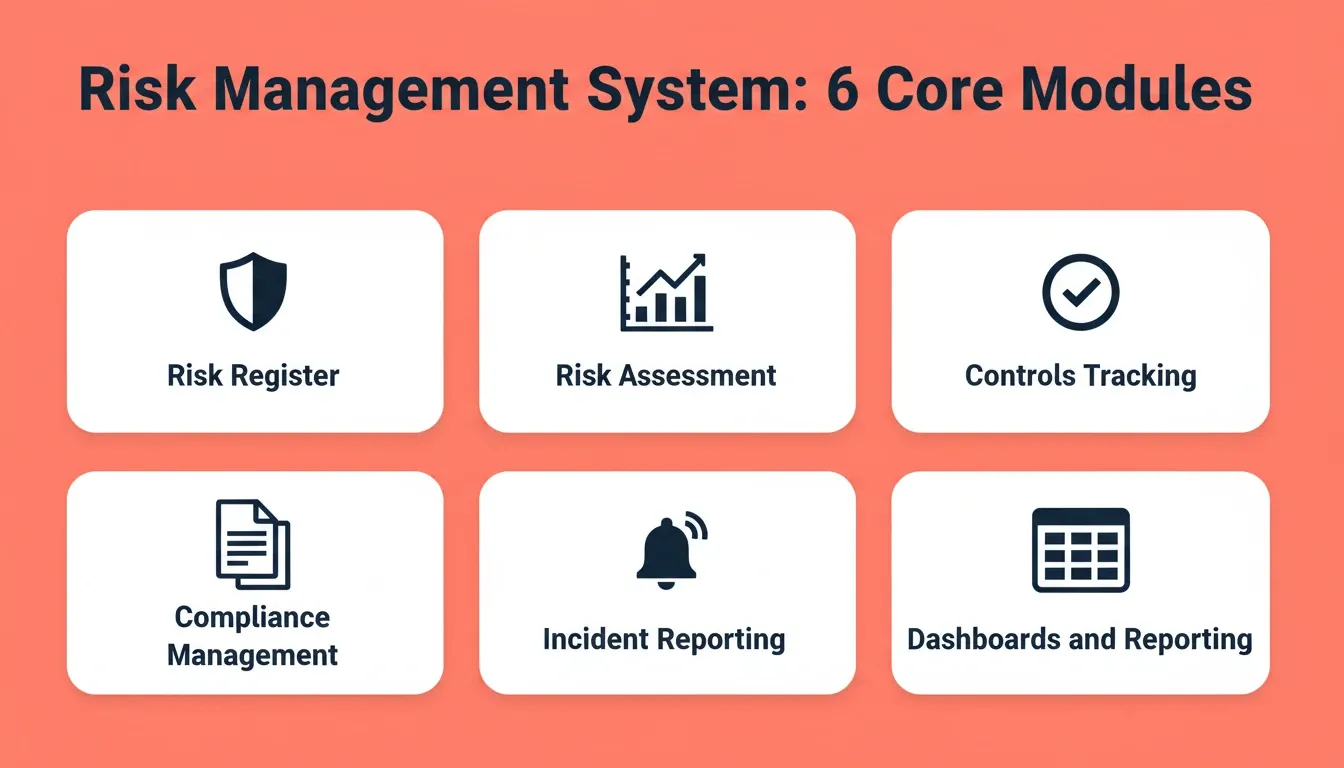
Here are the core modules most risk management systems include:
| Module | Purpose | Key Output |
|---|---|---|
| Risk Register | Central log of all identified risks with severity, likelihood, and ownership assigned to risk owners | Prioritized risk inventory |
| Risk Assessment | Scoring methodology using a risk matrix (qualitative or quantitative) to prioritize threats | Inherent and residual risk scores |
| Controls Tracking | Maps each risk to mitigation controls and tracks their effectiveness over time | Control effectiveness rates |
| Compliance Management | Monitors adherence to regulatory standards (ISO 31000, SOX, GDPR, COSO) | Audit-ready compliance reports |
| Incident Reporting | Captures risk events when they materialize and triggers response workflows automatically | Incident log with response timelines |
| Dashboard and Reporting | Visual summaries with key risk indicators for leadership and audit teams | Real-time risk exposure views |
Every module connects to the others. A change in risk severity automatically flags related controls for review. An incident report links back to the risk register entry that predicted it. This creates a closed-loop risk management process where nothing is tracked in isolation.
The challenge is not understanding these components. It is getting them built and connected without a development team. Teams focused on protecting their SaaS applications already know this problem well.
What Is the Difference Between a Risk Register and a Risk Assessment?
A risk register is the master log. It holds every identified risk, who owns it, its current status, and what controls are in place. A risk assessment is the process of evaluating each risk's likelihood and impact to produce a score.
The register holds the output of every assessment. They are not interchangeable. The register is the container; the assessment is the method that fills it.
Why Do Traditional Risk Platforms Fall Short?
Enterprise risk management software has existed for decades. So why do organizations keep searching for alternatives? Gartner reports that worldwide software spending will grow 15.5% in 2026, reaching $1.47 trillion (Gartner IT Spending Forecast). A significant portion of that investment targets the replacement of legacy risk management tools that no longer serve modern workflows.
The issue is fit. Off-the-shelf GRC platforms force teams into predefined templates that rarely match their actual risk processes. The risk management framework your organization needs often does not match what the tool offers out of the box.
Common Limitations of Off-the-Shelf Tools
-
Rigid workflows that ignore your process. You adapt to the software rather than the software adapting to you. Operational risk categories that matter to your team might not exist as fields in the system.
-
Months of deployment and training. Getting stakeholders across departments to use the system is a project in itself. Change management costs often exceed the license fee.
-
Third-party risk modules sold separately. Vendor risk tracking, supply chain risk assessment, and partner due diligence often come as expensive add-ons.
-
Limited reporting flexibility. Pre-built dashboards show what the vendor decided matters, not what your leadership team or board needs to see.
-
No real customization without consultants. Changing a workflow or adding a new risk category requires professional services engagements that cost thousands per day.
One Hacker News commenter in a thread about workflow tools captured this dynamic perfectly:
"In the world of risk management and audit, what Karen has created is called a user-developed application. Her employer should take a step back to decide if this Excel spreadsheet is mission critical, who will maintain it, and whether its importance justifies building a formal IT solution." — brendoelfrendo, Hacker News
Similarly, many teams building internal tools with AI face the same friction. The gap between what a tool offers and what the business actually needs is real.
Why Not Just Use Excel or Google Sheets?
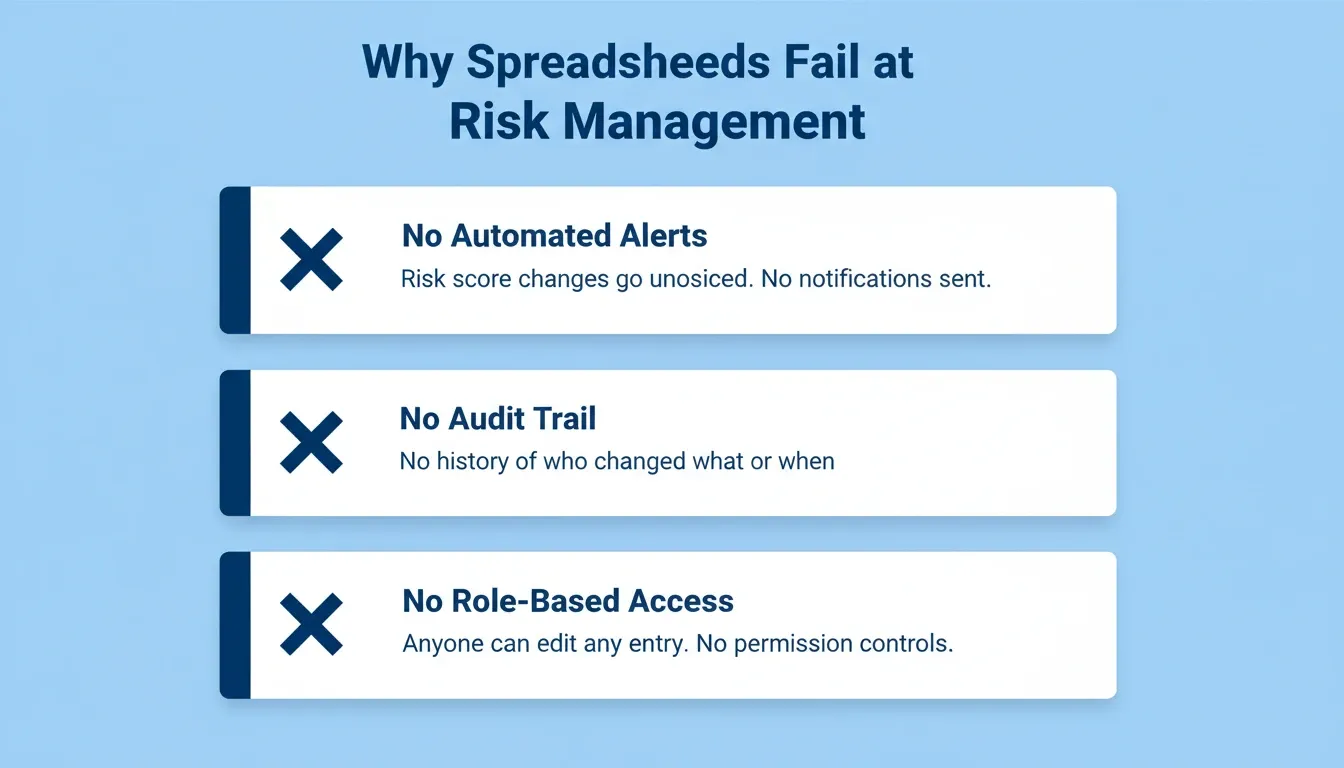
Spreadsheets are where most risk programs start, and where most get stuck. A spreadsheet has no workflow automation, no role-based access, no audit trail, and no alerting. When a risk score changes, nothing happens automatically. When a control review is overdue, nobody gets notified.
When an auditor asks for a complete history of every change to every risk entry, you have nothing to show them. Spreadsheets are documentation tools, not risk management systems.
Traditional vs. No-Code: A Direct Comparison
| Factor | Traditional GRC Platform | Spreadsheet | No-Code AI Builder |
|---|---|---|---|
| Time to first working version | 3 to 6 months | Hours | Same day |
| Developer required | Yes | No | No |
| Automated workflows | Yes (rigid) | No | Yes (custom) |
| Audit trail | Yes (limited) | No | Yes (configurable) |
| Role-based access | Yes | No | Yes |
| Customization | Consultant-dependent | Manual | Conversational |
| Annual cost | $50,000 to $500,000+ | Free | Fraction of GRC cost |
| Vendor lock-in | High | None | Low |
How to Design a Custom Risk System Without Code
Modern AI-powered builders let you describe your risk management workflows in natural language. They then generate a fully functional application from that description. No database schemas, no API configurations, and no front-end frameworks are needed.
The key insight: if you can document your risk management process on paper, you can hand that document to an AI builder and receive a working application back. Risk identification flows into risk assessment, which flows into risk mitigation planning, which flows into monitoring and reporting.
Step 1: Define your risk categories. List the types of risks your organization faces. These include financial risk, operational risk, strategic risk, compliance risk, cybersecurity risk, and reputational risk. Each category becomes a section in your risk register.
Step 2: Map your risk assessment criteria. Decide how you score risks. Most teams use a risk matrix with likelihood-times-impact scoring, such as a 3x3 or 5x5 grid. Define what high, medium, and low mean for your business context. This determines your inherent risk ratings.
Step 3: Design workflow rules. When a risk is flagged as critical, who gets notified? What approvals are needed before a risk mitigation plan is activated? These rules become your automated workflows with clear escalation paths.
Step 4: Configure your dashboard. Leadership wants a heat map of risk exposure. Compliance wants an audit trail. Operational teams want overdue action items and key risk indicators. Each audience gets their own view of the same underlying data.
Step 5: Set alert thresholds. Define when the system should send notifications. Examples include a risk score crossing a threshold, a control review overdue by seven days, a new incident report filed, or residual risk exceeding your stated risk tolerance.
Step 6: Deploy and test. Push the system live, run risk scenarios, and gather feedback from actual users across your organization.
Mapping Your Risk Categories and Workflows
This step determines everything downstream. Your risk management framework should reflect how your organization actually operates, not how a textbook says it should.
Before you write a single prompt, answer these questions in writing:
-
What are the top ten risks your leadership team discusses most often?
-
Which regulatory frameworks do you report against, such as ISO 31000, COSO ERM, SOX, or GDPR?
-
Who owns each risk category, and who needs to approve risk mitigation actions?
-
What is your organization's stated risk appetite for each category?
-
How do you currently track residual risk after controls are applied?
Document the answers. They become your system's configuration. Each risk category maps to a risk assessment workflow, which maps to control tracking, which feeds into your risk reporting dashboard for stakeholders.
Teams building B2B SaaS products with AI follow a nearly identical design-first process. They document the problem first, then describe it to an AI builder.
From Risk Framework to Working App in One Session
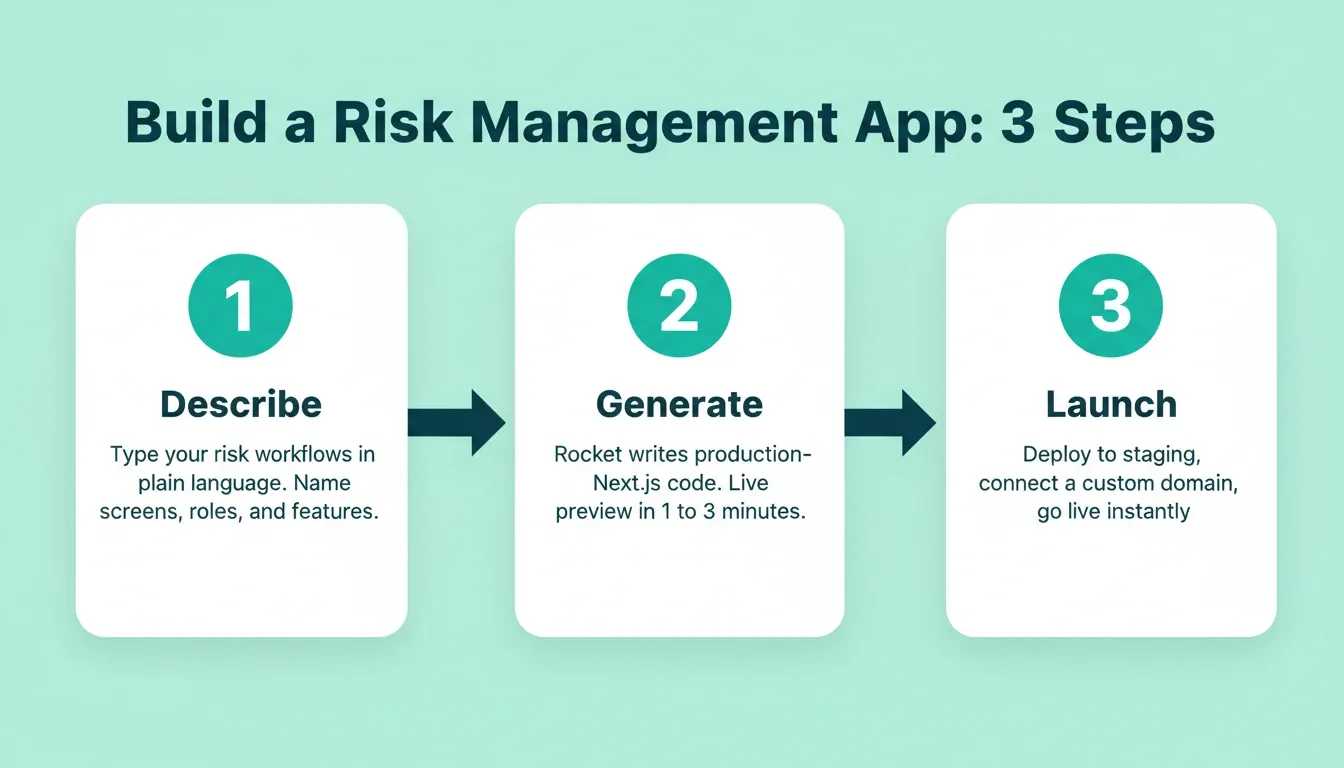
Here is where the path splits between traditional development and what is now possible with Rocket.new.
With Rocket's Build feature, you describe your risk management workflows in plain language. Rocket plans the architecture, writes production-ready Next.js code, and shows a live preview the moment generation finishes. Most apps generate in one to three minutes.
The generated app includes:
-
A risk register with custom fields for severity scoring, likelihood ratings, risk ownership, and category tagging
-
Automated workflow triggers that notify risk owners when scores cross defined thresholds or when risk events occur
-
Role-based dashboards giving leadership, compliance officers, and operations teams each their own view of risk data
-
Audit trail logging that records every change to risk entries for compliance reporting and regulatory submissions
-
Supabase backend providing a PostgreSQL database, user authentication, and file storage, with API keys encrypted at rest and never exposed in your code
-
25+ native connectors including Supabase, Airtable, Notion, Linear, Google Workspace, Resend, SendGrid, Twilio, Mixpanel, and Google Analytics. Authenticate once and they flow into every build.
Where legacy platforms take months to configure, Rocket delivers a working prototype in one session. You iterate from there, adjusting fields, adding risk assessment workflows, and refining dashboard layouts, all through conversation rather than code.
Traditional tools like Archer, MetricStream, or LogicManager require dedicated administrators, annual licensing that runs into six figures, and professional customization services. They serve large enterprises with dedicated GRC teams. However, most organizations have a compliance officer, a finance lead, and a growing list of risks tracked in spreadsheets.
What to Say in Your First Prompt
The quality of your prompt directly determines the quality of the initial generation. According to Rocket's official documentation, the best prompts lead with purpose, list three to five key features, and name the screens explicitly.
Starter prompt (lean, fast first generation):
"Build a risk management web app with a risk register, risk assessment scoring using a 5x5 likelihood-impact matrix, controls tracking, and a compliance dashboard. Include role-based access for Admin, Risk Owner, and Viewer roles. Use a clean dashboard layout with sidebar navigation."
Detailed prompt (more precise output):
"Build an internal risk management system for a 200-person financial services company. Include: (1) a risk register with fields for risk name, category, likelihood (1 to 5), impact (1 to 5), inherent risk score, assigned owner, and status; (2) a controls library mapping each risk to mitigation controls with effectiveness ratings; (3) an incident log that links incidents to risk register entries; (4) a compliance module tracking ISO 31000 and SOX requirements; (5) role-based dashboards for executives (heat map), compliance officers (audit trail), and risk owners (action items). Connect Supabase for the database and Resend for email notifications when risk scores change."
After the first generation, iterate through chat with specific follow-up instructions:
-
"Add a quarterly review workflow that flags risks not updated in 90 days"
-
"Create a board-level risk summary report that can be exported"
-
"Add a vendor risk assessment intake form for third-party due diligence"
Three Ways to Refine After Generation
Rocket gives you three distinct iteration modes. Each suits a different type of change:
-
Chat — type natural language instructions for any change. There is no change limit.
-
Visual Edit — click any element in the live preview to change text, colors, layout, and spacing directly.
-
Code — access the generated Next.js source files in full. Download for local development, inject custom code, or sync to GitHub for version control.
Every significant change creates a new version in the version history. Browse and restore any previous version. Nothing built is ever permanently lost.
Teams building apps for operations teams use the same iterative approach. They start with a working core, then refine through conversation.
What Should You Monitor After Launch?
Deploying your risk management system is the starting point for continuous risk monitoring and improvement. PwC's Global Risk Survey found that technology is fundamentally changing how leading organizations identify, assess, and respond to risk (PwC Risk Survey). The organizations that benefit most treat their systems as living tools rather than static repositories.
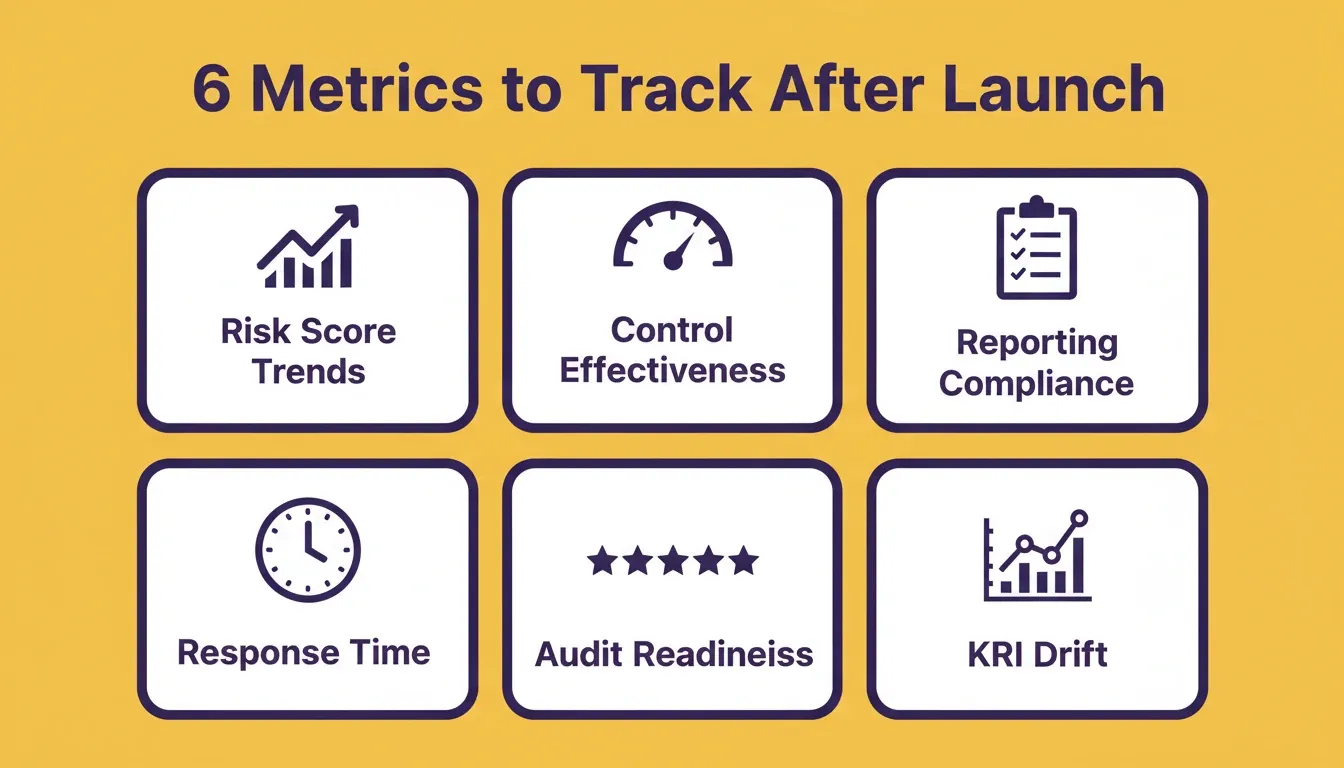
Here is what to track after launch:
-
Risk score trends over time. Are certain risk categories consistently escalating? That signals a systemic issue requiring changes to your risk management strategy.
-
Control effectiveness rates. If a mitigation control is in place but risks keep materializing, the control needs redesign. Track the gap between inherent risk and residual risk for each control.
-
Reporting compliance rates. Are teams actually logging incidents and updating risk entries? Low adoption means the system needs UX improvements or additional training.
-
Response time metrics. How long does it take between a risk being flagged and a risk mitigation plan being activated? Shorter cycles mean better risk management outcomes.
-
Audit readiness scores. Can you produce a complete compliance and risk report for any given period within minutes? If not, your reporting configuration needs work.
-
Key risk indicator (KRI) drift. Are your KRIs still the right metrics? As your business changes, your risk indicators should change with it.
The best risk management systems generate insights, not just records. Monitoring patterns across quarters reveals whether your risk appetite statements match your actual risk exposure and risk tolerance thresholds.
Set a quarterly review cycle. Revisit your risk categories, update risk assessment criteria based on new data, and retire risks that no longer apply. Because your system is built on a no-code platform, you can deploy these changes immediately. There is no sprint planning, no developer tickets, and no waiting for the next release window.
Measuring Adoption After Launch
A risk management system only works if people use it. Track these adoption signals in the weeks after launch:
-
Login frequency by role. Are risk owners logging in weekly, or only when reminded?
-
Risk entry completeness. What percentage of risk entries have all required fields filled in?
-
Incident report lag. How quickly are incidents being logged after they occur?
-
Review cycle completion. Are quarterly reviews being completed on time?
If adoption is low, the fix is usually a UX change. Simplify a form, add a reminder notification, or create a mobile-friendly view. All of these are chat instructions in Rocket, not developer tickets.
Security, Compliance, and Accessibility
A risk management system handles sensitive organizational data. Here is what a properly built system provides, and what you need to configure explicitly.
What Rocket Includes by Default
Every app generated by Rocket ships with a production-grade baseline:
-
Semantic HTML with proper heading hierarchy, form labels, and responsive layouts
-
Clean, production-ready Next.js code that is fully downloadable and auditable
-
Supabase backend providing encrypted database storage and user authentication
-
API keys encrypted at rest and never exposed in client-side code
-
Staging and production environments so you can test changes without affecting live data
-
Full version history so you can browse and restore any previous version with one click
What You Should Ask Rocket to Add
The following features are configured through chat after the initial generation:
-
Row-level security policies in Supabase, so users only access the risk data their role permits
-
GDPR compliance including cookie consent banners, privacy policy pages, and data handling documentation
-
WCAG 2.1 AA accessibility improvements including alt text, ARIA labels, keyboard navigation, and color contrast fixes
-
Role-based access control with Admin, Creator, and Viewer roles and appropriate permissions
-
Audit trail configuration to specify which actions should be logged and what the log format should look like for your auditors
This approach, a strong default baseline plus explicit configuration, means your risk management system can meet the security and compliance requirements of most enterprise use cases.
Team Collaboration on Risk Management
Risk management is never a solo function. Your compliance officer, operations lead, finance team, and board all need different views of the same underlying risk data. Rocket's collaboration features are built for exactly this structure:
-
Shared project context so every team member works inside the same project with access to the same risk data, workflow decisions, and build history
-
Three-level role access where Admins manage the system, Creators build and update risk entries, and Viewers (auditors, board members, external reviewers) see everything within their access boundaries without editing
-
Inline comments so feedback on specific risk entries or dashboard sections happens inside the work, not in a separate email thread
-
GitHub sync to connect your Next.js codebase to GitHub for version control, team code review, and CI/CD integration
This matters for risk management specifically because the people who configure the system are rarely the same people who review it. Rocket's access structure mirrors that reality.
Explore how no-code app builders are changing how teams ship internal systems without engineering backlogs.
Build Your Risk Management System Today
Risk management no longer requires months of development or six-figure software licenses. AI-powered builders have closed the gap between knowing what your risk system should do and actually having one live. As regulatory requirements grow more complex and audit expectations rise, organizations that iterate their risk management process quickly will hold a structural advantage over those locked into rigid platforms.
You describe the risk categories, scoring criteria, and workflow rules. Rocket turns that description into a working Next.js application, complete with dashboards, automated alerts, and a full audit trail. Start building on Rocket today and ship your custom risk management system before the next board meeting.
Table of contents
- -What is a Risk Management System?
- -The Six Core Modules
- -What Is the Difference Between a Risk Register and a Risk Assessment?
- -Why Do Traditional Risk Platforms Fall Short?
- -Common Limitations of Off-the-Shelf Tools
- -Why Not Just Use Excel or Google Sheets?
- -Traditional vs. No-Code: A Direct Comparison
- -How to Design a Custom Risk System Without Code
- -Mapping Your Risk Categories and Workflows
- -From Risk Framework to Working App in One Session
- -What to Say in Your First Prompt
- -Three Ways to Refine After Generation
- -What Should You Monitor After Launch?
- -Measuring Adoption After Launch
- -Security, Compliance, and Accessibility
- -What Rocket Includes by Default
- -What You Should Ask Rocket to Add
- -Team Collaboration on Risk Management
- -Build Your Risk Management System Today