Use these 15 AI prompts to build an inventory management system with real-time stock tracking, automated reordering, and demand forecasting. No custom development required.
Does your stock data live in spreadsheets?
Specific prompts designed for AI app builders can generate a working inventory system. You get real-time stock tracking, automated reordering, and warehouse visibility in a single afternoon.
The global supply chain management market will grow from $38.51 billion in 2025 to $58.42 billion by 2030, driven by businesses that automate their operations. Yet most small and mid-size teams still manage stock with manual processes. These processes create errors, delays, and lost sales.
This blog gives you 15 copy-paste-ready prompts organized by function. You can build and deploy a working system without writing boilerplate code from scratch.
What is an Inventory Management System?
An inventory management system tracks stock levels, orders, sales, and deliveries across one or more locations in real time. A well-built system eliminates manual counting and prevents stockouts. It also automates purchase orders and gives warehouse teams instant visibility into available stock.
Modern inventory systems typically cover six core functions:
-
Stock level tracking: real-time visibility into quantities per SKU, location, and category
-
Order management: automated purchase orders triggered by reorder points
-
Demand forecasting: historical data analysis to predict future stock needs
-
Warehouse operations: barcode scanning, cycle counting, and transfer management
-
Supplier management: vendor scorecards, lead times, and performance tracking
-
Reporting and alerts: threshold notifications, turnover rates, and expiry tracking
Traditional development of a system covering all six functions typically requires 3 to 6 months. AI app builders compress that timeline to hours. They translate natural language descriptions directly into production-ready code.
For a deeper look at the full build process, see how to build an inventory management system using AI tools.
Why Inventory Management Still Breaks Without Automation
Most inventory problems come down to one thing: too many manual steps between data and decisions. Without automation, even well-organized teams hit the same walls repeatedly.
-
Inconsistent tracking across locations creates blind spots where stock disappears from one system but appears in another
-
Demand forecasting done in spreadsheets misses seasonal patterns and leaves businesses overstocked or understocked at the worst times
-
Manual reorder processes mean purchase orders go out late, leading to stockouts that frustrate customers and damage revenue
-
Lack of real-time visibility forces warehouse teams to count stock physically, wasting hours that could go toward fulfillment
-
According to NetSuite's inventory research, changing demand and inaccurate data rank among the top challenges businesses face when managing stock
These pain points compound as a business grows. Fortunately, each one maps directly to a prompt that can generate the right software module. You can find more prompt patterns in this guide to writing effective app-building prompts.
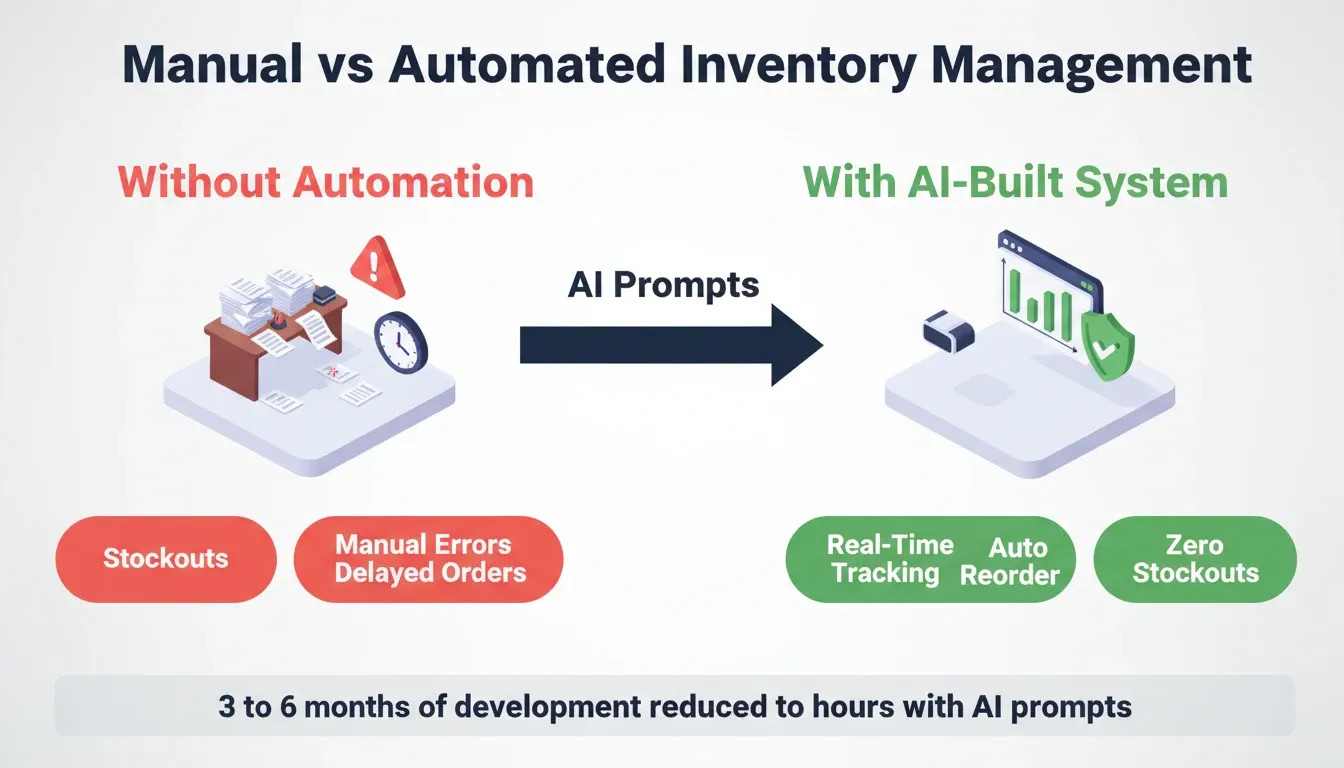
The difference between manual and automated inventory management:
| Without Automation | With an AI-Built System |
|---|---|
| Stock counts in spreadsheets, updated manually | Real-time dashboard synced across all locations |
| Reorders triggered by memory or gut feel | Automated purchase orders at configurable thresholds |
| Demand forecasting done in Excel, quarterly | Rolling forecasts updated from live sales data |
| Expiry dates tracked in a notebook | Automated alerts at 30, 14, and 7 days before expiry |
| Supplier performance tracked informally | Scored scorecards with on-time delivery and defect rates |
| Reports built manually, weekly or monthly | Automated reports generated on schedule, exported as PDF |
How AI Prompts Speed Up Inventory App Development
Traditional inventory software takes months to scope, design, code, and test. Prompts compress that timeline by translating your requirements directly into production-ready code through an AI builder.
-
Natural language replaces technical specs. Describe what you need, and the AI generates the full data model, API routes, and UI components
-
Each prompt targets one module. Instead of building a monolithic app, you generate focused features and connect them
-
Iteration happens in conversation. Change a reorder threshold, add a product category, or adjust a dashboard layout by describing the change in plain English
-
Full-stack output from a single input. One well-written prompt can produce frontend, backend, database schema, and authentication in a single pass
-
Speed that compounds. With Rocket, most apps generate in 1 to 3 minutes. Each module you build inherits the context of everything you have already described
Prompt-to-production flow: how a single natural language prompt becomes a deployed inventory management application.
The difference between a vague prompt and a precise one is the difference between a prototype and a production app. Stronger prompt engineering best practices produce better first-generation output every time.
The 15 Prompts: From Stock Tracking to Demand Forecasting
Here are the prompts grouped by inventory function. Each one generates a specific module. Copy them directly into an AI builder like Rocket, or customize them for your specific products and warehouse structure.
Stock Level Tracking (Prompts 1 to 3)
Prompt 1: Real-Time Dashboard
Build a real-time inventory dashboard that displays current stock levels for all SKUs, with color-coded alerts when items drop below minimum thresholds. Include filtering by category, warehouse location, and supplier.
Prompt 2: Barcode Scanning Interface
Create a barcode scanning interface that lets warehouse staff update stock counts using a mobile device camera. Each scan should log the item, quantity change, timestamp, and employee ID.
Prompt 3: Multi-Location Tracker
Generate a multi-location inventory tracker that syncs stock levels across three warehouses in real time. Include transfer requests between locations and automatic reconciliation of discrepancies.
Order Management (Prompts 4 to 6)
Prompt 4: Automated Purchase Orders
Build a purchase order system that automatically generates orders when stock hits reorder points. Include supplier selection logic based on lead time and cost, with approval workflows for orders above $5,000.
Prompt 5: Order Fulfillment Module
Create an order fulfillment module that assigns incoming customer orders to the nearest warehouse with available stock. Show picking lists, packing slips, and shipping label generation.
Ready to build your first inventory module? Describe your stock tracking requirements and Rocket generates a production-ready app in 1 to 3 minutes. Start building on Rocket
Prompt 6: Returns Processing
Generate a returns processing system that tracks returned items from receipt through inspection to restocking or disposal. Include reason codes and automated refund triggers.
Demand Forecasting (Prompts 7 to 9)
Prompt 7: Forecasting Dashboard
Build a demand forecasting dashboard that uses the past 12 months of sales data to predict stock needs for the next quarter. Visualize trends with line charts and flag items at risk of stockout.
Prompt 8: Seasonal Inventory Planner
Create a seasonal inventory planner that identifies products with recurring demand spikes. Auto-suggest pre-order quantities 60 days before each predicted peak.
Prompt 9: ABC Analysis Tool
Generate an ABC analysis tool that classifies inventory by revenue contribution. Show A-items (top 20% generating 80% revenue), B-items, and C-items with recommended stock policies for each.
Automated Alerts and Reporting (Prompts 10 to 12)
Prompt 10: Alert System
Build an alert system that sends email and in-app notifications when stock drops below safety levels, a shipment is overdue by more than 48 hours, or inventory value exceeds budget by 15%.
Prompts 1 to 10 can each become a live module in minutes. Rocket handles the frontend, backend, and database in one pass. No DevOps team required. Try Rocket
Prompt 11: Weekly Report Generator
Create a weekly inventory report generator that summarizes stock turnover rate, dead stock percentage, carrying costs, and fill rate. Export as PDF with charts.
Prompt 12: Expiration Date Tracker
Generate an expiration date tracker for perishable goods. Alert staff 30, 14, and 7 days before expiry. Auto-generate markdown pricing suggestions for items approaching their date.
Advanced Features (Prompts 13 to 15)
Prompt 13: Supplier Scorecard
Build a supplier performance scorecard that tracks on-time delivery rate, defect percentage, and price consistency across all vendors. Rank suppliers monthly and flag underperformers.
Prompt 14: Role-Based Access Portal
Create a role-based inventory portal with three access levels: warehouse staff (scan and count), managers (approve orders and view reports), and admins (full system configuration and user management).
Prompt 15: Audit and Cycle Counting
Generate an inventory audit module with cycle counting schedules. Assign random SKU batches to staff daily, compare counted quantities against system records, and log variance reports.
You now have all 15 prompts. Stack them inside a single Rocket project and your modules share context automatically. Every prompt you run knows what the previous ones built. Build your full inventory system on Rocket
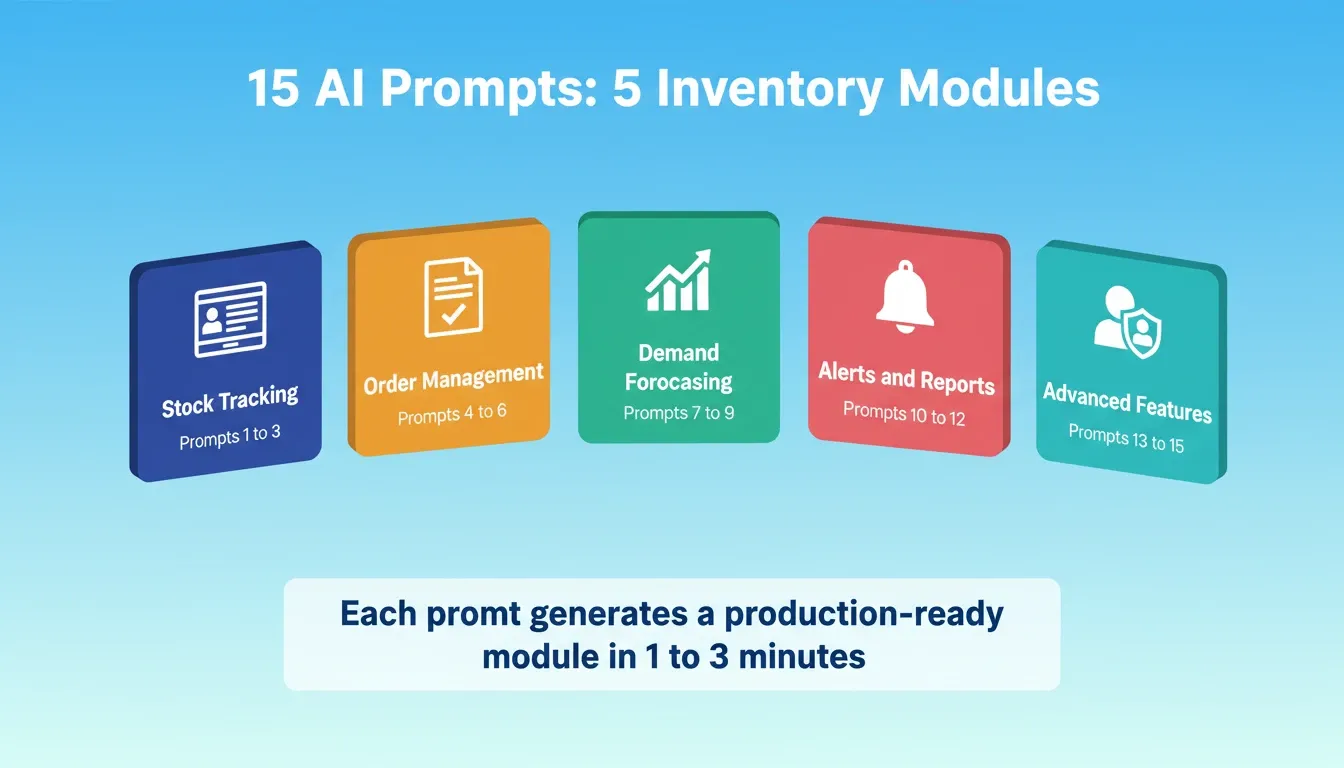
The 15 prompts map to 5 distinct inventory modules. Each generates a production-ready component in 1 to 3 minutes.
| Category | Prompts | Key Features Generated | Typical Build Time |
|---|---|---|---|
| Stock Tracking | 1 to 3 | Real-time dashboards, barcode scanning, multi-location sync | 1 to 3 min each |
| Order Management | 4 to 6 | Auto-reorder, fulfillment routing, returns processing | 1 to 3 min each |
| Demand Forecasting | 7 to 9 | Trend prediction, seasonal planning, ABC analysis | 1 to 3 min each |
| Alerts and Reporting | 10 to 12 | Threshold notifications, automated reports, expiry tracking | 1 to 3 min each |
| Advanced Features | 13 to 15 | Supplier scoring, role-based access, audit workflows | 1 to 3 min each |
Each prompt is designed to stand alone or stack with others. Start with prompts 1 to 3 for a solid foundation, then add modules as your business grows.
How to Chain These Prompts Into a Complete System
Individual prompts generate individual modules. Chaining them inside a single project turns those modules into a connected system. This approach works especially well for teams building AI apps for operations at scale.
Step 1: Set up a Project and add your context. Upload your product catalog, warehouse layout, supplier list, and any existing data schemas. Every prompt you run afterward inherits this context automatically. You never re-explain your business.
Step 2: Start with the data foundation (Prompts 1 and 4). Generate the real-time stock dashboard first, then the purchase order system. These two modules share the same core data model: SKUs, quantities, and reorder points. Building them together ensures a consistent schema.
Step 3: Add forecasting on top of live data (Prompts 7 to 9). Once stock tracking is live and generating data, the forecasting prompts can reference actual sales history. Prompt 7 becomes significantly more accurate when the dashboard from Prompt 1 is already in place.
Step 4: Layer in alerts and reporting (Prompts 10 to 12). These modules read from the data generated in steps 2 and 3. Build them after the core tracking is stable.
Step 5: Add access controls last (Prompt 14). Role-based access is easier to configure once all modules exist. Define what each role can see and do across the complete system.
Step 6: Connect integrations. The most relevant integrations for inventory systems are listed below.
| Integration | Purpose in Inventory System |
|---|---|
| Supabase | PostgreSQL database with row-level security, authentication, and real-time subscriptions |
| Airtable | Connect existing product catalogs or supplier databases |
| Stripe | Add payment processing for purchase orders or customer-facing order flows |
| Notion or Linear | Sync inventory tasks and alerts with your team's workflow tools |
| SendGrid or Mailchimp | Route automated alerts and weekly reports through your email provider |
What Makes a Prompt Work for Inventory Software
Not all prompts produce usable output. The difference between a prompt that generates a toy demo and one that produces a deployable system comes down to five structural patterns.
The Five Elements of a High-Quality Inventory Prompt
1. Explicit data model Name the entities your system needs to track. Mention SKUs, quantities, locations, timestamps, and relationships between entities. Vague prompts produce vague schemas.
-
Weak: Build an inventory tracker
-
Strong: Build an inventory tracker with SKUs, stock quantities per warehouse location, reorder thresholds, supplier IDs, and last-updated timestamps
2. Embedded business rules Reorder thresholds, approval limits, access levels, and notification triggers should all be stated upfront. The AI cannot infer your business logic. You have to supply it.
3. Named user roles Terms like warehouse staff and inventory manager tell the AI to generate different interfaces and permissions for each role. Without role names, you get a single-user interface with no access control.
4. Defined output scope Stating full-stack with authentication, database, and deployment-ready code prevents the AI from generating only a frontend mockup. Be explicit about what the output should include.
5. Numeric parameters Specific numbers like $5,000 approval threshold or alert at 48 hours overdue produce precise logic instead of placeholder values. Every number you include becomes a real rule in the generated code.
The warehouse management system market is projected to reach $10.04 billion by 2030 at a CAGR of 17.1%, showing strong demand for automated inventory solutions. Treat each prompt as a compressed requirements document. The more context you provide about your inventory workflow, the closer the first output will be to what you actually need.
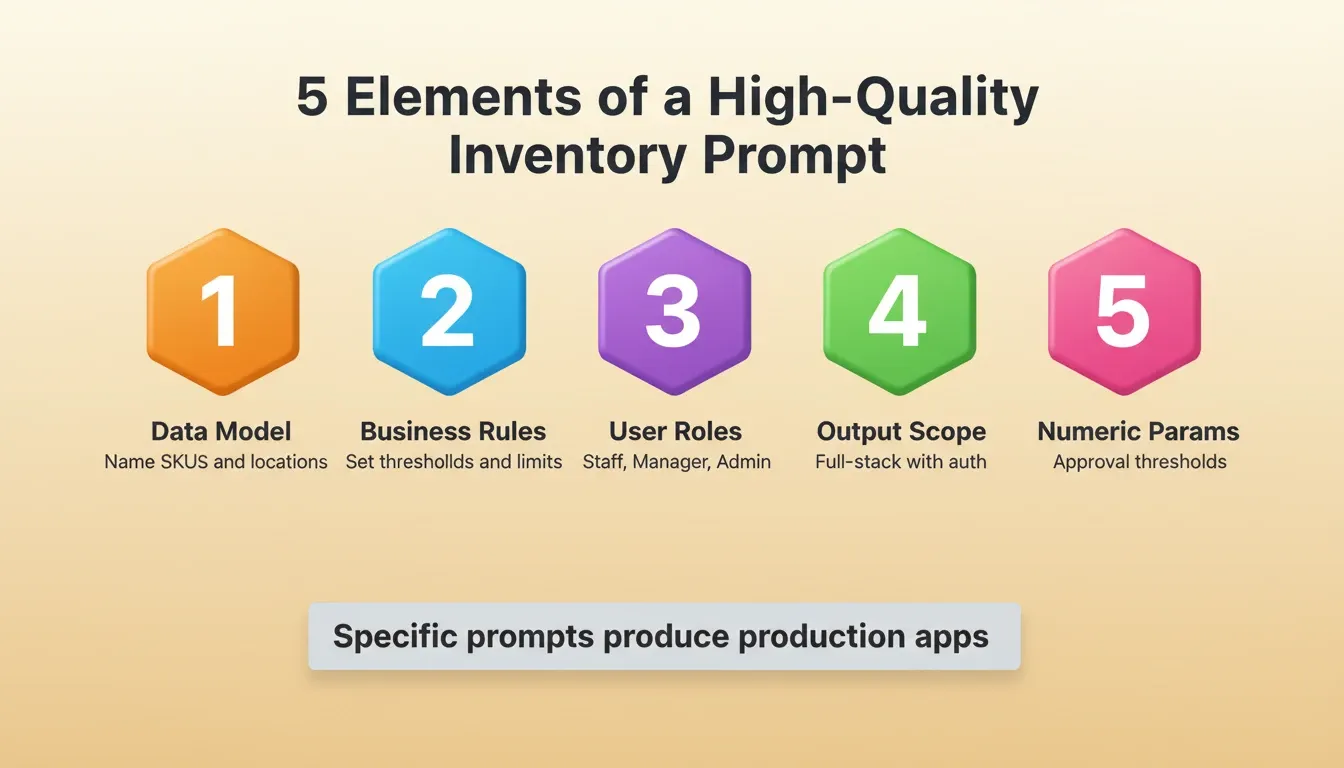
Every high-performing inventory prompt includes these five structural elements. Missing any one of them produces incomplete or generic output.
Why Rocket Handles Inventory Builds Differently
Most AI builders generate frontend-only prototypes and leave you to figure out the backend, database, and deployment. Rocket works differently across four dimensions that matter for inventory systems specifically.
Full-stack from the first generation. Describe your inventory system in plain language and Rocket's Build produces a Next.js frontend, API routes, and Supabase database connections in one pass. The output is a working, deployable product. Most apps generate in 1 to 3 minutes.
Context that compounds across every prompt. Add your product catalog, warehouse layout, or business rules to the project once. Every prompt you write afterward inherits that background automatically. No re-explaining, no re-uploading. When you run Prompt 7 (demand forecasting), it already knows the SKU structure you defined in Prompt 1.
Production defaults built in. Every build ships with SEO-ready structure, WCAG accessibility compliance, GDPR coverage, and performance optimization as the baseline. For inventory systems used by warehouse staff on mobile devices, this means the app works correctly on any screen size from day one.
Iterate through conversation, not configuration. Change reorder thresholds, add a new supplier field, or adjust the dashboard layout. Describe what you want next and Rocket applies it in context. Three iteration modes are available: Chat (natural language), Visual Edit (click any element to change it directly), and Code (full access to the generated Next.js or Flutter source).
Before you build, you can also use Solve to validate your inventory system requirements. This maps the right modules, user roles, and data model before you write a single prompt. After launch, Intelligence keeps you informed of how competitors evolve their operations tools, so your system stays ahead.
1.5 million people have tried Rocket across 180 countries. The platform serves builders shipping products, operators running research and intelligence operations, and enterprise teams consolidating tool sprawl, all from a single shared-context workspace.
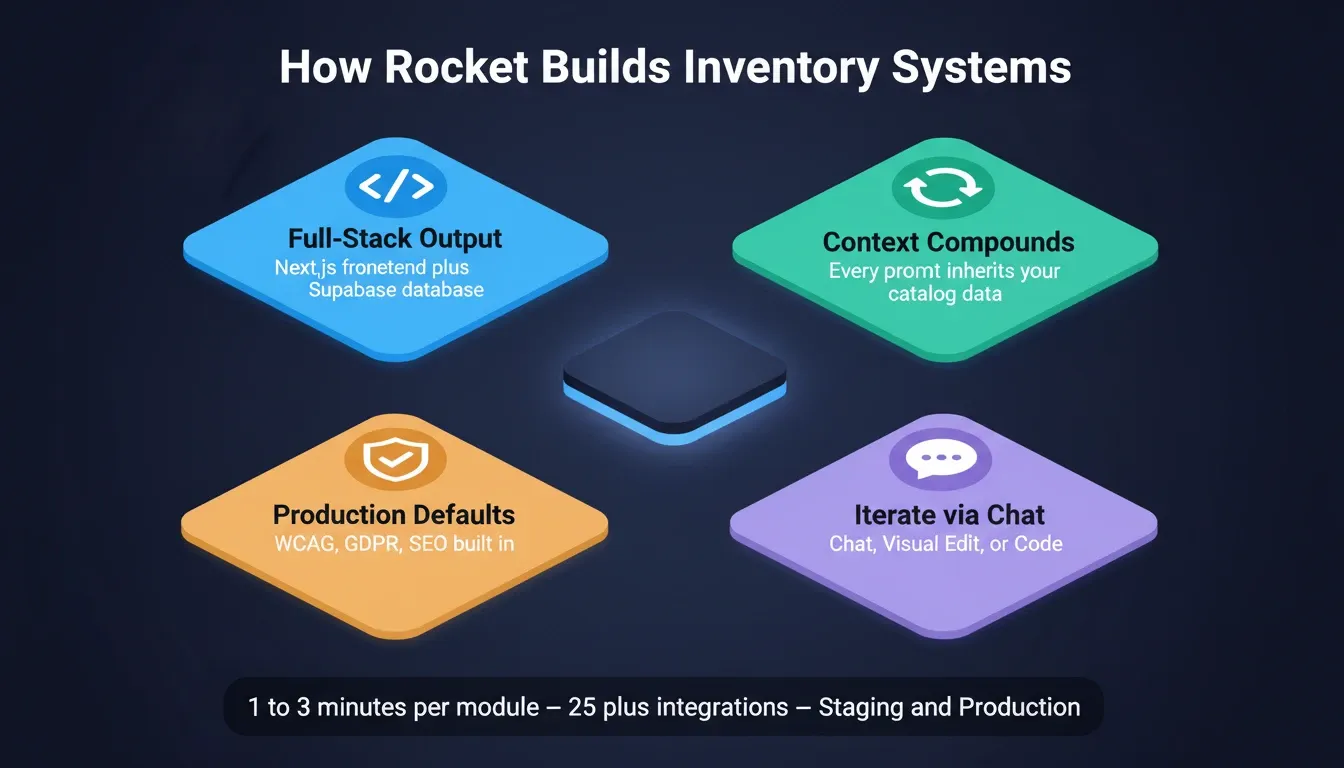
Rocket generates a Next.js frontend, Supabase database, and production-ready code in a single pass, with WCAG, GDPR, and SEO built in by default.
Common Mistakes When Prompting for Inventory Systems
Even with great prompts, a few patterns consistently produce poor results. Knowing what to avoid saves hours of rework.
Prompts that are too broad Build me an inventory app produces generic output with no business logic or custom workflows. The AI has no idea what products you sell, how many warehouses you have, or what your reorder rules are.
Missing error handling instructions Apps break when a barcode scan fails or a supplier API times out. Add explicit error handling to your prompts: If a barcode scan fails to match a SKU, display an error message and log the unmatched scan for review.
Ignoring scalability context The generated schema works for 50 products but may not handle 5,000 without explicit guidance. Add scale context: The system should handle up to 10,000 SKUs across five warehouse locations.
No mention of mobile responsiveness Inventory apps are used on warehouse floors, not just at desks. Add mobile-responsive with large touch targets for warehouse staff using handheld devices to any prompt that involves scanning or counting.
Skipping the data model first The most common failure pattern is prompting for UI before specifying the data model. You get a polished frontend with no real logic behind it. Always define what data the system tracks before describing how it looks.
Treating each prompt as isolated If you build each module in a separate session without shared context, the modules will not connect cleanly. For teams building internal tools with AI, shared project context is what makes individual modules work as a system.
Start Building Your Inventory System Today
The right AI prompts to build an inventory management system are the fastest path from scattered spreadsheets to a deployed, production-grade application. As AI app builders continue to mature, inventory systems that once required months of custom development will be generated, iterated, and deployed in hours. This makes automated stock management accessible to teams of every size.
You have the prompts. You have the framework. The next step is describing your inventory requirements and generating your first module. Start building on Rocket and go from prompt to production in one session.
Table of contents
- -What is an Inventory Management System?
- -Why Inventory Management Still Breaks Without Automation
- -How AI Prompts Speed Up Inventory App Development
- -The 15 Prompts: From Stock Tracking to Demand Forecasting
- -Stock Level Tracking (Prompts 1 to 3)
- -Order Management (Prompts 4 to 6)
- -Demand Forecasting (Prompts 7 to 9)
- -Automated Alerts and Reporting (Prompts 10 to 12)
- -Advanced Features (Prompts 13 to 15)
- -How to Chain These Prompts Into a Complete System
- -What Makes a Prompt Work for Inventory Software
- -The Five Elements of a High-Quality Inventory Prompt
- -Why Rocket Handles Inventory Builds Differently
- -Common Mistakes When Prompting for Inventory Systems
- -Start Building Your Inventory System Today