
AI-powered loan management systems automate credit scoring, fraud detection, and underwriting, cutting processing time from weeks to minutes. This blog covers architecture, compliance, and how to build and deploy a production-ready lending platform.
How do fintech teams process thousands of loan applications without a single manual review?
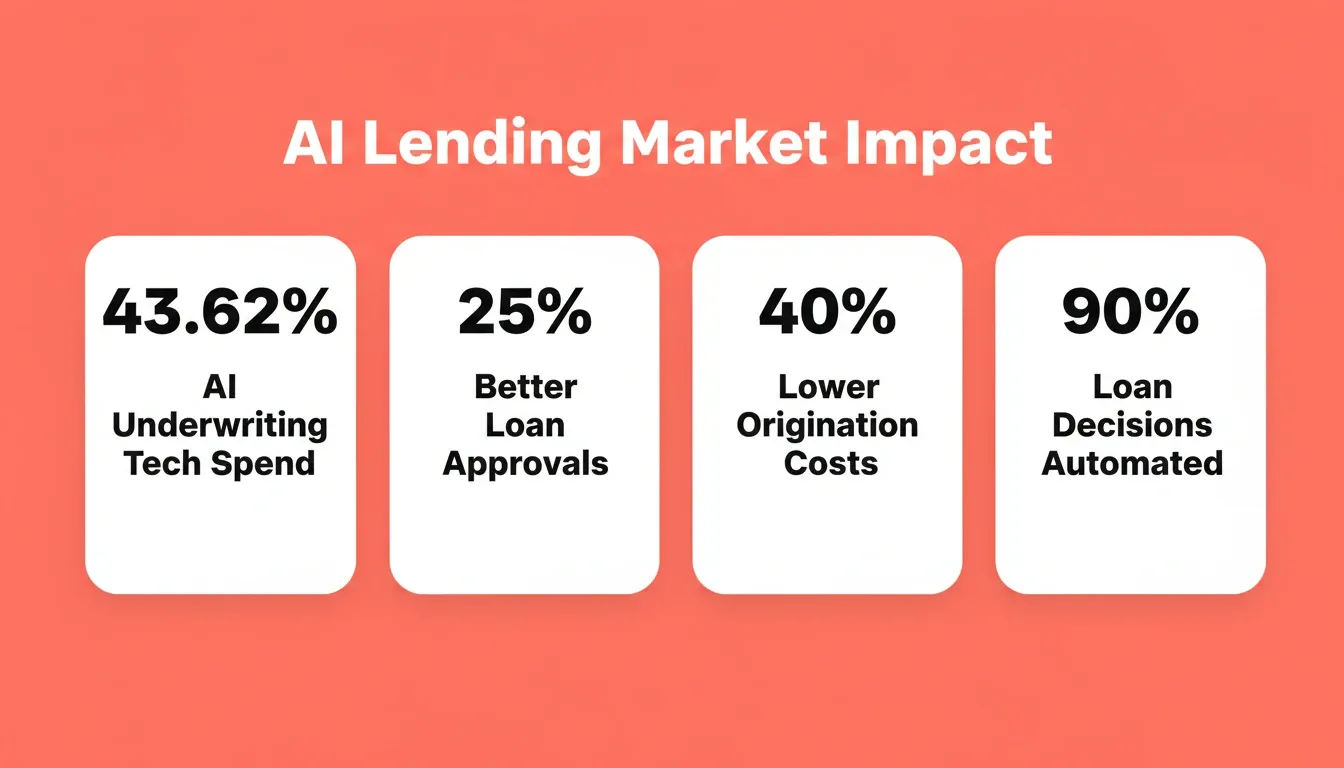
AI-powered underwriting engines now control 43.62% of technology spend in digital lending, according to Mordor Intelligence. For fintech founders and product teams, this signals a real opportunity and a clear direction.
This blog covers everything you need to build a loan management system with AI: the architecture, the core modules, the compliance requirements, and the fastest path to a deployed lending platform.
What is a Loan Management System?
A loan management system (LMS) is software that handles the complete lifecycle of a loan. It covers application intake, credit assessment, disbursement, repayment tracking, and collections. Modern AI-powered loan management systems replace manual document checks and legacy underwriting workflows. They use automated decision engines that process applications in minutes rather than weeks.
A production-grade lending platform typically includes six interconnected modules: a borrower-facing application portal, a credit scoring engine, a risk assessment layer, an automated underwriting decision engine, a fraud detection module, and a loan servicing dashboard for operators.
Key facts before you build:
-
AI underwriting engines control 43.62% of technology spend in digital lending
-
90% of loan decisions can be automated with a well-architected system
-
Compliance must be designed in from day one. Retrofitting KYC, AML, and audit trails is one of the most expensive mistakes in fintech
Why are Lenders Moving Toward AI-Powered Loan Systems?
Traditional lending workflows are breaking under modern demand. A single loan application passes through seven to twelve manual checkpoints before reaching a human decision-maker. These delays lose borrowers.
-
Processing speed gap: Manual underwriting takes 30 to 45 days for mortgage loans. AI-driven loan processing systems compress this to hours or even minutes for personal and SME lending products.
-
Default prediction accuracy: Machine learning models trained on alternative data sources achieve 25% better approval rates without increasing risk exposure for lenders.
-
Operational cost reduction: Banks that use automated credit scoring eliminate repetitive document-verification tasks. This cuts loan origination costs by up to 40%.
-
Regulatory pressure: Financial regulators, including the CFPB in the US, the FCA in the UK, and the RBI in India, now expect real-time compliance monitoring and audit trails. Manual teams simply cannot deliver this at scale.
-
Borrower expectations: Consumer-facing fintech apps have trained borrowers to expect instant decisions. Legacy systems lose applicants at the first delay.
The shift is not about replacing loan officers. It is about removing bottlenecks that add no value to the lending decision. As a result, lenders improve borrower experience and reduce credit risk exposure.
What Does a Modern AI Lending Platform Look Like?
A well-architected lending platform connects several specialized modules into a single workflow. Together, they handle the entire loan lifecycle, from application intake through repayment tracking and collections.
-
Application portal: A borrower-facing interface for submitting loan requests, uploading documents, and tracking loan status in real time
-
Credit scoring engine: ML models that assess borrower creditworthiness using traditional bureau data combined with alternative signals like transaction history and payment behavior
-
Risk assessment layer: Predictive analytics that evaluate default probability, assign risk tiers, and adjust interest rates for each loan product
-
Automated underwriting: A rules-based and model-driven decision engine that approves, denies, or escalates loan applications without human intervention
-
Fraud detection module: Pattern recognition algorithms that flag suspicious applications, identity mismatches, and synthetic identities before loan disbursement
-
Loan servicing dashboard: An operator-facing panel for managing active loans, payment schedules, collection workflows, and borrower communications
The interaction between these components is where the real value lives. A database-connected lending system passes borrower data between modules without manual handoffs. This creates a continuous decision pipeline from origination to servicing.
Core Modules and Their Functions
| Module | AI Capability | Business Impact |
|---|---|---|
| Credit Scoring | Gradient boosting, neural networks | 25% more loan approvals at same risk level |
| Fraud Detection | Anomaly detection, graph analysis | 60-80% reduction in lending fraud losses |
| Automated Underwriting | Decision trees, NLP document parsing | 90% of loan decisions automated |
| Risk Monitoring | Time-series analysis, early warning signals | 35% faster default intervention |
| Borrower Communication | Conversational AI, NLP chatbots | 70% of borrower support queries resolved instantly |
Compliance and Regulatory Requirements for AI Lending Systems
Compliance is not a post-launch concern in fintech. Regulatory requirements must be designed into the data model, audit trail, and decision logic from day one.
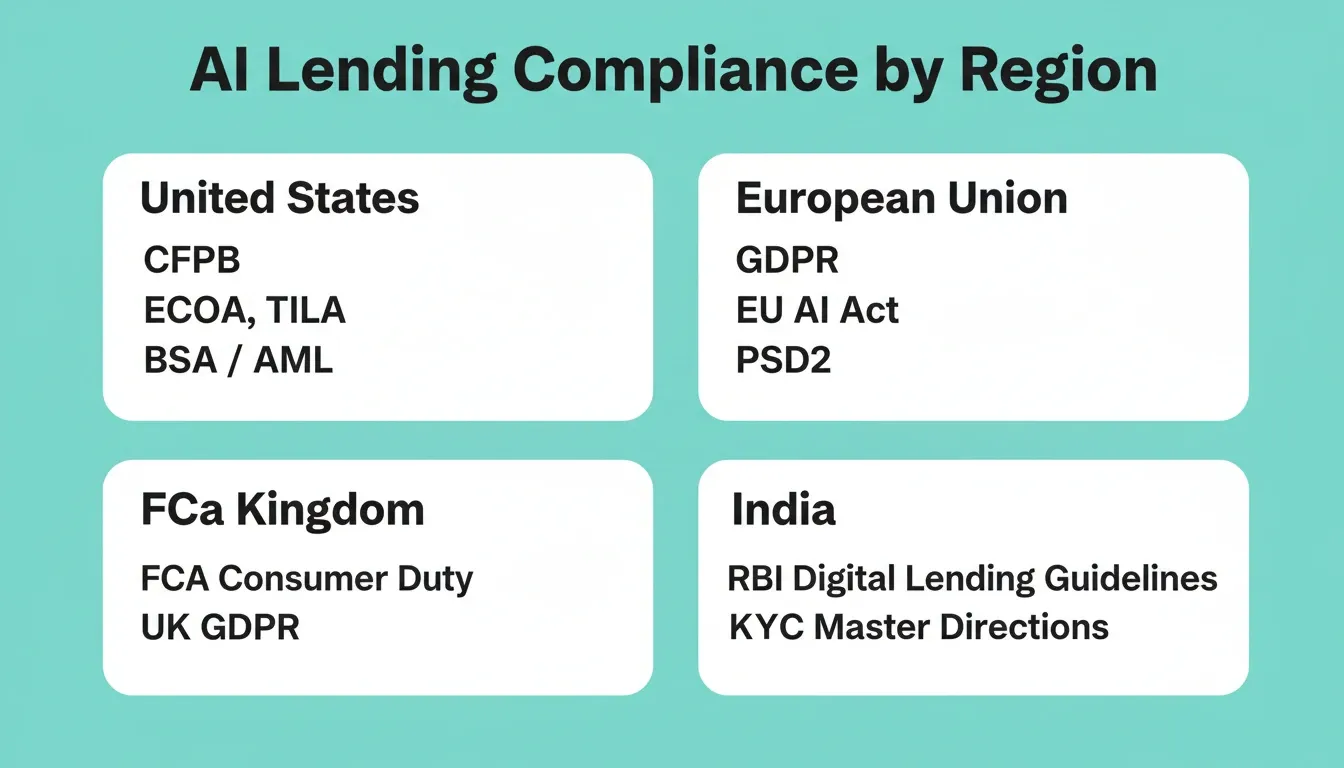
Core compliance requirements by region:
-
United States: Equal Credit Opportunity Act (ECOA), Fair Housing Act (FHA), Truth in Lending Act (TILA), Bank Secrecy Act (BSA) for AML, and CFPB oversight for consumer lending. AI models must be explainable. Adverse action notices must cite specific reasons for denial.
-
European Union: GDPR for borrower data handling, EU AI Act for high-risk AI classification in credit scoring, PSD2 for payment data access, and the AML Directive (AMLD).
-
United Kingdom: FCA Consumer Duty, FCA AI and machine learning guidance, and UK GDPR.
-
India: RBI Digital Lending Guidelines (2022), Fair Practices Code for NBFCs, and KYC Master Directions.
Before you write a single line of code, validate your banking app idea against the regulatory requirements for your specific market and borrower segment.
What this means architecturally:
Every loan decision must generate an audit trail. The system must log which model version made the decision, which input data it used, which score it produced, and which rule triggered the outcome. Build these capabilities into your data model before the first API call:
-
Explainability layer: Store SHAP values or LIME explanations alongside every credit decision
-
Bias detection: Run automated quarterly audits comparing approval rates across demographic groups
-
Data residency controls: Store borrower PII in jurisdiction-specific databases where regulations require it
-
Consent management: Track granular consent for alternative data sources
-
Right to erasure: Build GDPR-compliant data deletion workflows that preserve audit trails while removing PII
How Do You Plan the Lending System Architecture?
Starting without a clear architecture plan is the fastest way to accumulate technical debt in fintech software. Before writing a single line of code, you need clarity on data flows, model hosting, compliance boundaries, and how your loan management modules connect.
-
Data layer first: Define your database schema for borrowers, loans, payments, credit scores, and risk assessments. Choose SQL for transactional consistency or NoSQL for flexible document storage, depending on your loan product complexity.
-
Model serving strategy: Decide whether machine learning models run as microservices behind APIs or embed directly in the application layer. API-based serving allows independent model updates without redeploying the full lending platform.
-
Compliance boundaries: Map regulatory requirements, including KYC, AML, and fair lending laws, to specific system components. This ensures audit trails for every loan decision are built in from day one.
-
Cloud deployment model: Select public cloud (AWS, GCP) for speed or hybrid architecture for data sovereignty requirements that many financial services regulators mandate.
-
External connections: Identify the APIs you need, including credit bureaus, identity verification services, payment processors, and banking rails for loan disbursement and repayment collection.
-
Environment variable management: Store all API keys, secrets, and third-party credentials securely at the server level. Never expose them in client code.
AI Lending System Architecture Flow
Validate Your Lending Concept Before You Build
The most expensive mistake in fintech is not a bad execution. It is a good execution of the wrong product. Before writing a single line of code, validate that your specific lending product addresses a real, underserved gap in the market.
Use Rocket's Solve to run structured market research on your lending concept. Describe your target borrower segment, loan product type, and geography in plain language. Rocket runs thousands of queries across 150+ sources simultaneously. It returns a structured report covering market sizing, competitive landscape, regulatory requirements for your jurisdiction, and a direct recommendation on whether the opportunity is worth pursuing.
This research output does not disappear after you read it. When you open a Build task inside the same Rocket project, the market research, competitive brief, and regulatory findings are already present as context. As a result, the first version of your lending platform reflects genuine product thinking, not a generic template.
From Concept to Deployed Lending App with Rocket
Most teams spend months assembling a development stack before writing their first feature for a loan management platform. Backend frameworks, database setup, authentication systems, and deployment pipelines consume weeks of engineering time. That time could go toward building lending logic instead.
Rocket's Build generates production-ready Next.js web applications and Flutter mobile apps from plain-language descriptions. For a lending platform, this means your borrower portal, admin dashboard, credit scoring interface, and loan servicing views are generated together. Supabase handles the database layer, Stripe handles payment flows for loan disbursement and repayment collection, and authentication is configured from the first generation.
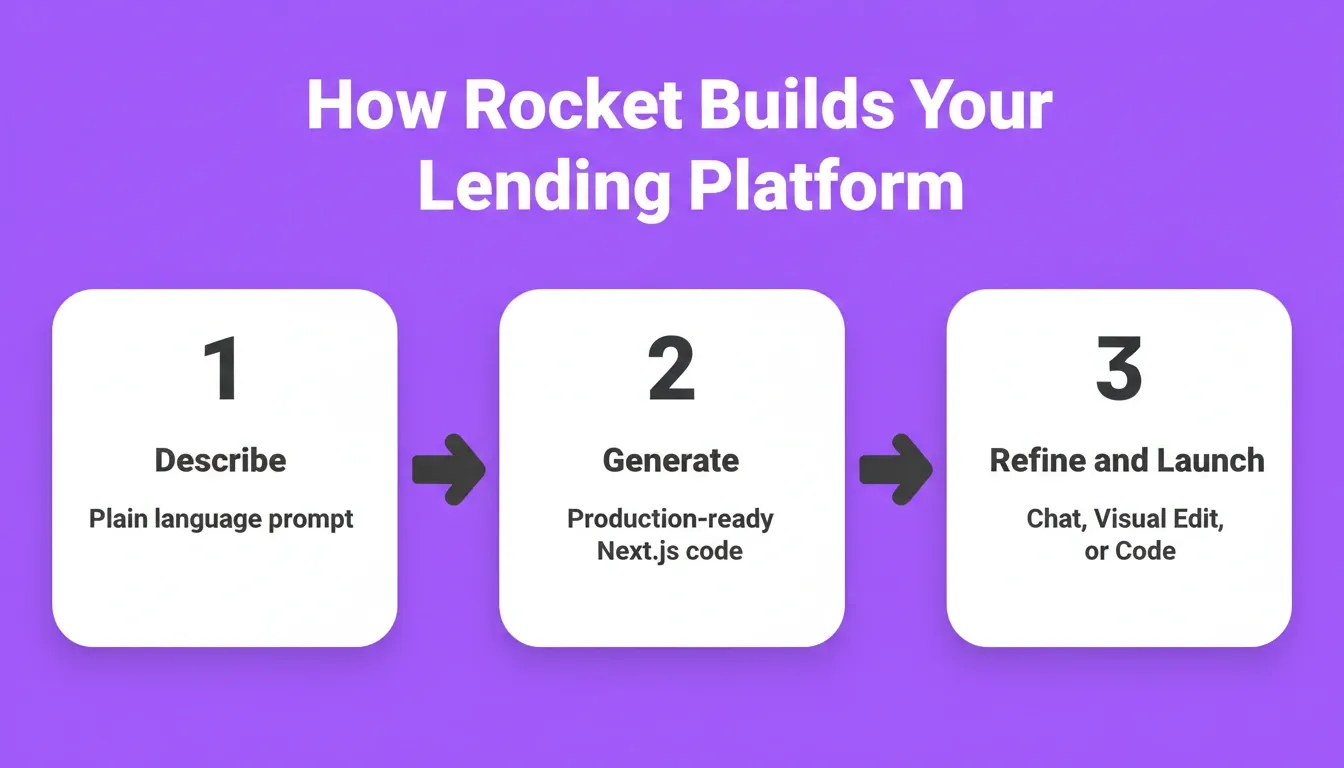
How to build your lending platform on Rocket:
Step 1: Describe your lending platform. Open a Build task and describe your system in plain language. Include the loan products you offer, the borrower portal screens, the admin underwriting interface, and the risk dashboard. Rocket plans the architecture and generates production-grade code. The output is a working, deployable product, not a wireframe.
Step 2: Connect your data and payment integrations. Rocket's 25+ integrations include Supabase (database, row-level security, auth), Stripe (payment processing for disbursement and repayment), Twilio (SMS notifications for borrowers), and SendGrid (email communications). Authenticate once and they flow into every build. You can also connect a SaaS billing platform for subscription-based lending products.
Step 3: Iterate through conversation. Need to add a fraud detection flag to the loan application review screen? Tell Rocket in natural language. Need a risk tier color-coding system on the servicing dashboard? One message handles it. No context re-explaining is required.
Step 4: Secure your API keys and credentials. Use Rocket's Environment Variables feature to store credit bureau API tokens, identity verification keys, and payment processor secrets at the server level. Keys are never exposed in client code.
Step 5: Test in staging, then deploy to production. Rocket deploys to a staging URL first. Share it with your team for review. When ready, deploy to production with a custom domain, automatic HTTPS, and one-click rollback. Built-in analytics track visitors, conversions, and Core Web Vitals after launch.
Step 6: Build the mobile borrower app. If your lending product needs a mobile app, describe it in the same Rocket project. Rocket generates a Flutter mobile app with dark/light theming, fluid navigation, and real design systems, ready for the App Store and Google Play.
Rocket vs. Traditional Development
| Capability | Traditional Development | Rocket |
|---|---|---|
| Time to first working prototype | 3-6 months | Hours to days |
| Database and auth setup | Weeks of configuration | Included from first generation |
| Payment integration (Stripe) | Separate sprint | Authenticate once, flows into build |
| Mobile app (iOS and Android) | Separate team, separate codebase | Flutter from same project context |
| Staging and production environments | DevOps setup required | Built in |
| Version history and rollback | CI/CD pipeline required | Built in |
| WCAG, GDPR, and SEO compliance | Manual implementation | Default baseline on every build |
Rocket Pricing
| Plan | Price | Credits/Month | What's Included |
|---|---|---|---|
| Free | $0 | 20 (one-time) | Build production-ready websites, landing pages, web apps, mobile apps |
| Pro | $25/mo | 100 | Build production-ready websites, landing pages, web apps, mobile apps |
| Rocket | $50/mo | 250 | Build + Solve + Intelligence |
| Booster | $250/mo | 1,500 | Full suite + SSO, data localisation, premium support |
All paid plans include unlimited team members. Annual billing saves 20%. No credit card is required to start.
Step-by-Step Development Workflow
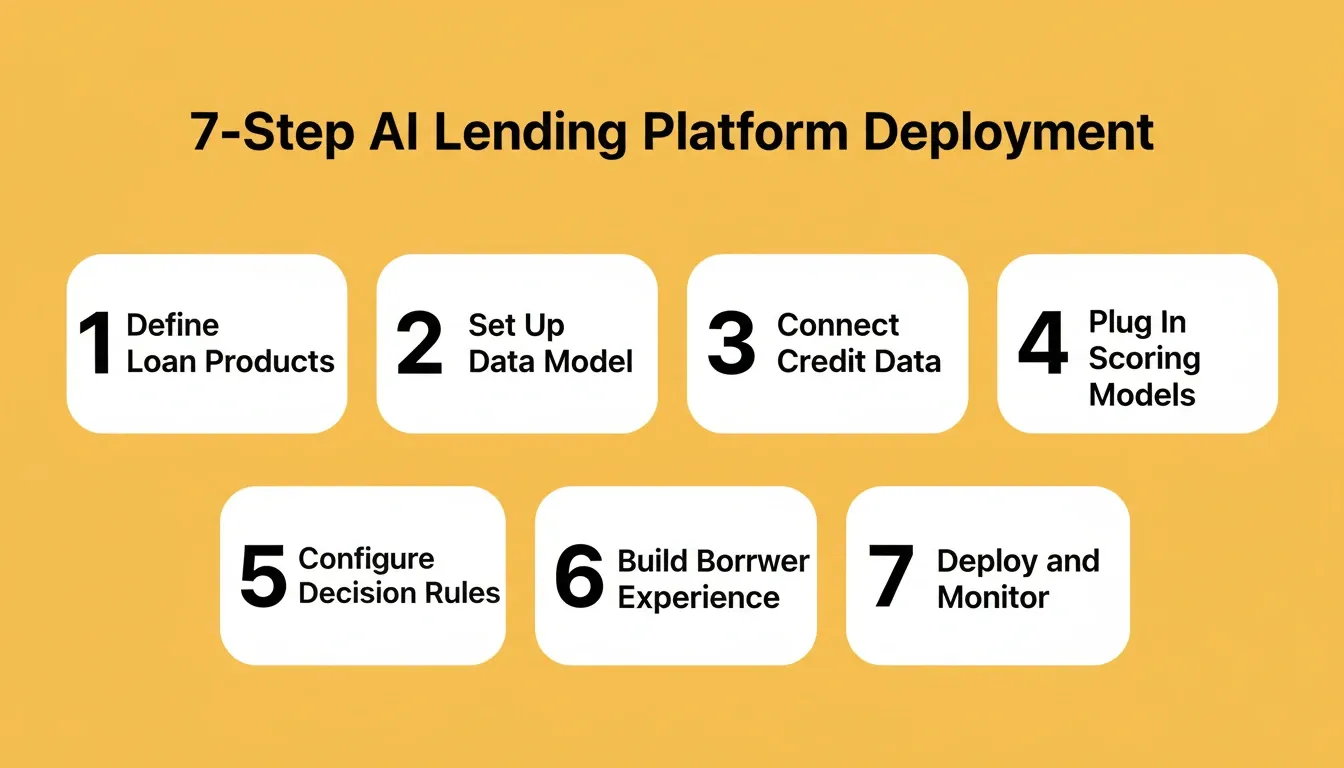
With architecture planned and tools selected, follow this practical sequence to bring your AI lending system to production. Each step builds on the previous one to create a complete loan lifecycle management solution.
-
Define your loan products. Specify loan types (personal, SME, mortgage), term lengths, interest rate ranges, and eligibility criteria before touching any code. This determines your entire data model.
-
Set up your data model. Create database tables for borrowers, loan applications, credit scores, risk assessments, payment schedules, and audit logs. These logs track every lending decision.
-
Connect credit data sources. Link to credit bureau APIs (Experian, TransUnion, Equifax) and alternative data providers for transaction history, cash flow analysis, and behavioral scoring inputs.
-
Train or plug in scoring models. Use pre-built machine learning models from providers like Zest AI or FICO. Alternatively, train custom credit scoring models on your historical lending data for better accuracy.
-
Configure decision rules. Set automated approval thresholds, escalation triggers for human review, and denial criteria. Base these on your risk appetite and regulatory requirements.
-
Build the borrower experience. Create loan application forms with progressive disclosure, real-time status tracking, document upload with OCR processing, and automated notifications.
-
Deploy and monitor. Launch with monitoring dashboards for model drift, approval rates, default rates, loan portfolio health, and borrower satisfaction metrics.
As noted in Azilen Technologies' industry analysis, generative AI in lending is projected to grow from $3.86 billion in 2025 to nearly $9.7 billion by 2030. Their research highlights that "the industry is primarily fueled by a surge in digital financial transactions and the need for automated, personalized credit services."
Teams that build full-stack lending applications with AI prompts capture this fintech market faster than those following traditional software development timelines. The competitive advantage in lending technology is speed to market, not team size.
Common Mistakes When Building AI Lending Systems
Understanding what goes wrong is just as important as knowing what to build. Here are the most frequent and costly errors fintech teams make when building loan management systems.
1. Starting with the model, not the data. The most sophisticated credit scoring model is only as good as the data it trains on. Teams that rush to model selection before establishing clean, labeled historical loan data produce models with poor generalization.
2. Retrofitting compliance. Building the lending logic first and adding KYC, AML, and audit trails later forces expensive rework. Compliance boundaries must be in the data model from the first schema design.
3. Ignoring model drift. A credit scoring model trained on pre-recession data will underperform during economic stress. Without monitoring for model drift, approval rates and default rates move in the wrong direction before anyone notices.
4. Building a web-only borrower experience. Most loan applications start on mobile. A lending platform that is not mobile-first loses borrowers at the application stage.
5. No human escalation path. Fully automated underwriting works for clear approvals and clear denials. Edge cases, such as thin credit files, self-employed borrowers, and recent credit events, need a human review queue with clear escalation logic.
Who Should Build an AI Loan Management System?
AI lending platforms are not only for established banks. The combination of accessible ML infrastructure, open banking APIs, and AI app builders makes it practical for a much wider range of teams to build and deploy lending products.
Fintech founders building new lending products, including personal loans, BNPL, SME lending, and earned wage access, need to move from concept to live platform faster than a traditional development timeline allows.
Community development financial institutions (CDFIs) and credit unions need to modernize loan origination workflows without the budget for enterprise banking software vendors.
Embedded finance teams at non-financial companies, including e-commerce platforms, HR software, and payroll providers, add lending products to their existing user base. Teams building B2B SaaS products with AI often find that embedded lending is a natural expansion of their core platform.
Non-technical founders with lending domain knowledge, including former loan officers, credit analysts, and risk managers, understand the lending business deeply. They need a platform that lets them build without a full engineering team.
Monitor Your Lending Market with Intelligence
Shipping a lending platform is not the end of the work. It is the beginning of staying competitive. Rocket's Intelligence monitors every public platform your competitors operate on, continuously. Pricing changes, new loan products, regulatory responses, and feature releases surface as daily briefs. Each brief includes a clear interpretation of what each signal means for your business.
For fintech teams, this matters more than in most categories. Regulatory changes move fast. Competitor pricing shifts can redefine borrower expectations overnight. Staying ahead of those signals is what separates lending platforms that grow from those that stagnate.
Smart Lending Starts with Smarter Infrastructure
The lending industry rewards speed, accuracy, and compliance in equal measure. Teams that combine AI-driven credit scoring and risk assessment models with modern development platforms can compete with established lenders at a fraction of the traditional cost and timeline.
Your next move is straightforward: validate your lending concept, define your loan products and data model, and choose tools that let you iterate quickly without sacrificing production quality. The technology exists today to go from a lending concept to a live platform serving real borrowers, without assembling a full engineering team.
The Future of AI Lending Is Already Here
AI-powered loan management systems are no longer a competitive advantage for large banks. They are the baseline expectation for any lending product that wants to survive the next five years. Borrowers expect instant decisions. Regulators expect explainable ones. The market rewards teams that can deliver both.
You describe the lending platform. Rocket generates the production-ready code, including database, auth, payments, and compliance defaults. Deploy in one click, iterate in plain language, and stay ahead of the market with built-in competitive monitoring. Start building your loan management system on Rocket.new, no templates, no waiting, no engineering team required.
Table of contents
- -What is a Loan Management System?
- -Why are Lenders Moving Toward AI-Powered Loan Systems?
- -What Does a Modern AI Lending Platform Look Like?
- -Core Modules and Their Functions
- -Compliance and Regulatory Requirements for AI Lending Systems
- -How Do You Plan the Lending System Architecture?
- -AI Lending System Architecture Flow
- -Validate Your Lending Concept Before You Build
- -From Concept to Deployed Lending App with Rocket
- -Rocket vs. Traditional Development
- -Rocket Pricing
- -Step-by-Step Development Workflow
- -Common Mistakes When Building AI Lending Systems
- -Who Should Build an AI Loan Management System?
- -Monitor Your Lending Market with Intelligence
- -Smart Lending Starts with Smarter Infrastructure
- -The Future of AI Lending Is Already Here