
What is a landing page? It’s a standalone web page built to convert visitors into leads or customers by focusing on one goal, minimizing distractions, and driving a single clear action.
So, what is a landing page?
Have you ever clicked an ad or social media post and landed on a page that immediately told you what to do next? That’s a landing page.
In simple terms, it’s a standalone web page designed to convert visitors into leads or customers. Unlike a homepage with multiple links, a landing page focuses on a single goal, guiding visitors to take action.
The Unbounce 2024 Conversion Benchmark Report shows that optimized landing pages drive higher conversions, with data from 41,000+ pages and 464 million visitors highlighting their effectiveness.
So, what is a landing page really doing? It’s acting as a destination that communicates value fast, removes distractions, and pushes visitors toward a single action: sign-up, download, purchase, or registration.
Why Landing Pages Matter?
Landing pages are central to online marketing. They give your marketing campaigns a focused endpoint. Unlike other web pages, they are built to convert visitors efficiently.
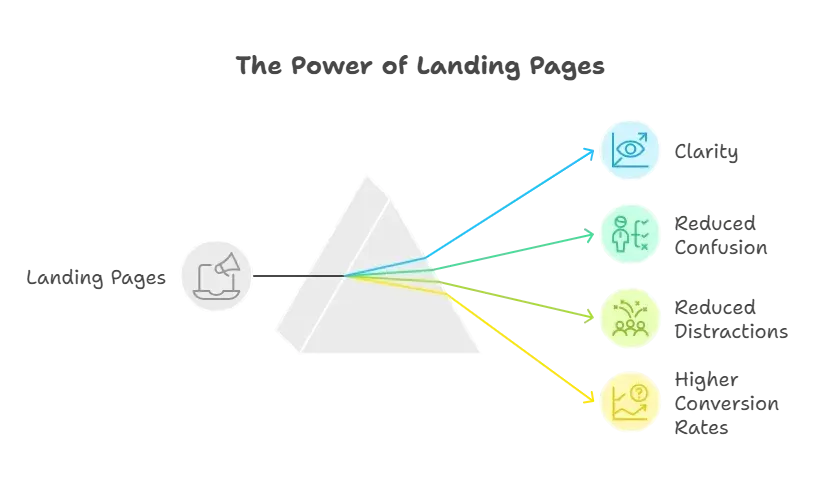
Landing pages matter because they provide focus and clarity, helping your marketing campaigns achieve better results.
Key Benefits of a Good Landing Page
A good landing page provides more than just a web presence—it helps your marketing campaigns perform better and delivers measurable results.
Benefits include:
- Increased Conversion Rates: A targeted page converts better than a general page.
- Lead Generation: Capture email addresses or contact information.
- Focused Messaging: Each page speaks directly to the visitor’s intent.
- Supports Paid Ads: Ads drive traffic to pages that match their offer, improving ROI.
- SEO Opportunities: Optimized for search engines to attract relevant traffic.
With these benefits, a good landing page not only guides visitors effectively but also strengthens your overall marketing strategy.
Types of Landing Pages
Every marketing goal is different, and the type of landing page you use can make a big difference in results. Choosing the right type ensures visitors see the message that matches their intent and are guided toward the action you want.
Landing pages are not one-size-fits-all. Depending on the goal, you can choose the type:
Common types include:
-
Lead Generation Landing Pages
These are also called lead-gen landing pages or lead-capture pages. They collect visitor info—like email or phone number. Usually used in B2B, SaaS, or email campaigns.
-
Click Through Landing Pages
These act as a bridge between your ad and a checkout page or signup form. The goal here is to convince visitors to move forward.
-
Dedicated Landing Page
A dedicated landing focuses entirely on one product, offer, or campaign. No distractions, no extra links—just the action you want.
-
Separate Landing Pages
Creating separate landing pages for each ad group or social media post lets you tailor messaging to visitor intent. It improves conversion rates because each page speaks directly to the visitor's intent.
Choosing the right type helps your campaigns run efficiently and guides visitors to complete the intended action.
High-Converting Landing Pages: What They Include
A high-converting landing page focuses on elements that guide visitors to take action quickly and easily.
| Element | Purpose |
|---|---|
| Clear headline | Tells visitors what they’ll get instantly |
| Subheadline | Supports the headline with detail |
| Visuals | Shows product or service visually |
| Benefits list | Explains value and outcomes |
| CTA button | Encourages the main action |
| Trust signals | Testimonials, reviews, or security badges |
| Minimal links | Keeps focus on the conversion |
High-converting landing pages use these elements to gently guide the visitor toward completing the intended action.
How to Create a Landing Page?
Creating landing pages doesn’t need to be complicated. The key is to have a clear roadmap so visitors know exactly what to do and are guided to take action.
1. Pick Your Objective
Decide what action you want visitors to take.
Examples:
- Download a guide
- Sign up for a webinar
- Purchase a product
- Request a demo
Your landing page's focus should match this goal. Everything else is secondary.
2. Know Your Target Audience
Understanding who will visit your landing page allows you to craft content that directly addresses their needs, challenges, and desires. The more your page speaks their language, the higher the chance they’ll take action.
3. Write a Clear and Compelling Headline
Your headline is the first thing visitors see, so make it attention-grabbing and easy to understand. A supporting subheadline can clarify the offer and encourage visitors to stay and explore further.
4. Include a Strong CTA
A prominent call-to-action guides visitors toward the desired action. Place it above the fold, make it visually distinct, and repeat it subtly as users scroll to increase engagement and conversions.
Examples: “Download Free Guide”, “Start Free Trial”, “Sign Up Now”.
5. Add Visuals
Images, graphics, or short videos make your landing page more engaging and easier to understand. Visuals help illustrate your offer and break up text, keeping visitors interested.
6. Remove Unnecessary Links
Limiting outbound links keeps visitors focused on your main goal. Too many distractions can reduce conversions, so a clean, single-purpose page works best.
7. Use Social Proof
Including testimonials, reviews, and trust badges builds credibility and reassures visitors. Social proof increases confidence in your offer and can significantly boost conversion rates.
8. Test with A/B Testing
A/B testing compares two page versions. Change one element headline, CTA, or layout. Measure which version gets better conversion rates.
Creating landing pages this way ensures clarity, focus, and higher conversion rates. Following each step helps guide visitors toward the desired action without distractions.
Landing Page Best Practices
Following landing page best practices helps ensure your pages perform efficiently and convert visitors effectively. A well-structured page reduces distractions and makes the desired action clear.
- Fewer links – Keep the visitor focused.
- Mobile-friendly design – Most traffic comes from mobile.
- Fast page speed – A slow page reduces conversion rates.
- Clear CTA – Easy to spot and understand.
- Use bullet points – Quickly communicate benefits.
- Minimal distractions – Avoid pop-ups or excessive text.
- SEO optimization – Helps search engines find your page.
Applying these practices helps create a landing page that is clear, user-friendly, and more likely to convert visitors into leads or customers.
Landing Page Builders
Building landing pages frequently can be simple when you use the right tools. The right builder saves time, helps you design clean layouts, and ensures your pages are ready to convert.
Popular landing page builders include:
- Unbounce – Drag-and-drop with templates.
- Leadpages – Strong for lead generation landing.
- Instapage – Great for personalized content and A/B testing.
- Mailchimp – Connects landing pages to email campaigns.
- Wix/Squarespace – Simple create a landing page for small businesses.
These landing page builders make it easy to create pages, design layouts, and publish quickly, helping your marketing campaigns reach potential customers efficiently.
Rocket.new: AI-Powered Landing Pages
Creating landing pages can be fast and simple with Rocket.new.
Rocket.new is a vibe solutioning platform that turns text prompts into live web projects. This makes it fast to create landing pages, even without coding.
Top Features:
- Prompt to App Creation: Builds apps directly from single prompts
- Figma Import: Converts design files into live, editable layouts
- AI-Powered Backend: Automatically handles logic, data, and workflows
- Custom Domain Support: Publishes projects with a branded domain
- Code Export: Allows developers to extend or customize later
- Live Preview: Shows instant updates while editing
- Reusable Components: Speeds up building with ready-to-use elements
- Command-based actions: Use / and @ to run actions and quickly scope edits.
Template Example: Edifice - Intelligent Proptech Landing Page Template
Rocket.new offers a landing page template called Edifice, it is a single-page proptech landing page template built for smart building management platforms. It opens with an interactive building address input, animates a live wireframe tower, and delivers a simulated efficiency score before a visitor scrolls. The asymmetric 60/40 grid, Midnight Blue palette, and teal accent create a dark, data-driven aesthetic that earns every click.
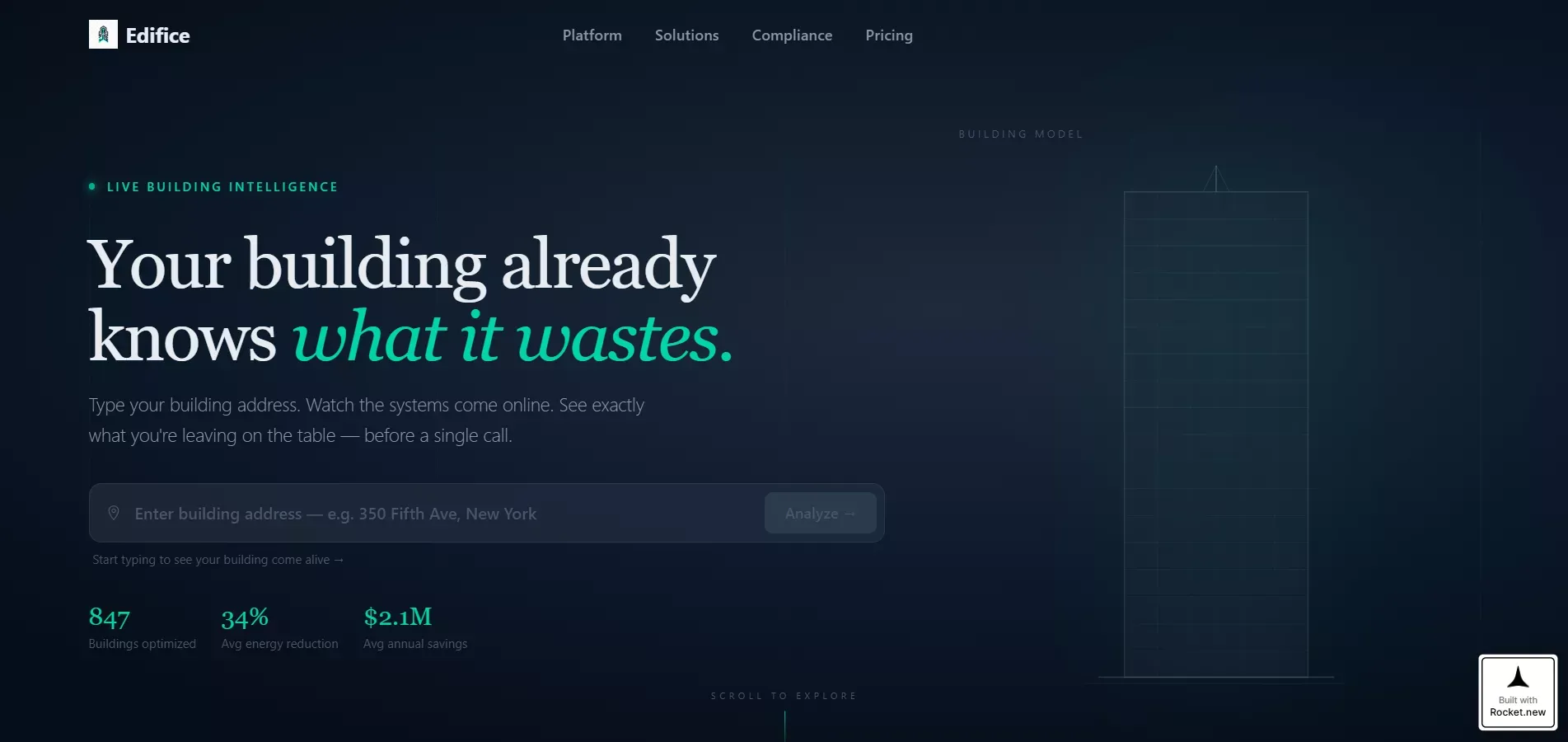
Who this template is for This template is built for PropTech and real estate software companies that sell to commercial building operators. It speaks directly to the people who manage large, complex properties and need to show ROI fast.
Use Cases:
- Promotional landing pages – For a new product or service.
- Lead capture pages – Grow email lists with lead generation pages.
- Event registration pages – Webinars, online courses, or workshops.
- Service signups – Consultants or freelancers can use a dedicated landing page for leads.
Rocket.new simplifies building high-converting landing pages while keeping design and SEO tight.
👉Build Your Landing Page with Rocket 🚀
Optimize Landing Pages
After creating landing pages, optimization ensures success:
- Track conversion rates for CTAs.
- Improve page speed for fast load times.
- Tweak copy for landing page visitors based on behavior.
- Use heatmaps to see clicks and scroll patterns.
- Keep updating for better search engine results.
Optimized pages convert better and help your marketing strategy perform well.
Community Insight
One user on Reddit wrote:
“Ads bring the right people in, but the landing page has to close the deal. I rebuilt mine with fast load speed and clear CTA above the fold. Conversions nearly doubled.”
This shows that lead generation landing pages are as important as ads. You need both for a successful landing page outcome.
Common Mistakes to Avoid
Even the best landing pages can fail if simple mistakes are made. Avoiding common pitfalls ensures your pages convert as intended and provide a smooth experience for visitors.
- Overloading with links or buttons.
- Ignoring mobile optimization.
- Poor CTA placement.
- Weak headlines or subheadlines.
- Slow page load time.
- No social proof or testimonials.
Avoid these pitfalls to make landing pages that convert reliably. Paying attention to these details keeps your pages clear, focused, and effective.
Landing Page in a nutshell
Visitors leave generic web pages without taking action. A dedicated landing page focuses on one goal, guides visitors, and reduces distractions.
A landing page is your marketing funnel’s final push. With clear messaging, strong CTA, visuals, and trust signals, it helps convert traffic from paid ads, social media, and search engines into leads or customers. Properly built and optimized pages make your marketing efforts measurable and effective.
Table of contents
- -Why Landing Pages Matter?
- -Key Benefits of a Good Landing Page
- -Types of Landing Pages
- -High-Converting Landing Pages: What They Include
- -How to Create a Landing Page?
- -1. Pick Your Objective
- -2. Know Your Target Audience
- -3. Write a Clear and Compelling Headline
- -4. Include a Strong CTA
- -5. Add Visuals
- -6. Remove Unnecessary Links
- -7. Use Social Proof
- -8. Test with A/B Testing
- -Landing Page Best Practices
- -Landing Page Builders
- -Rocket.new: AI-Powered Landing Pages
- -Optimize Landing Pages
- -Community Insight
- -Common Mistakes to Avoid
- -Landing Page in a nutshell