
Rocket.new keeps research, strategy, and build in one shared memory, so nothing resets between phases. AI agents read structured briefs, competitor insights, and decisions before generating code. This continuity reduces rework, speeds up development, and keeps products aligned with real user needs.
What happens to the market research when your team opens a code editor?
On Rocket.new, it travels with them. Strategy artifacts, competitor signals, and founder decisions live inside one platform, so the build phase starts from the same project memory that produced the brief.
That continuity matters because Harvard Business Review researchers found knowledge workers toggle between applications and websites roughly 1,200 times a day, costing nearly four hours of productive time each week.
So, when thinking and building sit in separate tools, most toggling is recovery work. The platform closes the gap.
Key Takeaways
- The platform maintains persistent project memory across Solve, Build, and Intelligence, so nothing resets between sessions.
- Market research, PRD drafts, and priority feature lists pass automatically from the brief into Build.
- Engineering teams pick up a project weeks later without a catch-up memo or a background for the call.
- Full version history, component-level editing, and the dedicated success team keep iteration precise and reversible.
- The context thread that starts with a rough idea stays connected through launch and every post-launch change.
What Breaks When Research and Build Live in Separate Tools
Most teams keep early thinking in Notion or Google Slides, then switch to a separate no-code platform for building. The project brain spans five apps that do not communicate with each other, and context is lost the moment someone moves those documents into a separate coding environment.
Where Context Goes Missing
So what falls through the cracks? The failure modes are predictable:
- Features get built that contradict validated user insights.
- UX patterns repeat because no one remembers the rationale.
- Decisions made in week one fade by week four.
- New team members run interviews that happened months earlier.
How Fragmentation Reshapes the Build Process
Fragmentation reshapes the process of building software. Planning, code generation, and deployment stop feeling like one motion. User interviews from March sit in a Google Doc, and by April, builders work from a one-line Jira summary. The texture of what real users said is gone before the first line of code gets written.
Maintaining clarity and focus on the core idea during app development can significantly reduce wasted effort and improve the overall quality of the final product.
Every sprint planning session then needs a fresh briefing, and that latency burns founder and developer time that should go into shipping. A strategy developed in one app never transfers cleanly into the build phase when prompt windows in the next tool cannot see the earlier thinking.
The Cost of Starting Cold
The same breakage happens when a new engineer joins or when a founder returns to a paused project after two months. Most AI tools amplify this, since each new session sees only a prompt. The AI output becomes inconsistent because the system starts cold every time, and that is often how the wrong thing ships, even though the analysis was correct.
The hidden costs accumulate quickly:
- Recreating flow diagrams from memory.
- Rewriting strategy docs that already existed in a no-code platform somewhere.
- Running alignment meetings because context fades between sessions.
The platform treats building as a continuation of the same project, so the structured brief artifacts created earlier are read directly by Build agents, and the drift from the original idea stays small.
Where Traditional No-Code Platforms Fall Short
Traditional no-code platforms cover screen building well, but give no structured home for market analysis, pricing models, or persona decisions. That falls short for anyone building something meant to last past a weekend prototype. Upstream thinking lives in a different tool, so the building environment never sees it.
Many platforms iterate between thinking and execution as two separate jobs, while other platforms cover the surface area of UI but leave strategy stranded. The gap between where ideas are formed and where products are built is where quality quietly erodes, which is why keeping both in the same environment matters from the very first decision.
How The Platform Keeps Research Findings Alive All the Way to Code
The platform works as a vibe solutioning platform with a Solve phase that feeds directly into Build. That shared memory architecture is the structural choice that separates it from other platforms built around a single prompt window.
By blending planning and execution into one process, the platform lets teams adjust ideas based on real-time feedback during app development. A single prompt cannot carry months of prior reasoning on its own.
Three moving parts keep the handoff tight:
- Every problem, audience, constraint, and competitor enters the system as queryable structured data, not an attachment.
- Solve reports stay live and editable, and Build agents re-read them at the start of each session.
- One shared project memory holds every task and signal under the same project.
Build never starts from a blank prompt. It starts from the full brief corpus plus ongoing signals from competitive intelligence, so the first generation reflects actual market data rather than assumptions. Agentic AI agents break high-level objectives into sub-tasks, so a complex strategy is divided into manageable build steps inside one environment without gaps along the way.
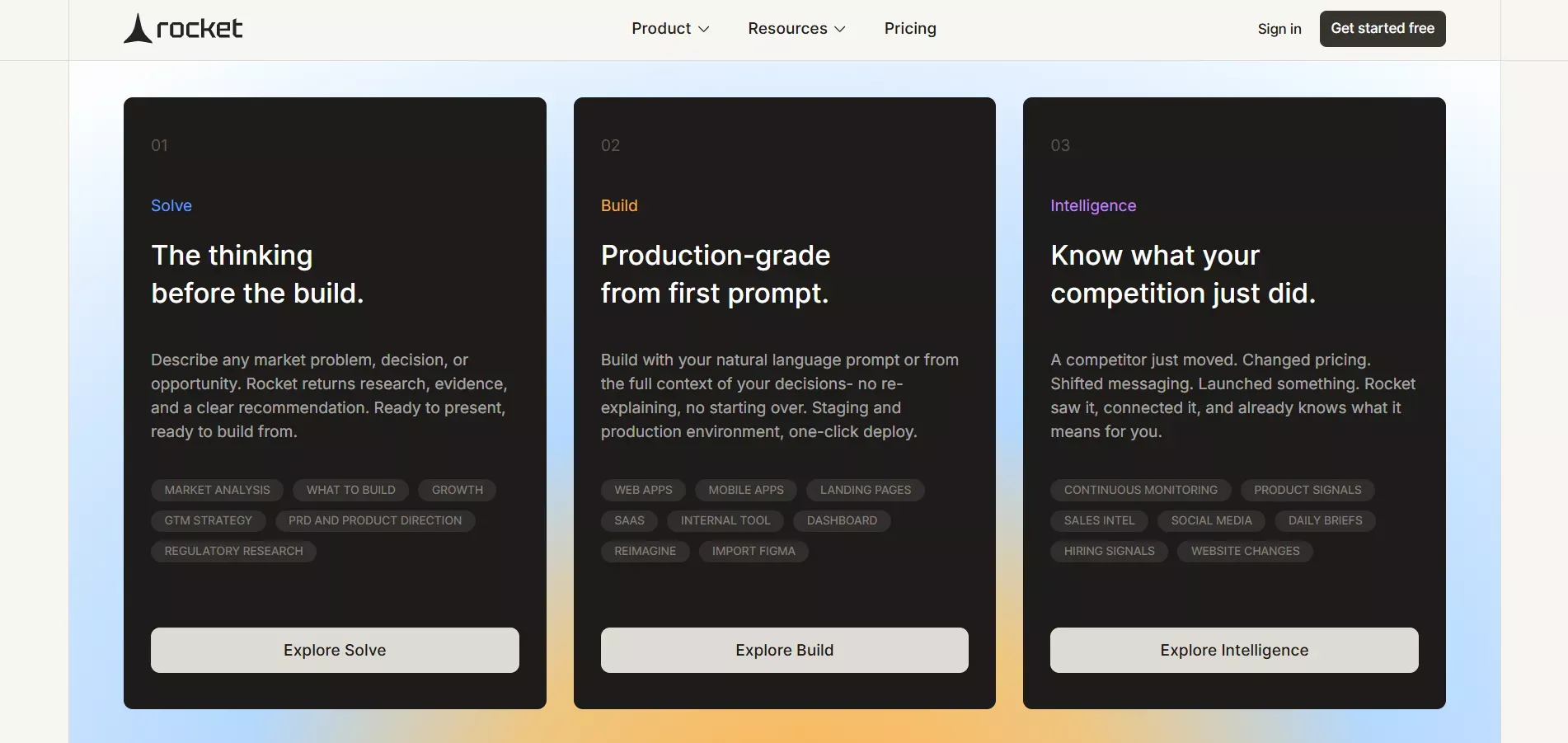
Solve: Structured Thinking That Becomes System Memory
That layer runs before any UI or backend gets built and turns a rough idea into a structured brief your engineering team can execute against. It conducts market analysis, competitor mapping, and problem validation before any code is written, so development is grounded in actual market data.
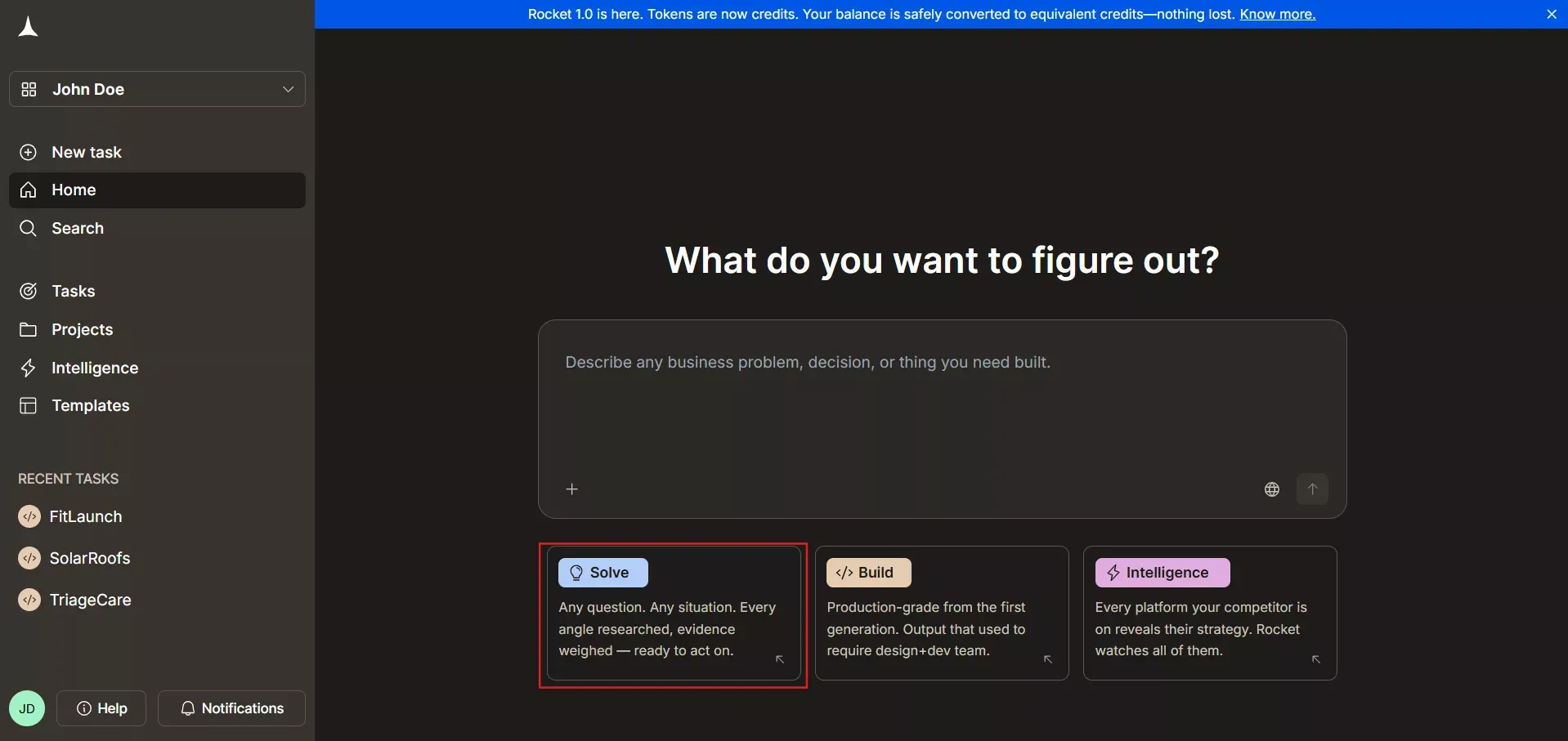
Solve reads inputs like:
- Market segments and market sizing data across relevant geographies.
- Problem statements and problem validation findings from user interviews.
- User jobs-to-be-done and compliance constraints, such as HIPAA or GDPR.
- Monetization hypotheses and named competitor lists.
The outputs are machine-readable. Evidence-backed reports, opportunity maps, prioritized feature sets, and a product brief ready to hand into Build. Build agents consult those artifacts when deciding flows, components, and APIs.
A SaaS onboarding tool defined in May carries user journeys and strategy that Build references verbatim weeks later. The analysis done in week one shapes the code written in week three.
Build That Reads Solve Before it Writes Code
Before the AI agents generate a single screen, they ingest every relevant brief artifact. Problem definitions, priority features, target personas, compliance flags, and success metrics all flow into the generation run as a live spec. That is how Build can write code that reflects strategy rather than just text from the latest prompt.
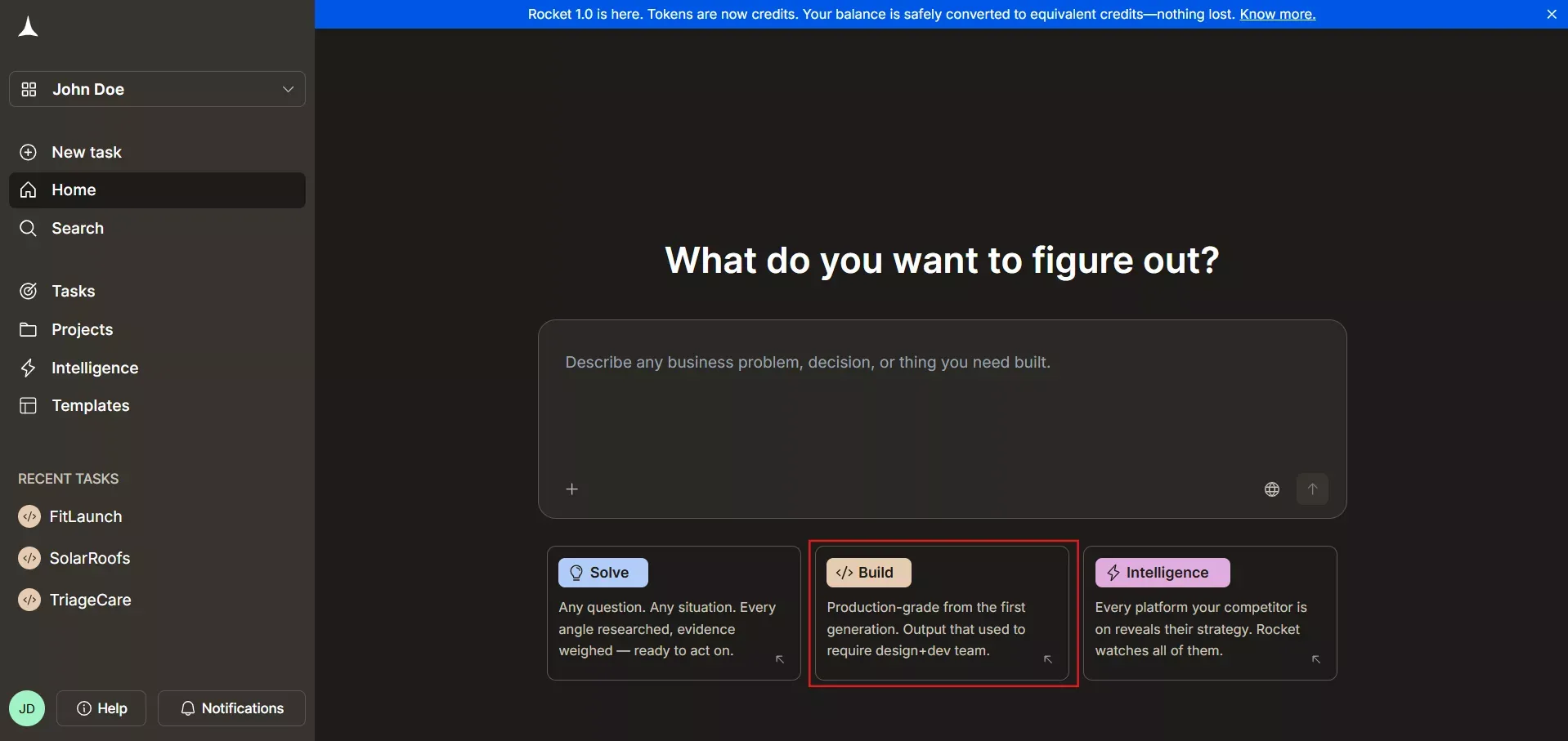
What Build Uses as Input
Build uses these inputs to shape:
- Navigation hierarchy and user flows
- Data models and API endpoints
- Component selection, copy tone, and visual hierarchy
- Responsive design defaults and accessibility baselines
Staying Aligned as Strategy Evolves
When a founder updates the brief, say, re-prioritizing a core flow after new market analysis, the build proposal updates alongside. The first pass reflects the latest strategy, not a month-old guess, so the v1 UI never drifts from what the analysis said. That alignment only works because memory is shared across phases.
By blending planning and execution, Rocket.new enables users to continuously adjust their ideas based on real-time feedback during the app development process, enhancing clarity and reducing wasted effort.
Production-Ready From the First Generation
Most no-code tools produce demo-quality prototypes that require significant rework before they can handle real users at real scale, while Rocket.new eliminates this rework by providing production-ready output from the first generation.
Rocket.new generates code that is structured for launch from the first pass, including SEO-ready markup, accessibility compliance, modular architecture, and responsive design as default behaviors.
Competitive Intelligence Built Into the Workflow
Competitive intelligence in the platform is not a separate subscription in a different tab. It is the Intelligence pillar, running continuously while the other two work. Founders define competitors during the brief, and that list becomes a persistent data source across the full lifecycle.
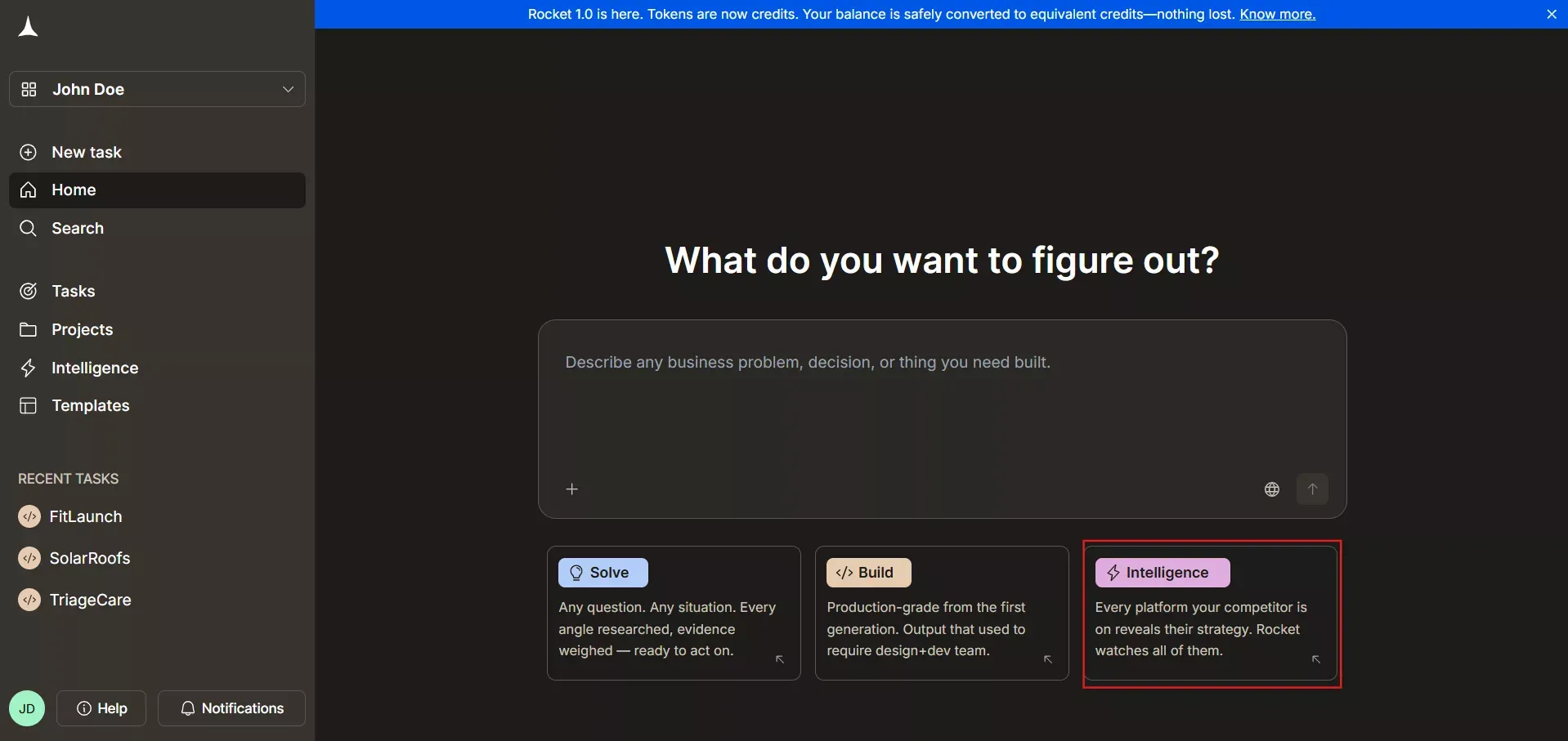
Intelligence tracks competitor sites, pricing pages, job postings, and feature changelogs on a daily loop, and signals flow back into the same project graph that Build and the research layer both read. Competitive intelligence stays connected to the same workspace where the brief, the code, and the deployment history live.
How Persistent Memory Compresses Launch Timelines
Memory preservation is not theoretical. Persistent project memory allows teams to step away from a project and return to find every decision, structure, and context thread intact, which is essential for long-running projects.
Without persistent project memory, every iteration of a product starts from a guess, making it difficult to evolve based on user signals and market changes.
The single environment combines a visual editor, AI chat, and a code panel, all powered by the same project memory. Solo founders and small teams routinely go from a validated idea to a production-ready v1 in weeks rather than quarters.
A typical timeline looks like this:
| Phase | Timing | What actually happens |
|---|---|---|
| Solve the task opens | Early May 2026 | Market research, market sizing, and problem validation enter as structured objects |
| Build begins | Mid-May 2026 | Build begins only after the full brief is ingested by the ai agents |
| Launchable v1 live | Early June 2026 | Production-grade output reaches staging, then ships to production environments as a live product |
A few patterns hold across every fast timeline:
- No catch-up meetings when a new contributor joins the project.
- No re-summarizing earlier interviews, strategy decisions, or priority lists.
- Team members inherit the entire project graph on day one.
- Weekly iterations replace monthly ones because cognitive overhead drops.
Compare that to the usual multi-tool path: planning deck, designer mockups, engineering specs, a separate dev environment, each with its own briefing process. On the single platform, no fresh briefing is needed each time someone new enters. The single environment serves that memory instantly, so a new team member sees why a feature was prioritized without scheduling a meeting.
Why Keeping Memory Alive Matters Long After Launch
Shipping v1 is not the finish line. Research and build cycles continue as user data, regulatory updates, and new competitors enter the picture. Most tools treat launch as the end of the project, and that is exactly where other platforms fall short.
The platform keeps early assumptions, decisions, and validations accessible for every post-launch iteration, so teams avoid repeating discovery every time they adjust pricing, flows, or integrations. For regulated industries, auditability requires knowing why something was built a certain way, and full version history preserves the trail.
Post-launch, the context thread keeps pulling:
- Usage patterns flow back into the brief to refine strategy.
- Feature hypotheses get re-tested against live analytics and user feedback.
- Compliance changes get logged with every past state, so audits trace every decision.
- The platform supports component-level editing, so one element changes without disturbing the rest.
This loop works because all three pillars share one memory across the full lifecycle. Here is how the end-to-end flow looks:
A feature underused by real users in July 2026 can trigger a rethink that pulls the original job-to-be-done from months earlier. The system recognizes that the wrong thing was not the feature itself but the implementation approach.
That level of reasoning works only when the context thread is intact end-to-end. Once context fades between sessions, every contributor pays the tax again, and the cumulative break in understanding compounds with every release.
What People Are Saying
The problem here is not abstract. Developers across the ecosystem keep running into the same wall when thinking, planning, and code generation live in different places.
"Context management is actually one of the highest-leverage unsolved problems in AI-assisted development. It's not a feature request. It's a fundamental shift in how developers can trust and rely on AI coding partners." - Source: Decker, DEV Community
A few things stand out from that community take:
- Losing context is not a UX annoyance; it is a trust problem.
- Once AI tools forget, developers stop investing in the deep knowledge that makes them useful in the first place.
- Fixing this is the difference between a one-shot generator and a reliable build partner.
How Rocket.new Handles Context Between Research and Build
The platform is built around a principle: memory is the product. It stitches every phase of the full lifecycle inside one tool, so thinking done on day one shapes the code written on day twenty.
A rough idea turns into a structured brief, the brief becomes a live product in Build, and Intelligence watches the competitive edge around it. Teams can import external assets, like a Figma design that becomes a live component library tied to earlier decisions.
That positioning is a significant shift from how platforms iterate today, where each tool holds only what the current session gave it. The platform addresses six differences that set it apart from other platforms in how it treats memory, lifecycle, and edits. Those six differences show up in daily use.
Features That Keep Memory Connected
The platform's capabilities map directly to the problem:
- A vibe solutioning platform holds planning, building, and monitoring inside one platform so nothing resets between sessions.
- A 25k+ templates library, free to use, lets founders start building from a match that already carries brand and stack details.
- Flutter for mobile and Next.js for web share one codebase per app, with no tool hop at deployment time.
- Built-in collaboration features let team members share the same project graph, decisions, and file history.
- Three products on one platform, Solve, Build, and Intelligence, share one memory that compounds over time.
- Full version history supports rollback, labels, and one-click deployment from any past state.
- The platform supports component-level editing, so one element changes without affecting the rest of the project.
- A dedicated success team and a human expert step in when the AI stalls on edge cases that need human expertise.
The AI holds the structural integrity of the codebase and UI as features are added, using the same memory that guided v1, so the final product evolves deliberately rather than through reactive tweaks. The first generation ships SEO-aware, accessible, modular, and responsive design code, which means the first pass is production-grade output, not a throwaway prototype waiting for rework.
Use Cases Worth Running On The Platform
A few concrete scenarios show how memory carries from the brief all the way to code:
- A solo founder validates a B2B onboarding flow in the planning step, then Build generates a Next.js app where navigation matches the validated jobs-to-be-done. No handoff, no re-briefing, no losing context between phases.
- A product team uses the planning step to compare four pricing strategies, picks one, and Build scaffolds the billing UI from that exact decision, with Stripe connected through native connectors.
- An engineering team imports an older repo through the GitHub flow to continue existing codebases on the platform, and ties new features back to earlier findings from six months before, so the original idea carries forward without drift.
- A consultant runs competitive intelligence on three rivals, triggers a Solve analysis off a detected pricing change, and ships a responsive design update that afternoon.
The platform is the default choice for serious founders who treat thinking and building as one tool. For established teams, continuing existing codebases alongside fresh research means adoption does not require discarding prior work, which is where other platforms force a reset. Keeping memory shared is the structural choice that makes that practical, and pairing ai agents with human expertise keeps edge cases from stalling delivery.
Why Context Continuity Beats Model Quality
Teams obsess over model choice and underrate persistent project memory, which is the more expensive miscalculation. A weaker model with strong memory will outperform a stronger model that starts cold every session, because the AI stalls less often when briefed on real project specifics.
The platform's orchestration keeps agents inside the same workspace where thinking, code, and competitive signals live, so Monday's answer holds up four months later.
For anyone building a live product meant to last past a weekend prototype, continuity across research and build is the real multiplier, and it is where Rocket maintains persistent project memory while other platforms reset between sessions.
Start building on Rocket.new, where your research never leaves the room.
Table of contents
- -Key Takeaways
- -What Breaks When Research and Build Live in Separate Tools
- -Where Context Goes Missing
- -How Fragmentation Reshapes the Build Process
- -The Cost of Starting Cold
- -Where Traditional No-Code Platforms Fall Short
- -How The Platform Keeps Research Findings Alive All the Way to Code
- -Solve: Structured Thinking That Becomes System Memory
- -Build That Reads Solve Before it Writes Code
- -Competitive Intelligence Built Into the Workflow
- -How Persistent Memory Compresses Launch Timelines
- -Why Keeping Memory Alive Matters Long After Launch
- -What People Are Saying
- -How Rocket.new Handles Context Between Research and Build
- -Features That Keep Memory Connected
- -Use Cases Worth Running On The Platform
- -Why Context Continuity Beats Model Quality