
Most AI builders give you code. Rocket.new gives you a system, one that starts before the first line, retains context across every session, and builds production-ready apps from validated thinking, not just fast output.
How does an idea become a working app?
Rocket.new converts a plain-language prompt into structured products with real code, clear logic, and deployment-ready output, starting where every other AI builder stops.
According to Statista, the global agentic AI market was valued at $5.1 billion in 2024 and is forecast to reach $47.1 billion by 2030, growing at a compound annual rate of over 44%.
That growth means more tools, more builders, and more confusion about which platform actually helps you ship something real.
The Real Problem With Most AI Builders
Most AI tools feel powerful at first. You type a prompt, get output, and it looks impressive. Then you try to expand it, add a feature, connect a backend, fix a broken flow, and things fall apart.
Here is what actually happens with most AI builders:
- Every new prompt resets context, because the tool has no memory of what came before
- You get generated code, but no system connecting the pieces
- Backend logic is either missing or disconnected from the frontend
- Features work in isolation but break when you try to scale
The core issue is not speed. It is architecture. Most AI tools were built to generate code fast. None of them were built to think before they generate. That is the gap rocket.new was built to close.
What Makes Rocket.new Different
Rocket.new is not a code generator. It is the world's first vibe solutioning platform, a system that covers the full arc from thinking to building to operating, all in one shared context.
The distinction matters. Here is what it looks like in practice:
A typical AI builder workflow: Prompt, then code, then confusion, then fix, then repeat.
The Rocket.new workflow: Research, then decide, then build, then deploy, then grow.
Every step compounds the last. The research you do before building informs the architecture. The architecture informs the code. The code deploys into a system that keeps learning. Nothing resets. 1.5 million people have tried Rocket across 180 countries, not because it builds faster, but because it builds smarter.
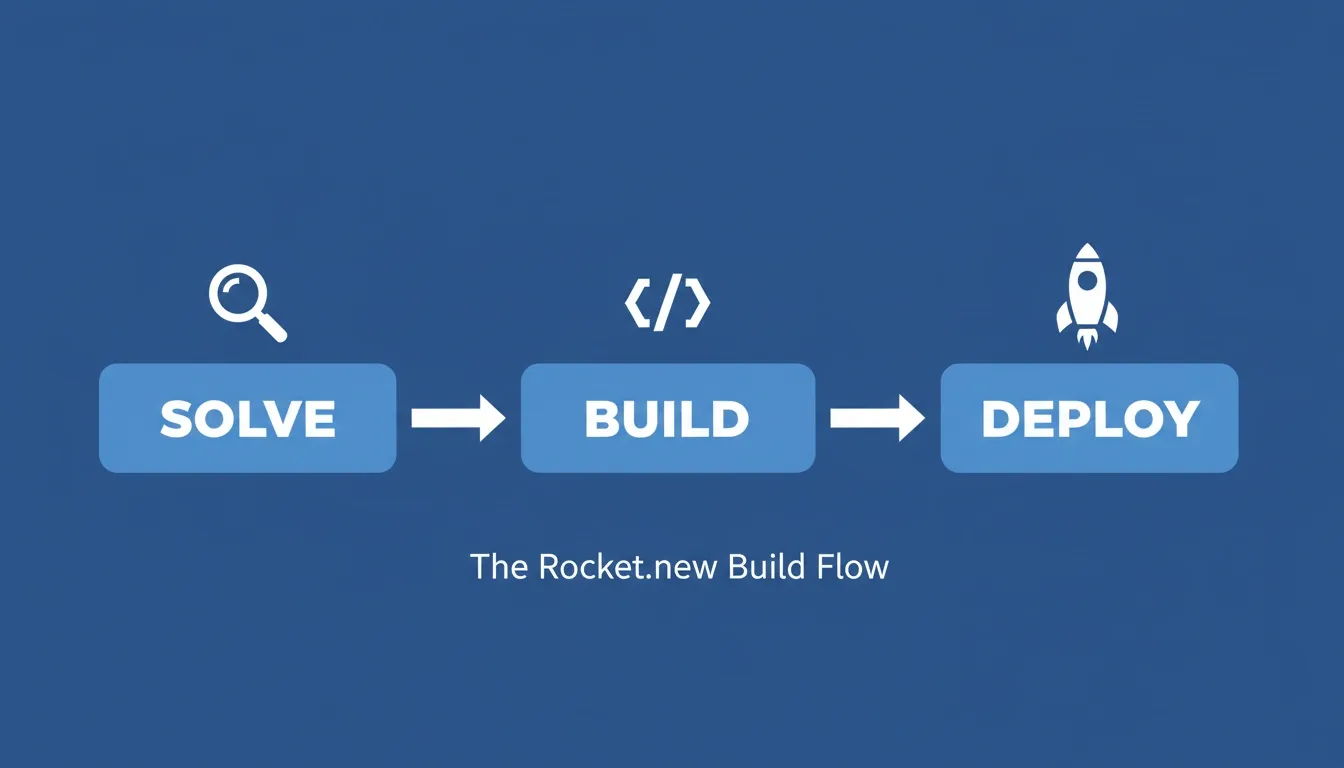
The three-stage Rocket.new build flow: Solve validates the idea, Build generates the product, and Deploy ships it live.
What Is Vibe Solutioning?
Vibe coding is when you describe what you want and the system builds it while maintaining context. Vibe solutioning goes one step further: it starts before the first prompt.
Most AI tools help you build faster. None of them tell you what to build. Rocket's Solve feature researches your market, maps your competitors, and validates your idea before a single line of code is written.
Then Build generates the product from that validated thinking. Then Intelligence monitors the market continuously, so your product stays aligned with what users actually need. This is not three separate tools. It is one system with shared context, and every part feeds the next.
The Three Capabilities That Change Everything
1. Shared Context Across Every Task
When you work in Rocket, every completed task adds to a shared project memory. The market analysis you ran last week is available when your team starts building today. The competitive research from Solve informs the feature set in Build.
Other tools reset with every prompt. Rocket compounds. The decisions you made in one session carry forward into the next, across your whole team, without reloading context.
2. Full-Arc Development, Not Just UI
Most AI builders generate a UI. Rocket generates a system.
What Rocket's Build produces:
- Frontend in React/Next.js or Flutter, responsive and production-ready
- Backend: database schema, API routes, authentication, and edge functions via Supabase
- 26+ integrations, including Stripe, HubSpot, Notion, Airtable, Google Workspace, and more
- One-click deployment to a live URL with custom domain and automatic HTTPS
You are not getting a prototype. You are getting a deployable product, built from a single prompt.
3. Continuous Competitive Intelligence
This is the capability that separates Rocket from every other builder. While you build, Intelligence monitors your competitors across nine signal types: product changes, pricing shifts, hiring patterns, ad spend, social activity, press coverage, G2 reviews, website updates, and job postings.
When a competitor moves, Rocket sees it, connects it, and tells you what it means. Your product does not just launch. It launches informed and stays informed.
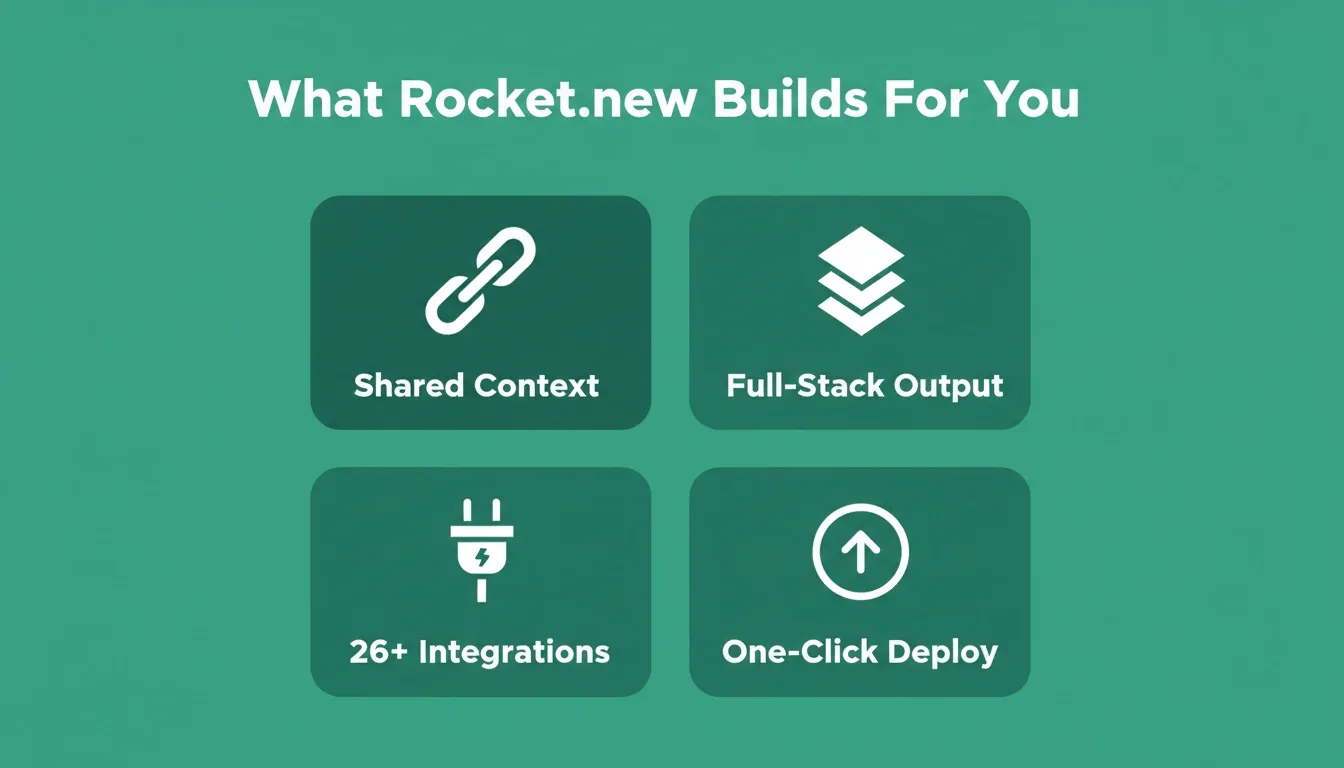
Rocket.new's four core output capabilities: shared context, full-stack output, 26+ integrations, and one-click deployment.
How Rocket.new Actually Works: Step by Step
The Rocket.new workflow: research informs every build, and intelligence keeps the product sharp after launch.
Step 1: Describe, or Research First
You can start with a prompt, or start smarter with Solve. Type your business problem in plain language, and Solve researches the market, identifies competitors, and surfaces the gaps your product should fill. That research flows directly into your Build context.
Step 2: Generate
Rocket plans the full architecture, sets up the backend, and writes production-ready code. It creates pages, screens, navigation, backend logic, and database structure, then shows you a working preview. This is not random generated code. It is a structured, connected system built from your validated thinking.
Step 3: Refine and Iterate
Tweak everything through prompts, visual edits, or direct code changes. The Advisor Agent, Rocket's built-in senior architect, diagnoses root causes when something breaks, resolves error loops, and makes architectural decisions automatically so you never get stuck.
Step 4: Deploy
When you are ready, deploy with one click. Connect a custom domain, publish to a live URL with automatic HTTPS and a global CDN. No DevOps required. Mobile apps can be submitted directly to the Apple App Store or Google Play Store.
Step 5: Monitor and Adapt
Intelligence keeps watching after launch. When the market shifts, you know. When a competitor moves, you know. The product stays sharp because the intelligence never stops.
Rocket.new vs Traditional AI Builders
| Capability | Traditional AI Tools | Rocket.new |
|---|---|---|
| Context retention | Resets with every prompt | Maintained across all tasks |
| Output type | Isolated generated code | Connected, production-ready system |
| Backend | Often missing or manual | Fully scaffolded via Supabase |
| Pre-build research | None | Solve: market analysis and validation |
| Post-launch intelligence | None | Continuous competitor monitoring |
| Deployment | Manual setup required | One-click with custom domain |
| Integrations | Limited or none | 26+ connectors |
| Workflow | Fragmented across tools | One platform, one shared context |
The gap is not a feature. It is a philosophy. Other tools build faster. Rocket builds smarter, because it starts before the build.
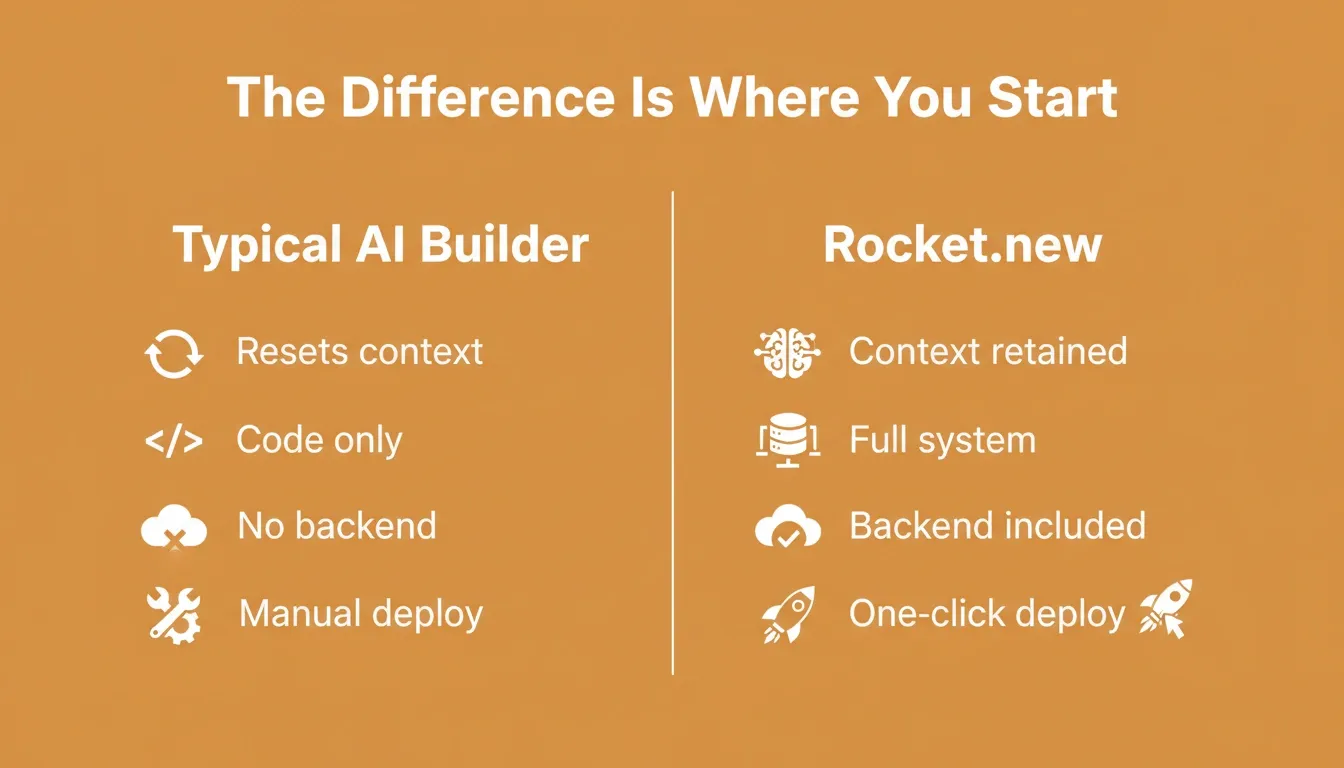 Side-by-side: how a typical AI builder compares to Rocket.new across context, output, backend, and deployment.
Rocket.new Pricing Plans
All plans include unlimited team members. Credits power Solve, Build, and Intelligence from a single balance, and they never expire. Annual billing saves 20% on all paid plans.
| Plan | Monthly Price | Credits Included | Key Capabilities |
|---|---|---|---|
| Free | $0 | 20 (one-time) | Build: web apps, mobile apps, landing pages |
| Pro | $25/month | 100/month | Build: web apps, mobile apps, landing pages |
| Rocket | $50/month | 250/month | Build + Solve (consultant-grade research) + Intelligence |
| Booster | $250/month | 1,500/month | Full suite + premium support + SSO + data localisation |
Additional credits can be purchased on top of any subscription. For SSO, data localisation, or onboarding assistance, contact the Sales team directly.
Real Use Cases: What You Can Build
Rocket is not a single-use tool. Here is what different users actually build with it.
Founders and Solo Builders
Validate a SaaS idea with Solve before writing a line of code. Ship a production-ready MVP in a weekend. Launch a landing page with auth, payments, and a connected database, all from a single prompt.
For a deeper look at this process, see how to build an app with AI in minutes.
Product Teams
Generate a working prototype from a Figma file in minutes. Run competitive teardowns before a roadmap planning session. Build internal dashboards connected to real data sources, without a dedicated developer.
Operators and Strategists
Produce board-ready market entry analyses using Solve. Generate competitive deal briefs before a high-stakes sales call. Track competitor pricing, hiring, and messaging shifts in real time through Intelligence.
Developers
Import a Next.js TypeScript repo from GitHub and continue building with AI. Connect 26+ third-party services with a single prompt. Use two-way Git sync to keep code in version control throughout the build. For more on developer tooling, see the best AI tools for developers guide.
Vibe Solutioning in Practice: A Concrete Example
Here is exactly why rocket.new's build starts differently from every other tool.
Scenario: A founder wants to build a B2B SaaS tool for HR teams.
With a typical AI builder: They open a blank prompt, describe the app, get a UI, spend days connecting a backend, and then discover the market is crowded with better-funded competitors. The project stalls or pivots.
With Rocket.new:
- They open Solve and type: "What is the competitive landscape for B2B HR onboarding tools?"
- Rocket researches the market, identifies top competitors, surfaces pricing gaps, and highlights the underserved segment.
- They type: "Build an HR onboarding tool for SMBs under 50 employees, with Supabase backend and Stripe billing."
- Rocket generates the full product, including frontend, backend, auth, and payments, in one session.
- Intelligence monitors the competitors identified in step 2, alerting the founder when pricing or features shift.
The difference is not speed. It is that the second approach builds the right thing.
To explore this further, read the vibe solutioning platform guide and the full-stack AI builder breakdown.
The Intelligence Layer: Always On
A recent discussion on Analytics India Magazine captured the shift happening right now:
"Most AI tools are obsessed with helping you build faster... should you be building this at all?"
That question is the entire point. The conversation around AI development has moved from "how fast can I build?" to "am I building the right thing?" Rocket was designed for exactly this moment.
Intelligence monitors nine signal types continuously: product changes, pricing shifts, hiring patterns, ad spend, social activity, press coverage, G2 reviews, website updates, and job postings. It does not just alert you. It connects signals into meaning and tells you what to do next.
As AI tools proliferate and the cost of generating code approaches zero, the competitive advantage shifts to the thinking before the build. The teams that validate before they build, monitor while they operate, and iterate from intelligence are the teams that win. For more on this, see how AI competitive intelligence works and how vibe coding tools are shaping next-gen workflows.
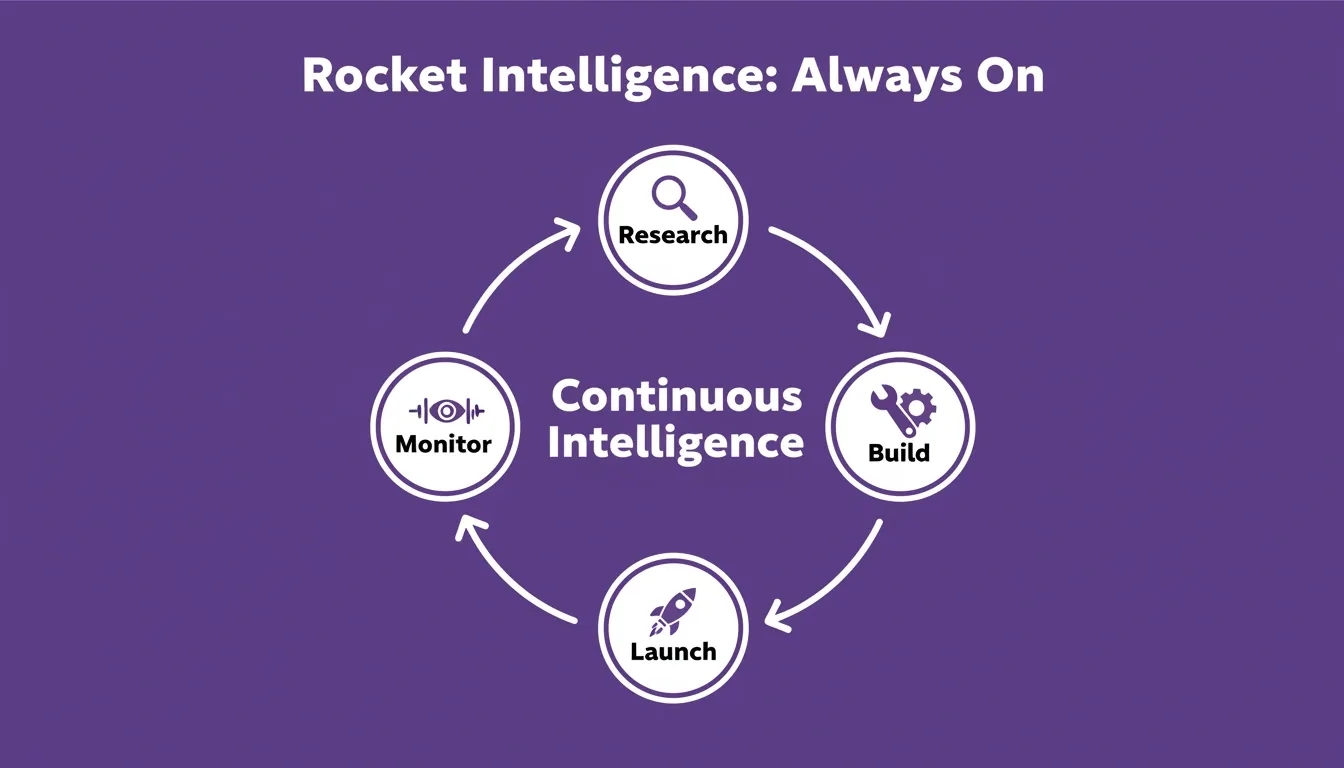
Rocket Intelligence runs a continuous loop, covering research, build, launch, and monitor, so your product never falls behind the market.
Who Rocket.new is Built For
The Builder uses Rocket to create products: web apps, mobile apps, landing pages, internal dashboards, and customer portals. Every build starts from the full accumulated intelligence of the project.
The Operator uses Rocket to run intelligence and research operations: board presentations, market entry analyses, competitive deal briefs, and campaign strategy documents. No product build is required to get significant value.
The Platform Consolidator uses Rocket to eliminate tool sprawl. Strategy and execution happen in the same place. The team works from the same accumulated intelligence, and every tool that used to require a separate context-loading step is replaced by one platform where everything compounds.
The Difference Is Where You Start
Most AI builders stop at code generation. They give you output but no system, speed but no direction, a prototype but not a product. Rocket.new solves this by starting where every other AI builder stops: before the build.
Solve validates the thinking. Build generates the product from that thinking. Intelligence keeps it sharp after launch. One platform, one shared context, everything compounds. As AI development tools become commoditized, the platforms that survive will be the ones that help builders make better decisions, not just faster ones. Rocket.new is built for that future, and it is available today.
Start building for free on Rocket.new and turn your next idea into a production-ready product, starting from validated thinking.
Table of contents
- -The Real Problem With Most AI Builders
- -What Makes Rocket.new Different
- -What Is Vibe Solutioning?
- -The Three Capabilities That Change Everything
- -1. Shared Context Across Every Task
- -2. Full-Arc Development, Not Just UI
- -3. Continuous Competitive Intelligence
- -How Rocket.new Actually Works: Step by Step
- -Step 1: Describe, or Research First
- -Step 2: Generate
- -Step 3: Refine and Iterate
- -Step 4: Deploy
- -Step 5: Monitor and Adapt
- -Rocket.new vs Traditional AI Builders
- -Rocket.new Pricing Plans
- -Real Use Cases: What You Can Build
- -Founders and Solo Builders
- -Product Teams
- -Operators and Strategists
- -Developers
- -Vibe Solutioning in Practice: A Concrete Example
- -The Intelligence Layer: Always On
- -Who Rocket.new is Built For
- -The Difference Is Where You Start