Smart founders building on Rocket.new skip 80% of traditional market sizing by replacing static reports with live demand signals - app store reviews, competitor pricing gaps, and community posts. They build working prototypes first and use real user feedback as their primary market research.
Is your market research spreadsheet making you a better founder, or just a more thorough procrastinator?
For most consumer app ideas, it is the latter. According to Founders Forum data, 42% of startups fail because they misread market demand - not because they skipped research, but because the research they ran was pointed in the wrong direction.
Smart founders building on Rocket.new have spotted this pattern. They cut the noise early, focus on live demand signals, and get working apps in front of real users before anyone else finishes their market report.
The Problem with Traditional Market Sizing
Traditional market sizing follows a familiar script. You build a TAM/SAM/SOM model, buy a market report, map competitor websites, write user personas, and produce a document that takes weeks but tells you almost nothing actionable.
The idea is that all this front-loaded work reduces risk. For a consumer app, it often does the opposite. It delays the one thing that would actually reduce risk: putting a working app in front of real users.
Consumer markets shift fast. Pricing changes, competitor features drop, trends break. The market data you gathered last quarter may already be out of date by the time you act on it. Meanwhile, a founder who shipped a prototype while you were doing research already has customer data, real feedback loops, and live improvement signals you simply do not have.
This is not a new observation. Juan Germano, founder of Jams, captured it well in a LinkedIn post:
"Most founders waste money on 'market research.' Last week, a founder showed me his $15,000 'market validation' report. 20+ pages of surveys, competitor analysis, user personas, market size calculations. I asked one question: 'How many people have you actually tried to sell this to?' Silence. Meanwhile, his competitor launched an MVP and signed 3 customers." Juan Germano on LinkedIn
The bigger picture problem is not that market research is bad. It is that most startups spend 80% of their research time on activities that produce low-quality signals for consumer app validation.
What Rocket.new Founders Use for Market Research Instead
Founders who move fast on consumer apps are not doing zero research. They are doing different research - the kind that produces live, current, high-quality signals in a fraction of the time.
Here is how traditional market sizing compares to the approach that winning startups use now:
| Research Activity | Time Required | Signal Quality for Consumer App |
|---|---|---|
| TAM/SAM/SOM spreadsheet model | Very High | Low |
| Purchased market research reports | High | Low - Medium |
| Competitor websites surface review | Medium | Low |
| Focus groups and user persona docs | High | Low |
| App store review and comment analysis | Low | High |
| Competitor pricing gap tracking | Low | High |
| Community post and forum monitoring | Low | High |
| Live prototype user feedback | Low | Very High |
The bottom half of that table is the 20% most founders underweight. It takes less time, costs almost nothing, and connects directly to how real users behave right now - not how an analyst projects they might behave in three years.
Real Market Data Beats Projected Numbers
There is a clear shift happening in how the fastest startups approach market intelligence. Rather than asking "how large is this market?" they ask: "who is stuck right now, and what signals show they would pay to get unstuck?"
That one shift changes everything about data gathering. Instead of reading industry reports, smart founders watch:
-
Which features competitors are getting criticized for in app store reviews and comment threads
-
Where competitor pricing leaves obvious gaps for a new entrant
-
What questions real users keep posting in forums, subreddits, and community channels
-
Which app ideas come up repeatedly in creator groups and team discussions
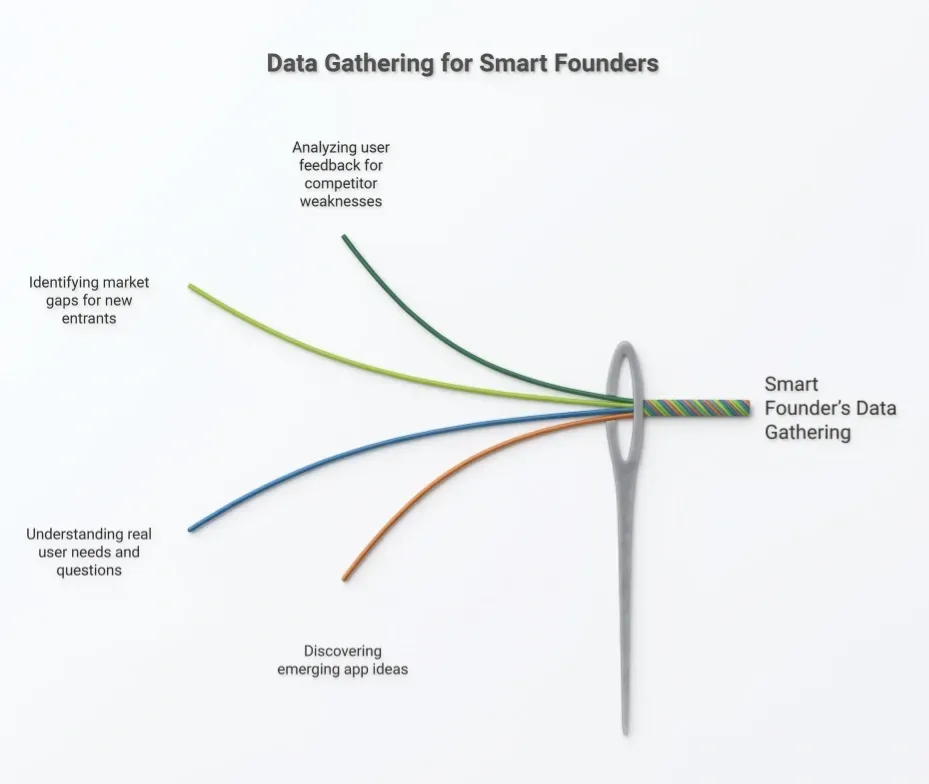 These signals are more reliable than static market sizing models because they reflect actual behavior, not projections. And with the right AI tools, collecting them takes hours, not weeks.
According to Hostinger's analysis, no-code platforms can now cut app development time by up to 90%. When a working prototype takes hours to build, spending weeks analyzing the market before you start is a difficult decision to justify. The loop between idea and real user feedback has compressed dramatically, and the founders who recognize that are moving faster than competitors still stuck in the report phase.
Vibe Solutioning and Vibe Coding: A Faster Validation Path
The idea behind vibe solutioning captures what the fastest consumer app founders are actually doing. Instead of defining the full market opportunity before building, they describe a specific problem, spin up a working prototype using AI tools, and treat the first round of real user reactions as their actual market research.
Vibe coding - building through natural language prompts rather than writing code manually - is what makes this practical at scale. You no longer need a technical co-founder or a developer on the team to get a working app in front of users. J.P. Morgan's guide to vibe coding for startups notes that AI development tools have fundamentally changed what startups can build and how quickly, enabling faster experimentation at lower costs than traditional development approaches.
This is not just theory. In Y Combinator's Winter 2025 cohort, 25% of startups had codebases that were 95% or more AI-generated. The founders winning in consumer apps are not the ones with the most thorough market reports. They are the ones who built something real fast, got into a feedback loop with users, and iterated from there.
How AI Tools Power Competitive Intelligence
When you do need to research competitors, AI tools change what is possible. One agent can scan competitor websites, pull together pricing data, identify gaps in reviews, and produce a structured competitive intelligence report in a fraction of the time it would take manually. That is the kind of market data that actually helps you define your app's market positioning before launch.
Knowing how to structure the right prompt - what the research community calls prompt engineering means you get actionable competitor signals rather than a generic summary. Smart startups treat this as a real skill. It compounds fast and replaces weeks of manual data gathering with a process that takes hours.
Launch at Rocket Speed: What Rocket AI Delivers
How Rocket.new Changes the Build-First Equation
Rocket.new is built specifically for this pattern - moving from idea to a working consumer app without the overhead that slows most founders down. The platform puts AI agents behind a single founder with a clear idea. You describe the app, and Rocket.new produces a working product ready for real user reactions. No technical team required. No weeks of setup before you can demo anything.
This changes the market sizing question entirely. Rather than spending weeks deciding whether to build, you build first and use real user feedback to decide whether it is worth scaling. That is the smarter sequence for a consumer app in a fast-moving market.
Key features that support the build-first approach:
-
Full consumer app from a single prompt: Cursor and similar AI coding tools still require significant technical context and developer experience to produce real work. Rocket.new is designed for non-technical founders who need a working app with UI, database, and logic in one place not just a code scaffold.
-
AI agents for competitive intelligence: Rather than manually reviewing competitor websites or purchasing market reports, Rocket.new's agents pull together the competitor data that matters for market positioning in hours.
-
Rapid iteration without a technical team: Tools like Lovable produce solid front-end prototypes but often struggle with complex app logic and backend systems. Rocket handles the full application stack, so the iteration loop stays fast as the app grows.
-
Production-ready from day one: Many no-code platforms produce demos that need to be rebuilt for real scale. Rocket.new produces code that is built to launch, so the app you test with early users is the app you ship.
The no-code AI platform market is growing from $6.56 billion in 2025 to a projected $75 billion by 2034, according to Hostinger's market analysis. That growth is driven by founders who refuse to wait months before they can test an idea. Rocket puts that speed in the hands of consumer app founders who have something real to build and want to move before the window closes.
The Smarter Path for Consumer App Market Sizing
Most founders spend too much time on research activities that feel productive but do not connect to real demand. The market sizing work that actually matters for a consumer app is faster, cheaper, and more grounded in how real users behave - not in how an industry report projects the market will develop.
Why Rocket.new founders skip 80% of traditional market sizing for consumer apps is not because they are reckless. It is because they understand that a working app in front of real users is more valuable than any static report. The founders who ship fast, listen to real feedback, and iterate quickly are the ones who win. Rocket.new is built to make that the default.
Table of contents
- -The Problem with Traditional Market Sizing
- -What Rocket.new Founders Use for Market Research Instead
- -Real Market Data Beats Projected Numbers
- -Vibe Solutioning and Vibe Coding: A Faster Validation Path
- -How AI Tools Power Competitive Intelligence
- -Launch at Rocket Speed: What Rocket AI Delivers
- -How Rocket.new Changes the Build-First Equation
- -The Smarter Path for Consumer App Market Sizing