
Most founders spend thousands on traditional market research methods only to find the insights arrive too late and disconnected from their product build. Rocket.new replaces the expensive Nielsen-style research cycle with Solve for instant structured intelligence, Build for production-grade output, and Intelligence for continuous competitive monitoring all inside one platform with shared compound context.
What if the research meant to save your startup is actually slowing it down?
Most founders have been there, briefing an agency, scheduling focus groups, running surveys, and waiting weeks for a report that lands in a PDF nobody fully reads.
Here's the hard number: 42% of startups collapse because they misread market demand building products nobody wants or needs, according to Founders Forum Group's startup statistics guide. And many of them did run traditional market research first.
The problem isn't whether founders do research. It's the kind they're doing, how long it takes, and whether any of it connects to what gets built.
That's why a growing number of Rocket.new founders skip 80% of the traditional Nielsen alternative and replace it with something faster, cheaper, and directly wired into what they're building.
What the Traditional Nielsen Model Actually Costs
Nielsen built its reputation on large-panel audience measurement, brand tracking studies, and deep competitive analysis reports. These tools were designed for enterprise teams with multimillion-dollar marketing budgets and six-month campaign cycles.
For most founders and small business owners, the math simply doesn't work.
Drive Research's 2026 market research cost breakdown lays it out plainly:
| Market Research Method | Estimated Cost Range |
|---|---|
| Online Survey | $5,000 - $15,000+ |
| Phone Survey | $15,000 - $30,000+ |
| Mail Survey | $10,000 - $25,000+ |
| In-Person Survey | $20,000 - $50,000+ |
| Focus Groups | $7,000 - $20,000+ per group |
| In-Depth Interviews | $5,000 - $15,000 (per 10-15 interviews) |
A full competitive analysis with market sizing and consumer survey results? You're looking at $50,000 to $100,000 before a single line of code gets written.
That's not a small business budget. That's a Series B budget.
And even if you could afford it, the timeline is painful. Traditional market research cycles run 6 to 12 weeks from briefing to final report. In a world where vibe coding tools let a co-founder ship a working prototype in an afternoon, waiting three months for a data dump to land is simply not how building works anymore.
The 80% Founders Are Walking Away From
The traditional Nielsen alternative bundles a lot of activities that look useful on paper but rarely change what founders actually build. Here's what most end up cutting:
-
Large-scale panel surveys: Expensive, slow, and often reflect stated preferences rather than real buying behavior
-
Brand tracking studies: Built for companies with established brands and media spend, not pre-launch products
-
Third-party qualitative research agencies: High cost, long turnaround, and no shared context with whoever is building the product
-
Traditional search-based competitive reports: Flat documents that go stale within weeks of delivery
-
Audience segmentation models: Designed for media buying, not product roadmap decisions
The 20% worth keeping? Direct customer conversations, community research, and live competitive intelligence all focused on answering the one question that actually matters: is there a real problem here worth solving?
Why Founders Are Tuning Out the Old Model
The founders building on Rocket.new aren't abandoning research. They're abandoning research that doesn't connect to action.
Here's the pattern most founders hit when they go the traditional route:
-
Founder has a product idea
-
Commissions a market research report
-
Waits 6 to 12 weeks
-
Receives an 80-page PDF data dump
-
Reads 15 pages, skips the rest
-
Starts building based on gut feeling anyway
-
Product does not match market need
-
Startup fails one of the 42%
The community picked up on this disconnect a while ago. A discussion in r/startups - "How much market research do tech founders ACTUALLY make before launching?"] surfaced something telling. Most respondents described research that's lightweight, scrappy, and action-oriented. Not a Nielsen-style report.
"We know that often times, founders get their hands dirty with programming and building the 'next big thing' without proper research beforehand, therefore they fail." - r/startups community thread, October 2024
The failure isn't always skipping research. Sometimes it's doing the wrong kind.
The AI Era Changed the Market Research Math
Something significant happened to market research in the past two years. The AI era didn't just give founders faster build tools. It gave them faster thinking tools and the two stopped being separate.
The vibe coding market is projected to grow from $2.96 billion in 2025 to $325 billion by 2040 at a CAGR of 36.79%, according to Roots Analysis. One of the most striking data points from that growth story: 63% of vibe coding users aren't developers at all, according to Hostinger's Vibe Coding Statistics Report for 2026.
That means the majority of people using AI to build products are founders, marketers, and operators people who need to validate ideas fast and start building immediately. A six-week research cycle doesn't fit their week.
At the same time, Forbes reported that 75% of new enterprise applications will be built using low-code or no-code platforms - up from under 25% in 2020. The shift happened fast. The old model of research first, build later, iterate slowly doesn't hold when a working product can be in front of real users within days.
Competitive intelligence is moving the same direction. A Foundation Capital analysis on AI agents and market research found one enterprise brand spending $2.6 million annually on traditional agency research work before switching to AI-driven competitive monitoring. The cost savings and speed gains were significant.
Small business founders and early-stage startups face the same math at a smaller scale. Traditional market research is priced for enterprise teams, built for enterprise timelines, and rarely connected to the actual product decisions that matter day to day.
What Smart Founders Do Instead
The founders skipping the Nielsen alternative aren't operating without data. They've replaced the 80% of traditional research that doesn't connect to action with a tighter, faster approach built on three principles:
Structured Brief Over Data Dump
Instead of a 100-page report packed with survey results they'll never fully parse, smart founders want a structured brief. What does the competitive analysis show? What are competitors doing that customers actually respond to? What market sizing numbers matter? Plain language answers to specific questions not raw data requiring a separate analyst to interpret.
Continuous Loop Over Point-in-Time Snapshots
Traditional market research gives you a moment frozen in time. Competitors can shift strategy the week after your report is finalized. What founders need is a continuous loop of competitive intelligence - ongoing monitoring that flags when something changes, not a document that's already aging when it's delivered.
Context That Carries Into the Build
This is the biggest structural failure of traditional research: the intelligence sits in one place and the build happens somewhere else. Every team member has to re-explain what the research showed before making a product decision. There's no shared context connecting the thinking to the execution.
Rocket.new: Research, Build, and Intelligence in One Place
This is exactly the gap Rocket.new was built to close.
Rocket.new is the world's first Vibe Solutioning platform - where founders research what to build, build it, and monitor what matters, all inside one platform. The platform covers the complete arc from strategic intelligence to execution to ongoing business operations inside a single workspace with shared compound context.
The three pillars connect in a continuous loop: Solve delivers decision intelligence on what to build and why. Build generates production-grade output from that intelligence. Intelligence monitors competitors continuously and feeds new signals back into future Solve sessions. Nothing is re-explained. Everything compounds.
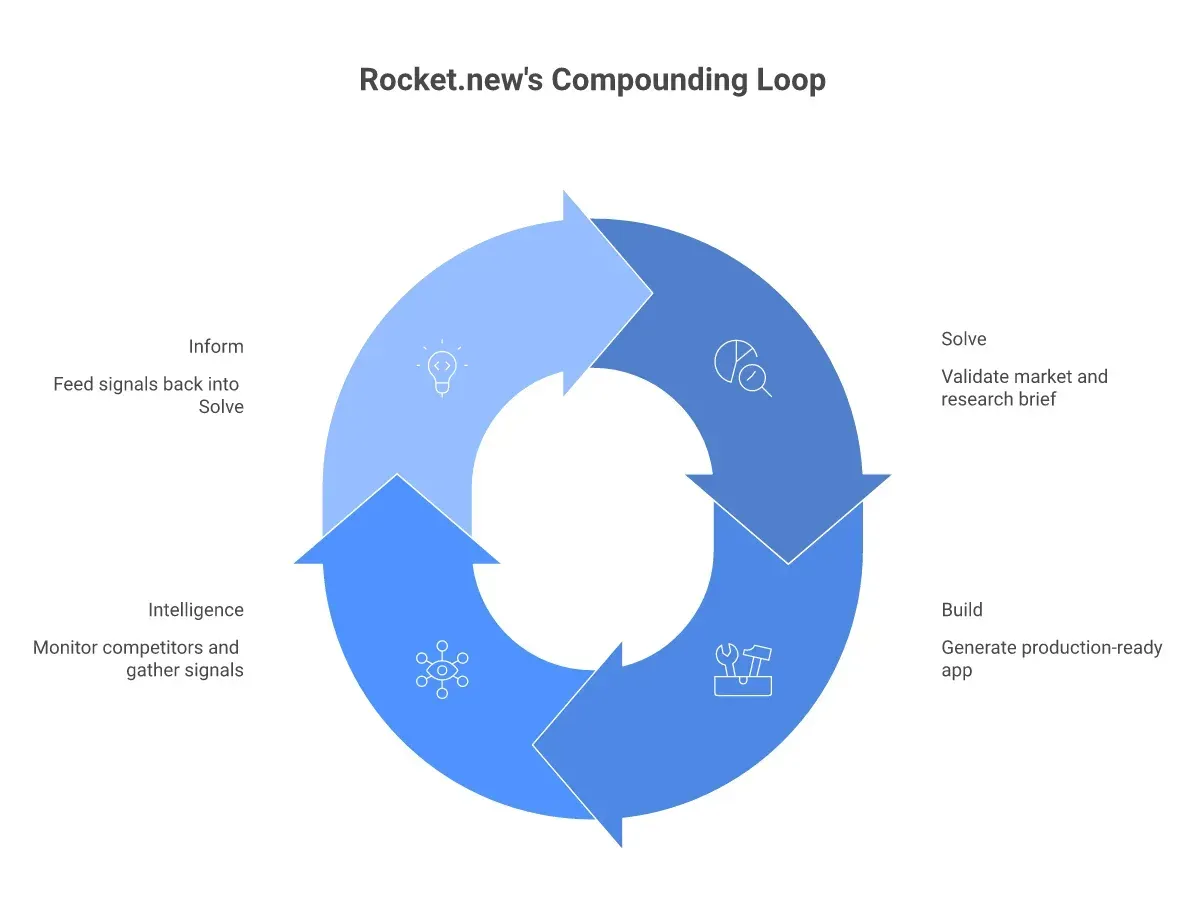 Rocket.new Solve-Build-Intelligence Cycle
Solve - Decision Intelligence Without the Agency Bill
Solve takes any business question and delivers a complete, structured solution with findings, evidence, and clear recommendations. Market sizing, competitive analysis, problem validation, pricing strategy, go-to-market approach - all in plain language, all directly connected to the product being built.
For small business founders and early-stage teams, Solve replaces the most expensive 80% of the traditional Nielsen alternative: the agency brief, the research design, the fieldwork, the analysis phase, and the report delivery. The output isn't a data dump. It's a structured brief that feeds directly into what comes next.
Output exports as PDF or PPT ready for team review or an investor conversation. One platform, one source of truth, no third-party agencies required.
Intelligence - Competitive Intelligence That Doesn't Go Stale
Rocket.new's Intelligence pillar monitors every public platform a competitor operates on, continuously. Not a quarterly snapshot. A continuous loop of signals with interpretation: what changed, what it means for your strategy, and what to do about it.
This replaces the competitive analysis cycles that most enterprise teams run every six months, long after the information would have been actionable. For a small business or startup with a lean team, this is the intelligence layer they'd otherwise never have the budget or headcount to maintain.
Deliveries go wherever the team works daily, weekly, or monthly briefs, all with context and signal interpretation built in. The intelligence layer isn't a separate subscription or a third-party dashboard. It's already inside the platform where the building happens.
Build - Production-Grade Output From a Foundation of Thinking
Here's where Rocket.new's architecture shows its real difference.
When a founder runs Solve research first, that intelligence the market sizing, the competitive analysis, the customer problems, the brand guidelines carries directly into Build. The entire workflow is connected. No re-explaining. No context loss between the research phase and the build phase.
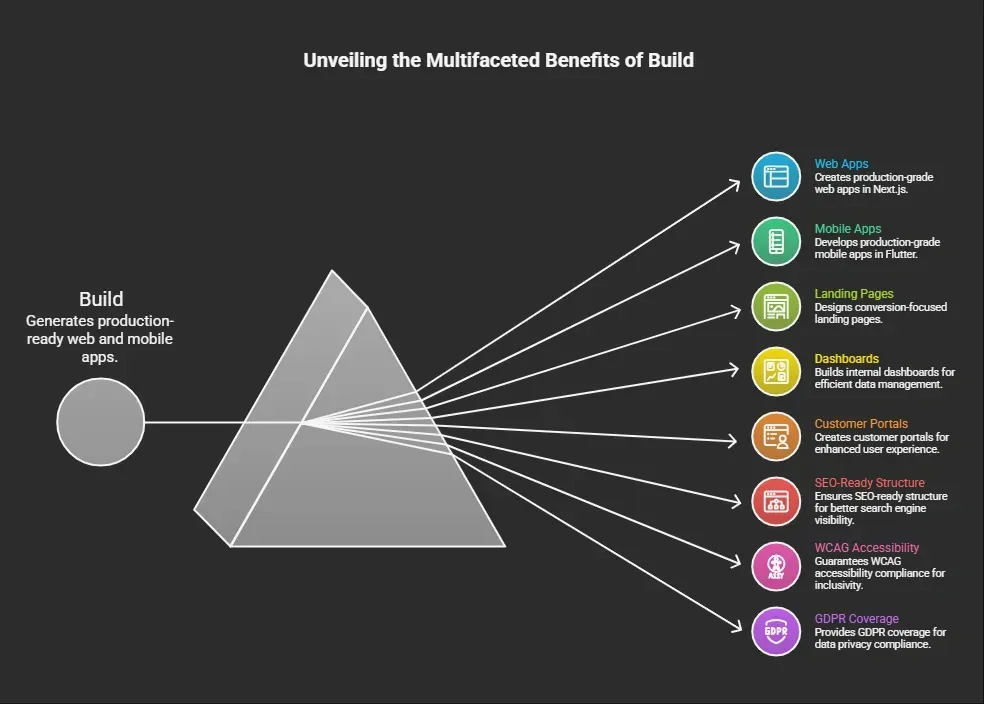 The design isn't pulled from a template library. It's intentional considered typography, real visual hierarchy, visual identity specific to each product. Nothing looks like a generic AI output.
After launch: full version history, one-click rollback, and built-in analytics covering visitors, conversions, and Core Web Vitals. The monitoring tools are already inside the platform. No additional setup needed.
One Platform vs. the Traditional Stack
| Feature | Traditional Nielsen/Agency | Lovable / Bolt / v0 | Rocket.new |
|---|---|---|---|
| Pre-build market research | Yes (expensive, slow) | None | Yes (Solve - minutes, structured) |
| Competitive intelligence | Quarterly, static report | None | Continuous, interpreted signals |
| Product building | No | Yes | Yes (web + mobile) |
| Shared context across research and build | No | No | Yes - compound context |
| Team collaboration | Limited | Limited | Roles, comments, unified billing |
| Small business cost | $50,000+ | Pay per build | SaaS tiers |
| Time to first insight | 6-12 weeks | N/A | Minutes |
The comparison with Lovable, Bolt, and v0 is worth calling out directly. These vibe coding tools are capable builders - but they start at execution. They have no opinion on whether what you asked them to build was worth building. The quality of what comes out depends entirely on what you brought to the prompt.
Rocket.new starts earlier. The thinking happens inside the same platform as the build. Founders leave with a product and the foundation it was built on.
For enterprise teams running AI agents across multiple markets, the single platform advantage compounds further. Instead of coordinating between a research agency, a design tool, a development team, and a monitoring service every team member works inside one shared context workspace. The Solve output that validated the direction becomes the foundation of the Build. The competitive intelligence from last week informs this week's product decision. Nothing gets re-explained. Everything compounds.
Why Founders Are Not Going Back
The decision to skip 80% of traditional market research isn't about cutting corners. It's about being honest about what actually changes product decisions.
Nielsen-style research was built for a world where launching a product took 18 months. Where the cost of getting it wrong was enormous because iteration was slow and expensive. That world still exists in some industries - regulated markets, physical products, enterprise software with long sales cycles.
But for the founders building web apps, SaaS tools, landing pages, and mobile products, the equation has shifted. When a co-founder can validate a product direction in Solve, build a working prototype in Build, and start monitoring competitive signals in Intelligence - all inside one platform, all within the same week the case for spending $50,000 and waiting three months on a traditional market research cycle simply doesn't hold.
The 42% of startups that fail due to misreading market demand aren't all failing because they skipped research. Many did research. They failed because the research wasn't connected to the decisions they were making or it arrived too late to act on.
Rocket.new changes that connection. One platform. One shared context. Research and build side by side.
Why Rocket.new Founders Skip 80% of Traditional Nielsen Alternative: The Short Answer
Traditional market research isn't going away. Large enterprise teams with long planning cycles will keep using it. Nielsen and its alternatives serve a real need for companies with the scale and timeline to absorb both the cost and the wait.
But for the founders, small business owners, and growing teams who make up most of the people building products today, the traditional Nielsen alternative asks for too much time, too much money, and delivers too little connection to the actual build.
The real question every founder should ask before paying for traditional market research: does this research actually change what I build, or does it sit in a PDF while I build based on instinct anyway?
When the answer is the latter, the smarter move is to put the research, the competitive intelligence, and the build inside one platform and let the context compound.
That's what Rocket.new was built to do, and why 1.5 million people across 180 countries have made it their platform of choice.
Table of contents
- -What the Traditional Nielsen Model Actually Costs
- -The 80% Founders Are Walking Away From
- -Why Founders Are Tuning Out the Old Model
- -The AI Era Changed the Market Research Math
- -What Smart Founders Do Instead
- -Structured Brief Over Data Dump
- -Continuous Loop Over Point-in-Time Snapshots
- -Context That Carries Into the Build
- -Rocket.new: Research, Build, and Intelligence in One Place
- -Solve - Decision Intelligence Without the Agency Bill
- -Intelligence - Competitive Intelligence That Doesn't Go Stale
- -Build - Production-Grade Output From a Foundation of Thinking
- -One Platform vs. the Traditional Stack
- -Why Founders Are Not Going Back
- -Why Rocket.new Founders Skip 80% of Traditional Nielsen Alternative: The Short Answer