
Most board meetings rely on outdated, backward-looking information that limits strategic discussion. Rocket.new’s Intelligence continuously monitors competitors, market signals, and emerging risks before the meeting begins. This helps boards focus on faster decisions, stronger governance, and forward-looking strategy instead of reactive updates.
The Preparation is the Meeting
What really separates a productive board meeting from one where directors leave uncertain and under-briefed?
Most companies would say it comes down to the quality of the discussion. But discussions are only as sharp as the context going in. And right now, most boards are walking into each board meeting with a picture that is weeks old, backward-looking, and missing what competitors are actually doing.
According to PwC's 2024 survey of management sentiment toward boards, only 30% of C-suite executives rate their board as "good" or "excellent" - a finding that points to a preparation problem, not a talent problem.
The problem is not effort. It is the kind of intelligence going into the board meeting preparation.
The Weight of the Board Pack
Founders and CEOs often spend 40-50 hours per quarter preparing for board meetings, according to board reporting research shared on LinkedIn. That is a full working week, every quarter, dedicated to compilation and presentation.
Most of what gets prepared is backward-looking. Performance updates. Budget reviews. Quarterly findings. Capital allocation discussions. These matter, but they describe what already happened.
The average board pack for the largest companies now runs 294 pages long - up from 267 pages the year before - according to Board Intelligence's 2025 research on board effectiveness. Directors spend 3-4 hours reading each deck. And 57% say finding key messages in their board papers is "like looking for a needle in a haystack."
Most directors are smart and experienced. But even a seasoned board chair cannot ask the right questions in a board meeting when the research behind the agendas stopped updating two weeks ago. The board members who add the most value in the room are the ones who arrived with context that goes beyond the board pack - and right now, most do not have that.
Sir John Manzoni, Chair of Atomic Weapons Establishment and SSE, described the frustration directly:
"It's incredibly frustrating as a board member when you receive 1,200 pages to read over the weekend and, as a result, you can't see the wood for the trees. By the time you've got through all of that, you realise you're missing the big picture." - Sir John Manzoni, via Board Intelligence
Most Boards Still Do Not Have the Full Picture
There is a clear gap between what most boards receive before each board meeting and what the full picture actually requires.
A board meeting can serve as a forcing function for leadership teams to step back and evaluate their company's strategy, helping to clarify capital allocation and growth priorities.
Board oversight today means more than reviewing past performance. Directors are expected to challenge management on strategy, risk, competitive positioning, and governance - including AI governance. Most boards cannot do that well when the research they receive was assembled days earlier from a static pull.
A 2026 global survey by Protiviti and Board Prospects, covering 772 board members and C-suite executives worldwide, found that only 26% of corporate boards discuss AI at every board meeting. Yet in 63% of organizations reporting high AI ROI, every board meeting agenda includes an AI discussion.
The gap between those two groups is not strategy or ambition. It is preparation.
Most boards are not missing the desire to discuss what matters. They are missing the continuous competitive monitoring that makes forward-looking discussions possible before directors sit down at the table.
Joe Tarantino, president and CEO of Protiviti, put it directly:
"Boards that consistently challenge management on strategy, risk, measurement and governance are better positioned to ensure AI delivers value while operating within appropriate guardrails." - Joe Tarantino, Protiviti CEO, via Protiviti Global Survey, 2026
That kind of challenge requires the right intelligence - and it needs to arrive before the board meeting, not after it.
Why Timing is Everything in Board Preparation
Here is where the before-versus-after distinction matters.
 Post-meeting analysis is common. Boards review what happened, assess decisions made, and flag follow-up actions. That process has value. But it captures what already happened - and by the time those findings feed into the next board meeting, the competitive picture has shifted again.
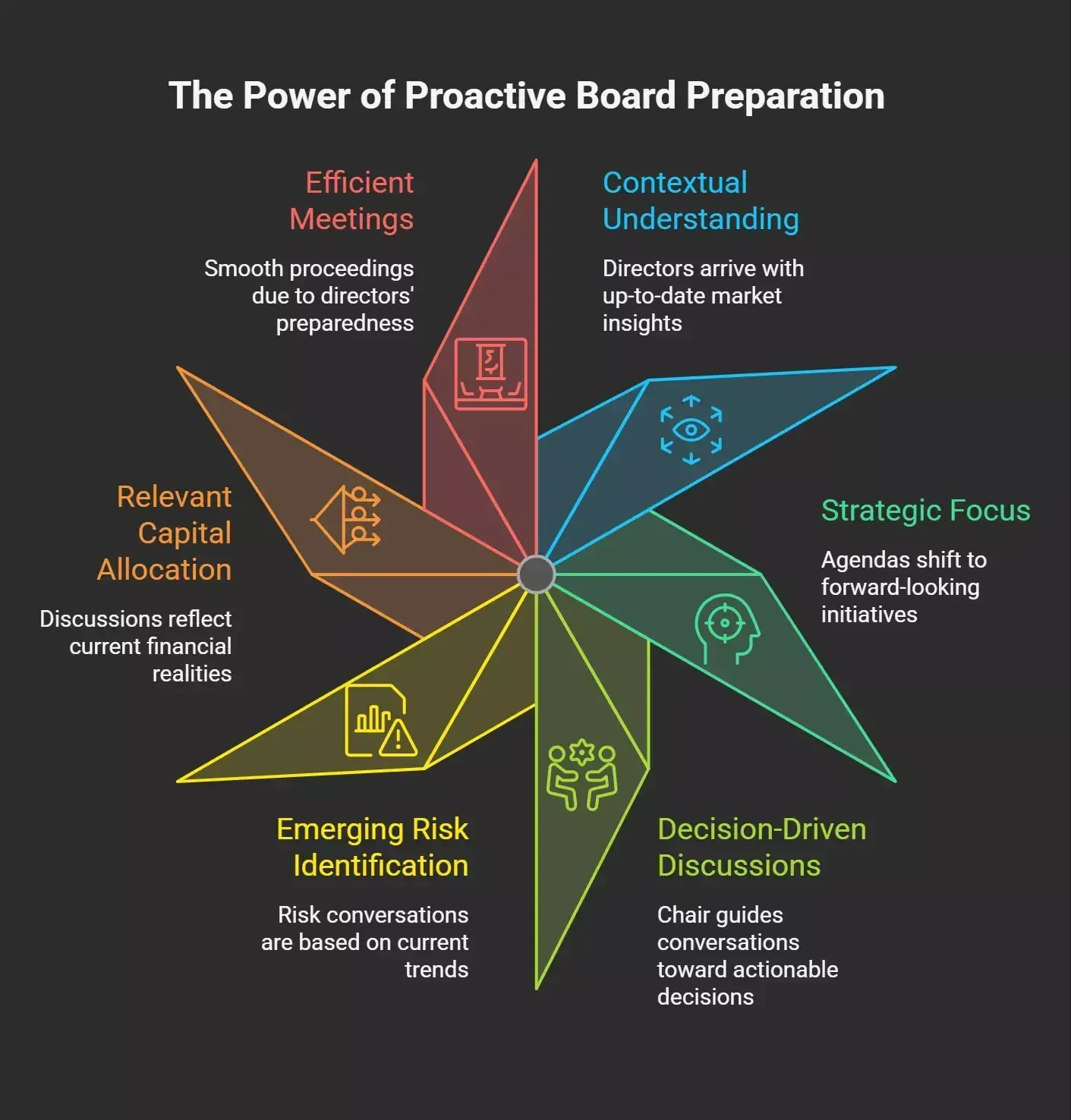
Pre-meeting intelligence is different. When a management team has current competitive monitoring running continuously in advance of each board meeting, the preparation process changes:
-
Directors arrive with context on what shifted in the market in the weeks leading up to the meeting
-
Agendas can focus on forward-looking strategy rather than context-setting
-
The board chair can direct discussions toward decisions rather than updates
-
Risk conversations are grounded in patterns that are emerging, not crises that have already landed
-
Capital allocation discussions reflect what is happening now, not six weeks ago
-
Board and committee meetings run more smoothly when directors already have the background
This is the difference between intelligence that shapes the agenda and intelligence that arrives too late to change it.
How Boards That Prepare Well Are Different
The boards that get the most value from their time together share a preparation process built on current intelligence - not just historical data and performance reviews.
Board Intelligence's December 2024 research found that 83% of directors did not believe their board and management team were set up to harness AI opportunities. This is not because companies lack ambition. It is because the tools for connecting AI to board preparation have not been simple or connected enough to build into daily workflows.
Most boards spend only 32% of their meeting time on strategy, compared to 41% on performance and 26% on governance - according to Board Intelligence research on board meeting time allocation. The plan to fix that imbalance has to start before the meeting. You cannot reclaim strategy time inside the room if the agendas were already built around performance catch-up.
| Preparation Area | Without Continuous Intelligence | With Continuous Intelligence |
|---|---|---|
| Competitor activity | Last quarter's snapshot | Current, ongoing monitoring |
| Risk identification | Flagged post-event | Emerging patterns detected early |
| AI governance | Reviewed reactively | Standing board meeting agenda item |
| Strategy discussions | Reactive to what happened | Informed by current market signals |
| Capital allocation | Based on historical findings | Informed by real-time competitive data |
| Director confidence | Dependent on management summaries | Independent context before discussions |
The difference is not just preparation speed. It is the quality of governance that follows when directors arrive with better research already done.
Rocket.new's Intelligence Is Built for the Pre-Meeting Window
Where Rocket.new Fits
This is exactly the gap Rocket.new was built to address.
Rocket.new is the world's first Vibe Solutioning platform - where strategic research, competitive monitoring, and building happen in the same place, sharing the same context. Among its seven pillars, Intelligence is the capability most directly relevant to board preparation.
Rocket.new's Intelligence monitors every public platform a competitor operates on - website changes, social media activity, press coverage, review sentiment, hiring signals, and executive activity - and runs continuously from setup. Rocket.new generates pre-meeting intelligence in under an hour, streamlining workflow and allowing directors to benchmark market data independently.
It does not wait for someone to pull a research report the week before a board meeting. It produces structured daily briefs with interpreted findings ready to review before the first meeting of the day.
Rocket.new intelligence replaces assumptions with evidence-backed insights, shifting board meetings from information delivery to decision-making. Rocket.new allows for proactive decision-making in board meetings by using real-time market data to prevent poor problem definition.
For board preparation, this means the management team arrives at each board meeting having already tracked weeks of competitive and market signals - not scrambling in the days before to compile a static presentation.
Reading Clusters, Not Just Events
AI can significantly enhance board effectiveness by addressing information asymmetry between boards and management, allowing directors to benchmark public disclosures and analyze historical data more effectively. Most AI tools send alerts when something changes. Rocket.new's Intelligence reads clusters of signals.
A competitor updating their pricing page is noise in isolation. That same update, alongside new enterprise sales job postings, a shift in their LinkedIn content strategy, and defensive responses to recent customer reviews, forms a clear strategic signal. Rocket.new connects those dots before they arrive in a board meeting context - giving the management team and directors the full picture rather than a list of isolated events.
This is the kind of intelligence that makes governance conversations sharper. When the board chair asks about competitive positioning, the answer is already documented, interpreted, and connected to the ongoing strategy plan.
Four Functions, One Shared Project
Rocket.new's Intelligence simultaneously serves sales, marketing, product, and strategy teams from a single shared project. For board oversight, this matters because the competitive intelligence informing a strategic discussion and the intelligence informing a product roadmap are no longer separated.
Board members, the management team, and the operational teams all work from the same picture. Findings do not get lost between tools. The intelligence compounds as more context builds up inside the project over time.
Rocket.new also includes Solve - a decision intelligence capability that takes any business question and delivers a complete, structured output ready to present or act on. For board and investor materials specifically, the Solve output becomes the foundation for agenda preparation, risk matrix discussions, and capital allocation analysis - all within the same project and shared context.
What Other AI Tools Cannot Provide
General AI tools can run a competitive research query. They return a snapshot of what is publicly available at the time of the request.
Then they reset. Every conversation starts from zero. There is no continuous monitoring. No pattern detection across weeks. No connection between competitive signals and the strategy documents the team is working on in parallel. Most companies building board preparation this way realize they are repeating the same research before every meeting - with no compounding value to show for it.
That is the gap Rocket.new addresses. The intelligence does not reset between board and committee meetings. It builds. The competitive brief from six weeks ago informs the risk conversation today - because it lives inside the same project, connected to the same context.
Most companies running board oversight on the standard model are essentially re-briefing their board from scratch each quarter. Rocket.new replaces that cycle with something that runs in the background, compounds over time, and drives alignment between what management knows and what directors need to know.
The Board Meeting Is Where Decisions Get Made - Not After
When intelligence arrives after the meeting, it is too late to shape the decisions that matter.
Risk assessments, strategic direction, capital allocation, board oversight of AI - these get decided in the room, during discussions that are only as good as the context going in. Most boards work hard and prepare carefully. The gap is not an effort. It is the kind of intelligence going into that preparation, and whether it is continuous, interpreted, and connected to the actual work of the management team.
Why does Rocket.new's intelligence matter more before a board meeting than after one? Because after is already too late.
Rocket.new's Intelligence makes continuous monitoring the default, not a periodic project. And that means every board meeting starts from a stronger foundation than the one before it.
Sign up now and prepare for every board meeting with continuous intelligence that turns discussions into sharper strategic decisions with Rocket.new.
Table of contents
- -The Preparation is the Meeting
- -The Weight of the Board Pack
- -Most Boards Still Do Not Have the Full Picture
- -Why Timing is Everything in Board Preparation
- -How Boards That Prepare Well Are Different
- -Rocket.new's Intelligence Is Built for the Pre-Meeting Window
- -Where Rocket.new Fits
- -Reading Clusters, Not Just Events
- -Four Functions, One Shared Project
- -What Other AI Tools Cannot Provide
- -The Board Meeting Is Where Decisions Get Made - Not After