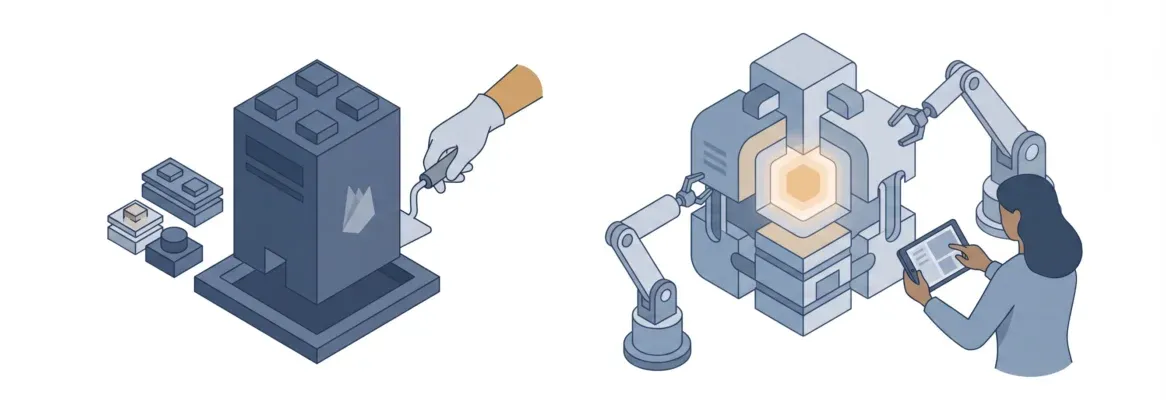
Rocket and Same.dev both generate apps from prompts, but they serve different stages. One covers web prototypes; the other covers the full arc from research to production web, mobile, and team collaboration.
Which AI app builder takes you from idea to production?
Rocket and Same.dev both turn prompts into working products. However, they serve fundamentally different stages of product development. Rocket is a full vibe solutioning platform covering research, web and mobile app generation, competitive intelligence, and team collaboration. Same.dev is a web-only builder with four integrations and expiring tokens.
1.5 million people have tried Rocket across 180 countries. That spans solopreneurs validating their first idea to enterprise teams running strategy and execution on the same platform. According to Stack Overflow's 2024 developer survey, 76% of developers now use or plan to use AI tools in their development process. The question is no longer whether to use an AI builder. It is which one handles the full lifecycle.
What is Same.dev and What Does It Do?
Same.dev is a web-only AI app builder that generates websites and web applications from a chat interface. It deploys via Netlify, uses Claude as its default AI model, and claims 600,000+ projects built.
Same.dev supports four native integrations: GitHub, Neon, Supabase, and Clerk. It also supports custom MCP server connections, but those require manual configuration outside the platform.
Same.dev works well for quick web prototypes where you need a basic frontend fast. It does not support mobile app generation or pre-build research. Additionally, it uses a token-based pricing model where unused tokens expire at the end of each billing cycle.
What is Rocket and What Makes It Different?
Rocket is the world's first vibe solutioning platform. It covers the complete arc from strategic intelligence to execution to ongoing business operation, all inside a single workspace with shared compound context.
Rocket is built around three core capabilities. Solve handles research and decision intelligence before you build. Build generates production-grade web and mobile apps from natural language. Intelligence monitors competitors continuously and delivers actionable signals. Together, these three capabilities share context so nothing is re-explained between steps.
The core difference from Same.dev is not feature count. It is category. Same.dev is a build tool. Rocket is a system where the thinking that determines what to build connects directly to the build that executes it.
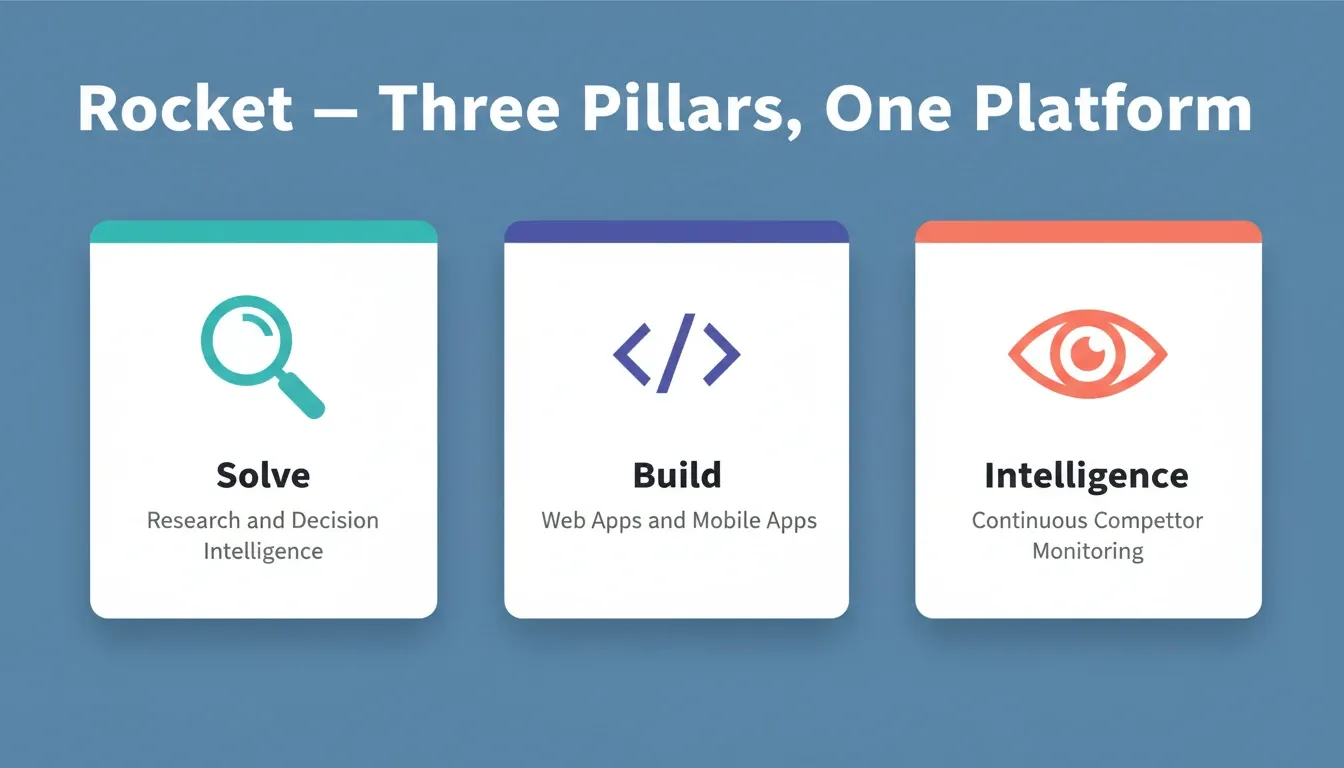
Rocket's three core capabilities work independently and share the same compound context.
How Does Each Platform Handle App Deployment?
Deployment is where the practical differences become obvious.
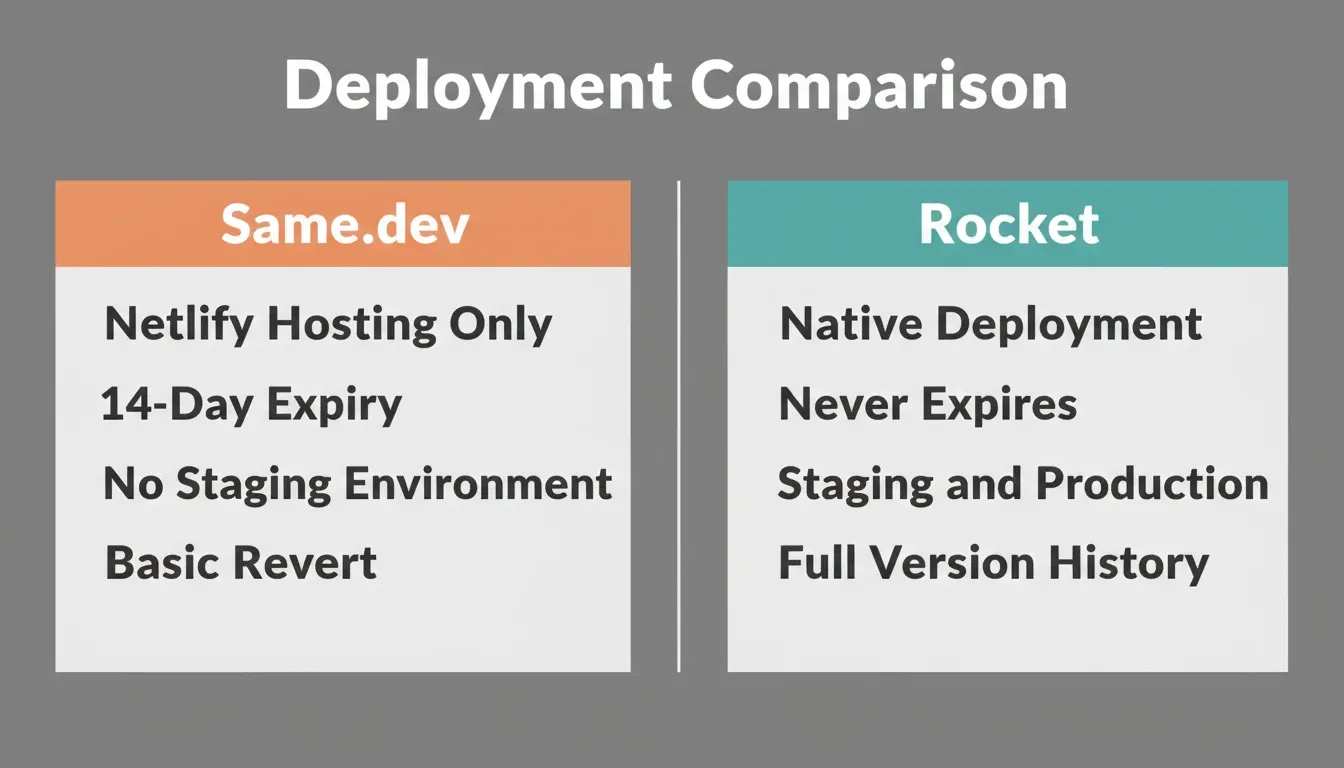
Same.dev relies entirely on Netlify for hosting. After a build, it generates a preview URL and a main domain. Unclaimed deployments expire after 14 days of inactivity. Custom domains require claiming the project through Netlify separately.
Rocket handles deployment natively. Every project includes staging and production environments, one-click rollback, and full version history. Rocket uses a default Netlify account for staging URLs, or you can connect your own. For production, Rocket manages domains directly, including automatic DNS setup and HTTPS provisioning. You can also purchase a domain from the Launch panel without an external registrar.
The key distinction: Same.dev hands you off to Netlify for everything after the build. Rocket keeps deployment control inside the AI app builder platform itself, with staging and production as first-class environments.
| Feature | Same.dev | Rocket |
|---|---|---|
| Staging environment | Not available | Yes — publish to staging URL, share with team |
| Production hosting | Netlify (external claim required) | Native — automatic DNS setup included |
| Custom domains | Via Netlify claim only | Included — buy domain directly in Rocket |
| Version history | Basic revert | Full history + one-click rollback |
| Deployment expiry | 14 days if unclaimed | Never expires |
| HTTPS | Via Netlify | Automatic for all custom domains |
| Built-in analytics | No | Yes — visitors, conversions, Core Web Vitals |
| Project download | Paid plans only | Available |
The lack of a staging environment in Same.dev means there is no safe space to test before going live. That gap becomes visible fast on any project with real users.
Which Platform Offers More Integrations?
Integrations determine how far you can take an AI-built app before you hit a wall.
Same.dev offers four native integrations: GitHub, Neon, Supabase, and Clerk. Custom MCP server connections require manual setup outside the platform.
Rocket ships 25+ integrations that connect directly into the generation layer. Authenticate once and they flow into every build. These cover payments (Stripe, PayPal, AdSense), email and messaging (Mailchimp, SendGrid, Twilio, Resend, Brevo, MailerLite), AI models (OpenAI, Anthropic, Gemini, Perplexity), databases and CMS (Supabase, Strapi, Directus), analytics (Google Analytics, Mixpanel), forms and scheduling (Typeform, Tally, Cal.com, Calendly), and productivity tools (Notion, Linear, Airtable, Google Workspace).
The AI SDK ecosystem is expanding rapidly, with MCP becoming a standard protocol for tool connections. Rocket already has deep integrations baked into its generation layer. As a result, your app ships with payment processing, analytics, and email without extra configuration steps.
Four integrations work for a prototype. Twenty-five work for a product.
Can You Build Mobile Apps on Both Platforms?
This is where the platforms diverge completely.
Same.dev does not support mobile app generation. Their documentation confirms the platform builds websites and web applications only. If you need a native mobile experience, you need a different tool entirely.
Rocket generates production-quality Flutter mobile apps with real design systems, dark and light theming, fluid navigation, and staggered animations. The output is a Flutter codebase ready for App Store and Google Play submission. It is not a web view wrapped in a native shell. You can distribute via instant web preview for demos, APK download for Android testing, or full app store submission.
Cross-platform coverage is built into the same workspace. Your project context carries between tasks. As a result, building a mobile companion to a web app takes minutes instead of weeks.
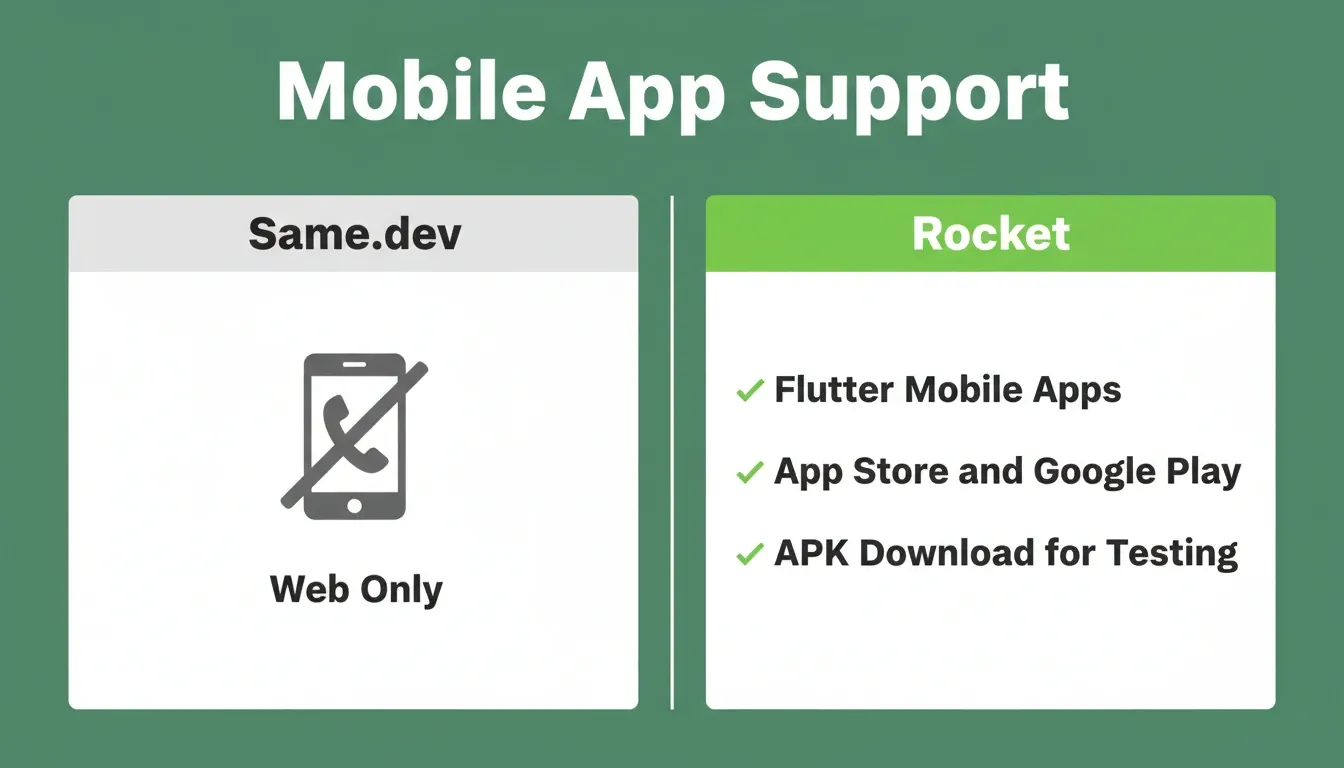
For teams targeting mobile users, Same.dev requires finding a second tool. Rocket handles both from one prompt.
Does Rocket Build Production-Ready Apps or Just Prototypes?
Every Rocket build ships with a set of defaults that most AI builders treat as optional extras.
SEO-ready structure, WCAG accessibility compliance, GDPR coverage, and performance optimization are built into every build. They are not add-ons. Core Web Vitals are tracked automatically after launch, with Rocket identifying specific issues and offering automatic fix suggestions. The design output uses considered typography, real visual hierarchy, and identity specific to the product.
Beyond customer-facing products, Rocket also builds internal tools and business infrastructure. These include OKR trackers, customer health monitors connected to Mixpanel and Airtable, GDPR DSAR management tools, investor data rooms, and sales enablement platforms.
Same.dev generates functional interfaces but does not ship these compliance and performance defaults as part of every build.
What Is Solve and Why Does It Matter Before You Build?
This capability has no equivalent in Same.dev.
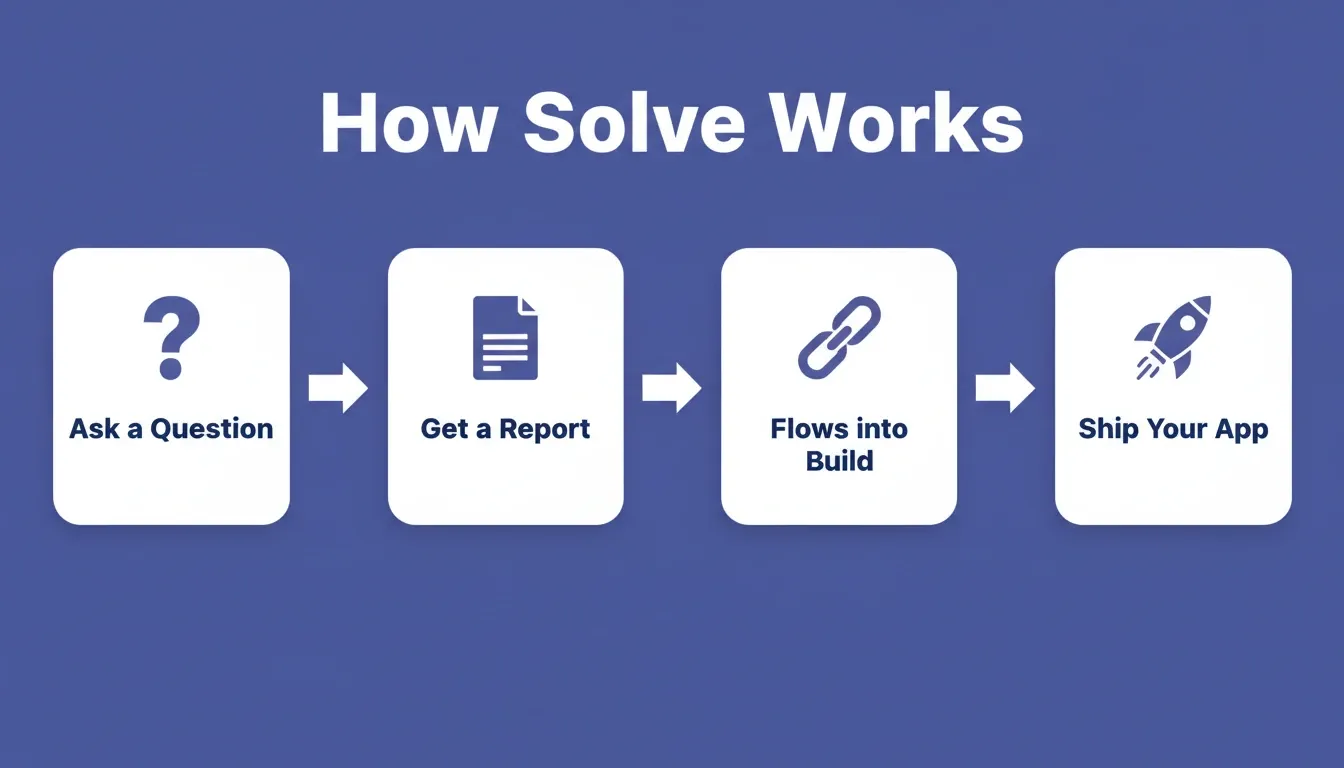
Solve is Rocket's research engine. Before you write a single prompt for your app, Solve turns any business question into a structured, evidence-backed report. The report includes an executive summary, supporting data, analysis, and actionable recommendations. Output formats include PDF, PPT, HTML, and PRD, ready to share with stakeholders immediately.
Because Solve lives inside the same platform as Build, research findings flow directly into your app generation. There is no copy-pasting between tools and no context lost at the handoff.
| Search | Chatbot | Solve | |
|---|---|---|---|
| What you get | Links | A summary | Structured multi-source report |
| Research effort | You do the work | None, but shallow | Done for you, in depth |
| Live data | Yes, unstructured | No | Yes, synthesized |
| Output format | Ten blue links | Paragraph answer | Executive summary, analysis, evidence, recommendations |
| Connection to build | None | None | Flows directly into Rocket Build |
Solve covers market sizing, competitive teardowns, pricing strategy benchmarking, product direction, investment analysis, GTM strategy, and regulatory research. Light Solve is available on all plans. Full Solve, with parallel research streams and board-ready depth, is available on Rocket and Booster plans.
Why Teams Pick Rocket for Production AI Projects
Teams that need to ship real products gravitate toward platforms that handle the full lifecycle.
Research before building means you arrive at the Build step with market data, competitive context, and a clear product direction already in place. Competitive Intelligence built in monitors competitor websites, pricing pages, social media, and customer reviews continuously. It delivers daily and weekly briefs directly to your sidebar.
Context that compounds means every task you complete makes the next one smarter. Files, research, and decisions added to a project carry into every subsequent task. In practice, the developer opening a Build task today has access to the market research the strategist ran last week, without a catch-up document.
Human Help when AI reaches its limit is a differentiator no other AI builder offers. Rocket's Success team steps in inside the platform, with user permission, when the AI cannot finish the job. There are no tickets and no email chains.
According to GitHub's 2024 developer survey, 97% of respondents reported using AI coding tools at work at some point. The tools that win are the ones that handle complexity without adding it.
How Do Pricing Models Compare for Scaling Teams?
Same.dev uses a token-based model with monthly expiry. Unused tokens disappear at the end of each billing cycle. There is no rollover.
Rocket uses a credit-based system where unused credits roll over month to month on all paid plans. Credits are not siloed by feature. One balance covers Build, Solve, and Intelligence. Add-on credit packs purchased separately do not expire while your subscription is active.
| Plan | Same.dev | Rocket |
|---|---|---|
| Free / Entry | 500K tokens/month (expires) | 20 credits (one-time grant) |
| Entry paid | $10/month — 2M tokens | Pro: $25/month — 100 credits/month |
| Mid-tier | $25/month — 5M tokens | Rocket: $50/month — 250 credits/month |
| High-tier | $100/month — 20M tokens | Booster: $250/month — 1,500 credits/month |
| Unused balance | Resets monthly | Rolls over (monthly plans) |
| Team members | Not available | Unlimited on all paid plans |
| Intelligence included | No | Rocket and Booster plans |
| Full Solve included | No | Rocket and Booster plans |
The expiry model punishes builders who work in bursts. Miss a month on Same.dev and your allocation resets to zero. Rocket's credit rollover respects the reality that product development is uneven.
Decision guide: when Rocket is the right choice vs. Same.dev for web-only prototypes
Who Should Use Rocket vs Same.dev?
The right tool depends on what you are building and how far you need to take it.
Same.dev is a good fit if:
-
You need a quick web prototype or landing page
-
Your integration needs are limited to GitHub, Supabase, Neon, or Clerk
-
You do not need mobile apps
-
You build consistently enough that monthly token expiry is not an issue
Rocket is the right choice if:
-
You need mobile apps alongside your web app
-
You want to validate your idea with structured research before building
-
You need more than four integrations, especially payments, email, analytics, or AI models
-
You need staging environments, version history, and rollback
-
You are building with a team and need shared context, access control, and per-user credit management
-
You need compliance defaults (WCAG, GDPR, SEO) built into every build
What Do Builders Say About Working With AI Tools?
Developer sentiment on AI builders is shifting. GitHub's research found that developers who use AI coding tools report spending saved time on system design and collaboration. The expectation is moving from "generate something" to "generate something production-ready."
Same.dev's community lives on Discord, with limited public reviews on established platforms at scale. By contrast, Rocket has been tried by 1.5 million people across 180 countries. That growth happened through organic product-led growth, not paid acquisition.
The pattern across production teams is consistent: the tools that win handle infrastructure so builders can focus on product decisions.
The Right Builder for the Right Stage
Choosing between Rocket.new vs Same.dev comes down to where you are in the product lifecycle. Same.dev handles quick web prototypes efficiently. Rocket handles everything that follows: research, mobile, integrations, compliance, and team collaboration, inside one platform where context compounds across every task.
As AI builders mature, the gap between tools that generate and platforms that think-then-build will widen. Teams that validate before they build, ship with compliance defaults, and monitor competitors continuously will consistently outpace those that start from a blank prompt. Start building on Rocket and take your next project from idea to production in a single workspace.
Table of contents
- -What is Same.dev and What Does It Do?
- -What is Rocket and What Makes It Different?
- -How Does Each Platform Handle App Deployment?
- -Which Platform Offers More Integrations?
- -Can You Build Mobile Apps on Both Platforms?
- -Does Rocket Build Production-Ready Apps or Just Prototypes?
- -What Is Solve and Why Does It Matter Before You Build?
- -Why Teams Pick Rocket for Production AI Projects
- -How Do Pricing Models Compare for Scaling Teams?
- -Who Should Use Rocket vs Same.dev?
- -What Do Builders Say About Working With AI Tools?
- -The Right Builder for the Right Stage