
Rocket.new is a vibe solutioning platform covering research, build, and competitive monitoring in one system. Cline is a VS Code coding agent. The right choice depends on whether you need faster coding or a complete path from idea to deployed product.
AI development tools have split into two very different categories. On one side are coding agents that live inside your editor and help you write code faster. On the other are full-stack platforms that take you from idea to deployed product without requiring you to manage infrastructure, deployment, or post-launch monitoring.
This comparison covers Rocket.new vs Cline in detail. Cline is one of the most capable open-source coding agents available today. Rocket is the world's first vibe solutioning platform. Both are built for AI-powered app development, but they solve different problems at different stages of the product lifecycle.
By the end of this guide, you will know exactly which tool fits your workflow, your team, and the stage your project is in.
Why Developers Are Choosing AI App Builders Over Coding Agents
Which AI development tool actually fits your goals? Stack Overflow's 2024 survey confirmed that AI adoption has moved well past experimentation. Today, 76% of respondents plan to use AI tools this year, and 62% already use AI daily.
Coding agents like Cline live inside your editor. They execute file changes and terminal commands on your behalf. Full-stack platforms like Rocket, by contrast, generate entire applications from descriptions and handle everything through deployment. This distinction shapes not just how you write code, but whether you spend hours configuring infrastructure or shipping products.
The AI development space has split into two distinct camps. Understanding how vibe coding and vibe solutioning differ as developer workflows makes this split clearer. Coding agents start at execution, while solutioning platforms start before the first line of code.
-
Coding agents like Cline, Claude Code, and Cursor operate inside IDEs. They offer intelligent autocomplete, file editing, and terminal execution. They work best when you already know the architecture and manage your own deployment pipeline.
-
AI app builders and vibe solutioning platforms like Rocket generate complete applications from prompts. They include frontend, backend, database schemas, and deployment infrastructure. They serve builders who want to go from idea to live product without assembling a toolchain.
The decision is less about which tool is "better." It is more about what stage your project is in and how much infrastructure you want to own.
How Does Cline Work as a VS Code Coding Agent?
Cline is an open-source autonomous coding agent (Apache 2.0 license) that runs as a VS Code extension. With over 5 million installs and 61,000+ GitHub stars, it has become one of the most popular AI coding tools available today.
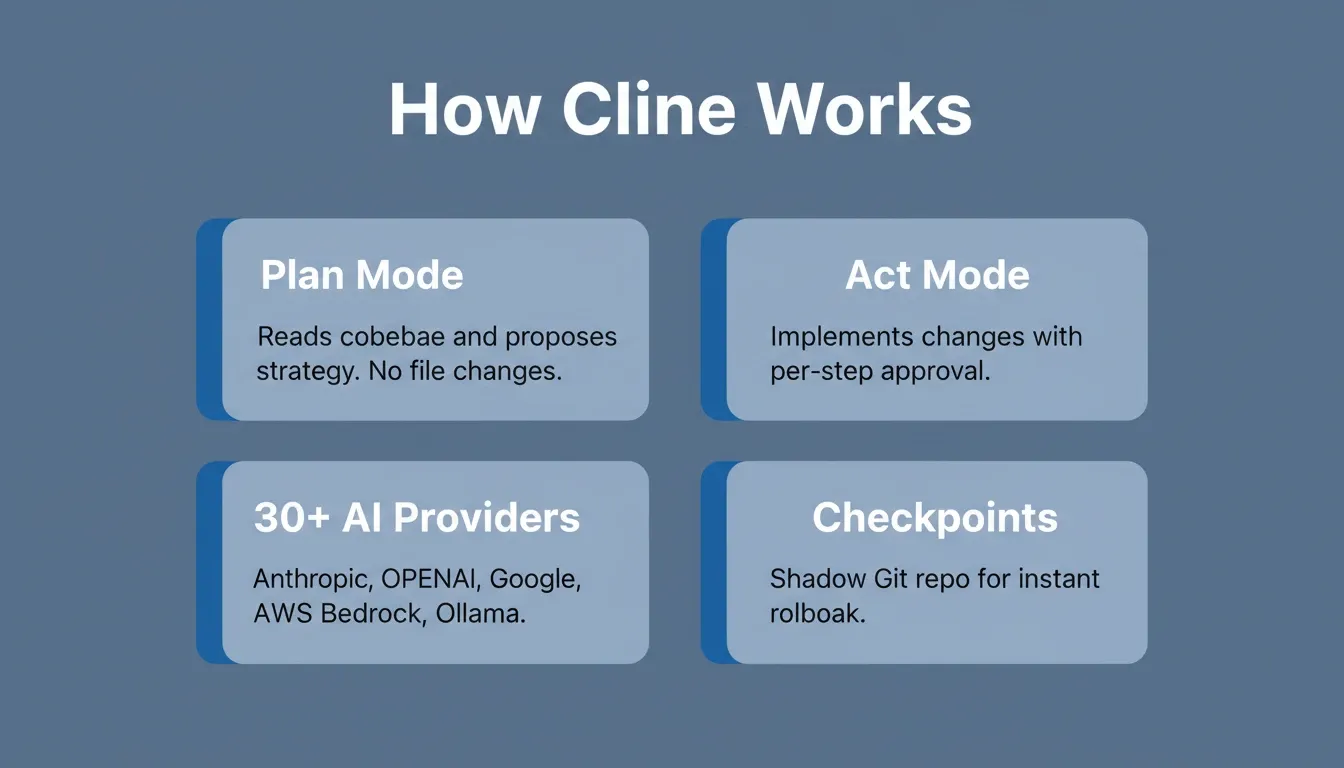
Cline's four core capabilities: Plan/Act separation, multi-provider support, MCP server extensibility, and shadow Git checkpoints
-
Plan and Act modes separate thinking from execution. Plan mode reads your codebase and proposes a strategy without changing files. Act mode then implements changes with per-step approval. This prevents the "AI rewrote half my project" failure mode.
-
Multi-provider support lets you switch between Anthropic, OpenAI, Google, AWS Bedrock, Ollama, and 30+ providers. You can do this without changing your workflow or reconfiguring the tool.
-
MCP server support extends capabilities with database access, API documentation, issue trackers, and custom tools you configure.
-
Checkpoints maintain a shadow Git repository. This lets you roll back any agent action to a previous state instantly.
As comprehensive Cline setup guides explain: "Unlike tools that immediately start generating code, Cline separates thinking from doing. Plan reads and reasons; Act executes with per-step approval."
Cline handles complex multi-file edits, terminal commands, and browser automation through Puppeteer. It works across VS Code, JetBrains, Cursor, Windsurf, and Zed. For developers who already have a project structure, a deployment pipeline, and strong opinions about architecture, Cline is genuinely powerful at what it does.
The critical limitation is scope. Cline helps you write and debug code inside your editor. It does not research whether the code is worth writing. It cannot generate a complete application architecture from scratch or deploy your product to a live URL with monitoring. Every session starts fresh, with no memory of prior decisions.
What Is Rocket, Exactly?
Rocket is not just an AI app builder. It is the world's first vibe solutioning platform, a category it created. Business thinking and building happen in the same place. This matters because Rocket competes on the complete arc from strategic intelligence to execution to ongoing business operation.
1.5 million people have tried Rocket across 180 countries. It is backed by Salesforce Ventures and Accel.
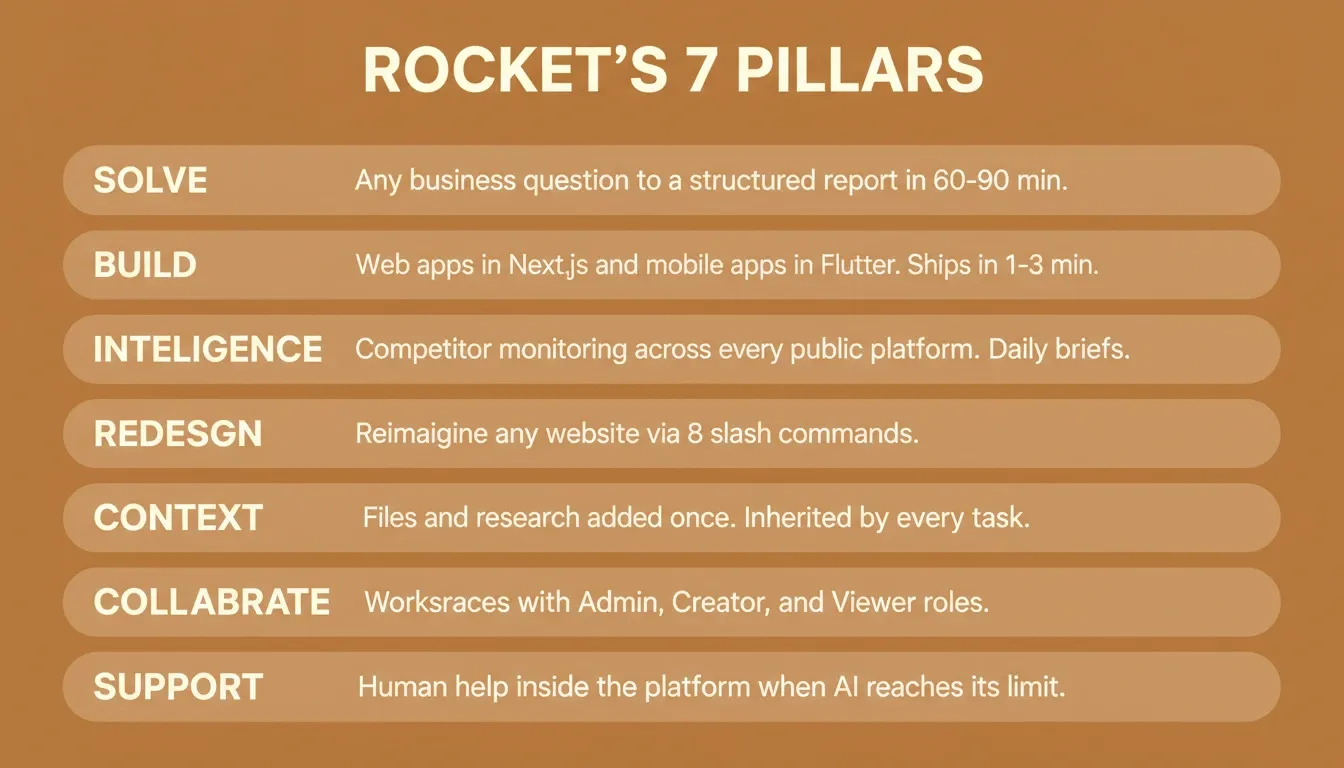
Rocket's seven pillars, each independently usable and connected through a shared context architecture
Rocket ships with seven pillars that work together through a shared context architecture:
| Pillar | What It Does |
|---|---|
| Solve | Turns any business question into a structured research report. Runs 150+ sources simultaneously. Delivers in 60-90 minutes. |
| Build | Generates production-grade web apps (Next.js) and mobile apps (Flutter) from natural language, Figma files, or GitHub repos. Most apps generate in 1-3 minutes. |
| Intelligence | Continuously monitors competitors across every public platform. Delivers daily briefs, pricing alerts, and trend signals automatically. |
| Redesign | Reimagines any existing website via eight slash commands. No starting from scratch required. |
| Context | Persistent shared memory. Add files and research once; every task inherits it automatically. |
| Collaborate | Team workspaces with three-level role-based access (Admin, Creator, Viewer), inline comments, and unified billing. |
| Support | Rocket's Success team steps in inside the platform when the AI reaches its limit, with user permission. |
Cline has none of these pillars beyond the coding step itself. It is a capable coding agent. Rocket is the system that surrounds, precedes, and follows the build.
What Sets a Managed AI Platform Apart from an Extension?
The structural gap between Cline and Rocket is not about coding quality. Both produce working code. The difference lives in what surrounds that code and what happens before and after it exists.
| Capability | Cline | Rocket |
|---|---|---|
| Code generation | Yes, file by file with approval | Yes, full app in 1-3 minutes |
| Pre-build research | No | Yes, Solve covers 150+ sources |
| Competitive monitoring | No | Yes, automated daily briefs |
| Framework selection | Manual (you choose and configure) | Automatic (Next.js for web, Flutter for mobile) |
| Deployment | You manage servers, CI/CD, DNS | One-click deploy with staging and production |
| Post-launch analytics | No | Built-in visitors, Core Web Vitals, conversions |
| Shared team context | No, sessions are individual | Yes, every task inherits prior decisions |
| Figma-to-code | No | Yes, preserves typography, spacing, color system |
| GitHub import | No | Yes, Next.js TypeScript repos via Codebase Pickup |
| Website redesign | No | Yes, eight slash commands across three categories |
| WCAG accessibility | Your responsibility to specify | Ships as a default baseline |
| Connected services | Via MCP servers you configure | 25+ services authenticated once |
-
Cline requires you to be the system. You install it, configure providers, manage API keys, handle deployment, and troubleshoot infrastructure. The agent helps you code faster, but the platform responsibility stays entirely with you.
-
Rocket is the system. You describe what you want. Rocket plans the architecture, generates the code, produces a live preview, and deploys with one action.
For non-technical founders and small teams, this distinction is the entire decision. For experienced developers, it determines whether you spend time on infrastructure management or product logic.
Where Rocket Fits When You Need More Than Code
Once you understand Cline's boundaries, Rocket's value becomes clearer. It does not compete with Cline at the IDE level. It replaces the entire workflow that Cline sits inside of.
Solve Before You Build
Before generating a single line of code, Rocket's Solve capability produces structured research. It covers your idea, market conditions, and competitive positioning. Solve runs parallel research across 150+ sources simultaneously. It delivers a complete structured report, including executive summary, supporting evidence, risk matrix, and actionable recommendations, typically within 60 to 90 minutes.
This intelligence flows directly into the build through shared context. As a result, the app reflects real market understanding rather than a cold prompt. Cline has no equivalent. You bring your own research, or you skip it entirely.
Production-Grade from First Generation
Rocket produces Next.js web apps and Flutter mobile apps with real design systems, dark/light theming, fluid navigation, and staggered animations from day one. According to GitHub's Octoverse report, Python and JavaScript remain the most-used languages globally. Rocket's Next.js output plugs directly into this ecosystem with TypeScript.
Every build ships with SEO-ready structure, WCAG accessibility compliance, and GDPR coverage as defaults. These are not optional extras. Cline produces whatever your prompt specifies; compliance is your responsibility to specify and verify.
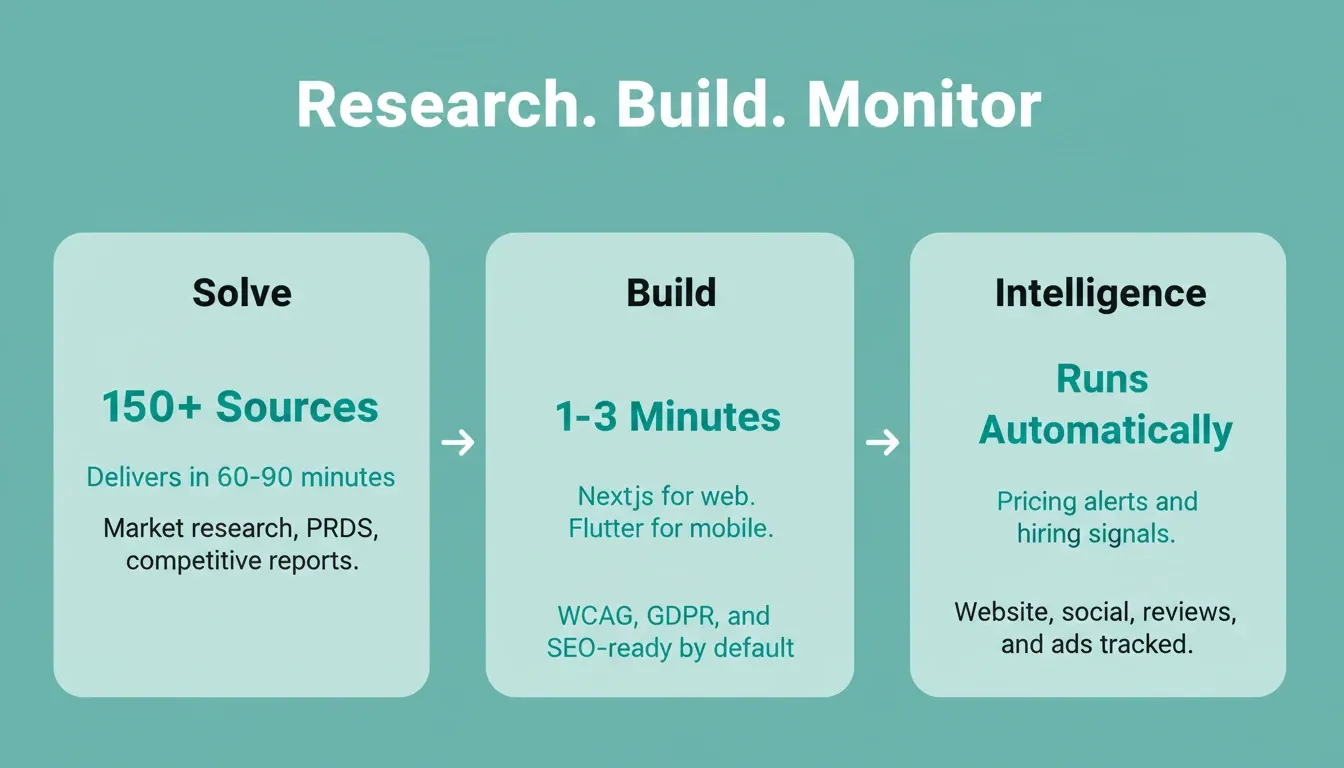
How Solve, Build, and Intelligence connect: research informs the build, and monitoring triggers the next decision
Multiple Ways to Start a Build
Rocket offers six distinct starting methods. You can begin from a natural language prompt, a Figma file, a GitHub repo, an image or PDF, a template, or a live URL via Redesign. Cline works from one starting point: your existing codebase, in your editor.
The Redesign capability alone covers a gap Cline cannot address. Point Rocket at any live website URL and use eight slash commands to reimagine it. Options include Reimagine Website Design, Full Website Makeover, Mobile-First Redesign, Redesign from Heatmap, Fix Conversion Issues, Fix Visual Hierarchy, Redesign Like Competitor, and Generate Brand-Matched Page.
Shared Context Architecture
Every task in a Rocket project inherits the accumulated intelligence of prior tasks. The research from last week is present when the build starts today. The PRD generated by Solve is present when the developer opens the build task. This compound memory is absent from session-based tools like Cline, where each session starts fresh.
Competitors can match individual features. They cannot replicate accumulated context.
Does Your AI Tool Handle Deployment and Post-Launch?
The moment that separates AI coding tools from AI building platforms is what happens after the code exists. This is where Cline stops and Rocket continues.
Deployment workflow comparison: Cline's manual multi-step process versus Rocket's integrated one-click deployment path
With Cline, you write the code. Then you configure Netlify, Vercel, or AWS. Then you set up environment variables, DNS records, and CI/CD pipelines. After that, you add analytics with a third-party tool. Each step is a separate manual process.
With Rocket, clicking "Launch" deploys to a staging URL instantly. Connect a custom domain, push to production, and analytics start collecting data automatically. Version history and one-click rollback are included by default. You can even purchase a domain directly through Rocket without visiting an external registrar.
The post-launch gap is where most AI coding tools fall short. They help you write faster but leave you alone for everything that makes software run in production and serve real users.
If your definition of "done" is working code on your machine, Cline delivers. If "done" means a live product with real users and performance monitoring, Rocket covers the remaining 60% of the work that coding agents leave untouched.
Who Should Use Rocket vs Cline?
Not every project needs a full platform. Here is how to choose:
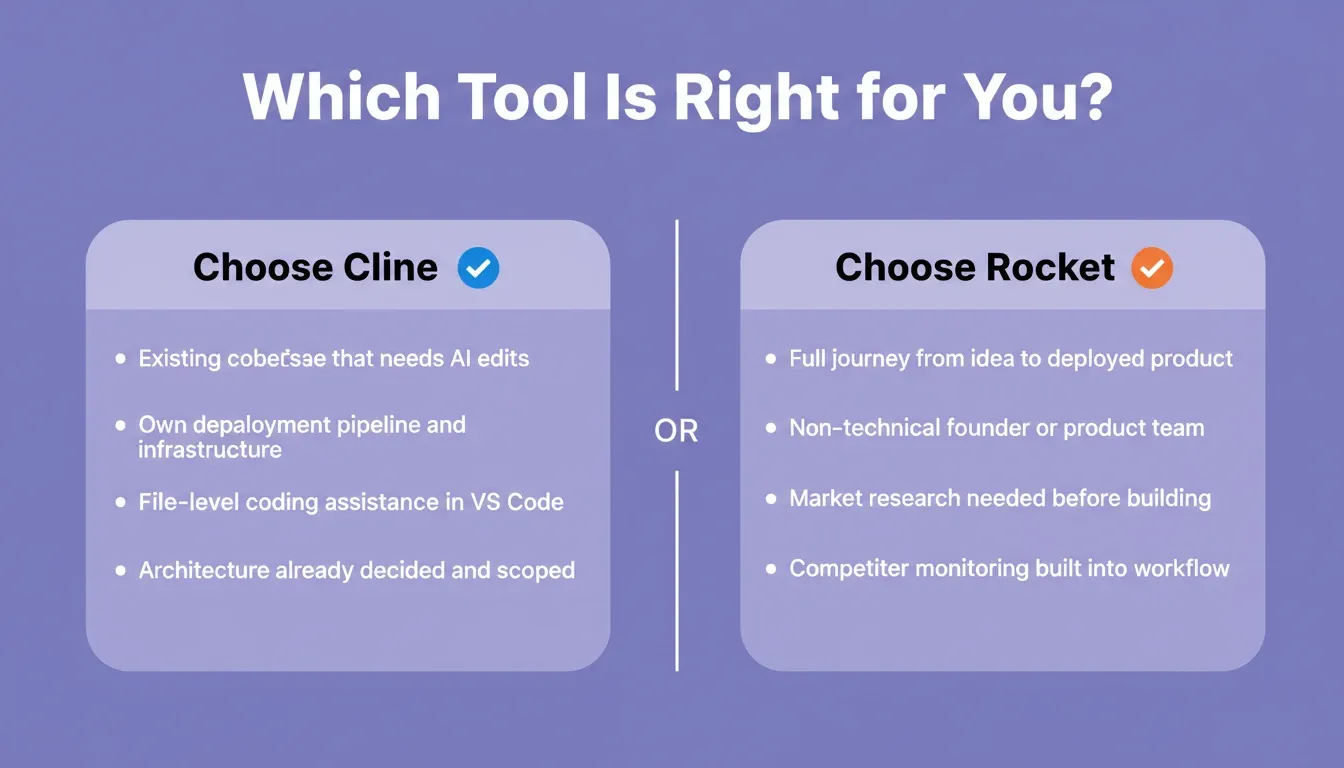
Quick decision guide: when Cline is the right fit versus when Rocket serves the moment better
| Situation | Best Tool |
|---|---|
| You have an existing codebase and need surgical AI edits | Cline |
| You know your architecture and want faster file-level coding | Cline |
| You are a developer who manages your own deployment pipeline | Cline |
| You need to go from idea to deployed product without infrastructure work | Rocket |
| You are a non-technical founder or product team | Rocket |
| You need market research before you build | Rocket |
| You want to monitor competitors automatically | Rocket |
| You need to convert a Figma design to production code | Rocket |
| You want to redesign an existing website without starting from scratch | Rocket |
| You need team collaboration with shared context | Rocket |
| You want to build iOS and Android apps from a single codebase | Rocket |
Some teams use both. They use Rocket for initial generation and deployment, then use Cline for surgical edits in the exported codebase. Rocket supports GitHub sync, so changes made locally can flow back into the platform.
Pricing at a Glance
Understanding the cost model for each tool helps set expectations before you commit.
| Tool | Base Cost | What You Pay For |
|---|---|---|
| Cline extension | Free (open source, Apache 2.0) | AI provider API keys (Anthropic, OpenAI, etc.) |
| Cline sessions | Typically $0.01-$0.10 per task | Varies by model and task complexity |
| Rocket Free plan | $0 / 20 credits | Light, exploratory, and personal use |
| Rocket Pro plan | $25/month / 100 credits | Production-ready builds for individuals |
| Rocket plan | $50/month / 250 credits | Frequent use by individuals and teams |
| Rocket Booster plan | $250/month / 1,500 credits | Power users and fast-moving teams |
| Rocket Intelligence | $100/month per competitor tracked | 500 credits/month per competitor |
Rocket uses a single credit balance that covers Solve, Build, and Intelligence. Unused subscription credits roll over month to month on monthly plans. The "Fix it" action for Rocket-detected errors does not consume credits for paid users. Annual billing saves 20%.
The Right Tool for Where You Are
Cline is a strong coding agent for developers who already know their architecture, own their deployment pipeline, and want AI assistance inside an existing workflow. Rocket.new serves a different moment: when you need the entire arc from research to live product in one system.
As AI-powered app development matures, the gap between tools that assist coding and platforms that handle the full product lifecycle will only widen. For teams and founders who measure success by shipped products rather than committed code, the platform approach eliminates the fragmentation that slows most projects down.
You type the problem. Rocket researches it, recommends a direction, and builds from that direction. Start building on Rocket today and go from business question to deployed application without assembling separate tools for research, coding, deployment, and monitoring.
Table of contents
- -Why Developers Are Choosing AI App Builders Over Coding Agents
- -How Does Cline Work as a VS Code Coding Agent?
- -What Is Rocket, Exactly?
- -What Sets a Managed AI Platform Apart from an Extension?
- -Where Rocket Fits When You Need More Than Code
- -Solve Before You Build
- -Production-Grade from First Generation
- -Multiple Ways to Start a Build
- -Shared Context Architecture
- -Does Your AI Tool Handle Deployment and Post-Launch?
- -Who Should Use Rocket vs Cline?
- -Pricing at a Glance
- -The Right Tool for Where You Are