
Learn how continuous intelligence helps modern teams replace slow quarterly reporting with real-time insights, enabling faster decisions, stronger collaboration, improved operational agility, and better business performance in the highly competitive and data-driven landscape of 2026.
Why is Continuous Intelligence Replacing Quarterly Reporting?
If your last major business decision came from a report created months ago, your team was reacting to history instead of responding to what is happening now. That is the growing problem with traditional quarterly reporting. Markets shift faster, customer behavior changes daily, and competitors move long before static reports are updated.
That is the core problem with quarterly reporting. And continuous intelligence is the answer. According to IBM, 80% of organizations still rely on stale data for decision-making, while 85% of data leaders admit that using outdated data has directly cost their companies money.
Continuous intelligence flips that model. Instead of waiting for reports, teams get real-time analytics, live data streams, and AI-powered insights delivered as events happen - not weeks after.
This blog will help readers understand how continuous intelligence works, why real-time data matters for modern decision-making, and how businesses can build faster, smarter response systems using live market insights.
What is Continuous Intelligence?
Most businesses still rely on static dashboards and delayed reporting cycles to make important decisions. Continuous intelligence changes that by turning data into a live, ongoing decision-making system instead of a periodic reporting process.
Continuous intelligence (CI) combines current and historical data, streaming analytics, and machine learning models to deliver real-time insights as events happen. Instead of waiting for scheduled reports, teams receive continuous updates that help them react faster to operational, customer, and market changes.
What Makes Continuous Intelligence Different?
-
Uses live streaming data instead of static snapshots
-
Combines historical and real-time analytics together
-
Applies machine learning to detect patterns and anomalies
-
Delivers actionable insights continuously instead of periodically
-
Supports faster operational and strategic decision making
-
Helps teams respond to changes while events are still happening
Think of it as the difference between checking weather reports once a week and having a live forecast updating all the time.
According to a November 2025 LinkedIn analysis by Amplework Software:
"Continuous intelligence is the next frontier in data-driven decision-making. Unlike traditional analytics that work with historical data, CI systems continuously ingest, analyze, and act on live streams of information." Amplework Software, LinkedIn Pulse, Nov 2025
This captures exactly what separates a continuous intelligence solution from a traditional BI report: it does not stop at the data. It keeps going.
Why Traditional BI Falls Short in 2026?
Traditional business intelligence tools were designed for a slower world. You gather data, store it, run batch processes, generate reports, and share those reports in meetings - often three to six weeks after the fact.
Traditional BI answers "what happened?" Continuous intelligence answers "what is happening right now, and what should we do about it?"
Here is the cost of that gap:
-
73% of leaders say their organizations lose up to 5% of annual revenue because decisions and execution move too slowly - a hidden cost researchers call the "Slowness Tax" (West Monroe, Jan 2026)
-
Companies using real-time analytics make decisions 5x faster than those relying on traditional BI
-
The global continuous intelligence platform market is valued at $6.05 billion in 2026, projected to reach $33.9 billion by 2035 at a CAGR of 21.13% (Market Reports World, 2026)
Traditional BI is not broken. It is built for a pace of business that no longer exists.
How a Continuous Intelligence Platform Works?
A continuous intelligence platform connects multiple data sources into a live analysis loop - combining real-time data streams with historical data, running machine learning models, and surfacing actionable insights automatically.
The Data Analysis Process: From Stream to Signal
The continuous intelligence platform does not wait for a human to run a query. Data flows in from multiple sources, machine learning models analyze data patterns in real time, and automated systems generate alerts or trigger responses. Each cycle in the feedback loop makes the next one sharper.
This is what employing continuous intelligence looks like in practice - a living decision engine, not a monthly export file.
Key Benefits of Implementing Continuous Intelligence
Continuous intelligence is not just about faster analytics. It changes how organizations respond to operational risks, customer behavior, and market conditions by turning live data into ongoing decision support.
Faster Business Decisions
The clearest advantage of a continuous intelligence platform is speed in decision making. When data streams feed directly into decision support systems, business decisions that used to take days take minutes. Teams stop arguing over stale spreadsheets and start acting on live signals.
Real-time decision making is no longer optional. When market conditions shift in hours, teams that rely on quarterly cycles simply cannot keep pace.
Predictive Maintenance Before Failures Happen
In manufacturing and operations, continuous intelligence combines historical data with real-time sensor data streams to predict equipment failures before they occur. Organizations using predictive maintenance report up to 41% reduction in equipment downtime, according to Market Reports World (2026).
That is not just about operational efficiency - it is the difference between a planned fix and an unplanned emergency shutdown.
Fraud Detection in Real Time
Financial services teams use continuous intelligence to analyze data from every transaction in milliseconds, comparing it against historical data patterns to catch suspicious transactions before they clear.
58% of organizations deploying continuous intelligence use it for fraud detection and customer analytics. Detecting fraud in real time - versus catching it in a weekly report - improves detection accuracy by 47% and reduces the financial damage significantly.
Customer Experience at Scale
Retailers and e-commerce companies use real-time data streams from user behavior to adjust recommendations, pricing, and messaging as it happens. This produces a measurable lift in customer experience - up to 37% better engagement for organizations running a continuous intelligence solution.
Personalized recommendations that refresh in real time simply cannot be replicated by a static weekly data pull.
The biggest value of continuous intelligence is not just seeing data faster. It is giving teams the ability to respond while situations are still changing instead of reacting after the opportunity or problem has already passed.
Continuous Intelligence vs. Traditional BI: A Direct Comparison
Traditional business intelligence systems were designed for analyzing what already happened. Continuous intelligence platforms are designed for responding while events are still happening in real time.
| Dimension | Traditional BI | Continuous Intelligence |
|---|---|---|
| Data freshness | Hours to weeks | Milliseconds to seconds |
| Decision speed | Slow (batch report cycles) | Fast (event-driven) |
| Fraud detection | Reactive | Proactive |
| Supply chain monitoring | Periodic snapshots | Continuous tracking |
| Predictive analytics | Limited to historical data | Built-in with ML models |
| Human intervention required | High | Low to minimal |
| Business decisions supported | Retrospective review | Real-time and forward-looking |
Traditional BI and a continuous intelligence platform are not the same category - they serve different moments in the decision-making cycle.
Machine Learning Behind Continuous Intelligence
Continuous intelligence works at scale because machine learning models can process live streaming data continuously and recognize patterns faster than manual analysis ever could.
By combining current and historical data, advanced analytics systems can identify anomalies, predict risks, and surface trends automatically in real time.
What Machine Learning Helps Detect
-
Predict equipment failures before breakdowns occur
-
Detect suspicious transaction behavior before fraud is confirmed
-
Identify supply chain disruptions before delays spread further
-
Surface customer behavior changes before they appear in reports
-
Recognize emerging patterns across massive streaming data environments
-
Improve prediction accuracy through augmented and streaming analytics
The combination of machine learning, historical data, and live streaming analytics is what allows continuous intelligence platforms to move faster than teams relying on static dashboards and delayed reporting cycles.
72% of enterprises are now integrating streaming data tools into their operations, recognizing that advanced analytics running on live data streams creates a genuine competitive advantage (Market Reports World, 2026). Augmented analytics and streaming analytics tools are also being layered in to strengthen prediction accuracy further.
The real strength of continuous intelligence is not just automation. It is the ability to continuously learn from live operational data and help organizations respond before problems, risks, or opportunities become obvious to everyone else.
The Cost of Staying on Quarterly Reports
Teams that still run on quarterly cadences face a predictable pattern in 2026:
-
A problem surfaces in a report - but it happened 60 days ago
-
Leadership schedules a meeting to discuss the data
-
An action plan is created two weeks later
-
Execution starts 90 days after the original event
By that point, the market has moved. Competitors have already responded. The moment is gone.
Organizations running on a continuous intelligence platform catch that same issue in real time, generate actionable insights automatically, and surface a decision support recommendation before the first meeting of the day.
Speed in decision making is not just a competitive edge. It is a revenue line item. The West Monroe "Slowness Tax" research puts a number on it: up to 5% of annual revenue, lost because decisions moved too slowly.
Rocket.new: Built for Continuous Intelligence
Rocket.new brings continuous intelligence directly into business workflows through its Intelligence pillar, without requiring a dedicated analyst team, complex monitoring stack, or heavy data infrastructure.
Instead of generating static reports, Rocket.new continuously monitors competitor activity across public platforms and interprets what those signals mean for your business in real time.
Continuous Monitoring Across Multiple Signals
Rocket.new tracks six major categories of competitive signals continuously:
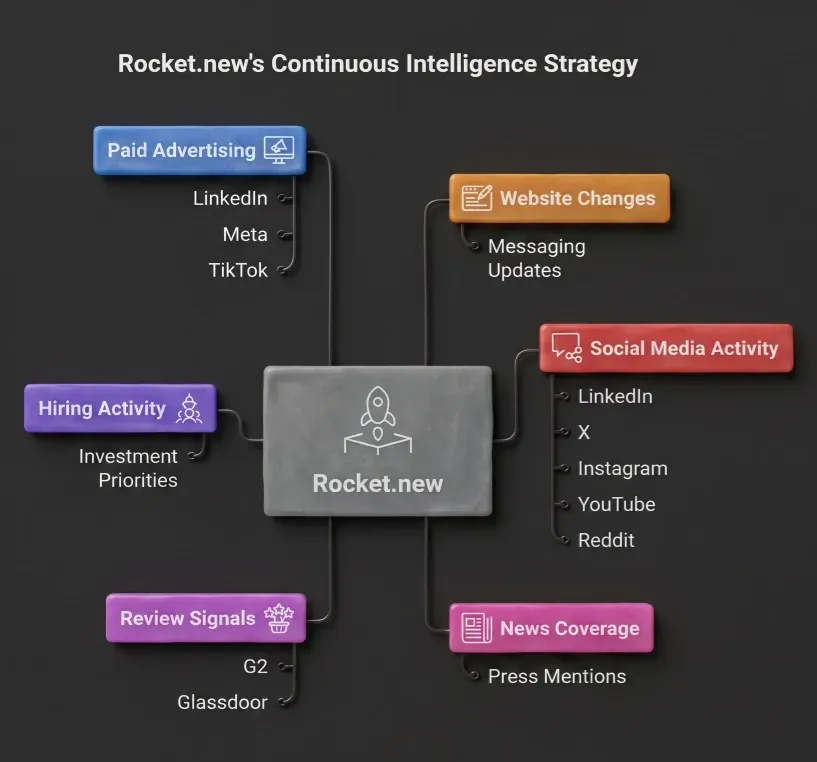 The platform transforms scattered market signals into a continuous intelligence stream teams can actually use.
Daily Competitive Briefs as Decision Support
Every morning, Rocket.new delivers structured competitive briefs that explain:
-
What changed
-
Why it matters
-
What teams should monitor next
-
Recommended strategic actions
This turns continuous intelligence into an active decision support system rather than a collection of disconnected alerts and dashboards.
Signal Clustering Instead of Isolated Alerts
Rocket.new does not treat every signal separately. It connects related changes to identify strategic movement patterns.
For example:
-
A pricing page update alone may mean little
-
A pricing update combined with enterprise sales hiring and defensive G2 responses signals a stronger market repositioning strategy
The platform reads these signal clusters automatically to provide clearer competitive context.
Intelligence That Builds Context Over Time
Because Intelligence operates inside shared projects, insights compound continuously across workflows and team collaboration.
A competitor signal discovered today can directly inform:
-
Product research
-
Strategic planning
-
Marketing decisions
-
Sales positioning
-
Future Solve and Build workflows inside Rocket.new
The intelligence system evolves continuously instead of resetting with every new report.
Where Traditional Competitive Tools Fall Short
Most traditional BI and competitive monitoring platforms focus on data collection alone. They provide dashboards, alerts, and raw monitoring feeds but leave the interpretation work entirely to internal teams.
The challenge is that most businesses cannot manually process dozens of signals across multiple platforms every morning and convert them into fast strategic decisions.
Tools like Klue or Crayon generate alerts. Rocket.new focuses on helping teams understand what those alerts actually mean for product strategy, customer positioning, campaigns, and market response.
That difference becomes critical when competitive speed directly affects business outcomes.
The Real Case for Continuous Intelligence in 2026
The shift toward continuous intelligence is happening because businesses can no longer afford delayed visibility in fast-moving markets.
-
Quarterly reporting: Explains what already happened instead of what is changing now
-
Real-time decision making: Helps teams respond while opportunities and risks are still developing
-
Stale data: 80% of organizations still rely on outdated information for important business decisions
-
Revenue impact: 73% of leaders report financial losses caused by slow decision-making cycles
-
Competitive advantage: Continuous intelligence platforms help businesses move faster than traditional reporting systems
-
Market growth: The continuous intelligence platform market is growing at 21% annually as companies prioritize live operational visibility
-
Operational speed: Organizations using continuous intelligence reduce delays across strategy, monitoring, and execution workflows
The companies leading in 2026 are not necessarily the ones with the most data. They are the ones turning live data into immediate action while competitors are still waiting for the next quarterly report.
Why Continuous Intelligence Is Becoming a Competitive Advantage
Continuous intelligence is becoming essential for businesses that want to make faster, smarter, and more accurate decisions in real time. Instead of relying on delayed reports and outdated dashboards, organizations are shifting toward live analytics, streaming data, and machine learning systems that continuously monitor operational and market changes.
The biggest advantage of continuous intelligence is speed. Teams can detect risks earlier, respond to customer behavior faster, and make decisions while situations are still evolving instead of reacting after opportunities are gone. Businesses that adopt continuous intelligence now will operate with a major strategic advantage as markets continue moving faster.
Rocket.new helps teams run continuous intelligence workflows by combining real-time monitoring, AI-powered research, and fast execution inside one connected platform.
Table of contents
- -What is Continuous Intelligence?
- -What Makes Continuous Intelligence Different?
- -Why Traditional BI Falls Short in 2026?
- -How a Continuous Intelligence Platform Works?
- -The Data Analysis Process: From Stream to Signal
- -Key Benefits of Implementing Continuous Intelligence
- -Faster Business Decisions
- -Predictive Maintenance Before Failures Happen
- -Fraud Detection in Real Time
- -Customer Experience at Scale
- -Continuous Intelligence vs. Traditional BI: A Direct Comparison
- -Machine Learning Behind Continuous Intelligence
- -What Machine Learning Helps Detect
- -The Cost of Staying on Quarterly Reports
- -Rocket.new: Built for Continuous Intelligence
- -Continuous Monitoring Across Multiple Signals
- -Daily Competitive Briefs as Decision Support
- -Signal Clustering Instead of Isolated Alerts
- -Intelligence That Builds Context Over Time
- -Where Traditional Competitive Tools Fall Short
- -The Real Case for Continuous Intelligence in 2026
- -Why Continuous Intelligence Is Becoming a Competitive Advantage