
An AI-powered competitive intelligence tool that moves beyond data collection by interpreting signals, helping businesses detect market trends, anticipate competitor actions, and make faster, more informed strategic decisions with greater clarity and confidence.
Why do some tools only collect data while AI tools interpret signals?
The difference comes from how modern systems handle competitive intelligence and support strategic decisions. Instead of dumping raw data into dashboards, today’s AI tools read patterns, connect signals, and highlight what matters across the market. They analyze behavior, not just numbers.
According to Gartner, AI is expected to reshape data and analytics and play a major role in decision-making across organizations. That shift leads to sharper competitive analysis, quicker insights, and stronger outcomes for sales teams and marketing teams.
See how modern tools turn data into meaningful insights and how to apply them for smarter decisions in a competitive market.
Why Traditional Competitive Intelligence Falls Short?
Let’s be real. Old-school competitive intelligence was mostly about collecting data and hoping someone had time to analyze it.
Teams relied on:
-
Manual research
-
Scattered data sources
-
Messy spreadsheets
That often led to too much raw data and not enough insights, making it harder to understand competitors and take meaningful action.
From Data Collection to Signal Interpretation
This is where AI powered competitive intelligence starts to make a real difference. Instead of just tracking competitors,
Modern systems interpret behavior across:
-
Social media
-
Pricing pages
-
Product launches
-
Earnings calls
-
Hiring signals
-
Why did competitors change pricing?
-
What does this mean for competitive positioning?
-
How should sales workflows adapt?
AI agents scan multiple sources and turn market data into competitive insights, turning basic tracking into deeper competitive analysis.
How AI Agents Power Smarter Competitive Intelligence
AI agents are doing the heavy lifting now. Not just collecting competitor updates, but actually understanding them.
Here’s how AI agents work in competitive intelligence tools:
| Function | What It Does |
|---|---|
| Data Processing | Collects and organizes data from multiple data sources |
| Natural Language Processing | Reads product documentation, reviews, and sales calls |
| Sentiment Analysis | Understands tone from customer feedback and social media |
| Predictive Analytics | Anticipates competitor moves and deal outcomes |
| Insight Generation | Turns patterns into actionable insights |
These AI agents don’t stop at data. They deliver insights that guide strategic decision making and yes, that means less manual research and more time closing competitive deals.
Why Sales Teams Care About Competitive Intelligence?
Sales teams are constantly navigating competitive deals, where quick answers and clear positioning can make or break outcomes.
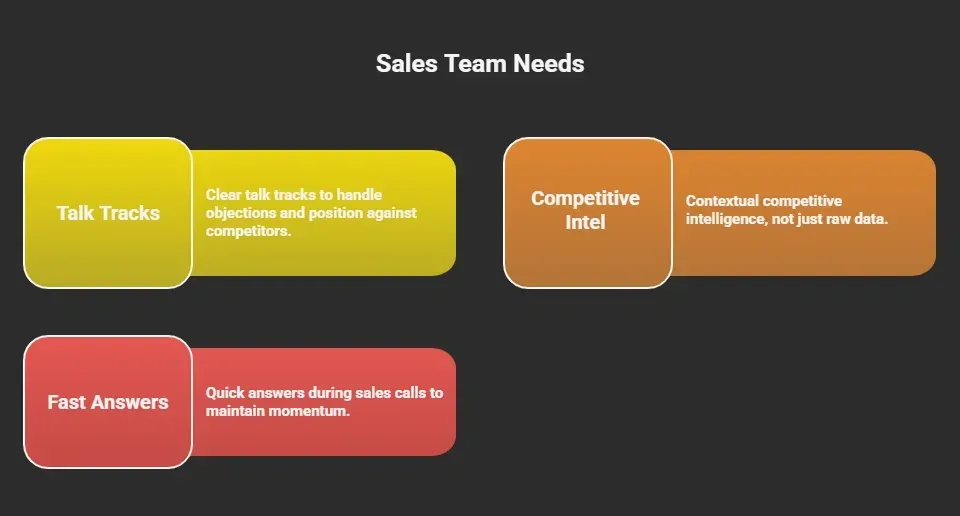 Without strong competitor analysis, deals often slip away.
AI tools help sales teams:
-
Compare feature sets in a way that highlights strengths and gaps
-
Adjust messaging based on real competitor behavior
-
Win more deals by improving positioning in competitive deals
With real-time competitive insights, sales enablement improves, and stronger deal outcomes start getting leadership attention.
How Marketing Teams Use Competitive Intelligence?
Marketing teams rely on competitive intelligence to stay aligned with what competitors are doing and how the market is shifting.
They use marketing intelligence to:
-
Campaign refinement: Adjusting messaging and targeting based on competitor activity
-
Social media tracking: Monitoring how competitors engage audiences across social media
-
Product launch analysis: Understanding how competitors position new releases
-
Competitor positioning: Identifying how competitors present themselves in the market
-
Audience sentiment: Reading how customers react to competitors and trends
-
Content gaps: Spotting missed opportunities in competitor content strategies
This approach leads to sharper messaging, smarter decisions, and a stronger market presence.
The Role of Data in Modern Competitive Intelligence
Data is everywhere. But not all data is useful. Modern AI powered tools filter relevant data from noise.
They gather data from:
-
Social media
-
CRM systems
-
Quarterly reports
-
Google alerts
-
Product documentation
Then AI agents process that data into insights.
So instead of drowning in raw data, teams get a holistic view of the market and that’s what helps companies stay ahead.
Competitive Intelligence vs Competitor Analysis
People mix these up a lot, but each plays a different role in understanding competitors and the market.
-
Competitor analysis: Focuses on studying specific competitors in detail
-
Competitive intelligence: Looks at the broader market environment and patterns
Both matter.
Competitor monitoring provides detailed insights into competitors, while competitive intelligence integrates those insights into strategic planning and supports better-informed decisions.
A Smarter Way to Read Competitive Signals: Rocket.new
Rocket Intelligence focuses on interpreting signals, not just collecting them. It helps teams move from raw data to meaningful insights.
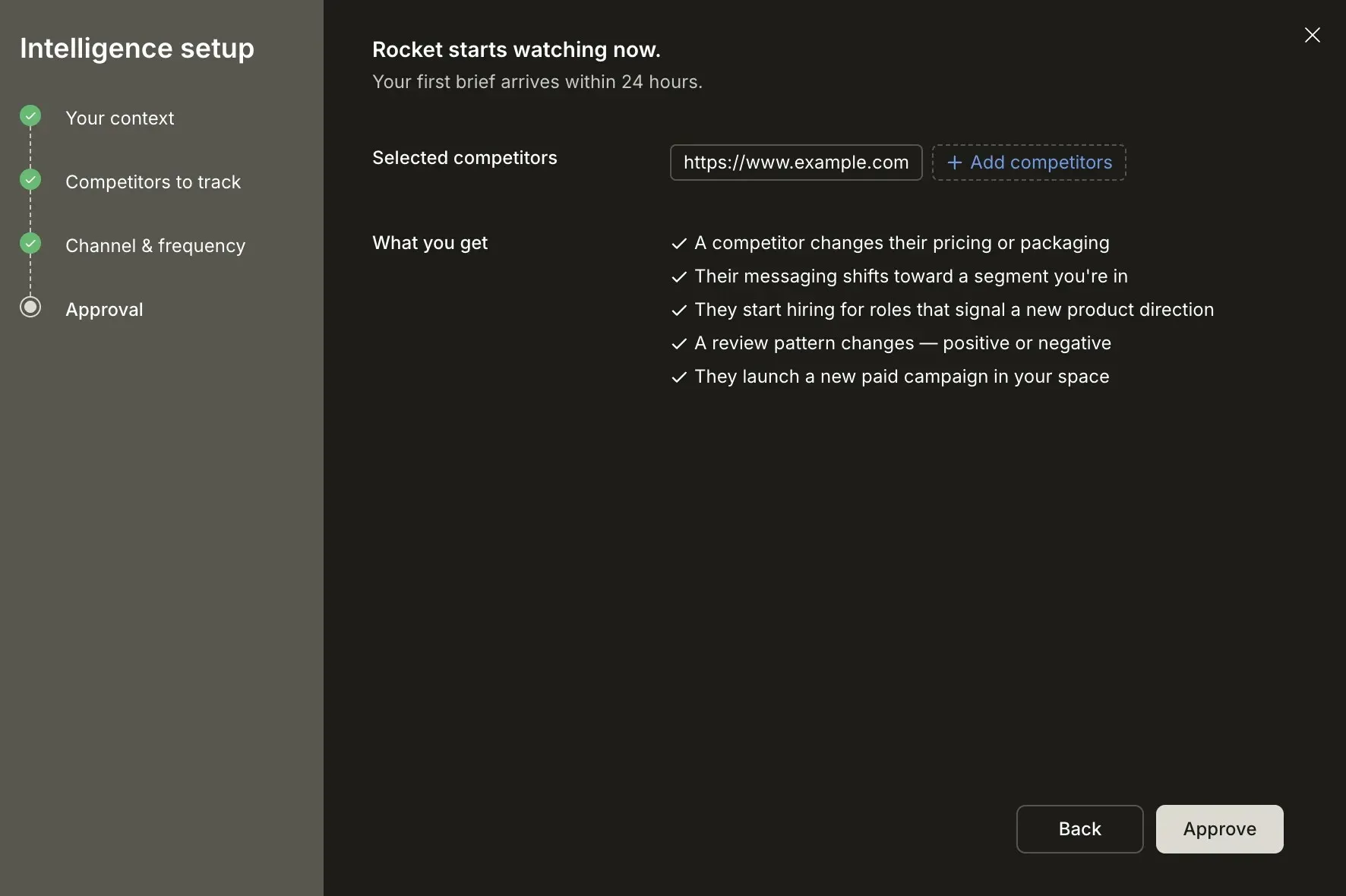
How Rocket Works?
Rocket uses AI agents and generative AI to process:
-
Competitor updates
-
Market data
-
Customer feedback
-
Sales calls
It connects multiple data sources and produces AI summaries. So instead of checking multiple tools like Google Alerts and other tools, teams get one clear view of what’s happening.
Key Features of Rocket Intelligence
-
AI powered insight generation for faster understanding
-
Competitor monitoring across different platforms
-
Sentiment analysis from social media conversations
-
Predictive analytics to understand deal outcomes
-
Tracking hiring signals and product launches
-
Integration with CRM systems for better sales workflows
-
AI features that support competitive deals
-
Automated quarterly reports for ongoing monitoring
Rocket is team-focused and helps decision makers act on actionable insights with confidence.
How Rocket Supports Modern Competitive Intelligence
Rocket aligns with how companies are shifting toward AI powered competitive intelligence and smarter ways of working with data.
Here’s how it contributes:
-
Manual research reduction: replaces time-consuming efforts with automated data processing
-
Signal interpretation: uses AI agents to read patterns instead of just collecting data
-
Decision support: turns competitive intel into clear strategic decisions
-
Sales impact: helps sales teams handle competitive deals with more confidence
All of this helps companies move from simple data collection to meaningful insight generation.
Why Companies Are Moving Toward AI Competitive Intelligence
Companies are shifting toward AI-driven approaches because they want faster insights and better decisions.
They are moving away from and toward:
-
Slow market research replaced by faster analysis using machine learning
-
Scattered data organized into structured, usable information
-
Outdated reports replaced by real-time updates
-
Manual effort reduced through automated insight generation
-
Delayed reactions improved with quicker responses to competitors
-
Limited visibility expanded with better support for strategic planning
This shift leads to stronger competitive positioning and better market performance.
Choosing the Best Tools for Competitive Intelligence
Not all tools are the same.
When choosing competitive intelligence tools, look for:
-
AI powered capabilities
-
Real-time competitor monitoring
-
Insight generation features
-
Integration with sales workflows
Tools like Rocket stand out because they focus on interpretation. That’s what separates basic tools from the best tools.
The Future of Competitive Intelligence
Competitive intelligence is moving toward automation and interpretation.
AI agents will:
-
Analyze more data
-
Deliver insights faster
-
Support decision makers
Companies that adopt AI powered tools will gain a competitive advantage. Those who rely on manual research will fall behind.
AI Competitive Intelligence Tool That Interprets Signals
Competitive intelligence once focused on collecting data, relying heavily on manual research, scattered data sources, and slow analysis. That made it difficult for teams to understand competitors and respond quickly. An AI Competitive Intelligence Tool changes that by using AI agents, machine learning, and natural language processing to interpret signals. Instead of raw data, teams get clear insights that support strategic decisions, sales enablement, and competitive deals.
Companies don’t need more data, they need better insights. When competitive intelligence tools focus on interpretation, teams move faster and make smarter decisions. The shift is simple: less collection, more understanding.
Want to move from scattered data to real insights? Check out Rocket.new to see how AI can simplify your competitive intelligence workflow.
Table of contents
- -Why Traditional Competitive Intelligence Falls Short?
- -From Data Collection to Signal Interpretation
- -How AI Agents Power Smarter Competitive Intelligence
- -Why Sales Teams Care About Competitive Intelligence?
- -How Marketing Teams Use Competitive Intelligence?
- -The Role of Data in Modern Competitive Intelligence
- -Competitive Intelligence vs Competitor Analysis
- -A Smarter Way to Read Competitive Signals: Rocket.new
- -How Rocket Works?
- -Key Features of Rocket Intelligence
- -How Rocket Supports Modern Competitive Intelligence
- -Why Companies Are Moving Toward AI Competitive Intelligence
- -Choosing the Best Tools for Competitive Intelligence
- -The Future of Competitive Intelligence
- -AI Competitive Intelligence Tool That Interprets Signals