
15 copy-paste AI prompts covering audience segmentation, competitor analysis, pricing strategy, and market demand validation. Run them before you build to cut weeks of research into hours.
The best AI prompts for market research help founders validate ideas in hours, not weeks. With 72% of insights teams now using generative AI, the right market research prompts collapse months of manual analysis into a single focused session before you write a line of code.
According to Greenbook's 2025 GRIT Business Report, 72% of insights buyers now use generative AI in at least one stage of a research project, up from 23% in 2023. That is a staggering shift.
The gap between founders who validate fast and those who spend months on manual market analysis keeps growing. The right prompts for market analysis turn AI from a generic chatbot into a senior market research analyst working on your specific problem.
Why AI Changes Pre-Build Research Forever
The old way of doing market research required focus groups, paid surveys, and weeks of waiting for results. AI flipped that ratio completely.
- 90% of research time now goes to strategy instead of data collection, according to Stratega Research's 2026 guide
- A senior market research analyst used to spend 80% of their week gathering data; now that same analyst spends it on market overview interpretation and decision-making
- The global AI market hit $390.9 billion in 2025, and market research tools represent one of its fastest-growing segments
- Traditional focus groups cost $6,000-$12,000 per session and take 4-6 weeks to schedule, while AI-powered prompts for market research deliver comparable insights in a single afternoon
Here is what the shift looks like in practice (cost figures are estimated typical ranges based on industry benchmarks):
| Factor | Traditional Research | AI-Powered Prompts |
|---|---|---|
| Time to first insight | 4-8 weeks | 1-2 hours |
| Cost per project (estimated) | $15,000-$50,000 | Under $500 |
| Market overview depth | Single geography | Global, multi-market |
| Industry trends coverage | Quarterly updates | Real-time analysis |
| Iteration speed | New study per question | Follow-up in seconds |
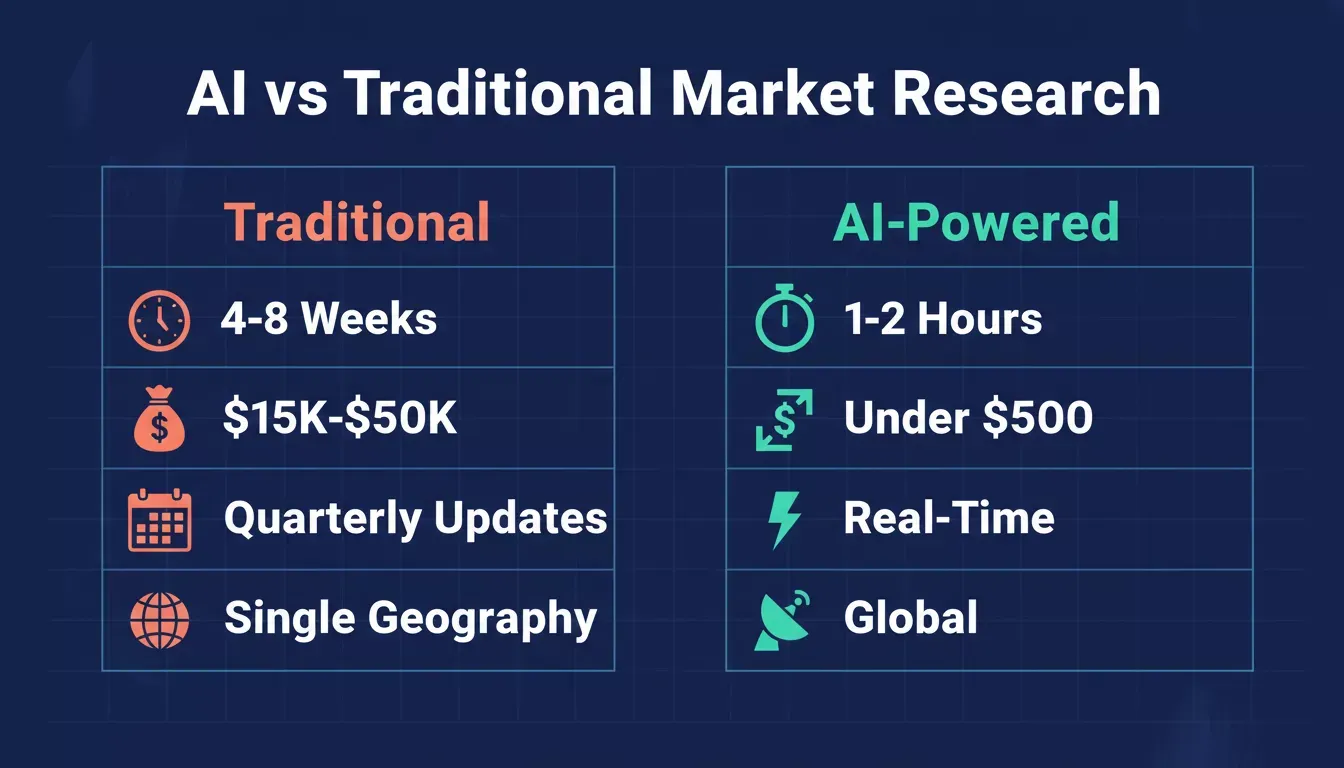
AI-powered market research delivers faster, broader, and more affordable insights than traditional methods
The difference is not just speed. It is the ability to run continuous market research instead of point-in-time snapshots. Teams that validate business ideas on Rocket before building report, cutting their pre-launch research phase from months to days.
Can AI prompts replace traditional market research entirely?
AI prompts for market analysis work best as a rapid first pass, not a complete replacement for all traditional methods. They significantly accelerate competitor analysis and market overview creation. For sensitive decisions involving large budgets, pair prompt-driven market research with customer interviews and actual market responses to validate findings.
Which Prompts Help You Understand Your Target Audience?
The strongest market analysis starts with knowing exactly who will pay for your product. Most founders skip this step or rely on assumptions that crumble on contact with actual buyers.
Prompt 1: Audience Segmentation Prompt
Identify the highest-value customer segments for your product before you build a single feature.
Example prompt:
"Act as a senior market research analyst. Identify the top 5 customer segments for [your product category] based on demographics, purchasing behavior, and pain points. For each segment, estimate market demand, willingness to pay, and brand perception toward existing solutions."
How it is used: Paste this with your specific product category filled in. The AI will produce:
- A ranked list of customer segments with demographic profiles
- Willingness-to-pay estimates and market demand signals per segment
- Brand perception gaps that reveal where existing solutions fall short
Common mistake: Founders describe their product category too broadly. "Software" returns generic segments. "Project management software for freelance UX designers" returns actionable ones. The more specific the category, the more useful the output.
Prompt 2: Behavioral Mapping Prompt
Surface what your target audience actually does today, not what they say they want.
Example prompt:
"Analyze how my target audience currently solves [specific problem]. What tools do they use? What do they complain about in forum discussions and reviews? Identify the top 3 unmet needs and emerging trends in their behavior over the past 12 months."
How it is used: Replace [specific problem] with the exact pain point your product addresses. The AI will produce:
- A breakdown of current workarounds and tools your audience relies on
- Recurring complaints pulled from forum and review data
- The top unmet needs ranked by frequency and emotional intensity
Prompt 3: Focus Group Simulation Prompt
Run a virtual focus group session in minutes without scheduling, recruiting, or paying participants.
Example prompt:
"Simulate a focus group discussion with 8 participants matching [your target audience profile]. Have them react to [your product concept]. Capture their objections, excitement triggers, and price sensitivity. Focus on what consumers drive market trends in this category."
How it is used: Fill in your audience profile and product concept. The AI will produce:
- Simulated participant reactions covering objections and enthusiasm
- Price sensitivity signals that inform your pricing strategy
- Consumer-driven market trend patterns relevant to your category
What a real output looks like: The AI typically returns a structured dialogue format with named participant archetypes (e.g., "Sarah, 34, freelance designer"), each reacting differently to your concept. This gives you a fast read on which objections are universal versus segment-specific.
Prompt 4: Brand Perception Audit Prompt
Map where competitors own the market narrative and find the positioning gap no one has claimed yet.
Example prompt:
"Map brand perception for the top 5 players in [your industry]. What do customers associate with each brand? Where does brand perception misalign with the actual product? Identify market gaps where no brand owns the positioning I want."
How it is used: Specify your industry and the AI will produce:
- A brand association map for each major competitor
- Perception gaps where customer expectations and product reality diverge
- Open positioning territory you can own from day one
Each of these prompts for market research produces different layers of insight. The audience segmentation prompt helps you find your most valuable market segments. The behavioral mapping prompt surfaces what your target audience actually does today.
Together, they give you a market overview that used to require hiring a consultant for three months.
One thing to keep in mind: AI generates insights based on patterns in available data. Cross-reference your findings with real customer conversations and actual market responses to build confidence before committing resources.
For structured guidance on framing research questions that get sharper outputs, prompt engineering best practices make a measurable difference in output quality.
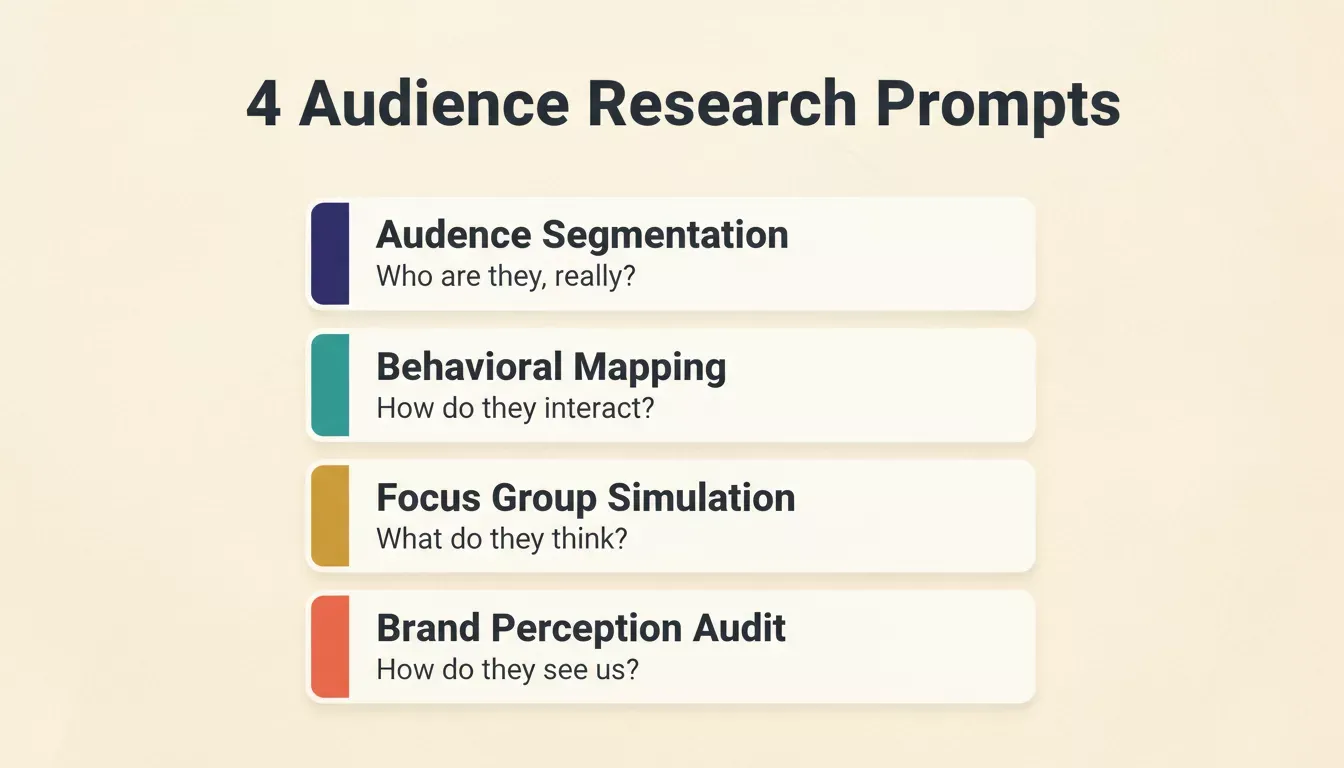
The four audience research prompts and what each one is designed to surface
Ready to run these prompts? Paste any of the four above into Rocket and get structured audience intelligence in minutes. Start your audience research now!
How Can Competitor Analysis Prompts Reveal Hidden Opportunities?
Good competitor analysis is about finding where your direct and indirect competitors leave money on the table. These prompts help you significantly accelerate competitor analysis without spending weeks on manual research.
Prompt 5: Competitive Mapping Prompt
Build a full competitive matrix across pricing, positioning, and customer satisfaction in one pass.
Example prompt:
"Identify my direct and indirect competitors in [your market]. For each competitor, analyze: market positioning, pricing strategies, market share estimates, and customer satisfaction scores from public reviews. Present as a comparison matrix."
How it is used: Fill in your market and the AI will produce:
- A structured comparison matrix of direct and indirect competitors
- Pricing strategy breakdowns showing where each competitor sits on the value spectrum
- Customer satisfaction scores that reveal where rivals are losing ground
Prompt 6: Weakness Detection Prompt
Turn competitor negative reviews into your product's strongest differentiators.
Example prompt:
"Analyze negative customer reviews for [Competitor A, B, C]. What recurring complaints appear? Where do these competitors underperform relative to their pricing? Detect potential market gaps that their weaknesses represent."
How it is used: Name your top three competitors and the AI will produce:
- A ranked list of recurring complaints by frequency and severity
- Underperformance gaps relative to each competitor's price point
- Market gaps that represent direct product opportunities for you
Common mistake: Founders name only their most obvious direct competitors. Include at least one indirect competitor, a different product solving the same problem in a different way. Their weaknesses often reveal the most valuable positioning gaps.
Rocket's competitive teardowns feature in Solve automates this process with structured SWOT analysis and competitor positioning maps.
Prompt 7: Strategic Moves Tracker Prompt
Predict where your competitors are heading before they announce it publicly.
Example prompt:
"Review recent product launches, hiring patterns, and partnership announcements from [top 3 competitors]. What do these moves signal about their strategy for the next 12 months? How might these impact existing market leaders in [your industry]?"
How it is used: Name your competitors and industry and the AI will produce:
- A signal-by-signal breakdown of recent competitor activity
- Strategic intent analysis connecting hiring and launch patterns to likely roadmap moves
- Impact assessment showing how these moves shift the competitive landscape
Prompt 8: Market Share Analysis Prompt
Understand which competitors are gaining ground and why before you enter the market.
Example prompt:
"Compare market share shifts among the top 5 players in [your industry] over the past 3 years. Which competitors are gaining ground? Which are losing? What industry trends correlate with these shifts?"
How it is used: Specify your industry and the AI will produce:
- A three-year market share trajectory for each major player
- Trend correlations explaining why certain competitors are winning or losing
- Timing signals that tell you whether the market is consolidating or still open
The power here is that you can analyze multiple competitors simultaneously, something that would take a research team weeks of manual competitor research. These prompts for market analysis help you build a competitive picture that shows not just where competitors are today, but where they are heading. For a deeper look at how competitive intelligence connects to product strategy, the signals that matter most are rarely the obvious ones.
Competitor analysis workflow: five steps from mapping to positioning
"I've used the following AI prompts to support my market research efforts and found them quite effective. I typically run these queries using ChatGPT, Gemini, and Perplexity conversational AI tools." — Dean Reid, market research practitioner and author of the LinkedIn series Market Research with AI
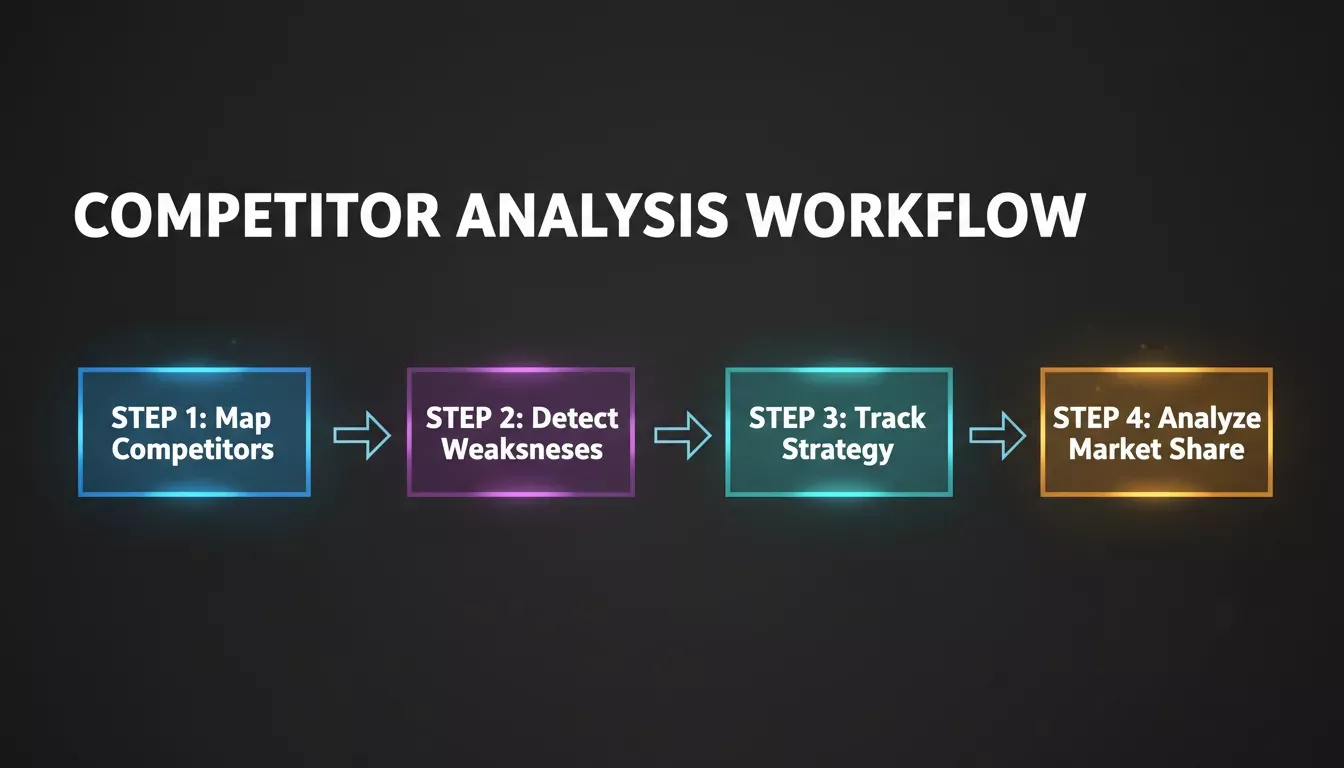
The four competitor analysis prompts that reveal hidden market opportunities
Run these competitor prompts in Rocket and get a full competitive picture before you write your positioning statement. Map your competitive landscape!
What Pricing Strategy Prompts Should You Run Before Launch?
Pricing wrong costs more than building wrong. These prompts for market research help you analyze pricing models across your category before you commit to a number.
Prompt 9: Pricing Analysis Prompt
Scan every pricing model in your category and find the segment where a new entrant can win on value.
Example prompt:
"Act as an experienced pricing strategist. Analyze pricing strategies used by competitors in [your market]. Compare SaaS pricing models including freemium, tiered, and usage-based. Identify overpriced market segments where a new entrant could win on value. Include competitor promotional pricing tactics and seasonal patterns."
How it is used: Fill in your market and the AI will produce:
- A side-by-side comparison of freemium, tiered, and usage-based pricing models in your space
- Overpriced segments where customers are paying more than the value delivered
- Seasonal and promotional pricing patterns that reveal how competitors defend market share
Prompt 10: Price Sensitivity Prompt
Understand how much customers in different regions will actually pay before you publish a pricing page.
Example prompt:
"Analyze regional price sensitivity for [your product type] across North America, Europe, and Asia. How do psychological pricing factors influence buying decisions in each region? What pricing strategies correlate with the highest customer retention rates?"
How it is used: Specify your product type and the AI will produce:
- Regional price sensitivity benchmarks across three major markets
- Psychological pricing factors that drive or block purchase decisions by geography
- Pricing strategy patterns correlated with the highest long-term retention rates
What a real output looks like: Expect a table or structured breakdown per region, noting that North American buyers often respond to annual billing discounts while European buyers are more sensitive to per-seat pricing. These regional nuances directly inform how you structure your pricing page.
Prompt 11: Value-Based Pricing Framework Prompt
Build a pricing architecture grounded in what customers gain, not what your product costs to build.
Example prompt:
"Help me design pricing strategies for [your product]. Compare pricing strategies that emphasize value versus cost-plus pricing. What premium pricing strategy signals work for [your category]? Identify where designing efficient pricing strategies can create both entry and competitive advantages."
How it is used: Fill in your product and category and the AI will produce:
- A value-versus-cost-plus pricing comparison tailored to your product
- Premium pricing signals that your category's customers already respond to
- Entry-level and competitive pricing structures that create durable market advantages
The pricing strategy research prompt is particularly useful because it forces you to think about market positioning before you set a price. Too many founders pick a number based on gut instinct rather than on what the market analysis actually shows.
Rocket's pricing strategy research capability in Solve benchmarks competitor pricing and evaluates willingness to pay with structured reports, not guesswork.
A good pricing prompt also reveals how rivals use discounting approaches to capture market share, whether seasonal discounts increase conversions without devaluing the brand, and which price points attract the right customer segments for long-term growth.
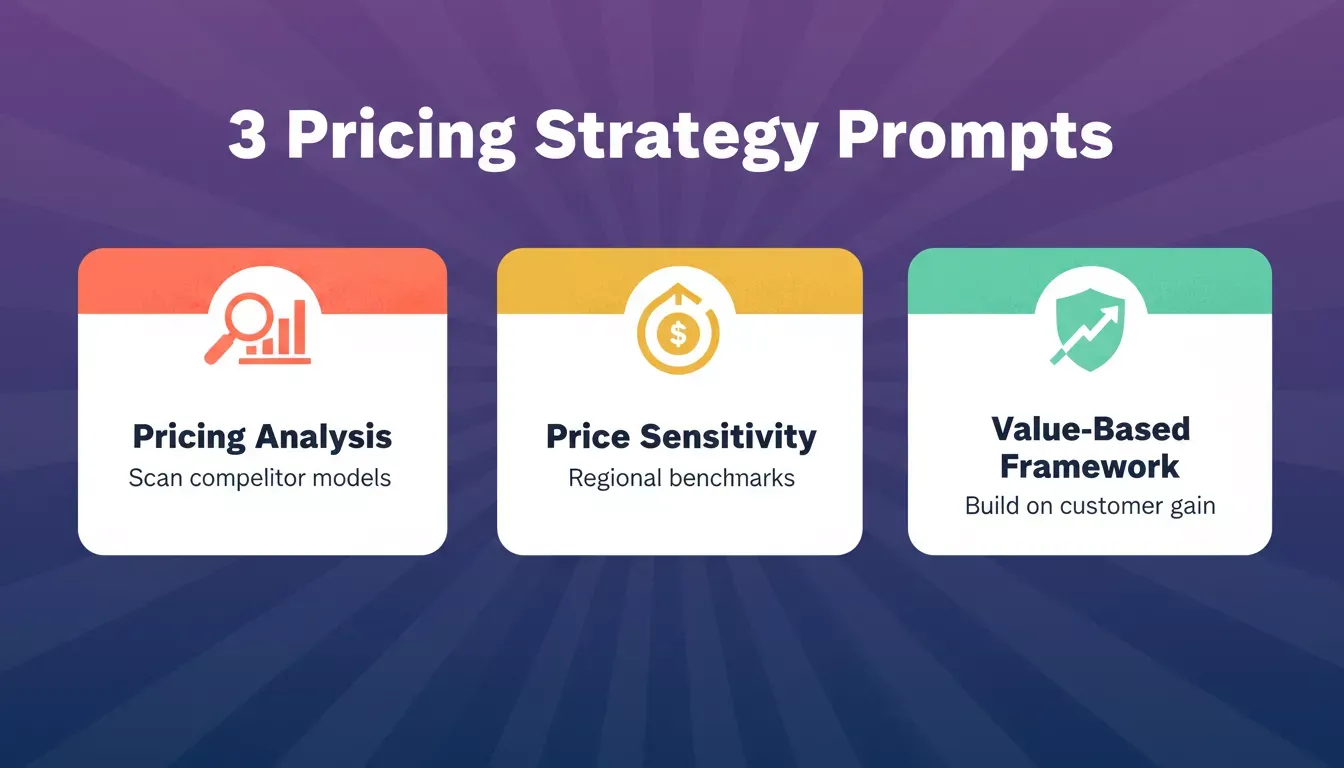
The three pricing prompts that tell you what the market will actually pay before you set a price
Use these pricing prompts in Rocket to build a data-backed pricing strategy before your first customer conversation. Build your pricing strategy
How Do You Validate Market Demand With AI Before Committing?
Identifying industry trends is one thing. Proving that enough people will actually pay for your solution is another. These prompts help you validate market demand before you invest serious time.
Prompt 12: Demand Signals Prompt
Quantify whether real market demand exists for your idea before writing a single line of code.
Example prompt:
"Analyze market demand signals for [your product idea]. Look at search volume trends, forum discussions about the problem, industry growth trends, and recent venture capital investments in adjacent solutions. Structure market estimates using TAM, SAM, and SOM frameworks."
How it is used: Fill in your product idea and the AI will produce:
- A demand signal summary covering search trends, forum activity, and VC investment patterns
- TAM, SAM, and SOM market size estimates grounded in real data
- Growth trajectory indicators showing whether demand is accelerating or plateauing
Prompt 13: Trend Validation Prompt
Separate genuine market shifts from short-term hype before you bet your build on a trend.
Example prompt:
"Identify market trends in [your industry] over the past 24 months. Distinguish between emerging trends with staying power and short-term hype. What market trend identification data points (keyword growth, patent filings, startup funding) suggest this trend will hold for the next 3 years?"
How it is used: Specify your industry and the AI will produce:
- A 24-month trend timeline separating durable shifts from temporary spikes
- Multi-signal validation using keyword growth, patent activity, and funding data
- A three-year durability forecast for each trend identified
Common mistake: Running this prompt once and treating the output as final. Trend signals shift quickly. Run this prompt again after your MVP launches to check whether the market has moved since your initial research.
Prompt 14: Risk Assessment Prompt
Map every threat to your market entry before you commit resources to building.
Example prompt:
"What are the top 5 risks of entering [your market] right now? Consider regulatory changes, emerging trends that could make my approach obsolete, shifts in consumer preferences, and potential market gaps that might close before I launch. For each risk, suggest a mitigation approach."
How it is used: Name your target market and the AI will produce:
- A ranked list of the top five market entry risks with severity ratings
- Regulatory, competitive, and behavioral risk factors specific to your space
- A mitigation approach for each risk you can act on before launch
Prompt 15: Market Growth Forecasting Prompt
Build a defensible five-year market growth projection grounded in real industry signals.
Example prompt:
"Help me forecast market growth for [your niche] over the next 5 years. What key industry developments could accelerate or slow adoption? Where should I adjust growth projection range estimates based on current market demand data?"
How it is used: Fill in your niche and the AI will produce:
- A five-year market growth forecast with high, base, and low scenario ranges
- Key industry developments that could accelerate or decelerate adoption
- Demand-adjusted projection ranges that account for current market signals
These prompts for market research give you a strategic market insight into whether your timing is right. Market trend identification prompts are particularly valuable because they help you distinguish between a real shift and a temporary spike.
The best founders do not just identify key trends. They validate their startup ideas with real data before writing code, using AI to extract valuable market trends from dozens of data sources simultaneously. Rocket's market analysis reports in Solve cover market sizing, growth projections, and competitive landscape in one structured output.
When your research confirms market demand, move directly to building. Founders who use AI MVP builders ship validated products while competitors are still writing business plans.
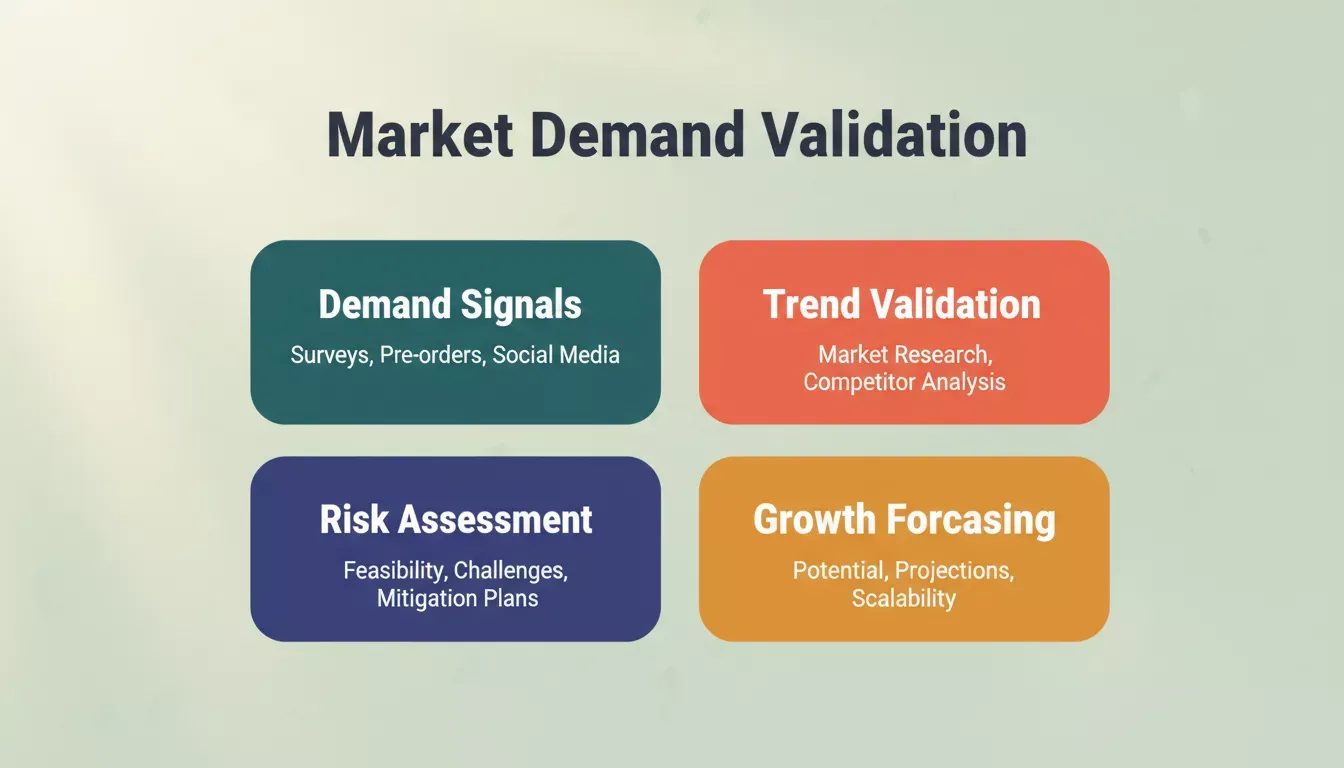
The four demand validation prompts that tell you whether your timing is right before you commit
Run these demand validation prompts in Rocket and get a structured market demand picture before you commit to your build. Validate your market demand!
How Rocket Turns Research Into a Working Product
Most founders finish their market analysis and then face a painful handoff. The research lives in one tool. The product brief lives in another. The actual build happens somewhere else entirely. Context gets lost at each step.
Rocket.new eliminates that gap. It is the only platform where your market research, competitor analysis, and product validation flow directly into a deployed application.
- Research-to-spec pipeline: Feed your prompts for market analysis directly into Rocket's Solve feature, which turns findings into actionable product specifications grounded in real market data
- Competitor-aware building: Rocket's Intelligence layer tracks your competitors continuously across websites, reviews, hiring signals, and ad activity, so the product you build already accounts for market gaps and emerging trends
- Full-stack deployment: Once your market research validates the idea, build and ship your validated startup in days rather than months, with production-ready Next.js or Flutter code
- No context loss: Unlike traditional workflows where market overview findings get summarized into a brief that loses nuance, Rocket retains every insight from research through build via its shared context architecture
Other AI builders start from a blank prompt. They generate code without understanding your target audience, your market positioning, or the competitive environment you are entering. Rocket starts from understanding. The result? Products that reflect what the market actually needs, not just what a founder assumed during a late-night brainstorming session.
Rocket is used by 1.5 million people across 180 countries, from solopreneurs validating their first idea to enterprise teams running strategy and execution on the same platform. For a practical walkthrough of how the full research-to-build loop works, the market entry workflow in Rocket's docs covers every step from Solve through launch.
Ready to stop researching and start shipping? Rocket takes your validated market analysis and turns it into a production-ready product with no handoff, no lost context, and no wasted weeks.
Your Research Is Only as Good as What You Build Next
The right prompts for market research collapse weeks of analysis into focused, high-confidence sessions. They help you understand your target audience, map the competitive environment, set pricing strategies grounded in data, and validate that market demand actually exists for your idea.
But insights without action are just interesting reading material. The gap between knowing what to build and actually building it is where most founders stall.
Ready to stop researching and start shipping? Rocket takes your validated market analysis and turns it into a production-ready product with no handoff, no lost context, and no wasted weeks.
Start building on Rocket for free and go from market research prompts to a deployed product in one connected workflow.
Table of contents
- -Why AI Changes Pre-Build Research Forever
- -Which Prompts Help You Understand Your Target Audience?
- -Prompt 1: Audience Segmentation Prompt
- -Prompt 2: Behavioral Mapping Prompt
- -Prompt 3: Focus Group Simulation Prompt
- -Prompt 4: Brand Perception Audit Prompt
- -How Can Competitor Analysis Prompts Reveal Hidden Opportunities?
- -Prompt 5: Competitive Mapping Prompt
- -Prompt 6: Weakness Detection Prompt
- -Prompt 7: Strategic Moves Tracker Prompt
- -Prompt 8: Market Share Analysis Prompt
- -What Pricing Strategy Prompts Should You Run Before Launch?
- -Prompt 9: Pricing Analysis Prompt
- -Prompt 10: Price Sensitivity Prompt
- -Prompt 11: Value-Based Pricing Framework Prompt
- -How Do You Validate Market Demand With AI Before Committing?
- -Prompt 12: Demand Signals Prompt
- -Prompt 13: Trend Validation Prompt
- -Prompt 14: Risk Assessment Prompt
- -Prompt 15: Market Growth Forecasting Prompt
- -How Rocket Turns Research Into a Working Product
- -Your Research Is Only as Good as What You Build Next