The right AI prompts help product managers cut research, prioritization, and stakeholder alignment from days to minutes. This guide delivers 15 ready-to-use prompts for customer research, competitive analysis, feature prioritization, and faster MVP decisions.
Over 70% of product managers now use AI daily, yet most still spend 66% of their week on manual work. The gap is not the tool, it is the prompt. This guide covers the best AI prompts for product managers building MVPs, with ready-to-use templates for customer research, competitive analysis, feature prioritization, and faster product decisions.
"AI has closed the gap between idea and execution. What used to take a team now takes one DANGEROUS PM with the right tools." — Aamer Khan, Product Manager
Why Do Most Product Teams Waste Hours on Tasks AI Handles in Seconds?
According to ChatPRD's 2026 industry data, over 70% of product managers now use AI-powered tools daily for tasks ranging from data analysis to stakeholder communication. That number was under 40% just two years ago. The gap between PMs who prompt AI well and those who default to manual work is widening fast.
This guide shares 15 prompts designed specifically for product managers at the MVP stage. Each one targets a real decision point: market research, feature prioritization, competitive analysis, or user feedback synthesis. Copy them, customize them, and start shipping faster.
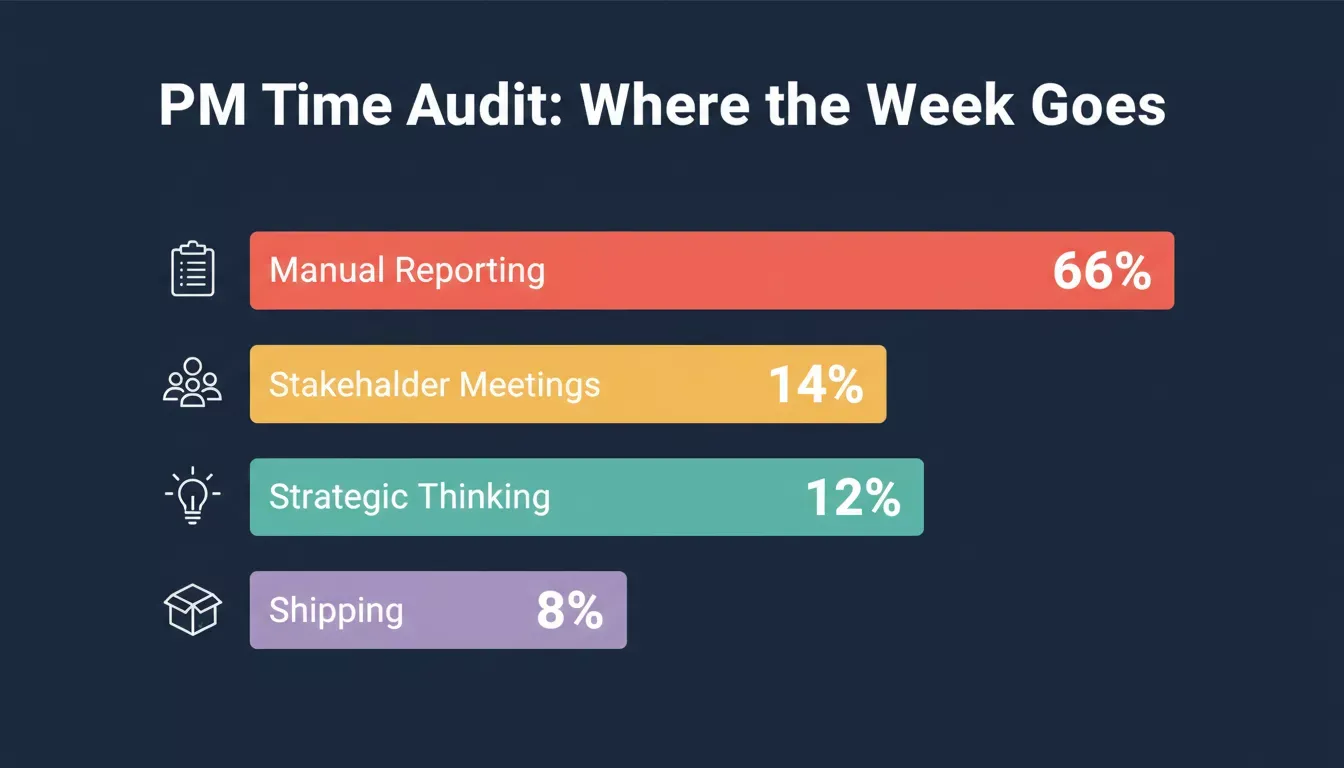
Where the average PM week actually goes, and why AI prompts change the math
How Do AI Prompts Accelerate Product Decision Making?
Every product decision sits on a pile of incomplete information. The right prompts cut through that noise by giving AI the specific context it needs to return structured, useful output.
-
Prompts for strategic thinking help product managers frame big-picture questions. Instead of asking "what should we build?", you prompt AI to analyze your target user's top three pain points based on recent customer reviews and feature requests.
-
Decision-making prompts reduce the time between "we think this matters" and "we have data to confirm it." A well-structured prompt can produce a competitive analysis draft in under a minute, helping teams identify the right path forward.
-
Research prompts let you run market research at the speed of conversation. Feed AI your industry context, and it generates hypotheses about user needs that would take a human analyst days to compile and analyze.
The difference between a vague AI response and actionable insights comes down to prompt structure. Product managers who invest in prompt engineering best practices save time on every decision cycle. You can also explore Rocket.new's prompt library for product managers to see how structured prompts generate production-ready results from the first generation.
The Anatomy of a High-Performing Prompt
Before diving into the prompts, it helps to understand the structure that makes them work. Every prompt in this guide follows the same four-layer pipeline.
| Layer | What to Include | Example |
|---|---|---|
| Role and Context | Your job title and industry | Acting as a senior PM in SaaS... |
| Specific Task | The exact output you need | Analyze these 30 feature requests... |
| Constraints | Budget, timeline, team size | Two-week sprint, two engineers |
| Output Format | How you want the result structured | Output a prioritized table |
The more precisely you fill each layer, the less editing the output needs. Vague inputs produce vague outputs; every prompt below is structured around this principle.
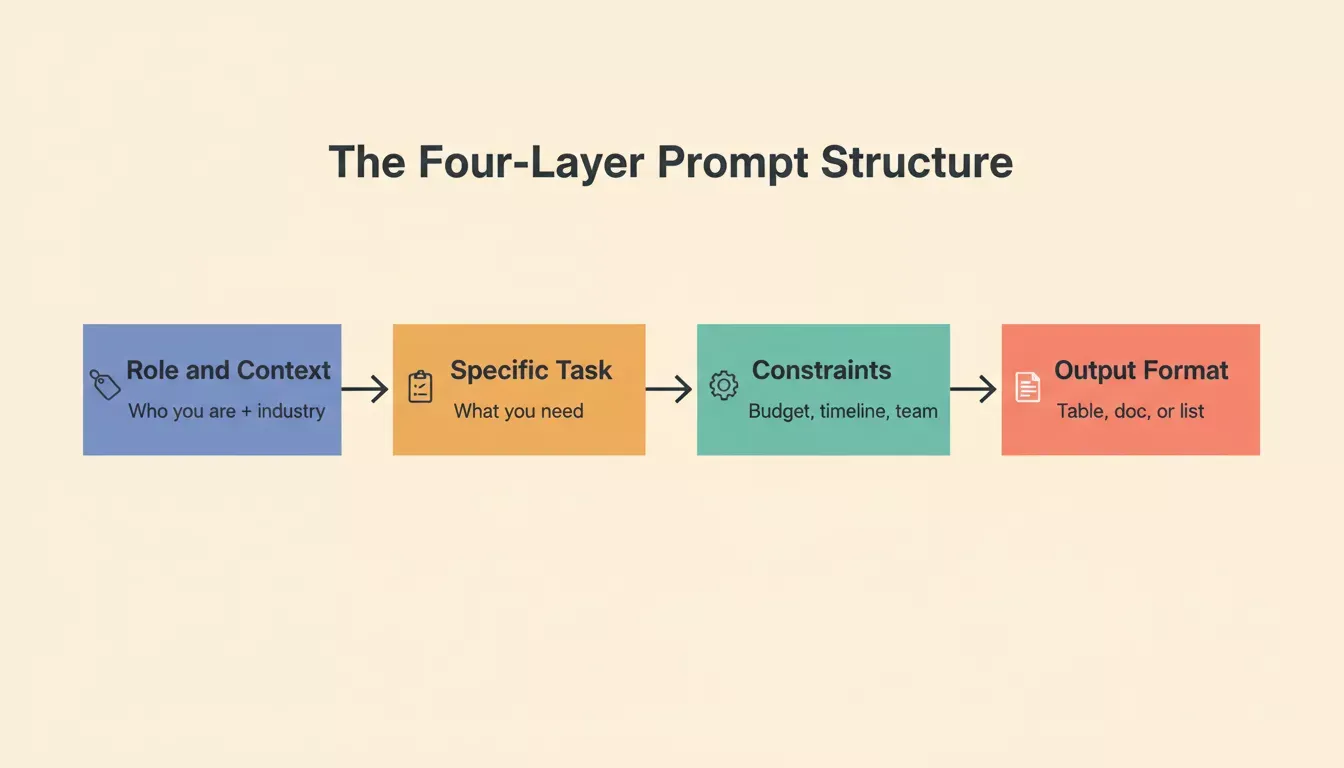
The four-layer prompt structure every PM should use before writing a single word of their prompt
Which Prompts Work for Customer Research and Feedback Analysis?
Customer research used to mean scheduling interviews for weeks and waiting on reports. Now, product managers paste transcripts, survey data, or support tickets into AI and get patterns identified in minutes.
Prompt 1: Feedback Synthesis Prompt
Use this prompt to instantly surface recurring themes and user pain points from raw sprint feedback without manually reading every line.
Example prompt:
"Analyze the following customer feedback from the last sprint review. Identify patterns in feature requests, categorize them by user segment, and flag any recurring pain points that appear more than twice."
The AI will often produce:
-
A categorized breakdown of feedback by user segment
-
A ranked list of recurring pain points with frequency counts
-
Highlighted themes that need immediate product attention
Prompt 2: Sentiment Analysis Prompt
Use this prompt to quickly separate what customers love from what is frustrating them across a batch of reviews or survey responses.
Example prompt:
"Review these recent customer reviews and create a summary of positive themes vs. negative friction points. Highlight which concerns appear in more than 20% of responses."
The AI will often produce:
-
A side-by-side positive vs. negative theme breakdown
-
Percentage-weighted friction points sorted by frequency
-
Actionable signals tied to specific product areas
Prompt 3: User Interview Extraction Prompt
Use this prompt to pull structured product insights from messy interview transcripts without spending hours on manual synthesis.
Example prompt:
"From the attached document containing five user interviews, identify the top three unmet user needs and suggest how each connects to our product roadmap priorities."
The AI will often produce:
-
A prioritized list of unmet user needs with supporting quotes
-
Roadmap connection suggestions for each identified need
-
A gap analysis between what users want and what is currently built
Prompt 4: Feedback Prioritization Prompt
Use this prompt to rank a large backlog of feature requests by impact and effort, so your team can stop debating and start building.
Example prompt:
"Given these 30 feature requests from customers, rank them by frequency, potential impact on retention, and effort to implement. Output a prioritized table."
The AI will often produce:
-
A ranked feature table with frequency, impact, and effort scores
-
A top-tier shortlist of high-impact, low-effort quick wins
-
A deprioritized list of requests that do not justify current investment
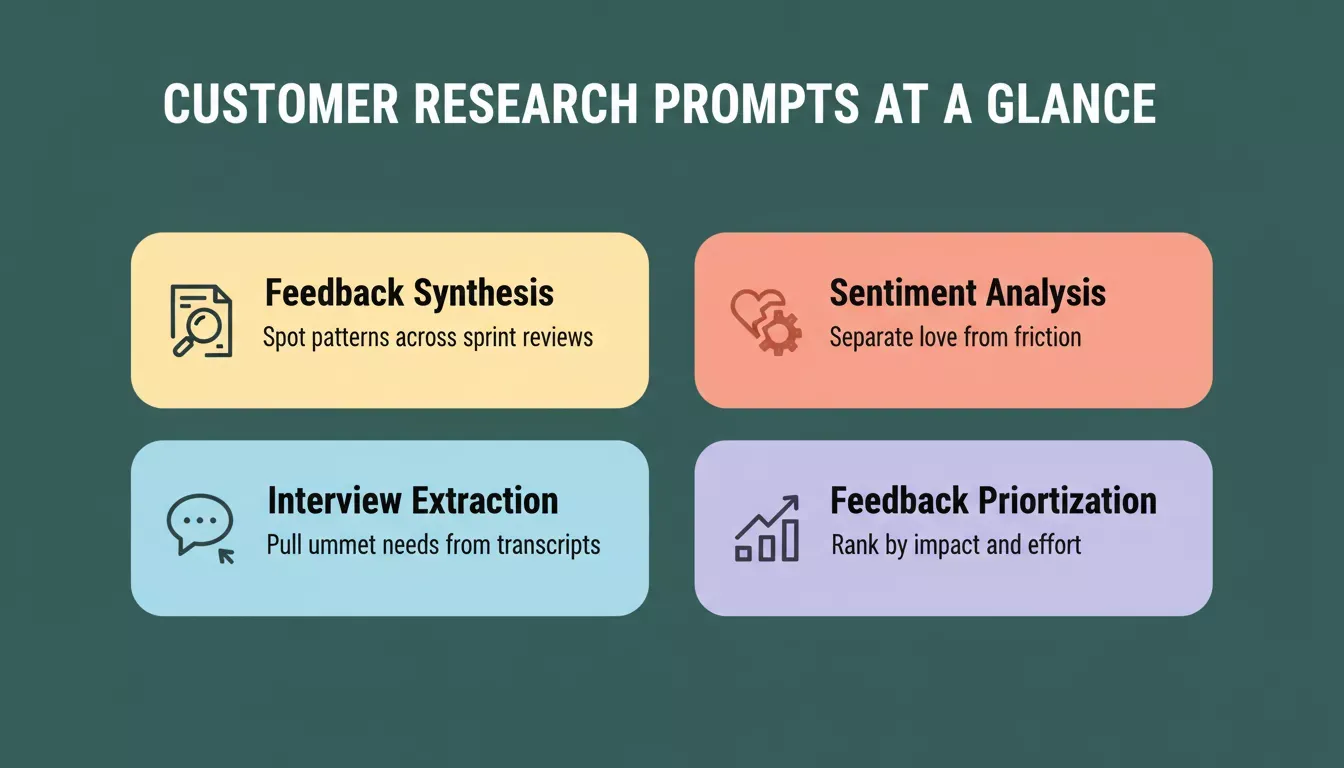
Four customer research prompt types and what each one is built to surface
Airtable's 2026 research found that the average product leader spends more than 66% of their week on manual work, including feedback synthesis. These prompts automate the heavy lifting so PMs can focus on strategic decisions and vibe coding workflows instead.
Ready to run these prompts on your real feedback? Paste any of the four above into Rocket alongside your data and get structured output in under a minute.
What Are the Top Prompts for Competitive Analysis and Market Research?
Your competitors publish pricing changes, ship features, and hire for new roles every week. The right prompts turn those scattered signals into a clear picture of where your industry is heading and what your team should build next.
Prompt 5: SWOT Generation Prompt
Use this prompt to build a structured competitor SWOT in minutes using publicly available data instead of spending days on manual research.
Example prompt:
"Create a SWOT analysis for [competitor name] based on their public product updates, recent blog posts, and customer reviews from G2. Include specific examples for each category."
The AI will often produce:
-
A four-quadrant SWOT table with specific, cited examples per category
-
Identified competitor weaknesses your product can exploit
-
Strategic opportunities mapped to gaps in their current positioning
Prompt 6: Market Trends Summary Prompt
Use this prompt to get a structured view of where your industry is moving and which competitors are leading each trend before your next roadmap session.
Example prompt:
"Analyze the top trends in [your industry] over the last six months. Identify which competitors are leading each trend and where gaps exist that our team could fill."
The AI will often produce:
-
A ranked list of emerging trends with competitor attribution
-
Gap analysis highlighting underserved areas in the market
-
Suggested product angles your team could own before competitors do
Prompt 7: Positioning Comparison Prompt
Use this prompt to see exactly where your messaging stands against competitors and find the differentiation angles your go-to-market team needs.
Example prompt:
"Compare our product's positioning against [competitor A] and [competitor B]. Highlight strengths, weaknesses, and areas where our messaging could differentiate more clearly."
The AI will often produce:
-
A side-by-side positioning matrix across key value dimensions
-
Specific messaging gaps where competitors are outperforming you
-
Differentiation recommendations your marketing team can act on immediately
Prompt 8: Feature Gap Analysis Prompt
Use this prompt to identify what your competitors offer that you do not, and quickly decide which gaps are worth closing for your next sprint.
Example prompt:
"List features that [competitor] offers, but we do not. For each gap, analyze whether it addresses a real user need or is just a low-priority addition based on industry data."
The AI will often produce:
-
A feature gap table with competitor-to-product mapping
-
The user needs validation for each identified gap
-
A prioritized shortlist of gaps worth closing vs. gaps to ignore
| Prompt Category | Use Case | Output Format | Estimated Time Saved |
|---|---|---|---|
| SWOT Analysis | Quarterly strategy planning | Structured 4-quadrant table | 3 to 4 hours |
| Market Trends | Roadmap planning | Bullet summary with sources | 5 to 6 hours |
| Positioning | Go-to-market review | Side-by-side comparison | 2 to 3 hours |
| Feature Gap | Sprint planning | Prioritized feature list | 4 to 5 hours |
Estimated based on typical PM workflows where manual work accounts for more than 66% of the working week.
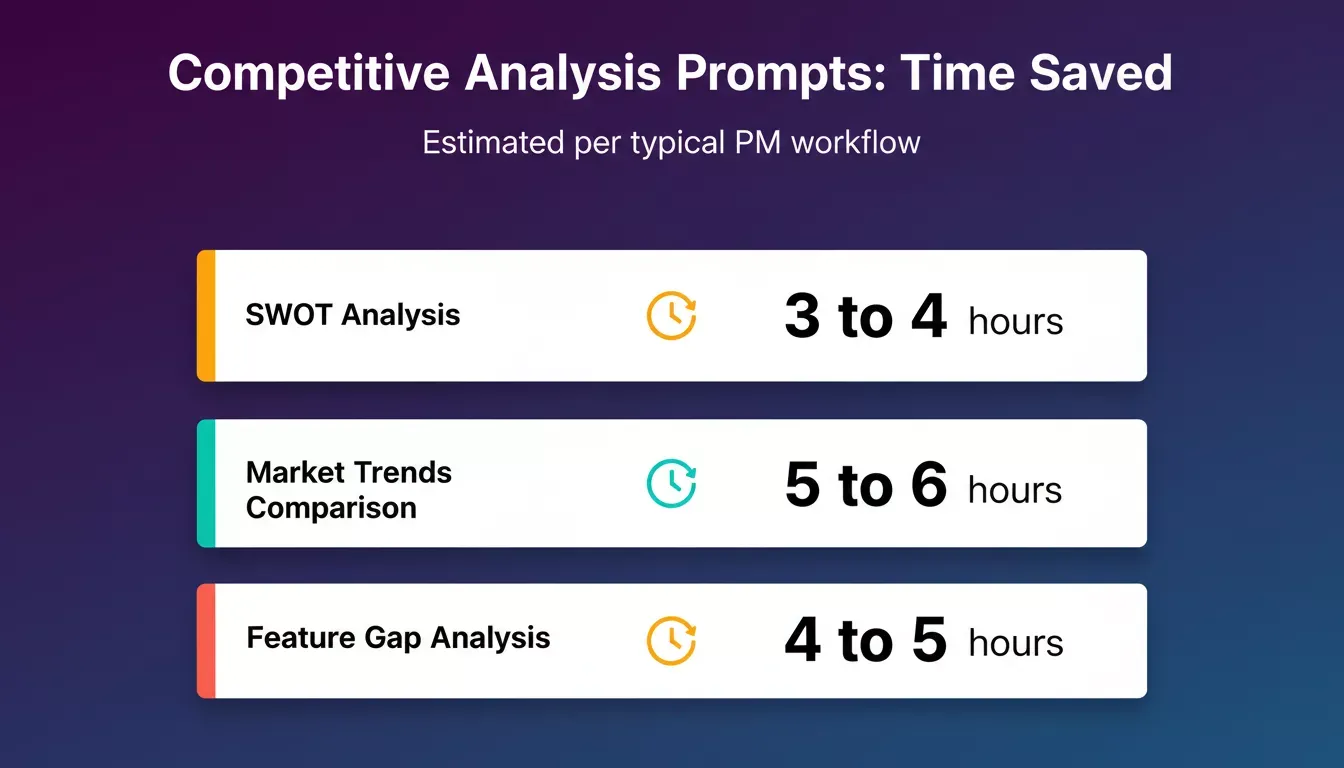
Competitive analysis prompts and the hours they reclaim per typical PM workflow
With AI-powered MVP builders, you can move from competitive analysis directly into building what the data tells you to ship. Rocket.new's Solve feature is specifically designed to run SWOT analysis, feature comparisons, and competitor positioning reports as structured, evidence-backed outputs, not generic summaries.
Want to run a live competitive analysis before your next sprint? Drop Prompt 5 or 8 into Rocket with your competitor's name and get a structured output your team can act on today.
How Can Prompts Help You Prioritize Features and Align Stakeholders?
Feature prioritization is where most product managers get stuck. Internal stakeholders want different things, engineering has constraints, and the team needs clarity on what moves the needle for customers.
Prompt 9: RICE Scoring Prompt
Use this prompt to apply a consistent scoring framework to competing feature requests so your team makes data-driven prioritization decisions instead of gut-feel ones.
Example prompt:
"Using the RICE framework, score the following feature requests based on reach, impact, confidence, and effort. Our target user is [persona]. Our success metrics are [metrics]. Provide examples of how each score was calculated."
The AI will often produce:
-
A RICE score table for each feature with calculation breakdowns
-
A ranked priority order based on combined RICE scores
-
Flagged assumptions your team should validate before committing to a build
Prompt 10: Stakeholder Request Synthesis Prompt
Use this prompt to cut through competing stakeholder demands and quickly identify which requests align with your product vision and which create scope creep.
Example prompt:
"Summarize the following stakeholder requests from this week. Identify which ones support our product vision and which ones create scope creep. Flag potential risks of proceeding with each."
The AI will often produce:
-
A categorized summary of aligned vs. misaligned requests
-
Scope creep flags with reasoning tied to your product vision
-
Risk notes for each request your team can reference in stakeholder conversations
Prompt 11: Sprint Review Action Items Prompt
Use this prompt to convert messy sprint review notes into clear, owner-assigned action items tied directly to business goals.
Example prompt:
"Based on the last sprint review notes, generate three action items for the next sprint. Each item should connect to a specific business goal and have a clear owner."
The AI will often produce:
-
Three structured action items with business goal alignment
-
Suggested owners for each item based on the context you provide
-
A brief rationale explaining why each action item was selected
Prompt 12: Tradeoff Analysis Prompt
Use this prompt to get a structured, data-backed recommendation when your team is stuck choosing between two competing features for the next sprint.
Example prompt:
"We need to choose between [Feature A] and [Feature B] for the next sprint. Analyze potential risks, user feedback signals, and business goals to recommend which one to prioritize first."
The AI will often produce:
-
A side-by-side tradeoff analysis for both features
-
A risk-weighted recommendation with supporting reasoning
-
A summary your team can use to align stakeholders on the final decision
When stakeholders disagree, these prompts create a shared decision-making artifact everyone can reference. The AI does not pick favorites; it structures the conversation around data so your team can identify the right call faster.
For teams building on Rocket.new, the Solve feature for product direction takes this further by generating research-backed roadmap input from structured product analysis.
From Prompt to Production-Ready MVP on Rocket.new
Writing prompts are half the work. Turning those insights into something users can touch is the other half, and that is where most tools fall short.
Most AI assistants give you text output and stop there. You get a competitive analysis or a feature list, then copy-paste it into another tool. Context gets lost between each handoff, and product managers end up doing manual translation work all over again.
Rocket connects research, prompting, and building into one workflow. When you analyze your market, the output feeds directly into your build. Your landing page reflects real competitor data. Your MVP features map to actual user pain points you identified minutes ago. Unlike tools that stop at generating a document, Rocket takes the output of your research and turns it into deployable app screens, UI components, and working user flows, without switching platforms or losing context.
-
Research first: Rocket runs competitive analysis and market research before you write code
-
Prompts become features: Your AI prompts for product strategy translate into app screens, UI components, and user flows
-
Ship the same day: Go from idea to deployed MVP using generative AI and full-stack building in one place
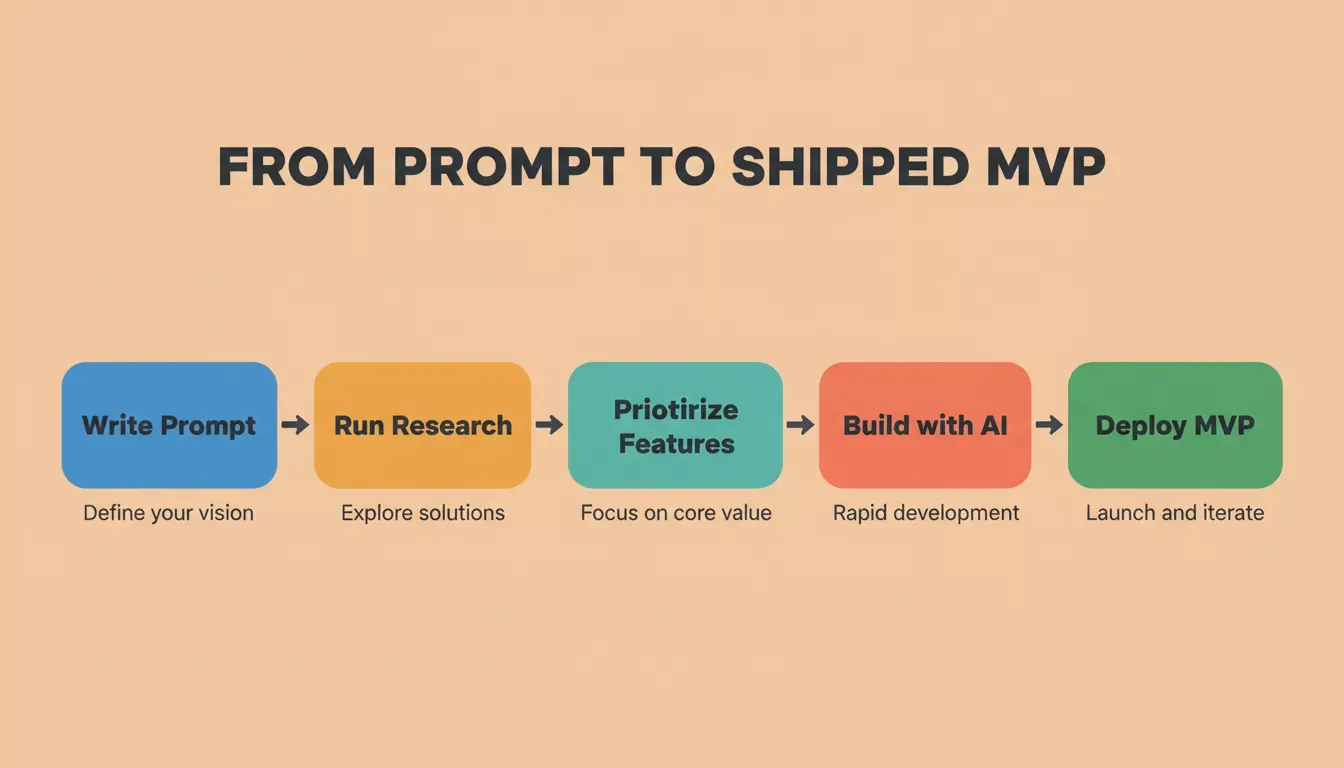
The complete journey from prompt to shipped MVP inside a single platform
What Makes a Prompt Actually Produce Actionable Insights?
A prompt is only as good as the context you provide. Vague inputs produce vague outputs, and most product managers struggle with this more than they realize. Context engineering matters. The four-layer framework introduced at the top of this guide, Role, Task, Constraints, Output Format, applies directly to the final three prompts below.
Prompt 13: Context-Rich Analysis Prompt
Use this prompt to get retention improvement recommendations grounded in your specific industry and user data instead of generic AI advice.
Example prompt:
"Acting as a senior product manager in the [industry] space, analyze the following user data. Identify three opportunities to improve retention. Provide specific examples and explain your reasoning step by step."
The AI will often produce:
-
Three retention opportunity recommendations with industry-specific reasoning
-
Supporting evidence drawn from the user data you provide
-
Step-by-step explanations your team can follow to act on each insight
Prompt 14: Format-Controlled Output Prompt
Use this prompt to generate a shareable, engineering-ready PRD for any feature without spending hours writing it from scratch.
Example prompt:
"Create a one-page PRD for [feature]. Include user stories, acceptance criteria, and potential risks. Format it as a structured document I can share with engineering by Friday for drafting docs."
The AI will often produce:
-
A structured one-page PRD with user stories and acceptance criteria
-
A risk section your engineering team can review before scoping
-
A clean, shareable format ready to drop directly into your team's workflow
Prompt 15: Iterative Refinement Prompt
Use this prompt as a follow-up after any previous prompt in this guide. First paste your previous AI output, then add this prompt below it to sharpen the recommendations against your real constraints.
Example prompt:
"The output above is from a previous AI session. Refine those recommendations considering these constraints: [budget], [timeline], [team size]. Propose a phased approach I can present to internal stakeholders next week."
The AI will often produce:
-
A phased implementation plan scoped to your exact constraints
-
Adjusted recommendations that reflect budget and timeline realities
-
A stakeholder-ready summary your team can present without further editing
Learn more about prompts that turn ideas into working apps and start creating prompts that match your specific context and product management goals. Rocket.new's core prompting concepts guide covers the essential principles for writing prompts that produce reliable, reusable results.
Your Prompts Shape What Gets Built Next
The prompts you write today determine the products your team ships tomorrow. Every question you ask AI is a product decision in disguise, a filter that shapes what data you see, what features you prioritize, and how quickly you move from concept to code.
These 15 prompts give you a starting point. Adapt them to your team, your industry, and your specific product challenges. The product managers who treat AI as a thinking partner, not just a writing tool, will build better products faster than teams still stuck in manual workflows.
If you are ready to go beyond prompting and start shipping, Rocket turns your product thinking into a live, production-ready app in one session.
Start building for free and see how fast your next MVP can move from idea to deployed product.
Table of contents
- -Why Do Most Product Teams Waste Hours on Tasks AI Handles in Seconds?
- -How Do AI Prompts Accelerate Product Decision Making?
- -The Anatomy of a High-Performing Prompt
- -Which Prompts Work for Customer Research and Feedback Analysis?
- -Prompt 1: Feedback Synthesis Prompt
- -Prompt 2: Sentiment Analysis Prompt
- -Prompt 3: User Interview Extraction Prompt
- -Prompt 4: Feedback Prioritization Prompt
- -What Are the Top Prompts for Competitive Analysis and Market Research?
- -Prompt 5: SWOT Generation Prompt
- -Prompt 6: Market Trends Summary Prompt
- -Prompt 7: Positioning Comparison Prompt
- -Prompt 8: Feature Gap Analysis Prompt
- -How Can Prompts Help You Prioritize Features and Align Stakeholders?
- -Prompt 9: RICE Scoring Prompt
- -Prompt 10: Stakeholder Request Synthesis Prompt
- -Prompt 11: Sprint Review Action Items Prompt
- -Prompt 12: Tradeoff Analysis Prompt
- -From Prompt to Production-Ready MVP on Rocket.new
- -What Makes a Prompt Actually Produce Actionable Insights?
- -Prompt 13: Context-Rich Analysis Prompt
- -Prompt 14: Format-Controlled Output Prompt
- -Prompt 15: Iterative Refinement Prompt
- -Your Prompts Shape What Gets Built Next