
Cursor, Replit, and Rocket.new serve different stages of software development. Cursor augments existing codebases, Replit offers browser-based prototyping, and Rocket generates production-ready full-stack apps from a single prompt, with built-in deployment included.
Which AI coding tool fits how you work?
According to the Stack Overflow 2024 Developer Survey, 76% of developers now use or plan to use AI tools. The challenge is no longer whether to adopt AI assistance. It is which tool matches your goals.
Cursor, Replit, and Rocket sit at three distinct points on the spectrum. Picking the wrong one can cost weeks of rework.
How Do These AI Tools Approach Software Development?
Before comparing features, it helps to understand the philosophy behind each platform.
Cursor is a desktop IDE built on VS Code. It layers AI-assisted coding directly into your existing workflows. It reads your codebase, suggests code snippets, handles refactoring across multiple files, and works with pull requests and GitHub repositories you already manage.
Replit is a browser-based IDE and cloud development environment. It pairs real-time collaboration with an AI agent for generating code. It handles hosting on the same platform where you write.
Rocket is an AI app builder that takes a different approach entirely. You describe what you want in plain English. The AI agent then generates a full-stack working app, complete with UI, navigation, backend logic, databases, and deployment, without requiring local setup or coding knowledge.
The core tradeoff is straightforward. Cursor gives experienced developers more control over existing code. Replit caters to learners and casual use with zero setup. Rocket fills the gap for anyone who wants to build real apps, web and native mobile alike, from idea to live URL in minutes.
What Does Cursor Bring to Experienced Developers?
Cursor focuses on making AI-assisted development faster inside a traditional code editor.
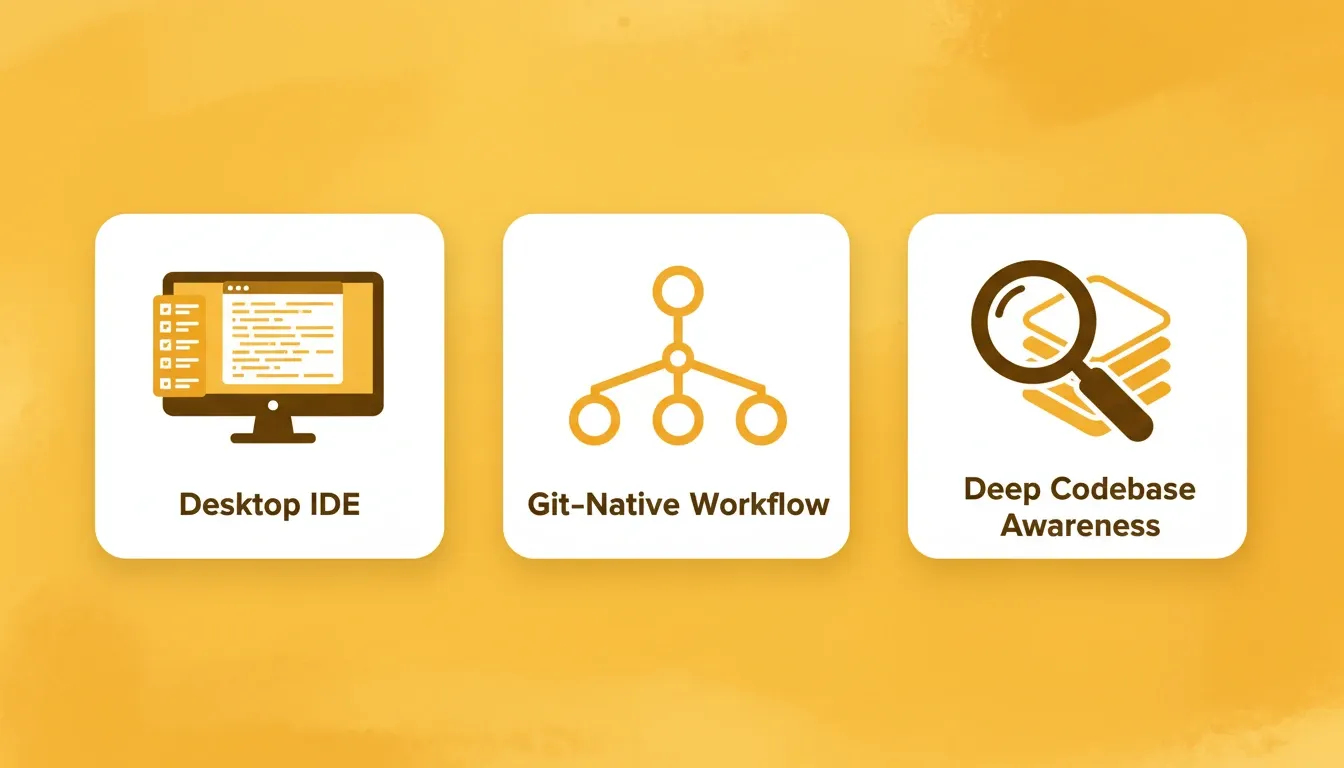
Built on VS Code. If you already use VS Code, the switch is painless. Your extensions, themes, and keybindings transfer. The desktop IDE runs locally on your machine. This gives you full control over your development environment and files.
Deep codebase awareness. Cursor reads your entire project structure and understands context across multiple files. It makes AI-powered suggestions that respect your existing code patterns. It handles code completion, refactoring, and debugging with strong contextual understanding.
Git-native workflow. Version control runs through your local setup. Pull requests, branching, and GitHub repositories integrate naturally. Cursor works inside the same git-based workflow you already know.
Local setup required. You need your own machine configured with dependencies, node modules, and environment variables. There is no built-in deployment or hosting. Cursor assumes you handle infrastructure yourself.
Experienced developers who already have a tech stack get genuine value from Cursor. However, non-technical users, solo builders looking for speed, and anyone who wants to skip local setup will hit friction fast. For a direct feature-by-feature breakdown, see how Rocket compares to Cursor.
How Does Replit Handle the Building Process?
Replit takes a different approach by moving your entire development environment to the browser.
Zero setup, instant start. Open a tab, pick a language, and start writing code. No local setup is required, and no dependencies need manual installation. The browser-based IDE handles your development environment in the cloud. This makes it convenient for beginners who just want to get started.
Real-time collaboration built in. Multiple users can work in the same repl simultaneously. As a result, Replit works well for pair programming, classrooms, and small teams doing rapid prototyping.
AI Ghostwriter (Replit Agent). Replit's AI agent generates code snippets, completes functions, and helps debug errors. The free tier includes limited AI usage. The Replit Core plan adds more AI credits and compute resources.
Hosting included, but limited. Replit handles hosting for published apps on the same platform. You get a live URL for sharing. However, apps can spin down when idle on the free plan. Custom domains require paid tiers, and performance for production workloads falls short compared to purpose-built deployment infrastructure.
Replit works well for casual use, learning, small scripts, and rapid prototyping. The GitHub Octoverse 2024 report noted that first-time contributors and students increasingly use cloud-based tools to experiment with code generation and build projects without managing infrastructure.
Where Replit falls short is production-grade apps. Projects grow complex, file structures get unwieldy, and the gap between a prototype and a deployed product widens. Non-technical users still need coding experience to get meaningful results from the AI agent. For teams evaluating alternatives, see this guide to Replit alternatives for faster app development.
Why Rocket Changes the Entire App Building Journey
So what if you could skip the configuration, skip the debugging, and just describe what you want to build?
Rocket is an AI app builder that generates full-stack applications from natural language prompts. You describe your app idea in plain English, including the screens you want, the features you need, and your design preferences. The AI agent then handles the rest: architecture planning, writing code, generating UI, setting up databases, and deploying to a live URL.
Three core capabilities work together:
Build generates production-ready web apps in Next.js and native mobile apps in Flutter from a single prompt. Every build ships with real design systems, accessibility compliance, SEO-ready structure, and considered typography. The output does not look like AI made it.
Solve runs strategic research before you build. Type any business question, such as market entry, pricing strategy, or competitive analysis. You get a structured recommendation with evidence, ready to present to any room.
Intelligence monitors your competitive landscape continuously across every public platform a competitor operates on. It reads their website, social media, ad activity, reviews, and job postings. It then tells you what all of it means together.
Three ways to iterate. Chat with the AI agent using natural language. Click elements directly with visual editing to change styles, text, and layout. Or open the full source code and edit files manually. There are no limits on iterations.
Zero setup, built-in deployment. No local setup, no environment configuration, and no dependency management is required. Rocket handles hosting, custom domains, staging environments, version control, and one-click deployment. Every working app is one click away from a shareable live URL.
Integrations ready to use. Stripe, Supabase, Google Analytics, Notion, Airtable, Mailchimp, and more connect directly into generation. Authenticate once, and they flow into every build.
Which Tool Matches Your Workflow and Goals?
Here is how these three AI tools compare across the features that matter most.
| Feature | Cursor | Replit | Rocket |
|---|---|---|---|
| Setup | Local setup required | Zero setup (browser) | Zero setup (browser) |
| AI Approach | Code suggestions in editor | Code generation + agent | Full app generation from prompts |
| Deployment | Manual (you handle hosting) | Built-in hosting (limited) | Built-in hosting with custom domains |
| Mobile Apps | No native mobile support | No native mobile support | Flutter native mobile apps |
| Visual Editing | No | No | Yes, click-to-edit UI |
| Version Control | Git (local) | Git (built-in) | Full version history + rollback |
| Real-Time Collaboration | Via git (async) | Live multiplayer editing | Team workspaces with role-based access |
| Best For | Experienced developers with existing codebases | Beginners, learners, and scripts | Founders, teams, and anyone shipping fast |
| Free Tier | Limited free plan with AI credits | Free tier with compute limits | Free tier included |
The JetBrains DevEcosystem Survey found that only 13% of developers believe AI will fully write code in place of humans. Most developers view AI as a tool for speed and learning curve reduction, not replacement. As a result, the right tool depends on your technical background and what you need to ship.
Pricing comparison across all three platforms:
| Platform | Free Tier | Entry Paid Plan | Notes |
|---|---|---|---|
| Cursor | Limited AI credits | $20/month (Pro) | Desktop app; no hosting included |
| Replit | Free tier with compute limits | $20/month (Core, billed annually) | Includes hosting; compute limits apply |
| Rocket | Free tier included | $25/month (Pro) | Hosting, custom domains, and deployment included |
Choosing depends on your situation:
-
Developers who want full control over a large codebase, who prefer working directly with programming languages, and who already have existing deployment workflows should consider Cursor.
-
Beginners and learners who want zero friction to start writing code, who value real-time collaboration for classrooms or side projects, and who do not need production reliability should consider Replit.
-
Teams and solo builders who want to go from idea to deployed product without managing infrastructure, who need both web and mobile from the same tool, and who value speed over manual configuration should choose Rocket.
To understand the technical reasons behind Rocket's framework choices, see why Rocket generates Next.js and Flutter.
What Are Developers Actually Choosing in Practice?
Real users discuss this choice every day across forums and social platforms.
A developer on Reddit's r/cursor community noted: "I tried Cursor for my main project and Replit for throwaway prototypes, but neither gives me a shipped product in one sitting. The gap between code suggestions and a deployed app is still big." This reflects a common pattern where different tools serve different stages of the building process.
The data supports a shift toward AI-powered platforms that handle the full journey. GitHub's Octoverse report documented a 98% year-over-year growth in generative AI projects. Developers increasingly build AI capabilities directly into applications rather than just using AI for code completion.
For non-technical users and growing teams, the pattern is evolving. People want to describe what they want in natural language and get a working app. They do not want code snippets that require additional assembly, debugging, and manual deployment.
Rocket handles this gap. It is not a code editor with AI assistance bolted on. It is not a browser IDE with AI agent features added. Instead, it is a platform built from day one to turn natural language into deployed software. It covers web apps, mobile apps, internal tools, dashboards, and landing pages, with shared context that carries forward between every task.
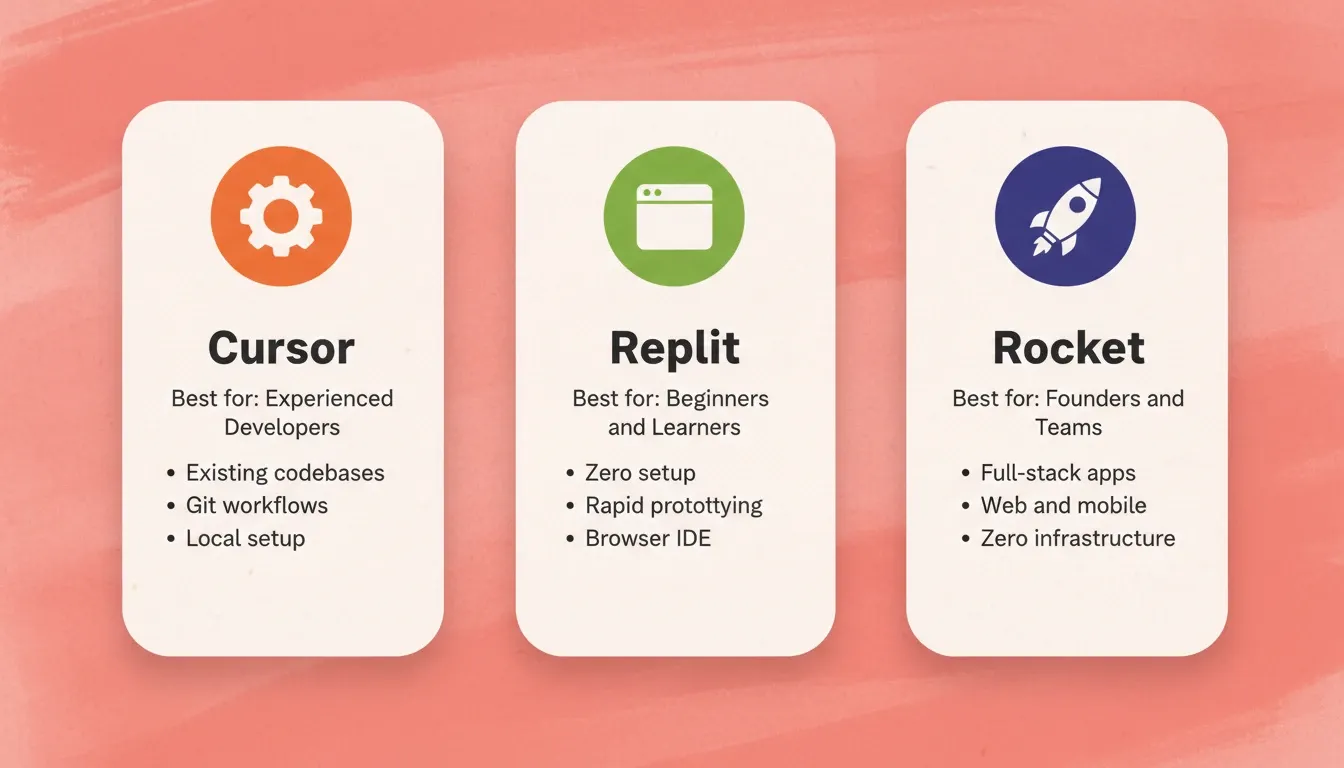
For experienced developers working inside large codebases, Cursor offers strong AI assistance in a familiar development environment. For everyone else, from product managers who need a working prototype to founders validating ideas to teams building internal tools, Rocket covers the entire journey without forcing you to become a platform manager.
The Right Tool Depends on Where You Start
Cursor, Replit, and Rocket each solve a real problem. They just solve different ones. Cursor is for developers who already know what to build and want AI to help them build it faster. Replit is for learners and experimenters who want zero friction to start. Rocket is for anyone who wants to go from idea to deployed product without managing infrastructure, programming languages, or deployment pipelines.
As AI-assisted development continues to evolve, the gap between "code faster" tools and "build complete products" platforms will only widen. The question is no longer which tool has the best autocomplete. It is which platform covers the full arc from first idea to shipped product.
You type the problem. Rocket researches it, recommends a direction, builds the app, and deploys it. Sign up for Rocket.new and build your first app for free.
Table of contents
- -How Do These AI Tools Approach Software Development?
- -What Does Cursor Bring to Experienced Developers?
- -How Does Replit Handle the Building Process?
- -Why Rocket Changes the Entire App Building Journey
- -Which Tool Matches Your Workflow and Goals?
- -What Are Developers Actually Choosing in Practice?
- -The Right Tool Depends on Where You Start