
Rocket.new generates complete, deployable full-stack apps from a single prompt. Claude Code helps developers write and fix code across their existing projects. This blog breaks down exactly what each tool does and which one ships a production ready app faster.
Which AI tool actually ships a production ready app: Rocket.new or Claude Code?
According to the Stack Overflow 2024 Developer Survey, 76% of developers are using or planning to use AI tools in their workflow. The demand for a full-stack AI app builder that handles real app development has never been higher.
The choice between Rocket and Claude Code comes down to one question: do you want AI that assists your coding, or AI that builds the entire application for you?
What is the Core Difference?
Before comparing features, it helps to understand what each tool actually is.
Rocket is a full-stack AI app builder. Describe what you want in plain language, and Rocket generates a complete application. It covers frontend, backend, database, authentication, and deployment, all ready to launch. Web apps run on Next.js. Mobile apps run on Flutter. The framework is assigned automatically based on your platform choice.
Claude Code is an AI coding assistant from Anthropic. It reads your existing codebase, understands context across files, and helps you write, refactor, and debug code through conversation. It is available in the terminal, VS Code, desktop app, and browser. It does not generate a full-stack app, set up a database, or deploy your project.
The difference in one line: Claude Code is a powerful tool inside a workflow. Rocket is the workflow.
What Makes an AI App Builder Ready for Production?
Not every AI app builder takes you from idea to a live product. Here is what separates a production ready app from a polished prototype that falls apart when real users arrive.
-
Backend logic and database schemas built in. A production-grade tool generates authentication, databases, APIs, and backend logic without asking you to configure separate services.
-
One-click deployment to custom domains. Shipping a full-stack application should take seconds, not days of DevOps work.
-
Full code ownership and export. You should own every line and find your code clean enough for a team to read and extend later.
-
Version history and rollback. Real projects break. The platform should let you step back fast without starting over.
Tools like Lovable, Bolt, and Emergent offer rapid prototyping. However, the real test comes after the demo, when real users arrive and scale pressure builds.
| Criteria | Rocket | Claude Code | Lovable | Bolt |
|---|---|---|---|---|
| Backend + Database | Auto-generated (Supabase) | Manual setup | Limited | Basic |
| Deployment | One-click included | Not included | Included | Included |
| Mobile apps | Native Flutter (iOS + Android) | Not supported | Not supported | Not supported |
| Authentication | Built-in flows | Manual code | Basic auth | Limited |
| Code ownership | Full export + GitHub sync | Terminal output | Partial | Limited export |
| Visual editor | Yes (click-to-edit) | No | Limited | No |
| 25+ integrations | Yes | Manual setup | Some | Some |
| App Store submission | Yes (iOS + Android) | No | No | No |
How Does Rocket Build a Production App?
Rocket's Build workflow has three stages. First, you describe what you want. You can use a plain language prompt, a Figma file, a screenshot, a GitHub repository, or a pre-built template. If your prompt is specific enough, Rocket starts building immediately. If it is vague, Prompt Intelligence asks a short set of targeted questions, then starts once it has enough context.
Next, Rocket plans the architecture, writes production-ready code, and shows a live preview when generation finishes. Most apps generate in one to three minutes.
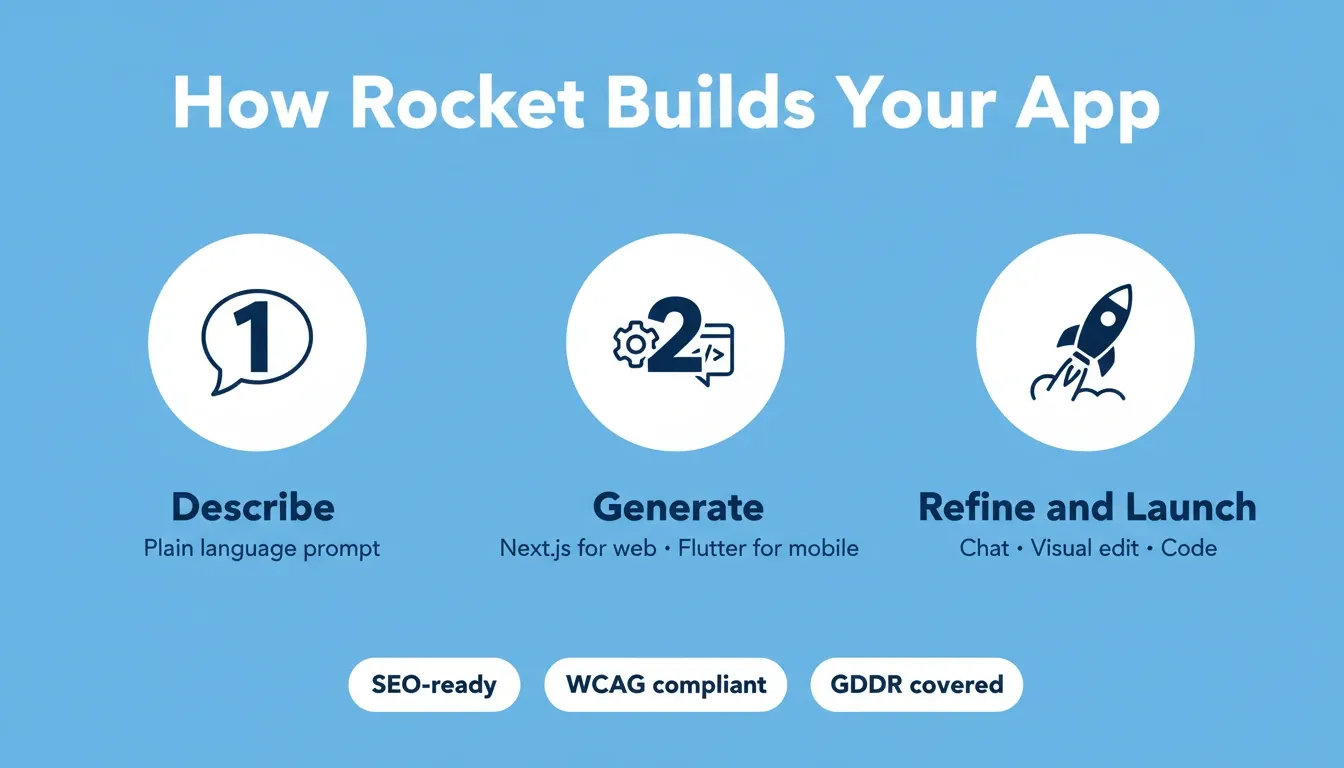
Rocket's Build workflow: from plain language prompt to deployed application in three steps
Finally, three editing modes let you iterate without starting over:
-
Chat: Describe changes in natural language to add features, fix bugs, or adjust layouts.
-
Visual edit: Click any element directly in the preview to change text, colors, spacing, or images. No code is required.
-
Code: View and edit source files directly for precision changes.
Every build ships with SEO-ready structure, WCAG accessibility compliance, GDPR coverage, and performance optimization by default. These are the baseline, not optional extras.
What Rocket Connects Out of the Box
Rocket integrates with 25+ services through its Connectors system. Authenticate once and Rocket generates the code, UI, and logic automatically. Key integrations include Stripe, Razorpay, Supabase, OpenAI, Anthropic, Gemini, Google Analytics, Mixpanel, HubSpot, Notion, Linear, Airtable, Figma, GitHub, and Netlify. For any service not listed, Rocket connects to any REST API via Postman, cURL, or OpenAPI specs.
When your app is ready, click Launch. Rocket deploys to a live URL instantly with automatic HTTPS. You can connect a custom domain, use separate staging and production environments, and roll back to any previous version with one click.
How Does Claude Code Perform in Real Projects?
Claude Code is an AI coding assistant from Anthropic. It works inside your existing codebase across multiple surfaces, including the terminal, VS Code, a desktop app, and the browser. It reads your files, understands context, and helps you write, refactor, and fix bugs through conversation.
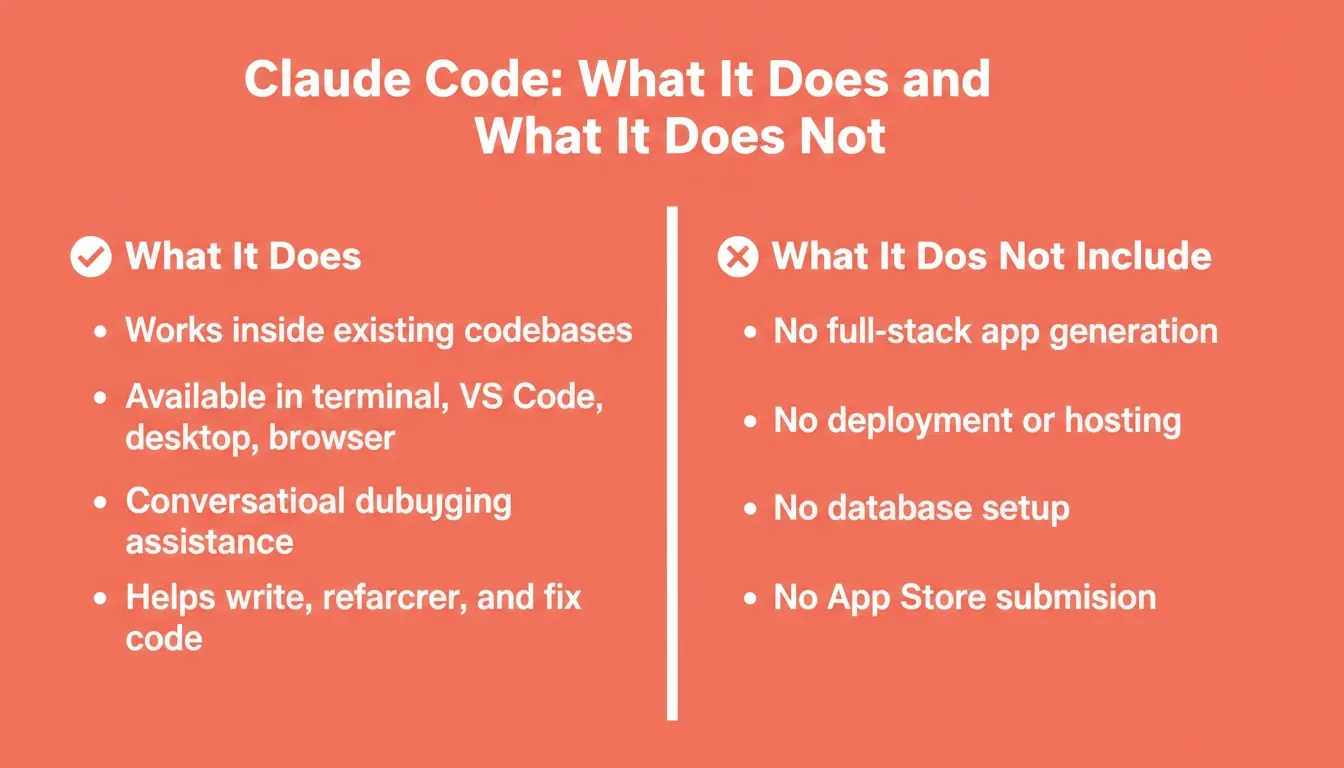
Claude Code works inside existing codebases across terminal, VS Code, desktop, and browser. Full-stack generation, deployment, and databases are not included.
-
Strong at working within an existing codebase. Claude Code reads the full context of your project, including files, dependencies, and patterns. It processes large codebases efficiently.
-
Debugging assistance that feels conversational. Describe the problem in plain language and Claude Code suggests fixes. This approach suits developers who want control over each step.
-
Limited to code output only. Claude Code does not generate a complete full-stack app, deploy your project, set up a full database, or submit to app stores. Deployment, hosting, and integrations remain your responsibility.
According to the Claude Code official documentation, the tool is an agentic coding assistant that helps you build features, fix bugs, and automate development tasks. It works best as part of a larger development workflow.
The debugging loop can get stuck in cycles. When a fix does not work on the first prompt, the back-and-forth process can consume significant time. Users report this pattern frequently when debugging harder problems.
Which Platform Handles Debugging and Long-Term Scaling?
The real test of any AI app builder comes after launch. When bugs appear, features need updates, and your user base grows, that is when platform choice matters most.
Claude Code debugging requires developer involvement at every step. You find the error, paste it into the interface, prompt Claude for a fix, review the output, and apply it manually. If the fix breaks something else, the loop starts again.
Rocket identifies errors and applies fixes across the full codebase automatically. The AI detects what broke, traces the issue through connected files, and pushes a fix. Confirm and the app rebuilds. No manual copy-pasting of error messages is needed.
Long-term scaling also works differently. Claude Code does not manage deployment, databases, or architecture. As your project grows, you handle scaling yourself. Rocket includes hosting, databases, and structured systems designed for long-term growth. This makes it easier to scale without rebuilding from scratch.
Debugging workflow comparison: manual loop (Claude Code) versus automated resolution (Rocket)
When Claude Code Is the Right Choice
This comparison is not one-sided. Claude Code is genuinely well suited for specific use cases. Choosing it for the right situation is the smart decision.
Choose Claude Code when:
-
You already have a codebase and need help extending or refactoring it.
-
You are an experienced developer who wants AI assistance without giving up control over architecture decisions.
-
Your project requires custom infrastructure that a managed platform cannot accommodate.
-
You are working inside an established team workflow with existing CI/CD pipelines.
Choose Rocket when:
-
You are building from scratch and need a complete application fast.
-
You need web and mobile apps from a single prompt.
-
You want one-click deployment, custom domains, and App Store submission.
-
You are a non-technical founder or a small team without a dedicated backend developer.
Understanding this distinction makes the comparison useful. Claude Code is a powerful tool inside a workflow. The question is whether you want to build and manage that workflow yourself.
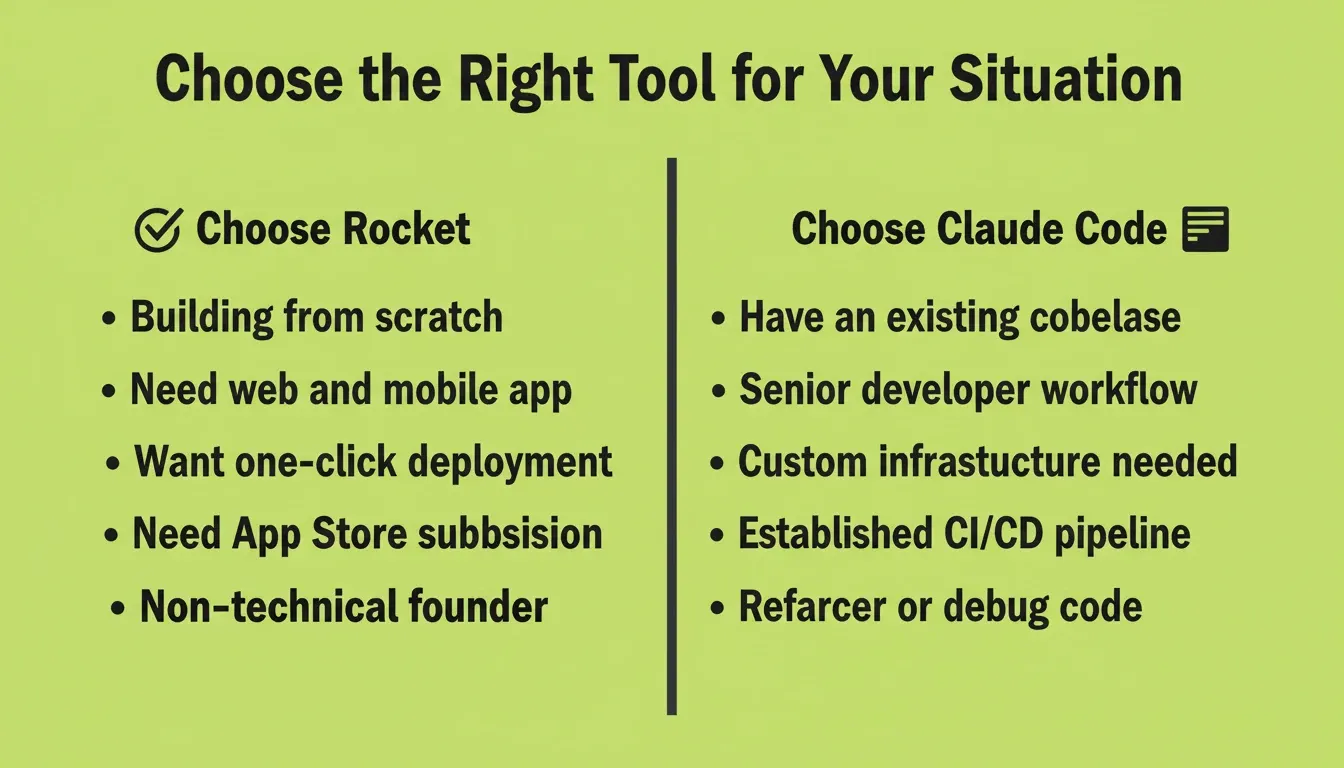
A quick decision guide: match your situation to the right tool before you start building
How Do Real Users Compare These AI Tools?
Community feedback tells a clearer story than any feature list. Here is what real users have been saying across developer forums and social platforms about these vibe coding tools and what they wanted from each one.
Developers comment frequently about Claude Code's learning curve. Users who wanted a simple app building experience felt frustrated when they hit walls on deployment. A common comment on Reddit: "Claude Code is great for fixing my existing code, but I still needed to figure out hosting and databases on my own."
Rocket users comment on speed. Community response has been positive, with people noting they went from idea to deployed app in a single session. One user shared: "I wanted to build a client portal for my small business. Rocket built the whole thing, login, dashboard, database, in one session. It felt like having a full team."
According to GitHub's developer experience research, 92% of developers at enterprise companies already use AI coding tools. However, using AI today does not guarantee production-grade output. That is where choosing the right platform for app building matters for making real things work.
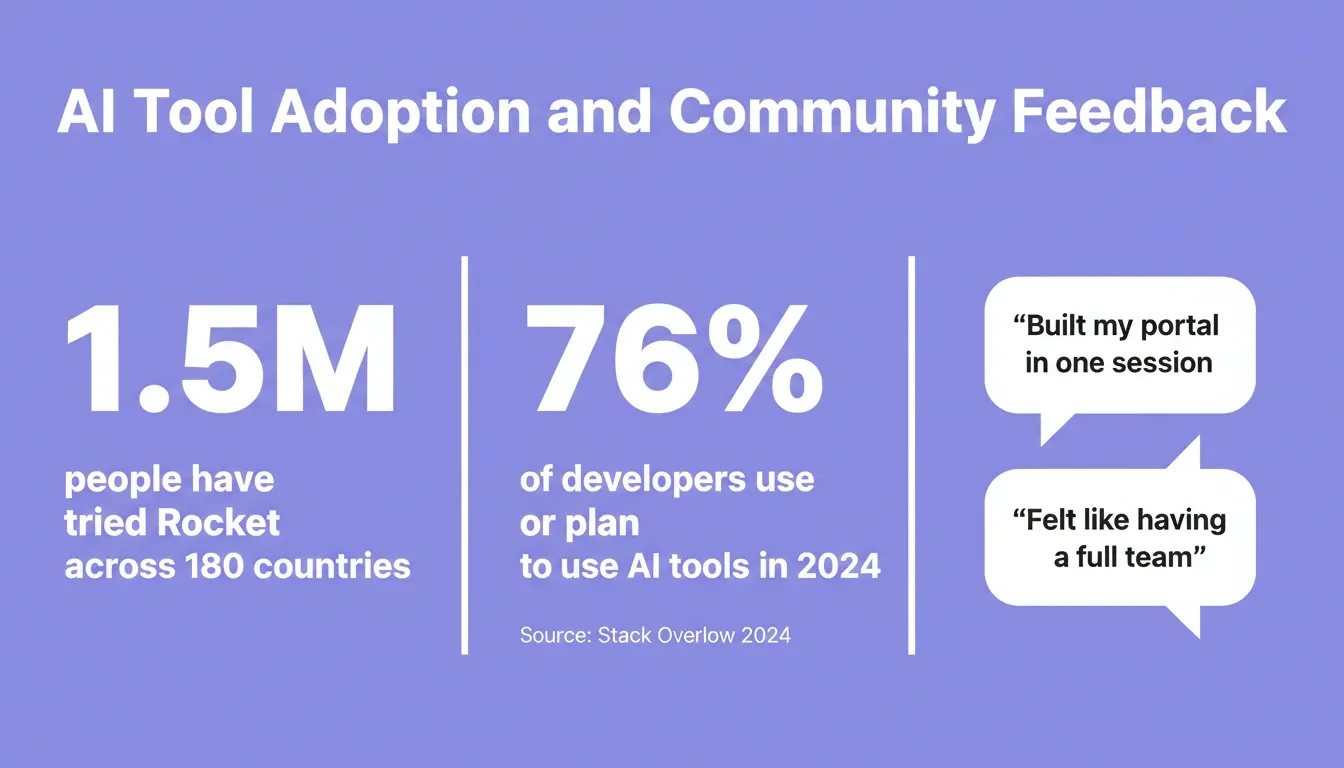
1.5 million people have tried Rocket across 180 countries. 76% of developers use or plan to use AI tools (Stack Overflow 2024).
Who Should Choose Which Tool: A Decision Framework
| Your situation | Best choice |
|---|---|
| Building a new app from scratch, no codebase yet | Rocket |
| Need web and mobile app from a single prompt | Rocket |
| Want one-click deployment and custom domain | Rocket |
| Need App Store and Google Play submission | Rocket |
| Non-technical founder or small team | Rocket |
| Existing codebase that needs new features | Claude Code |
| Senior developer who wants AI pair programming | Claude Code |
| Custom infrastructure or unusual tech stack | Claude Code |
| Working inside an established CI/CD pipeline | Claude Code |
| Need to refactor or debug existing code | Claude Code |
Pricing Comparison
Rocket offers a free tier to start with no credit card required. Plans scale based on usage, with credits covering Build generation, Solve research, and Intelligence monitoring, all from one balance.
| Plan | Monthly Price | Monthly Credits | Best For |
|---|---|---|---|
| Free | $0 | 20 (one-time) | Light, exploratory use |
| Pro | $25 | 100 | Individual builders |
| Rocket | $50 | 250 | Individuals and teams |
| Booster | $250 | 1,500 | Power users and fast-moving teams |
Save 20% on all paid plans with annual billing. Credits never expire and unused credits roll over month-to-month.
Claude Code requires a paid Anthropic plan. Costs are based on token usage per session and grow depending on project size and session length. There is no free tier for Claude Code. A Claude Pro or Max subscription is required to access it.
| Tool | Free Tier | Pricing Model | Deployment Included |
|---|---|---|---|
| Rocket | Yes (20 credits) | Credit-based, from $25/mo | Yes |
| Claude Code | No | Token-based (Anthropic plan required) | No |
The Right Tool Depends on Where You Start
For teams building production ready apps from scratch, Rocket.new vs Claude Code is not a close call. Rocket handles the full stack, from frontend to backend, database, and deployment, from a single prompt with no DevOps required. As AI app builders continue to close the gap between idea and shipped product, the tools that cover the complete arc from generation to deployment will define how fast teams can move. 1.5 million people have tried Rocket across 180 countries. Start building on Rocket and go from prompt to deployed application in minutes.
Table of contents
- -What is the Core Difference?
- -What Makes an AI App Builder Ready for Production?
- -How Does Rocket Build a Production App?
- -What Rocket Connects Out of the Box
- -How Does Claude Code Perform in Real Projects?
- -Which Platform Handles Debugging and Long-Term Scaling?
- -When Claude Code Is the Right Choice
- -How Do Real Users Compare These AI Tools?
- -Who Should Choose Which Tool: A Decision Framework
- -Pricing Comparison
- -The Right Tool Depends on Where You Start