M&A (Mergers and Acquisitions) advisory teams lose weeks to scattered documents, broken version control, and unanswered buyer questions. A purpose-built buyer workspace with due diligence with AI fixes the workflow, not just the storage.
Why does every M&A deal start with a document mess?
Advisory teams waste weeks managing deal documents across email, shared drives, and spreadsheets. A centralized buyer workspace with AI-powered document analysis, controlled access, and activity tracking changes this.
Why do M&A advisory teams still lose entire weeks to scattered deal files when 86% of corporate and private equity leaders have already built generative AI into their workflows? According to Deloitte's 2025 survey of M&A leaders, over a third of those adopters apply it specifically to the review process. The gap between knowing AI can help and actually having a workspace that organizes it all is where most teams get stuck.
This blog walks through the real problem, maps the workflow a secure buyer workspace should follow, and shows what happens when documents, access controls, review tracking, and buyer requests all live in one place.
The Real Cost of a Scattered Deal Process
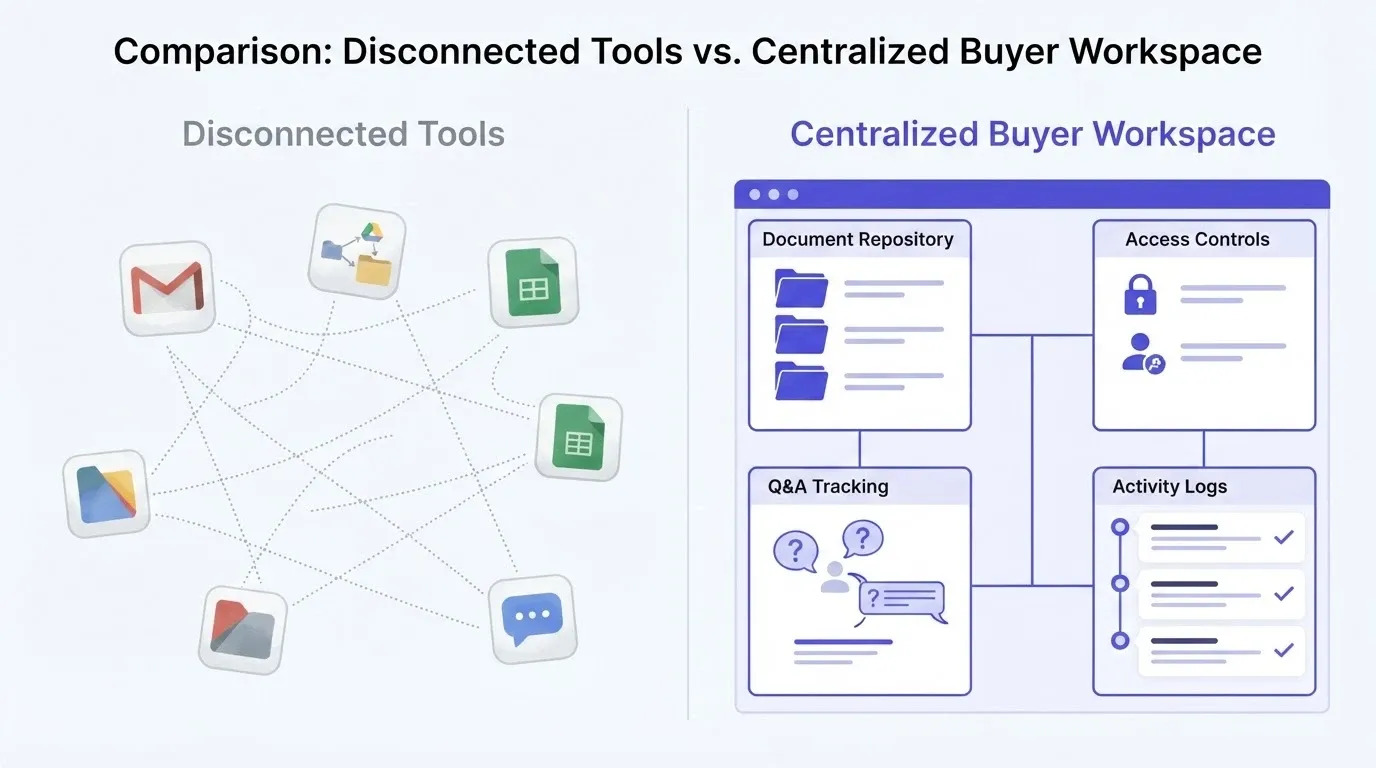
Every M&A transaction starts the same way: a data request list lands in someone's inbox, files get uploaded to a shared drive, and within 48 hours the deal room is already a mess.
Financial models sit in three different versions across two shared drives. Legal memos are buried in email threads. Compliance checklists live in a spreadsheet that nobody trusts because nobody knows which copy is current. The buyer's team sends the same question twice because they cannot see that it was already answered in a different thread.
The cost is not just time. It is missed risk signals buried in files that never reached the right reviewer. Deals slow down. Advisors spend hours chasing responses that should take minutes. When a finding is buried in a folder nobody checked, the damage is permanent.
When your deal documents sit in the wrong place, choosing the right tool for an investor data room becomes the first decision that shapes everything else.
Where Do Buyer Questions and Follow-Ups Actually Go?
During any active deal, buyer-side teams generate dozens of questions per week. These questions land in email threads, Slack messages, and phone call notes scattered across multiple inboxes.
-
Q&A tracking disappears into inboxes where responses get lost between unrelated messages, and nobody knows which questions remain unanswered
-
Follow-up requests lack accountability because there is no shared system showing who asked what, who owns the answer, and when the deadline is
-
Repeat questions waste advisor time since buyers across different workstreams ask the same thing independently, with no visibility into prior answers
The result? Deal teams spend hours each week chasing responses that should take minutes.
What the Due Diligence Process Actually Demands
Before building a workspace, it helps to understand what the process requires. M&A due diligence typically runs across four overlapping phases. Each phase has distinct document, access, and communication requirements.
M&A due diligence phases: from scoping through close
| Phase | What Happens | Where It Breaks Without a Workspace |
|---|---|---|
| Scoping and NDA | Define scope, sign NDAs, set access tiers | NDA versions scattered across email with no audit trail |
| Data Room Setup | Upload, organize, and permission documents | Manual folder structures with no role-based access |
| Active Review and Q&A | Reviewers read, flag issues, and submit questions | Questions lost in email with duplicate asks and no status tracking |
| Findings and Close | Compile findings, negotiate, and finalize | Reports built manually from scattered notes |
Most teams try to stitch this together with shared drives, email, spreadsheets, and a generic project management tool. The result is a process that is technically functional but operationally fragile.
What a Centralized Buyer Workspace Must Include
A buyer workspace is not a shared folder with a password. It is a purpose-built environment where every deal activity connects to the documents, the people, and the timeline it belongs to.
According to research, 77% of M&A transactions now rely on virtual data rooms for secure document sharing. The problem is that most of those rooms are still passive storage. They hold files but do not help you understand them.
What separates a workspace from a repository is workflow. Here is what each layer needs to do.
Document Management and Version Control
The foundation of any deal workspace is a single indexed repository. Every document needs one canonical location, one current version, and a clear ownership trail.
-
Folder hierarchy by workstream covering financial, legal, operational, HR, IP, and compliance so reviewers can navigate without asking where things live
-
Version control that prevents conflicting copies from spreading across local drives and email attachments
-
OCR and full-text indexing so documents are searchable by content, not just filename
-
Bulk upload with auto-classification that sorts incoming files into the right workstream folders based on content type
Role-Based Access and Controlled Permissions
Every deal has documents that only specific people should see. A financial model with projections might be visible to the lead buyer but restricted from competing bidders. A legal memo might need to stay within outside counsel.
-
Granular permissions at the document or section level, not just folder-level sharing links
-
Time-limited access windows that expire automatically after a deal phase closes
-
Watermarked views and download restrictions to discourage unauthorized distribution without blocking legitimate review
-
Full audit logs that capture who accessed what, when, from which device, and whether they downloaded or just viewed
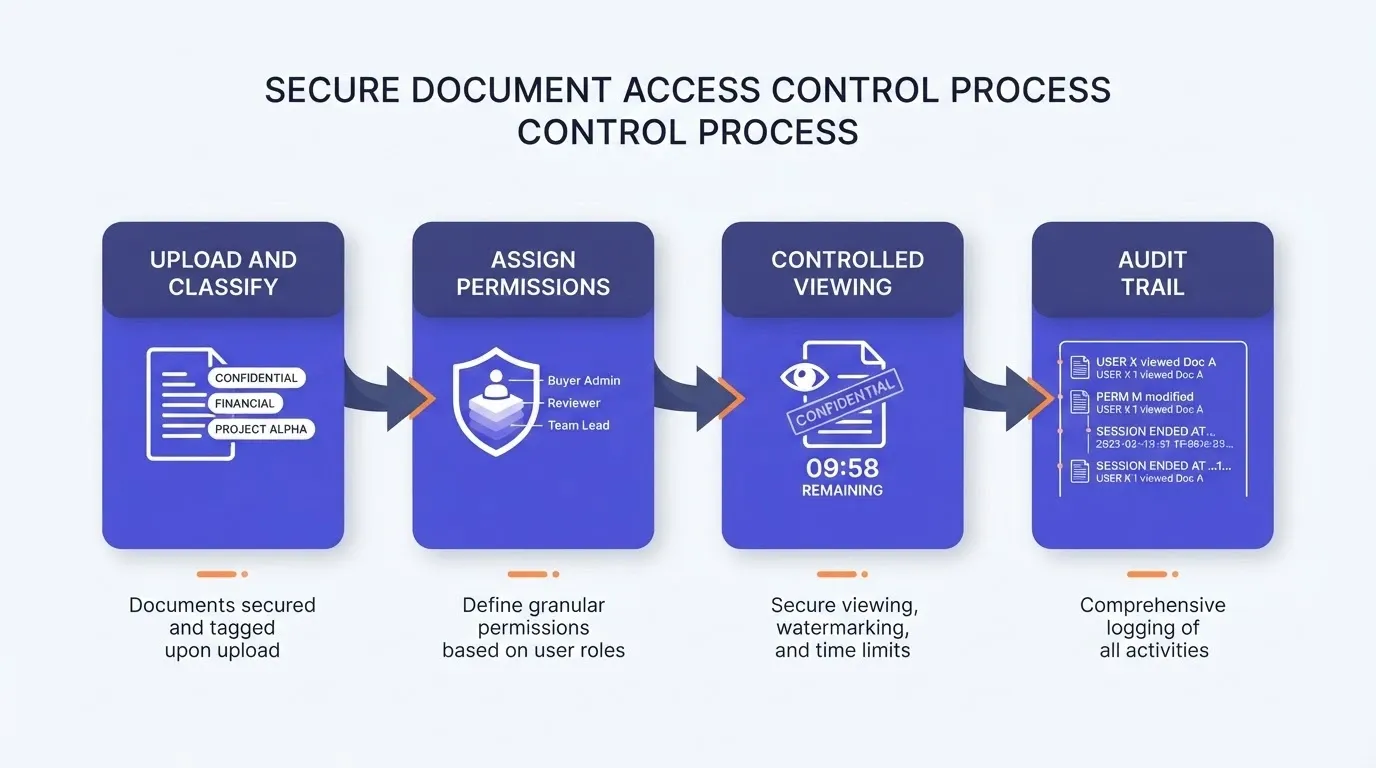
Secure document access: from upload through role-based permissions to audit logging
AI-Powered Document Review
This is where due diligence with AI delivers its clearest value. According to Finantrix, AI-powered platforms cut review timelines from 8 to 12 weeks down to 3 to 4 weeks while reducing analyst workload by 60 to 70%.
NLP models classify contracts by type, extract key terms like change-of-control clauses and indemnification caps, and flag anomalies before a human reviewer opens the file.
AI due diligence pipeline: from document upload through NLP analysis to prioritized reviewer output
The shift is not about replacing reviewers. It is about moving them from reading every page to judging the exceptions the model surfaces. That is where deal risk actually lives.
Structured Q&A Management
Untracked buyer questions are one of the most consistent sources of deal delay. A purpose-built Q&A tracker needs a centralized question log with status fields such as open, in review, answered, and escalated. It also needs ownership assignment with deadlines and thread visibility across workstreams so duplicate questions are caught before they waste advisor time.
Without this structure, the same question gets asked three times across three workstreams. With it, every question has a named owner and a deadline. The deal team can see exactly where the bottlenecks are.
Buyer Activity Tracking
Once documents are in the workspace and access controls are set, the next question is: who is actually looking at what?
-
Real-time view logs showing which buyers opened specific documents, how long they spent, and whether they downloaded or just skimmed
-
Engagement scoring that identifies the most active buyers, signaling genuine interest versus passive browsing
-
Automated alerts when critical documents remain unviewed past a deadline
A buyer who has spent four hours in the financial model but has not opened the IP schedule is telling you something. A workspace that surfaces that automatically is worth more than one that buries it in server logs nobody checks.
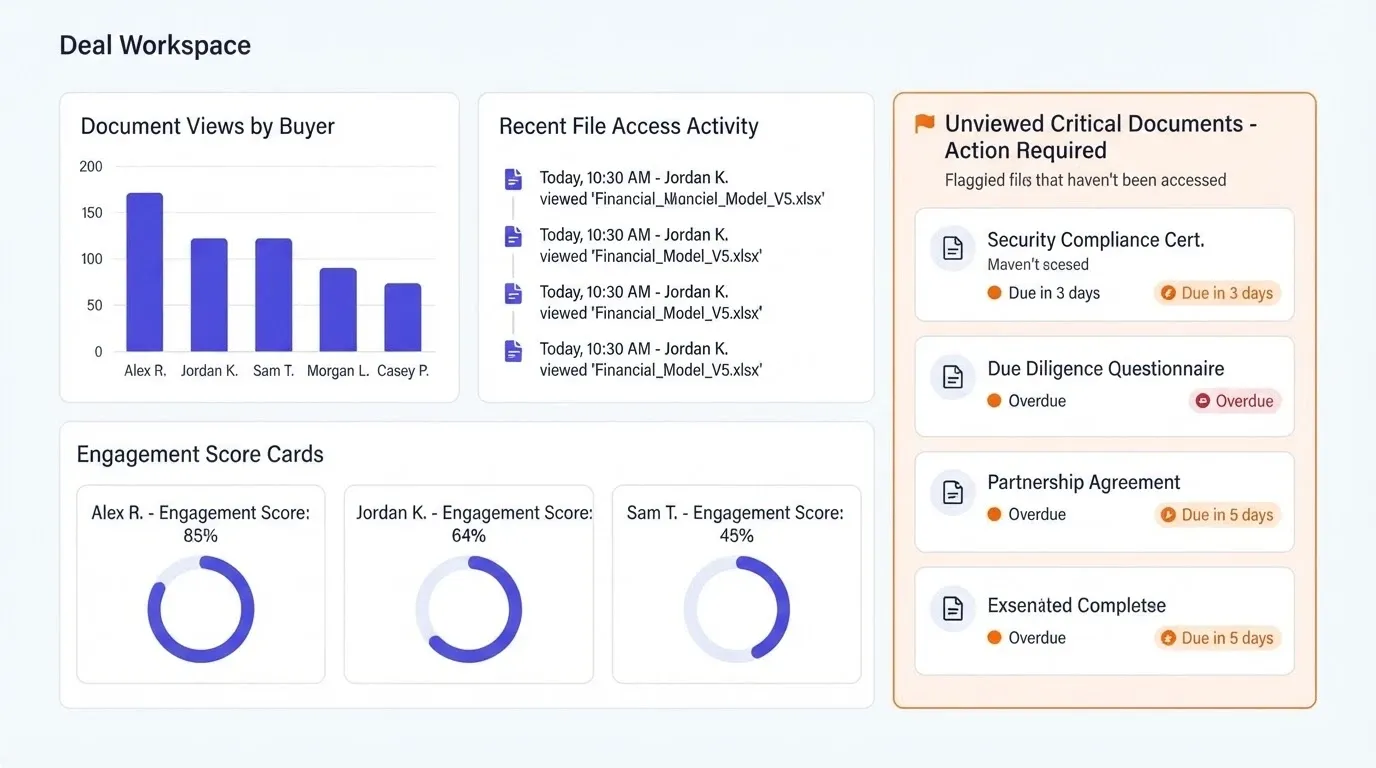
Buyer activity dashboard: real-time engagement metrics that replace manual spreadsheet monitoring
How to Build a Buyer Workspace With Rocket
Understanding what a buyer workspace needs is one thing. Building it without a six-month development project is another. Rocket's three-pillar platform covers the full arc from workflow description to deployed product.
Step 1: Use Solve to Map Your Deal Workflow
Before writing a single line of code, use Rocket's Solve to run a structured analysis of your deal workflow. Describe your transaction type, the workstreams involved, the document categories you typically handle, and the access tiers your deal requires.
Solve produces a structured, evidence-backed report with an executive summary, supporting analysis, and actionable recommendations. In this context, that means a scoped workspace design covering document categories, role definitions, review stages, and compliance requirements specific to your deal type.
That output becomes the brief for your Build task, with full context already in place. The Solve findings about your deal structure feed directly into the app Rocket generates in Build. Nothing gets lost between research and construction.
Step 2: Build the Workspace With Rocket Build
With the Solve output in hand, describe your workspace to Rocket Build in plain language. Rocket generates a production-ready Next.js web application with the exact screens, permissions, and tracking your deal needs.
A typical buyer workspace build includes document upload and management screens, role-based access control panels, a Q&A management dashboard with status and ownership, a buyer activity dashboard with view logs and engagement scores, and an audit log viewer for compliance review.
Rocket connects to 25+ services out of the box. For a buyer workspace, the relevant stack typically includes the following:
| Connector | Role in the Workspace |
|---|---|
| Supabase | Backend database, user authentication, and file storage |
| Notion | Sync deal notes, briefs, and context from your team's existing workspace |
| Airtable | Manage deal metadata, contact lists, and document inventories |
| HubSpot | Sync buyer contacts and deal pipeline data |
| Resend or SendGrid | Automated notifications for document uploads and Q&A responses |
| OpenAI or Anthropic | Power AI document analysis and Q&A drafting features |
Every Build message saves a new version automatically. You can compare code diffs, label milestones, roll back to any previous state, and deploy to staging or production independently. This means you can ship the workspace to your deal team today and iterate without risk.
Step 3: Monitor Deal Activity With Intelligence
Once the workspace is live, Rocket's Intelligence pillar runs continuously in the background. For deal teams, this means automated alerts when buyer engagement drops or critical documents go unviewed. It also means continuous monitoring that surfaces anomalies without requiring manual log review.
Intelligence delivers signals to a live dashboard in your sidebar. Set it up once, and it runs automatically.
Rocket vs. Traditional Approaches
Traditional virtual data rooms charge per-seat fees, lock you into fixed templates, and offer limited customization. Generic project management tools lack the security controls and document management depth that deals require. Custom development gives you full control but takes months and a full engineering team.
| Approach | Time to Deploy | Customization | AI Document Review | Access Controls |
|---|---|---|---|---|
| Traditional VDR | Days | Low, fixed templates | Limited or add-on | Folder-level |
| Generic project management | Hours | Medium | None | Basic sharing |
| Custom development | Months | Full | Requires separate build | Full |
| Rocket | Hours | Full, plain language | Built-in via connectors | Role-based, document-level |
Describe your deal workflow in plain language. Rocket generates a production-ready Next.js web app with the exact screens, permissions, and tracking your deal needs. Every version is saved so you can iterate without risk.
The Workspace Your Next Deal Deserves
The gap between how deal teams currently work and how they should work is not a technology problem. It is a workflow problem. As AI becomes standard in M&A practice, teams that move fastest will be the ones who stopped stitching together disconnected tools and started building environments designed for how deals actually get done.
Due diligence with AI is not a future capability. It is the baseline for any transaction that moves at the speed buyers now expect. Describe your deal workflow on Rocket.new and build a production-grade buyer workspace with the exact screens, permissions, and tracking your deal needs.
Table of contents
- -The Real Cost of a Scattered Deal Process
- -Where Do Buyer Questions and Follow-Ups Actually Go?
- -What the Due Diligence Process Actually Demands
- -What a Centralized Buyer Workspace Must Include
- -Document Management and Version Control
- -Role-Based Access and Controlled Permissions
- -AI-Powered Document Review
- -Structured Q&A Management
- -Buyer Activity Tracking
- -How to Build a Buyer Workspace With Rocket
- -Step 1: Use Solve to Map Your Deal Workflow
- -Step 2: Build the Workspace With Rocket Build
- -Step 3: Monitor Deal Activity With Intelligence
- -Rocket vs. Traditional Approaches
- -The Workspace Your Next Deal Deserves