A Live Hiring Dashboard gives executive search teams one real-time view of every candidate, search stage, and client decision. It replaces scattered tools with a single system that reflects how placements actually get closed.
Executive search is a high-stakes business. A single retained search involves dozens of candidate conversations, multiple rounds of client feedback, and parallel interview tracks. Yet most firms still manage all of it across disconnected tools.
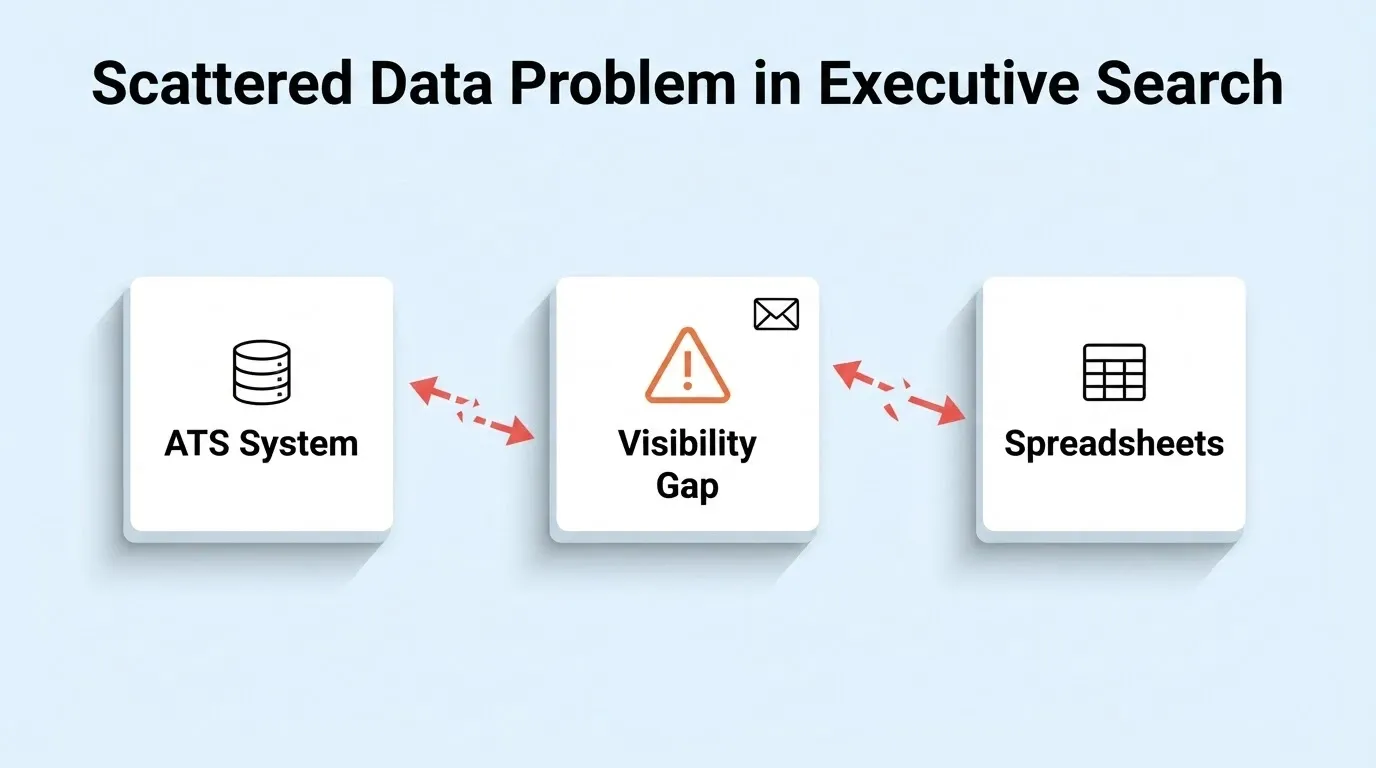
One ATS holds candidate records. Email threads carry interview notes. Spreadsheets track client updates. Reports are stale before they reach the partner's desk.
The result is invisible risk. Searches stall. Candidates disengage. Clients lose confidence. The firm loses placements it should have closed.
A Live Hiring Dashboard changes that equation.
This blog covers what it should include, how to build the right workflow into it, and which metrics actually matter.
Why Do Executive Search Firms Struggle with Search Visibility?
Running an executive search means managing dozens of candidate records, multiple client relationships, and parallel interview cycles at once. Most firms do this across disconnected tools, and the cracks show in predictable ways:
-
Candidate profiles sit in one ATS, while interview notes land in email inboxes. Recruiters waste hours copying data between systems instead of evaluating talent.
-
Client feedback gets trapped in spreadsheet tabs or Slack threads. When a partner asks for a status update, the answer requires pulling information from three different sources.
-
Search timelines have no single source of truth. Without a unified view, it is difficult to know which searches are on track and which are falling behind.
-
Reporting happens manually, if it happens at all. Weekly status reports eat into productive hours, and the data is already stale by the time it reaches stakeholders.
According to SHRM's 2025 recruiting benchmarking report, 56% of recruiting executives identified talent shortages as a top challenge. Median time-to-fill for executive roles now sits at 45 days. When information is scattered, that timeline stretches further.
Teams that invest in building internal tools with AI consolidate all of this into a single, always-current view so nothing falls through the cracks.
Scattered Data Across Executive Search Tools
Who Needs a Live Hiring Dashboard?
Not every recruiting team faces the same visibility problem. For executive search, the stakes are higher and the workflows are more complex than standard recruiting. A Live Hiring Dashboard is most valuable for:
-
Boutique executive search firms managing five or more active retained searches at once, where each search has its own client, timeline, and candidate set
-
In-house executive talent teams at large organizations running C-suite and VP-level searches with multiple internal stakeholders and approval layers
-
Search practice leads at larger staffing firms who need a consolidated view across multiple consultants' active pipelines
-
Talent operations managers responsible for reporting search progress to leadership and clients without manually assembling data each week
The common thread is clear. High-stakes searches, multiple stakeholders, and a workflow that breaks down when information is not centralized.
What Should a Recruitment Tracking Dashboard Include?
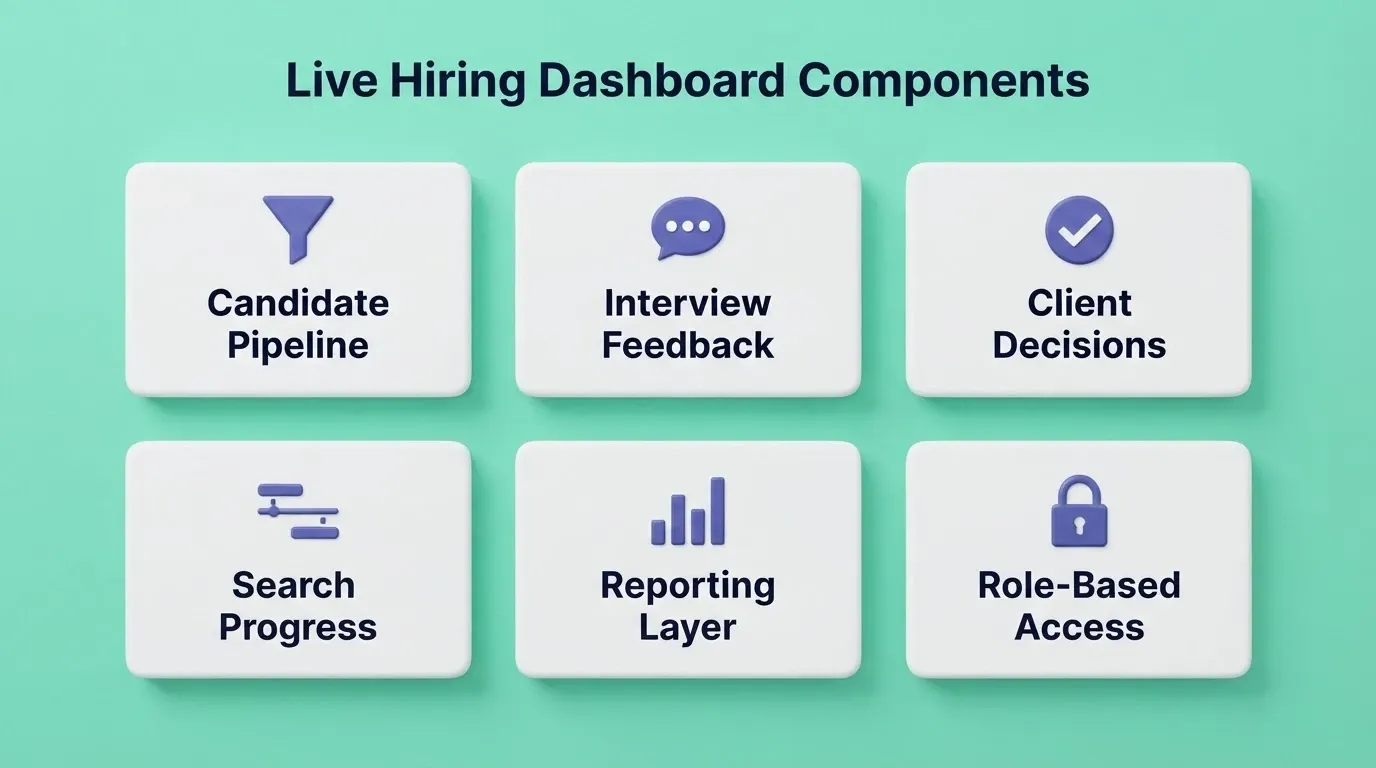
Not every dashboard solves the visibility problem. The difference comes down to which components are built into the system from the start.
| Component | What It Does | Why It Matters |
|---|---|---|
| Candidate Pipeline View | Shows every candidate by stage, from sourced to placed | Gives recruiters instant status without opening multiple tools |
| Interview Feedback Panel | Collects structured notes from evaluators | Replaces scattered email feedback with a centralized record |
| Client Decision Tracker | Logs approvals, rejections, and shortlist requests | Keeps client-side decisions visible to the full search team |
| Search Progress Monitor | Displays timelines, milestones, and days-in-stage | Flags stalled searches before they become problems |
| Reporting Layer | Surfaces time-to-fill, pipeline velocity, and fill rate | Turns raw activity data into numbers leadership can act on |
| Role-Based Access | Separate views for recruiters, partners, and clients | Protects confidential candidate data while enabling transparency |
According to time-to-hire benchmarks for 2026, executive roles hold at a median of 45 days to fill. The average hiring process now involves 13 interviews per hire, up 42% from three years ago. A recruitment tracking dashboard that connects these data points helps firms spot bottlenecks before they cost weeks.
Core Components of a Recruitment Tracking Dashboard
Read Further: How to Build a Project Tracking Web App
How Real-Time Candidate Tracking Improves Search Outcomes
Speed and visibility are directly tied to placement success. When search teams track candidates in real time, they close roles faster. They also lose fewer top-tier candidates to competitors.
57% of candidates say they have dropped out of a hiring process because it took too long. This comes from the Talent Board 2025 Candidate Experience Report, cited by noon.ai. Real-time tracking helps firms identify where candidates stall and step in before they disengage.
Median time-to-fill for executive positions sits at 45 days, while executive cost-per-hire jumped to $15,000 from $10,600. This data comes from SHRM's recruiting benchmarking report. Senior searches are getting more expensive without getting faster.
Firms using AI-assisted sourcing move from first contact to accepted offer in 28 days versus 41 for manual sourcing. That 13-day gap comes mostly from the front of the funnel. Real-time tracking identifies qualified candidates earlier and keeps momentum going.
Here is how a typical candidate moves through an executive search workflow:
Executive Search Candidate Workflow
Building the Full Search Workflow into Your Dashboard
A recruitment dashboard is only as good as the workflow it reflects. For executive search firms, that workflow runs from client intake through final placement. Each stage needs to be represented in the dashboard, not just tracked.
Stage 1: Client Intake and Search Kickoff
The search team defines the role profile, success criteria, compensation range, and timeline with the client. This creates the foundation record in the dashboard. Key fields include role title, reporting structure, must-have criteria, target companies, and agreed milestones.
The dashboard creates the search record, sets the timeline baseline, and establishes the metrics tracked throughout.
Stage 2: Sourcing and Pipeline Building
Recruiters build candidate pipelines through direct outreach, referrals, and database mining. The dashboard tracks pipeline depth per search. It shows how many candidates are in active conversation versus how many are needed to reach a shortlist.
Pipeline depth view, outreach status per candidate, and source attribution are the core outputs at this stage.
Stage 3: Screening and Structured Evaluation
Initial calls filter candidates against the role criteria. This is where most firms lose visibility. Interview notes go into email. Assessments live in personal documents. No one has a consolidated view of who said what about whom.
Structured feedback forms, scoring against defined criteria, and a consolidated evaluation view replace the fragmented record-keeping that slows decisions down.
Stage 4: Client Presentation and Feedback
Shortlisted candidates go to the client. The dashboard captures client reactions, follow-up requests, and decisions in real time. It replaces the back-and-forth email chain that typically delays this stage by days.
A well-built client portal gives clients a structured view of their shortlist with decision-capture built in. No more PDF attachments in email threads.
Stage 5: Final Interviews and Offer Management
The search narrows to two or three finalists. The dashboard monitors offer status, negotiation notes, competing offer awareness, and expected close dates. The search team gets the information they need to manage the close proactively.
Stage 6: Placement and Post-Placement Follow-Up
Once a candidate accepts, the dashboard marks the search complete and archives data for future reporting. Post-placement follow-up at 30, 60, and 90 days can be tracked here too. This is especially important for retained search firms whose reputation depends on successful placements, not just filled roles.
As Hung Lee, curator of Recruiting Brainfood, shared in LinkedIn's Future of Recruiting report:
"The single most important thing talent leaders need to do is 'AI self-enable.' You cannot make decisions about the direction of your AI-enabled Talent Acquisition team if you are not a fluent user of AI yourself."
That principle applies directly to search firms. The firms that build their own tracking tools, shaped around their own workflows, move faster and adapt to each client's unique process.
Read Further: Can AI Build an Internal Dashboard That Connects Airtable, Notion, and Mixpanel?
Choosing the Right Metrics for Your Search Dashboard
A dashboard without the right metrics is just a screen. Executive search firms need numbers that connect daily activity to client outcomes and business performance.
| Metric | What It Measures | Target Benchmark |
|---|---|---|
| Time-to-Fill | Days from search kickoff to accepted offer | Under 45 days for executive roles |
| Pipeline Depth | Number of qualified candidates per active search | 8 to 12 candidates at shortlist stage |
| Client Response Time | Days between candidate presentation and client feedback | Under 3 business days |
| Interview-to-Offer Ratio | How many interviews it takes to reach an offer | 4:1 or better |
| Fill Rate | Percentage of searches that result in a placement | Above 70% for retained searches |
| Candidate Drop-Off Rate | Percentage of candidates who exit the process | Below 20% at interview stage |
| Days-in-Stage | How long candidates sit at each pipeline stage | Flag anything over 7 days |
| Sourcing Channel Effectiveness | Which sources produce shortlisted candidates | Track per search to refine strategy |
The metrics you track should match your firm's business model. Retained search firms may prioritize fill rate and time-to-fill. Contingency firms may focus on pipeline depth and candidate response rates.
What to Look for When Choosing a Dashboard Tool
Before building or buying, executive search firms face a tool decision. The options fall into three categories, each with real trade-offs.
Off-the-shelf ATS platforms like Bullhorn, Vincere, or Loxo are built specifically for executive search. They come with candidate management, client portals, and reporting out of the box. The trade-off is that they are designed for the average search firm's workflow, not yours. Customizing them to match your specific stages, feedback structures, and client views is either expensive or not possible.
Spreadsheet and manual systems offer flexibility. You can structure them exactly as you want. The trade-off is no real-time updates, no automation, no role-based access, and significant manual overhead as the firm grows.
Custom-built dashboards give you exactly the workflow you need. Traditionally, this required a development team and months of work. That trade-off has changed significantly with AI-powered application builders. Custom tools are now accessible to professional services firms that previously had no path to custom software.
Read Further: AI Dashboard Builder to Transform Your Ideas Into Live Apps
How to Build a Custom Live Hiring Dashboard Without a Development Team
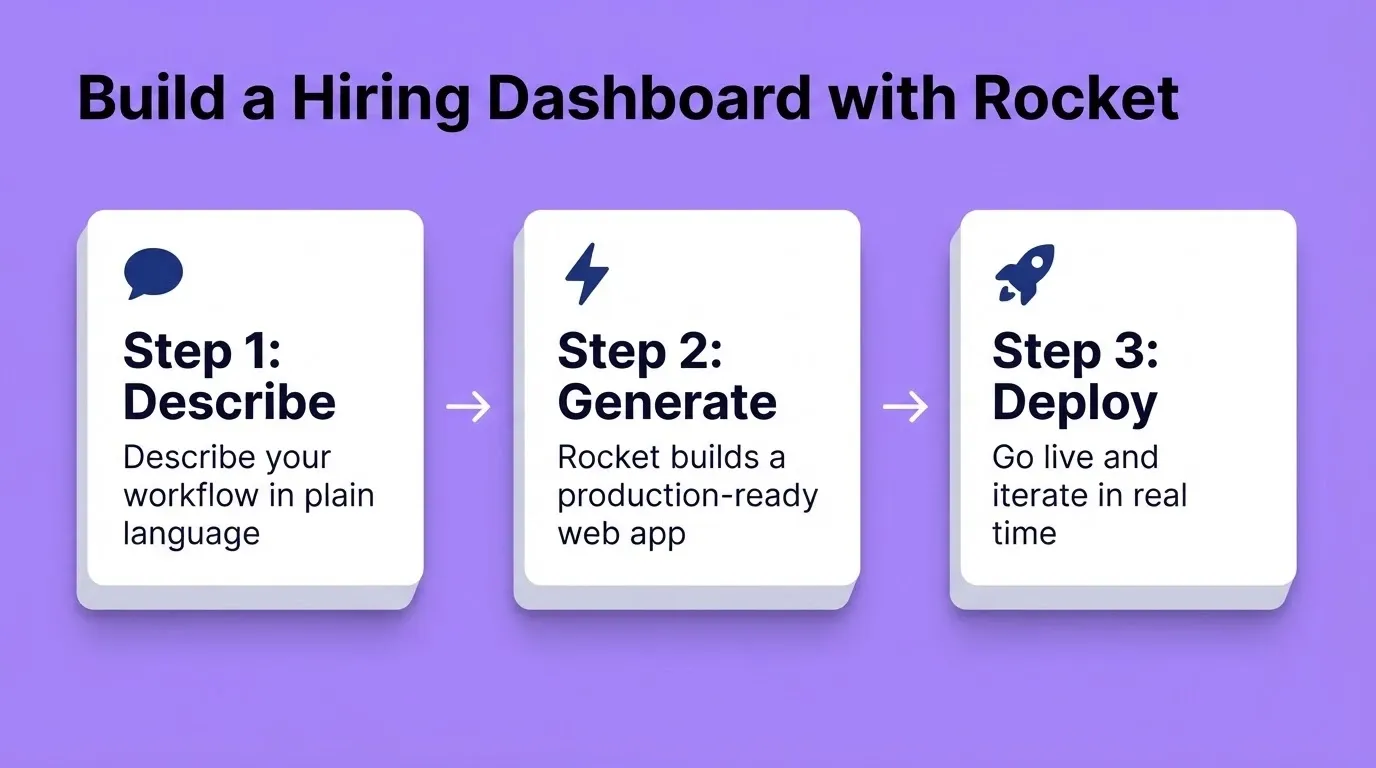
The traditional path to a custom dashboard involves hiring developers, writing a spec, waiting months, and paying six figures. That is no longer the only path. The workflow looks like this:
Step 1: Describe your search firm's process in plain language. Define what candidate stages you use, what feedback fields matter, which client views are needed, and what metrics to track. No wireframes or technical specs are required.
Step 2: Generate a production-ready web application. The output includes real-time data connections, structured forms for interview feedback, role-based views for recruiters and clients, and a reporting layer with the metrics that matter to your firm.
Step 3: Deploy to a live URL and iterate. Connect a custom domain, export to GitHub for your development team, or continue refining through conversation. Need to add a new search stage? Change a reporting metric? Describe the change and the app updates in context.
Step 4: Connect your existing tools. A well-built custom dashboard connects to the tools your team already uses. Airtable works for candidate data. Notion handles research notes. Mixpanel covers usage analytics. Supabase provides a full backend database layer.
What comes back is not a wireframe or mockup. It is a working, deployable product. Web applications are built in Next.js with SEO-ready structure, WCAG accessibility compliance, and GDPR coverage shipped as defaults. Every build includes full version history and one-click rollback.
Build a Hiring Dashboard with Rocket
Read Further: How to Build HR Onboarding Software in Minutes
The Clearest Path to Organized Executive Search
Executive search firms that centralize candidate tracking, interview feedback, and client decisions into a single live view stop guessing. They start acting on real data. The firms that build their own tools, shaped around their own workflows, consistently outperform those stuck patching together spreadsheets and generic software.
Building that system no longer takes months of development time or six-figure budgets. With AI-powered application builders, any search firm can describe its process and have a working Live Hiring Dashboard deployed within the same session.
The competitive advantage in executive search has always come from relationships and judgment. A Live Hiring Dashboard does not replace either. It removes the operational friction that gets in the way of both.
The Future of Executive Search Belongs to Firms That Own Their Data
The executive search industry is moving toward real-time, data-driven operations. Firms that rely on manual reporting and disconnected tools will find it increasingly difficult to compete. Those that build a Live Hiring Dashboard around their exact workflow will have a clear operational advantage.
The technology to build that system exists today. It no longer requires a development team or a six-figure budget. Describe your process, generate the app, and deploy. The firms that act on this now will compound that advantage over those that wait.
Start building your custom executive search dashboard with Rocket.new and give your team the real-time visibility they need to close placements faster.
Table of contents
- -Why Do Executive Search Firms Struggle with Search Visibility?
- -Who Needs a Live Hiring Dashboard?
- -What Should a Recruitment Tracking Dashboard Include?
- -How Real-Time Candidate Tracking Improves Search Outcomes
- -Building the Full Search Workflow into Your Dashboard
- -Stage 1: Client Intake and Search Kickoff
- -Stage 2: Sourcing and Pipeline Building
- -Stage 3: Screening and Structured Evaluation
- -Stage 4: Client Presentation and Feedback
- -Stage 5: Final Interviews and Offer Management
- -Stage 6: Placement and Post-Placement Follow-Up
- -Choosing the Right Metrics for Your Search Dashboard
- -What to Look for When Choosing a Dashboard Tool
- -How to Build a Custom Live Hiring Dashboard Without a Development Team
- -The Clearest Path to Organized Executive Search
- -The Future of Executive Search Belongs to Firms That Own Their Data