Agencies that connect client approvals directly to billing milestones stop losing revenue to process gaps. One unified portal replaces scattered tools, cuts payment delays, and gives every team member a single source of truth.
How much does it cost your agency when a client approval sits in an inbox for five days?
Project management research shows that only 49% of organizations deliver projects on time. For agencies juggling multiple client accounts, that gap between work completed and money collected grows quickly.
Meanwhile, approvals happen in email. Milestones live in spreadsheets. Invoices get sent from a completely different billing tool. On top of that, 97% of marketing and creative agencies report actively chasing clients for overdue payments (Clockify). That is not just a billing problem. It is a workflow problem that drains cash flow and client trust.
This blog covers what an Approval and Billing Portal does, what features it needs, how to build one, and how agencies are shipping custom portals today without a development team.
What is an Approval and Billing Portal?
At its core, an Approval and Billing Portal is a single web application. It connects client deliverable reviews, project milestone tracking, and invoice generation in one place. Instead of managing approvals in email and invoices in a separate billing tool, every step of the approval-to-payment cycle lives in one system.
In practice, the portal serves two audiences at the same time:
-
Agency teams — creative directors, project managers, and account managers who submit work, track status, and manage billing
-
Clients — who review deliverables, leave feedback, approve work, and view invoices and payment history
When both audiences share one workspace, the manual handoffs that cause delays disappear. An approval triggers a milestone. A milestone triggers an invoice. An invoice triggers payment tracking. Nothing waits for someone to send an email.
Why Do Agencies Struggle With Scattered Client Approvals?
Most agencies start small. They stitch together email threads, shared folders, and standalone billing tools. That patchwork works for a handful of clients. However, it falls apart fast once the roster grows.
Here is what that breakdown looks like in practice:
-
Approvals get buried in email. A creative director sends a design for review. The client's feedback lands three threads deep. As a result, nobody knows if the work was signed off or still pending.
-
Milestones go untracked. Without a shared system, project managers rely on memory or manual notes. Missed milestones mean delayed invoices and billing gaps that are hard to recover.
-
Invoicing lags behind actual progress. Billing teams wait for project updates before sending an invoice. This adds days or sometimes weeks to the payment cycle.
-
Payment follow-ups eat billable hours. Account managers spend time chasing overdue invoices. They should be serving clients and growing accounts instead.
-
Visibility disappears across the team. When approvals, milestones, and billing sit in different tools, nobody has a complete picture. Leadership cannot see which projects are profitable until it is too late to act.
The numbers back this up. Only 22% of organizations still plan projects using Microsoft Excel, and just 36% complete projects on budget, according to Monday.com. For agencies managing dozens of active client engagements, that gap between work done and money collected is exactly where cash flow breaks.
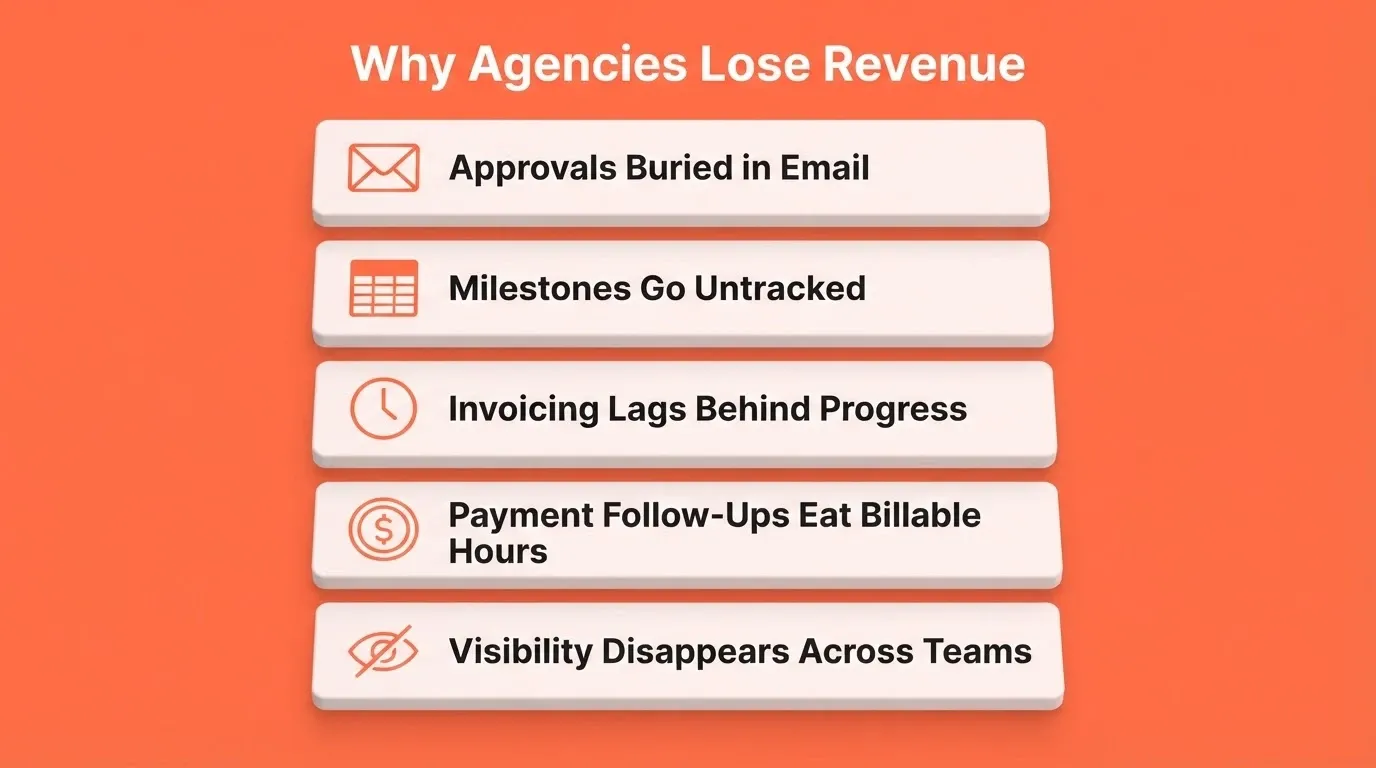
Five workflow gaps that cost agencies revenue every month.
So the fix is not another app layered on top. It is a single workspace where building a client portal with AI replaces the patchwork entirely.
What Features Does an Agency Approval and Billing Portal Need?
Before building or buying a portal, agencies need to understand which features actually solve the problem. Not every feature adds value. The core set falls into three layers, each serving a different part of the workflow.
Layer 1: Client-Facing Approval Features
These are the features clients interact with directly. If this layer has friction, clients will not use the portal and the whole system breaks down.
-
Deliverable upload and sharing — your team uploads work and the client gets a direct link, not a forwarded email with attachments
-
In-portal review and annotation — clients leave feedback in context, on the actual deliverable
-
One-click approval or revision request — a clear binary action: approve or request changes
-
Revision history and version tracking — every version and every round of feedback lives in one thread
-
Real-time status notifications — clients and team members get notified when status changes, without anyone sending a manual update
Layer 2: Internal Milestone and Billing Features
Once the client-facing layer is solid, the internal layer takes over. These features connect approved work directly to money.
-
Milestone-to-invoice automation — when a deliverable is approved, the milestone logs itself and creates an invoice line item automatically
-
Scope-linked pricing — each milestone maps to a specific deliverable and agreed price, which eliminates billing disputes early
-
Configurable payment terms — net-15, net-30, or custom schedules applied at the project level
-
Invoice generation and delivery — branded invoices sent directly from the portal
-
Payment processor integration — connect Stripe or another payment gateway so clients can pay directly from the invoice
Layer 3: Visibility and Reporting Features
Beyond the day-to-day workflow, leadership and account managers need a clear picture of what is happening across all clients. That is what this layer delivers.
-
Real-time payment dashboard — outstanding amounts, overdue invoices, and expected incoming payments across every active client
-
Automated payment reminders — polite, branded reminders sent automatically when invoices pass their due date
-
Project profitability tracking — time spent versus revenue collected per project
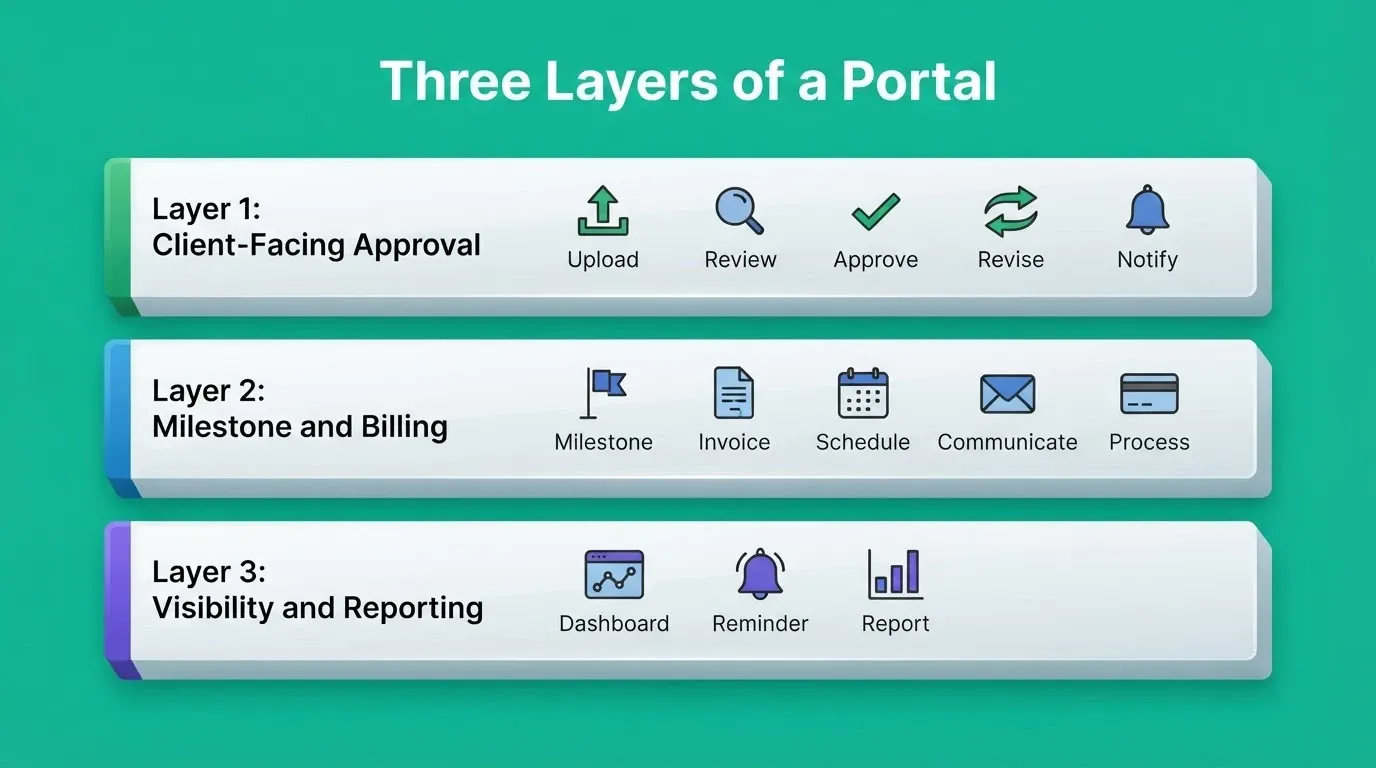
The three feature layers every agency portal needs to function end-to-end.
| Feature Layer | What It Solves | Who Uses It |
|---|---|---|
| Client-facing approval | Approval delays, lost feedback, version confusion | Clients and creative team |
| Milestone and billing | Invoice lag, billing disputes, manual data entry | Project managers and billing team |
| Visibility and reporting | Cash flow blind spots, payment follow-up overhead | Account managers and leadership |
What Does a Unified Agency Workflow Actually Look Like?
With the right features in place, the workflow changes completely. A unified Approval and Billing Portal connects every step between "work submitted" and "payment received" in one place. The creative team, the account manager, and the client all see the same status. No more chasing updates across three different tools.
Here is what that loop looks like in practice:
The approval-to-payment loop: every step triggers the next automatically, with no manual handoffs between tools.
No step requires a manual handoff between tools or people. The approval triggers the milestone. The milestone triggers the invoice. The invoice triggers payment tracking. Because of this, the whole cycle runs faster and with far fewer errors.
Sending Deliverables for Client Sign-Off
The cycle starts when your team uploads a deliverable and routes it to the right client contact for review. From there, the process is straightforward.
-
One upload triggers one notification. The client gets a direct link to the work, not a forwarded email with five attachments. They click, review, and leave feedback in context.
-
Status updates show up in real time. The portal displays whether the deliverable is pending review, approved, or sent back with notes. No more "did you see my email?" follow-ups.
-
Revision history stays visible. Every version and every round of feedback lives in one thread, so nothing gets lost between revision cycles.
When the client hits "approve," the next step fires automatically. No manual handoff required.
Logging Milestones and Generating Invoices
Once a deliverable is approved, the milestone should log itself and trigger the billing step. That connection between approval and invoicing is where most agencies lose time. Fortunately, the right portal closes that gap automatically.
-
Approved milestones automatically create invoice line items. No more waiting for a project manager to email the billing team with a status update.
-
Invoice amounts tie directly to scope. Each milestone maps to a specific deliverable and agreed price. This reduces billing disputes before they start.
-
Payment terms attach at the project level. Net-15, net-30, or custom schedules apply automatically, without manual calendar tracking.
According to Clockify, small businesses wait an average of 28.8 days for their invoices to be paid. Agencies that tie billing directly to approved milestones cut that window significantly. The invoice goes out the moment work is accepted, so the clock starts ticking sooner.
Monitoring Payment Status Without the Chase
The invoice is sent. Now what? In most agencies, someone opens a spreadsheet, checks a bank account, and manually updates the status. That process is slow, error-prone, and a waste of skilled people's time. A unified portal handles all of this automatically.
-
Automated payment tracking. The portal connects to your payment processor and updates invoice status in real time: paid, partially paid, or overdue.
-
Smart reminders replace awkward emails. When an invoice passes its due date, the portal sends a polite, branded reminder automatically.
-
Cash flow visibility at a glance. A simple dashboard shows total outstanding amounts, overdue invoices, and expected incoming payments across every active client.
Research from FreshBooks on payment terms and collection speed found that invoices with "7-day" payment terms get 58% paid within a week, compared to just 40% for 30-day terms. In other words, shorter terms combined with automatic reminders move money faster.
The pattern is simple: reduce manual steps, reduce payment delays.
How Do Unified Portals Cut Delays and Improve Cash Flow?
Switching from scattered tools to a single Approval and Billing Portal changes the math on approval speed, billing accuracy, and client retention. The difference shows up across every part of the operation.
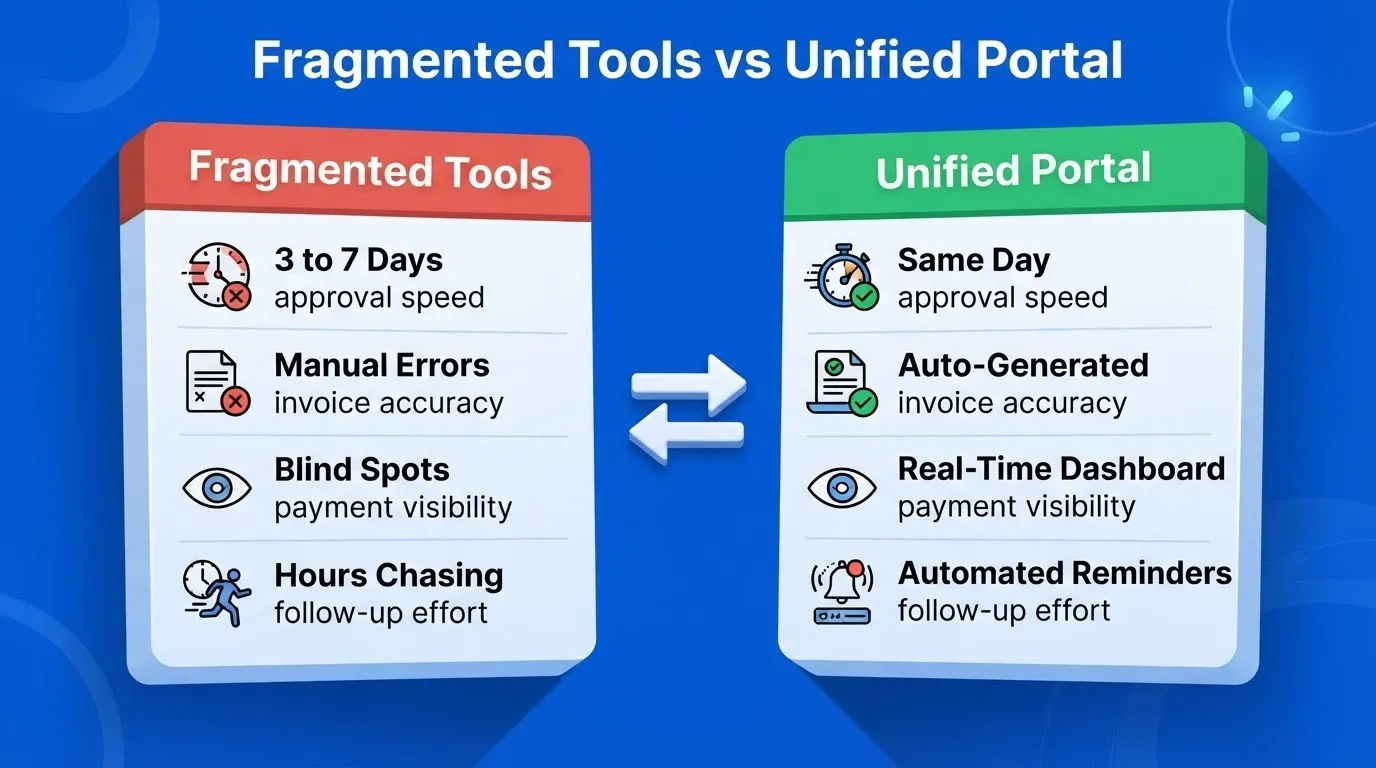
| Dimension | Fragmented Tools | Unified Portal |
|---|---|---|
| Approval speed | 3-7 days (email back-and-forth) | Same-day (in-app review and sign-off) |
| Invoice accuracy | Manual entry, frequent errors | Auto-generated from approved milestones |
| Payment visibility | Check bank statements manually | Real-time dashboard with status per client |
| Client experience | Scattered updates across channels | One login, full project and billing history |
| Follow-up effort | Account managers chase payments | Automated reminders and escalation rules |
As Mike Erickson, CEO of AFMS Logistics Management Group, puts it (via Clockify):
"Treat invoices like operational data, not paperwork. Lay out the payment terms and conditions before you close the deal with the customer. Set a clear dispute calendar, and negotiate cleaner fee definitions upfront so fewer invoices get stuck in review."
Beyond the numbers, the operational shift is just as significant:
-
Approval delays drop when friction drops. Clients are more likely to review and approve quickly when the process is a single click.
-
Billing disputes decrease when invoices match approved deliverables. Every line item links back to a signed-off milestone. This removes the ambiguity that causes payment holdups.
-
Teams reclaim billable hours. Time previously spent on status updates, invoice formatting, and payment follow-ups goes back to actual client work.
How to Build an Approval and Billing Portal: Step-by-Step
Building a custom portal used to mean a six-month development project and a five-figure budget. That is no longer the only path. Here is how agencies are building and launching custom portals today, often in a fraction of the time.
Step 1: Define Your Core Workflow
Before writing a single line of code, map the exact workflow your portal needs to support. This step is easy to skip, but it saves significant time later. Answer these questions first:
-
What types of deliverables does your agency produce? (design files, copy, video, reports)
-
How many rounds of revision does a typical project go through?
-
Who on the client side needs to approve: one person or multiple stakeholders?
-
What triggers an invoice: a single approval or a bundle of milestones?
-
What payment terms do you offer?
This workflow map becomes your build specification. The clearer it is, the faster the build goes.
Step 2: Choose Your Technical Approach
With the workflow mapped, the next decision is how to build. Agencies have three main options:
Option A: Custom-built from scratch. A development team builds the portal to your exact specification. Full control, highest cost, longest timeline. Typically 3-6 months and $30,000-$100,000 or more depending on complexity.
Option B: Configure an existing SaaS tool. Pre-built client portal tools offer fast setup but limited customization. You adapt your workflow to the tool rather than the other way around.
Option C: AI-generated custom portal. Describe the portal you need in plain language, and an AI app builder generates a production-ready web application. Full customization, fraction of the cost and time.
| Approach | Timeline | Estimated Cost | Customization |
|---|---|---|---|
| Custom development | 3-6 months | $30,000-$100,000+ | Full |
| SaaS tool configuration | 1-2 weeks | $50-$500/month | Limited |
| AI-generated portal | Hours to days | Significantly lower | Full |
Step 3: Set Up Your Backend
Once you have chosen your approach, the backend comes next. A portal needs three core components:
-
Database — to store client records, project data, deliverables, milestones, and invoices. PostgreSQL is the standard choice for structured relational data.
-
Authentication — role-based access so your team sees everything and clients see only their own projects.
-
File storage — for deliverable uploads with organized access controls.
For a deeper walkthrough on building the billing layer, see how to build a SaaS billing platform with AI.
Step 4: Connect Your Payment Processor
With the backend in place, payment processing is the next piece. Stripe is the most common choice for agency portals. It handles one-time invoice payments, subscription or retainer billing, automatic payment reminders, and webhook events that update your portal's payment status in real time. Connect Stripe to your portal's database so that when a payment is confirmed via webhook, the invoice status updates automatically.
Step 5: Build the Client-Facing Interface
The client interface needs to be simple enough that clients actually use it. Complexity here kills adoption, so focus on the essentials:
-
A clean dashboard showing active projects and pending approvals
-
A deliverable review page with annotation or comment capability
-
A clear approve or request revision action
-
An invoice history page with a pay button on outstanding invoices
Step 6: Configure Role-Based Access
With the interface built, access control is the final structural piece. Set up at minimum two roles:
-
Agency team — full access to all projects, all clients, all billing data, and admin settings
-
Client — access only to their own projects, deliverables, and invoices, with no visibility into other client accounts or agency financials
Step 7: Test Before Launch
Before inviting real clients, run through the complete workflow end-to-end. Create a test project, upload a test deliverable, log in as a test client and approve it, then confirm the milestone logs and the invoice generates. Make a test payment to confirm the invoice status updates to paid. Fix any gaps before clients encounter them.
Common Mistakes Agencies Make When Building Client Portals
Even with a clear plan, portal projects can go off track. Understanding the most common mistakes helps agencies avoid the same traps.
Building for internal teams first, clients second. The portal only works if clients actually use it. If the client-facing interface is confusing, clients will default back to email. Design the client experience first, then build the internal tools around it.
Skipping the workflow map. Agencies that start building without a clear workflow specification end up rebuilding the same features multiple times. Spending one hour mapping the workflow before touching any tool saves days of rework later.
Over-engineering the first version. A portal with client login, deliverable upload, approval actions, and invoice generation is a complete first version. Adding analytics and time tracking in version one only delays the cash flow improvements you are building the portal to achieve.
Not connecting approval to billing. Some agencies build a client approval portal and a separate billing system and never connect them. The connection between approval and invoice generation is the single highest-value feature in the entire system. Without it, the portal solves only half the problem.
Ignoring payment terms at the project level. Setting payment terms at the invoice level means someone has to remember the terms for every client. Set them at the project or client level instead, so they apply automatically every time.
Building Your Portal with an AI App Builder
For agencies that want full customization without the development timeline, AI app builders offer a practical path. Describing the portal you need in plain language and generating a production-ready web application is now a realistic option. Here is what that workflow looks like in practice.
Describe the portal. Tell the builder what you need: client login, deliverable uploads, approval workflows, milestone tracking, invoicing, and payment processing. A well-scoped prompt produces a working Next.js application with UI, navigation, backend logic, and production-ready code in the first generation.
Connect your services. For an agency portal, the core stack is a PostgreSQL database with user authentication and file storage, a payment processor for invoices and retainers, and a transactional email service for approval notifications and payment reminders. With Rocket, Stripe payment integration and 25+ other services connect directly into the build. Authenticate once and the integration is generated automatically.
Iterate through conversation. After the first generation, refine through chat. Add a new feature, adjust the approval flow, or modify the client dashboard, all without re-explaining what already exists. Each change builds on the last.
Deploy the same day. Rocket provides staging and production environments with one-click deployment. Every build ships with full version history, one-click rollback, SEO-ready structure, WCAG accessibility compliance, and GDPR coverage as the baseline.
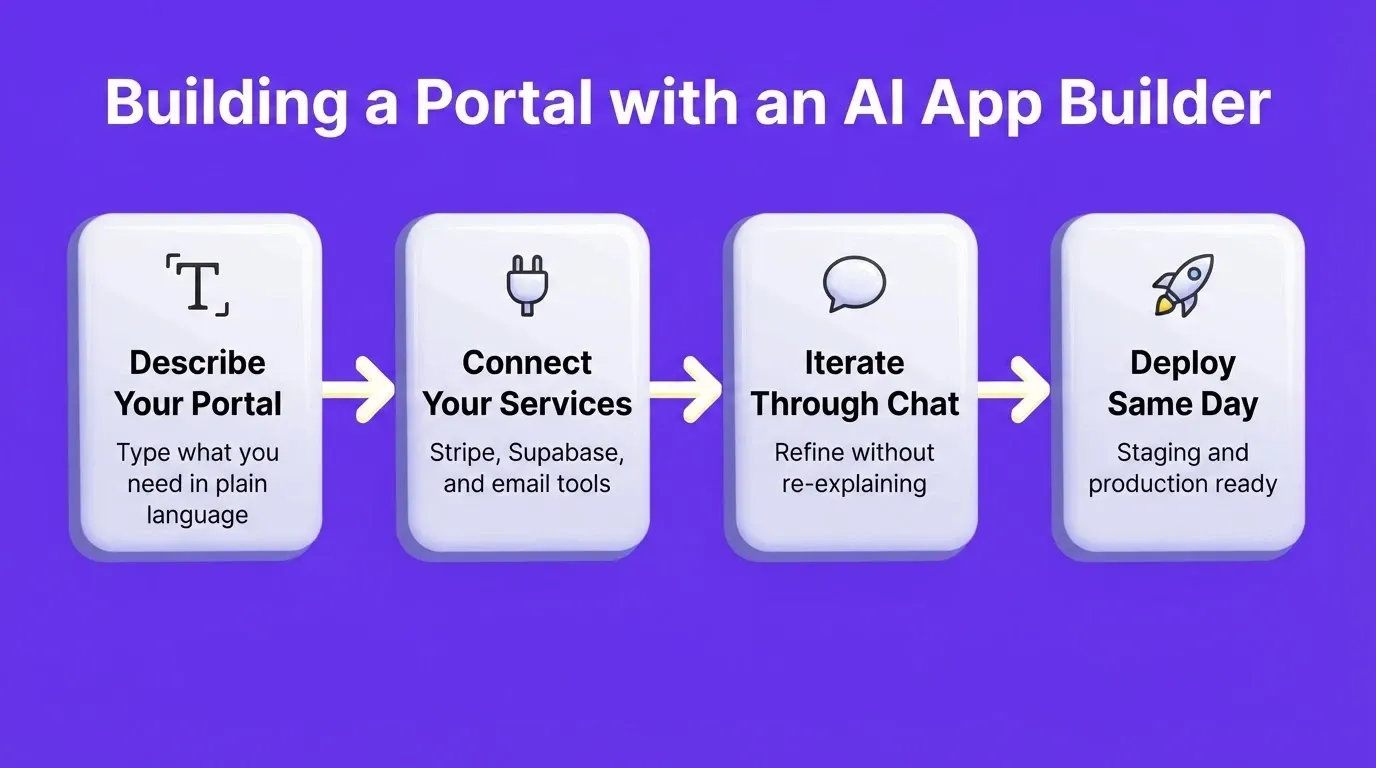
Four steps from description to deployed portal using an AI app builder.
The Approval and Billing Portal Your Agency Needs, Built Today
Agencies that connect client approvals to billing in one place stop losing revenue to process gaps. The workflow becomes clear: work gets submitted, clients approve it, milestones log automatically, invoices go out on time, and payments arrive faster.
The Approval and Billing Portal is the operational foundation agencies need now. As client expectations for transparency grow and payment cycles come under more scrutiny, agencies without a unified system will spend more time on administration and less on the work that generates revenue.
You do not need a development team or a six-month timeline. Describe what your agency needs, build it, and give your clients a portal they actually want to log into. Start building with Rocket today.
Table of contents
- -What is an Approval and Billing Portal?
- -Why Do Agencies Struggle With Scattered Client Approvals?
- -What Features Does an Agency Approval and Billing Portal Need?
- -Layer 1: Client-Facing Approval Features
- -Layer 2: Internal Milestone and Billing Features
- -Layer 3: Visibility and Reporting Features
- -What Does a Unified Agency Workflow Actually Look Like?
- -Sending Deliverables for Client Sign-Off
- -Logging Milestones and Generating Invoices
- -Monitoring Payment Status Without the Chase
- -How Do Unified Portals Cut Delays and Improve Cash Flow?
- -How to Build an Approval and Billing Portal: Step-by-Step
- -Step 1: Define Your Core Workflow
- -Step 2: Choose Your Technical Approach
- -Step 3: Set Up Your Backend
- -Step 4: Connect Your Payment Processor
- -Step 5: Build the Client-Facing Interface
- -Step 6: Configure Role-Based Access
- -Step 7: Test Before Launch
- -Common Mistakes Agencies Make When Building Client Portals
- -Building Your Portal with an AI App Builder
- -The Approval and Billing Portal Your Agency Needs, Built Today