
What happens when operations scale faster through business process automation with ai? It shifts everyday workflows into smarter systems that reduce manual effort, sharpen decisions, and help teams focus on meaningful, strategic work.
What happens when business process automation software with AI meets real‑world operations?
In fact, 78% of organizations now use AI in at least one business function. This shift isn’t just a tech trend; it’s a serious growth lever. It improves operational efficiency, helps teams focus on strategic work, and transforms business processes from static routines into dynamic, data-driven workflows.
For businesses already familiar with automation, this guide dives deeper into AI-powered business process automation software, showing how it drives growth, where it works best, and what makes adoption smooth.
Why AI Matters in Process Automation Today?
AI isn’t some general futuristic idea anymore. It’s embedded in the latest process automation technologies and is reshaping business operations in ways many companies hadn’t imagined.
The shift from traditional automation to AI-driven solutions is huge. While old-school tools handled repetitive steps, AI adds intelligence. It learns, predicts, and even recommends. So, automation isn’t just about doing tasks faster; it’s about doing them smarter.
Here’s what AI brings to the table:
- Natural language processing (NLP) extracts insights from contracts, emails, and documents.
- Machine learning learns from historical data and improves results over time.
- AI agents trigger workflow actions automatically, sometimes without human prompting.
The key takeaway?
AI adapts.
That makes processes more flexible, resilient, and ultimately growth-oriented. And that’s exactly what today’s businesses need.
The Tangible Benefits of AI in Automation
When organizations layer AI on top of their automation stack, the results become obvious. Teams often start by automating routine tasks such as data entry and scheduling. Then, as confidence grows, they tackle more complex areas.
Some of the benefits that catch attention immediately:
| Area | Traditional Automation | Intelligent Automation |
|---|---|---|
| Manual data entry | Scripts handle tasks | AI improves accuracy and catches errors |
| Rule-based workflows | Executes fixed steps | Learns from patterns and adapts |
| Reporting | Scheduled exports | Predictive insights suggest trends |
| Customer inquiries | Standard replies | Understands context with NLP |
| Compliance checks | Checklist verification | Detects anomalies automatically |
Simply put, AI makes workflows smarter, reducing human error while freeing teams to focus on strategic initiatives.
Common Use Cases for AI-Driven Business Process Automation
Each function in a business has its own flavor of AI automation.
Let’s look at where it’s making the biggest impact.
Marketing and Sales
- Automate repetitive tasks like lead scoring and follow-ups.
- Use predictive analytics to prioritize leads and campaigns.
- AI tools personalize messages based on customer interactions and historical data.
Customer Service
- Chatbots handle first-line inquiries using natural language processing.
- AI suggests answers to complex queries, reducing response times.
- Teams can focus on higher-value interactions to improve customer satisfaction.
Finance and Accounting
- Invoice processing and matching use machine learning to reduce errors.
- Compliance management flags inconsistencies automatically.
- Forecasting models anticipate cash flow shifts, aiding resource planning.
Supply Chain and Logistics
- AI analyzes demand trends and proactively adjusts inventory.
- Supply chain management becomes predictive rather than reactive.
- Predictive maintenance reduces downtime, keeping operations smooth.
Across these cases, AI doesn’t replace humans. The combination of artificial intelligence and rule-based logic turns standard processes into adaptable, strategic workflows.
Community Insight: Real Experiences from Leaders
On Reddit, one business leader shared:
“78% of global companies now use AI in operations, and nearly 90% are using or exploring it. Adoption is fueled by tools that make workflows smarter, not just automatic.”
This underscores a simple fact: teams adopting AI automation are thinking beyond mere efficiency. They’re building workflows that learn, adapt, and drive real business value.
Steps to Integrate AI into Your Workflows
So, you’re ready to bring AI into your business automation stack.
Where should you start?
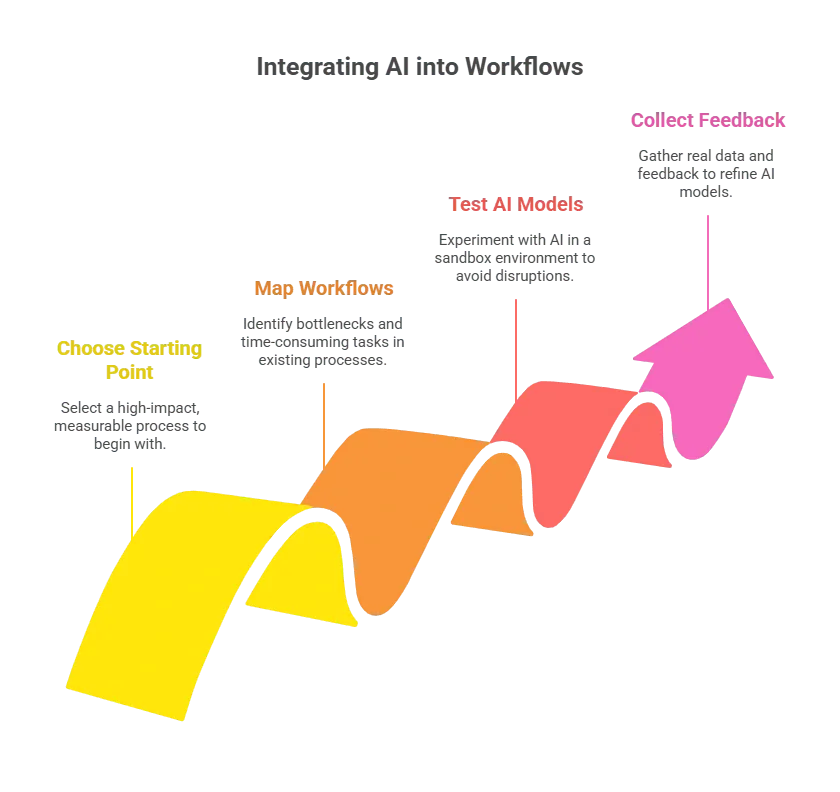
Starting small helps teams gain confidence. It also prevents overcommitment to tools that might not fit existing business workflows.
Challenges to Watch Out For
Even though AI sounds appealing, there are pitfalls to consider:
- Technical debt can be costly if systems aren’t built with change in mind.
- Human intervention is still needed for governance, reviews, and exception handling.
- Employee resistance is a real factor during change management.
- Not all processes benefit from AI. Some manual processes may still be faster or simpler without automation.
Acknowledging these challenges upfront ensures smoother adoption and better outcomes.
Picking the Right Automation Tools
Choosing tools isn’t just about shiny features.
Ask these questions:
- Can it integrate smoothly with existing systems?
- Does it leverage machine learning to improve outcomes?
- Can it handle complex tasks beyond simple repetition?
- Does it support compliance, reporting, or data analytics?
A strong solution helps automate complex processes and provides insights by analyzing historical data.
How Rocket.new Connects to AI Automation
Rocket.new is a vibe solution platform that provides AI-powered automation. It’s designed to help teams prototype, test, and deploy automation quickly without getting lost in technical complexity.
Key Features:
- AI-assisted workflow design to plan tasks faster
- Visual interface for mapping complex workflows
- Prebuilt templates for common business processes
- Collaboration tools for team efficiency
With Rocket.new, teams can experiment with AI-driven automation and see immediate results, seamlessly connecting design and execution.
👉Build Your Business Automation tools with Rocket.new
Measuring Growth from AI-Powered Automation
Numbers make the benefits real.
Here’s what to track:
- Time saved on repetitive tasks
- Error reduction in manual processes
- Cycle time improvements in key workflows
- Customer satisfaction changes from faster responses
- Cost savings from fewer errors and optimized operations
When measured consistently, these metrics demonstrate whether AI business process automation is contributing to growth.
Business Process Automation Software With AI
Smart use of business process automation software with AI transforms tedious workflows into strategic assets. Teams can focus on decision-making, creativity, and higher-value work rather than being bogged down by routine tasks. With careful planning, the right tools, and attention to data, AI automation delivers measurable results and sets a foundation for sustainable growth.
Table of contents
- -Why AI Matters in Process Automation Today?
- -The Tangible Benefits of AI in Automation
- -Common Use Cases for AI-Driven Business Process Automation
- -Marketing and Sales
- -Customer Service
- -Finance and Accounting
- -Supply Chain and Logistics
- -Community Insight: Real Experiences from Leaders
- -Steps to Integrate AI into Your Workflows
- -Challenges to Watch Out For
- -Picking the Right Automation Tools
- -How Rocket.new Connects to AI Automation
- -Measuring Growth from AI-Powered Automation
- -Business Process Automation Software With AI