TDD pairs a failing test with the smallest fix, then cleans up the code. Vitest, Playwright, and React Testing Library lead for TypeScript stacks. Generate a production-ready codebase on Rocket.new and sync to GitHub to start testing from day one.
TDD promises fewer bugs and safer refactors, but choosing the right tooling is where most teams stall. The method is simple on paper: write a failing test, write just enough code to make it pass, refactor, repeat. The hard part is matching a framework to each step of that feedback loop for your specific stack.
According to the State of JS 2024 survey, over 7,200 developers still use Jest at work, but Vitest now ranks first in interest and overall positivity (State of JS 2024).
The testing world is shifting fast. So instead of listing test frameworks alphabetically, this guide maps each tool to the testing layer and the red-green-refactor step it serves best.
Key takeaways
-
Match tools to testing layers: unit, component, E2E, API, and mutation each need a different framework.
-
Vitest is increasingly the first choice for new TypeScript projects; Jest still leads in professional adoption.
-
TDD works with AI-generated code: write the failing test first, then let the AI write the green-phase code.
-
Three recommended stacks cover most teams: Next.js + TypeScript, Lean Startup, and Enterprise.
-
Rocket.new generates production-ready Next.js and Flutter codebases you can wrap in your own TDD workflow from day one.
What is Test-Driven Development and Why Does Tooling Matter?
Test-driven development (TDD) is a software development practice in which you write a failing test before writing any production code, then write just enough code to make that test pass, then refactor.
The red-green-refactor loop repeats for each small piece of behavior you add. Kent Beck formalized the approach in his book Test-Driven Development: By Example (Addison-Wesley, 2002), and it remains the foundational reference for the methodology**.**
Tooling matters because the cycle only holds if feedback is fast. A slow runner, a framework that fights TypeScript, or a CI setup that breaks on every push will cause teams to skip tests rather than fix the tool. The right test-driven development tools make the loop feel effortless; the wrong ones make it feel like punishment.
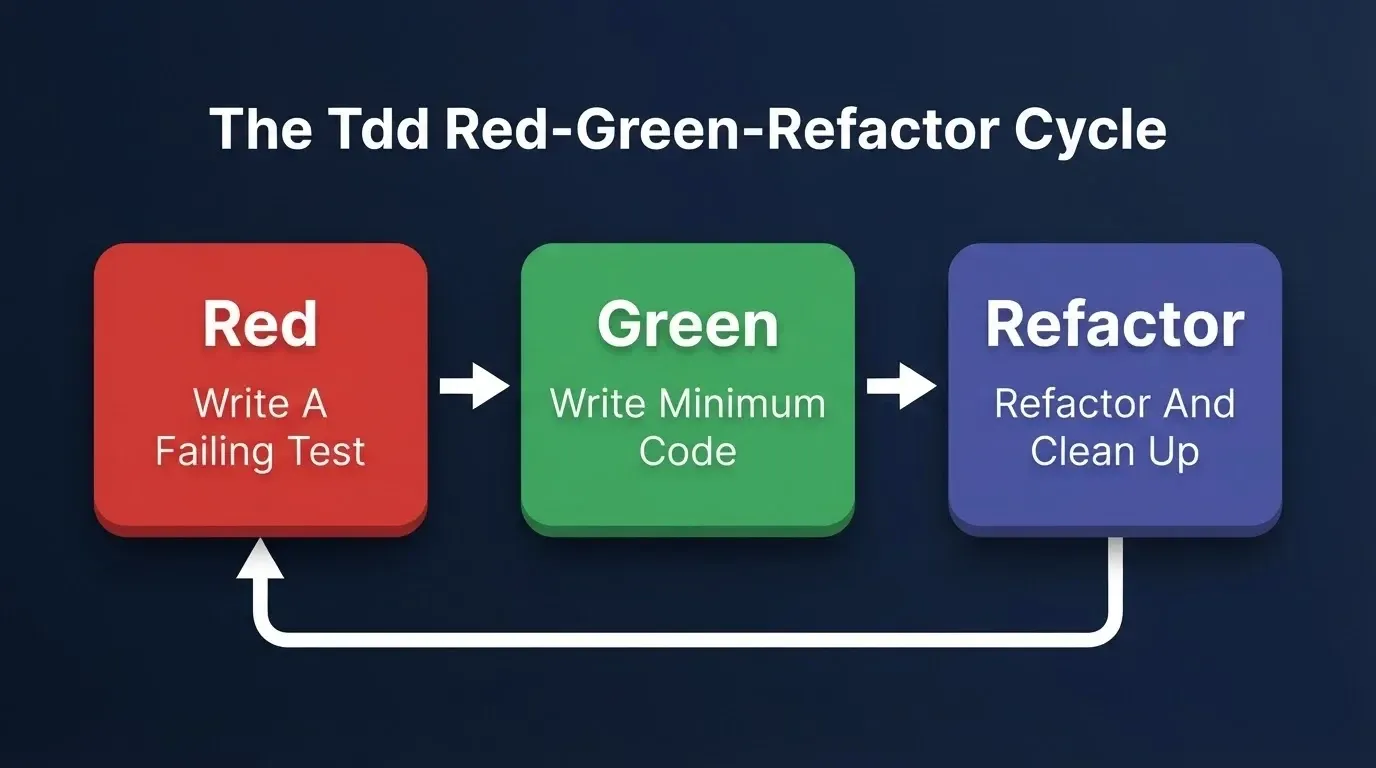
The red-green-refactor cycle: three connected phases that repeat for every behavior you add.
When you pick a tool for this cycle, five criteria matter more than anything else:
-
Speed. A slow test runner breaks the feedback loop. If a single test takes three seconds to run, you stop running it after each edit, and the red-green-refactor rhythm collapses.
-
Watch mode. Rerunning tests on file save keeps you inside the cycle. Tools with native watch mode, like Vitest, remove friction from writing tests and checking results.
-
Mocking support. Production code depends on external services, databases, and APIs. Good mock tooling lets you isolate the unit under test so each failing test points to the actual code that needs a fix.
-
TypeScript support. If your framework requires extra config to handle .ts files, you lose time before you write a single test case. Native TypeScript support means tests and production code share the same type system.
-
CI fit. Automated tests in a pipeline catch regressions that local runs miss. A tool that maps cleanly to GitHub Actions keeps TDD working for the whole team, not just one developer.
Quick Picks
| Goal | Best Tool |
|---|---|
| Best overall for TypeScript | Vitest |
| Best for existing codebases | Jest |
| Best cross-browser E2E | Playwright |
| Best for simpler E2E setups | Cypress |
| Best for startups | Jest + Supertest |
Which Frameworks Handle the Unit Layer?
Vitest and Jest handle the unit layer best for JavaScript and TypeScript stacks. For Python, use pytest; for Java, use JUnit. Each runs the red-green-refactor loop at the function level, where feedback is fastest.
Unit testing is where the red-green-refactor loop runs fastest. You write a test for one function or module, watch it fail, then write just enough code to pass. A quick feedback loop at the unit layer is what makes test-driven development (TDD) sustainable across thousands of test cases.
-
Vitest has become the first choice for new TypeScript and Next.js projects in 2026. It runs on Vite's dev server, so test execution is significantly faster than bundler-based runners. Watch mode is built in, TypeScript works without config, and the API mirrors Jest closely enough that migration from an existing codebase is painless.
-
Jest still dominates in professional settings, with over 7,200 respondents using it at work. It handles mocking, snapshot testing, and code coverage in one package. For teams with a large suite of Jest tests, the switching cost to Vitest is real, and Jest remains a reliable choice.
-
pytest (Python) and JUnit (Java) serve the same TDD purpose outside the JavaScript world. pytest offers fixtures and parameterized tests that simplify writing tests for complex failure scenarios. JUnit, paired with Mockito for mocking, anchors test-driven development in the Java ecosystem.
Here is a real example. Say you want a function that formats currency in a Next.js and TypeScript project. In a test-first approach, you write the failing test before the actual code exists:
TypeScript
1// formatCurrency.test.ts
2// RED: this test will fail - formatCurrency does not exist yet
3import { describe, it, expect } from 'vitest';
4import { formatCurrency } from './formatCurrency';
5
6describe('formatCurrency', () => {
7 it('formats a number to USD string', () => {
8 expect(formatCurrency(1999)).toBe('$19.99');
9 });
10});
Run it. The test fails because formatCurrency does not exist yet. That failing test is exactly what you want in the red phase. Now write just enough code to make the test pass:
1// formatCurrency.ts
2// GREEN: the minimum code to pass
3export function formatCurrency(cents: number): string {
4 return `$${(cents / 100).toFixed(2)}`;
5}
Run the test again. It passes. Now enter the refactor phase. The simple implementation breaks on negative values. Replace it with Intl.NumberFormat for correctness:
1// formatCurrency.ts
2// REFACTOR: correct edge cases, tests still pass
3export function formatCurrency(cents: number): string {
4 return new Intl.NumberFormat('en-US', {
5 style: 'currency',
6 currency: 'USD',
7 }).format(cents / 100);
8}
Your test told you when you were done writing code, and it caught the edge case during refactor. That discipline is the core of test-driven development (TDD), and it works the same way whether you use Vitest, Jest, pytest, or JUnit.
What About flutter_test for Mobile?
For teams building mobile apps with Flutter and Dart, the built-in flutter_test framework follows the same test-first pattern. You write a widget test that expects certain behavior, watch it fail, implement the widget, and confirm the test passes. Because Rocket generates Flutter for mobile apps, this matters: you can scaffold a Next.js web app or a Flutter mobile app and immediately start writing tests for the generated production code.
If you are exploring the right mobile framework for your stack, this comparison of mobile app development frameworks covers the trade-offs in detail.
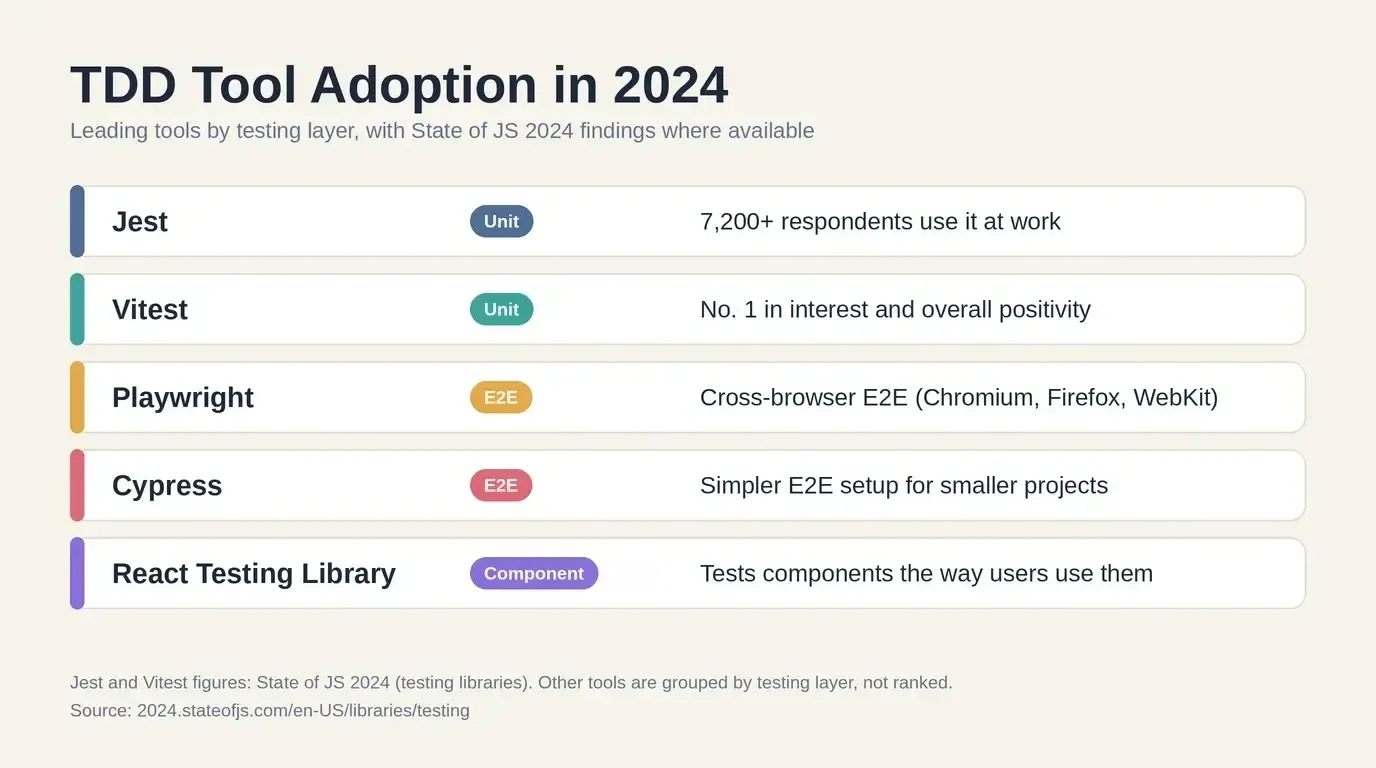
Developer adoption and interest rankings across the major TDD frameworks in 2024.
How Do Component and End-to-End Layers Fit the TDD Cycle?
React Testing Library handles the component layer; Playwright is the default for E2E. Component tests verify user-facing behavior without breaking on internal refactors; E2E tests catch bugs that unit tests miss entirely.
TDD does not stop at unit tests. Component tests and end-to-end (E2E) tests extend the same write-fail-fix-refactor rhythm to larger slices of behavior. The trade-off is speed: E2E tests run slower, so you write fewer of them, but they catch failure scenarios that no unit test would surface.
-
React Testing Library tests components the way users interact with them, querying DOM elements through roles, labels, and text content rather than internal component structure. This approach keeps tests resilient during refactoring because the tests do not break when you rename a prop or restructure a module.
-
Storybook interaction tests let you write test scenarios directly inside stories. You get visual confirmation of component behavior alongside automated assertions. For teams that care about design and functionality at the same time, this is a practical way to run test-driven workflows without leaving the design review process.
-
Playwright supports Chromium, Firefox, and WebKit from a single test file. It runs headless by default, handles auto-waiting so flaky test failures drop, and includes a built-in API testing layer. For teams practicing TDD at the E2E level, Playwright's speed and cross-browser reach make it the default choice.
-
Cypress runs tests inside the browser itself, which gives you a visual test runner, real-time reloading, and automatic screenshots on failure. It supports Chrome-family browsers natively, with Firefox support and experimental WebKit. The trade-off: parallel execution trails behind Playwright, and the free tier has test recording limits.
"It's rare to see a trend as clear as Vitest's ascension through the ranks over the past few years. While it may 'only' be number four in terms of usage, it already tops the interest, retention, and overall positivity rankings." State of JS 2024 (source)
That quote captures a larger pattern: the spec-first mindset that defines TDD is also reshaping how developers choose their testing stack. Fast feedback, native TypeScript support, and clean mocking now outweigh legacy familiarity.
For teams building React apps, understanding which React UI library fits your project is a natural companion decision to picking your testing framework.
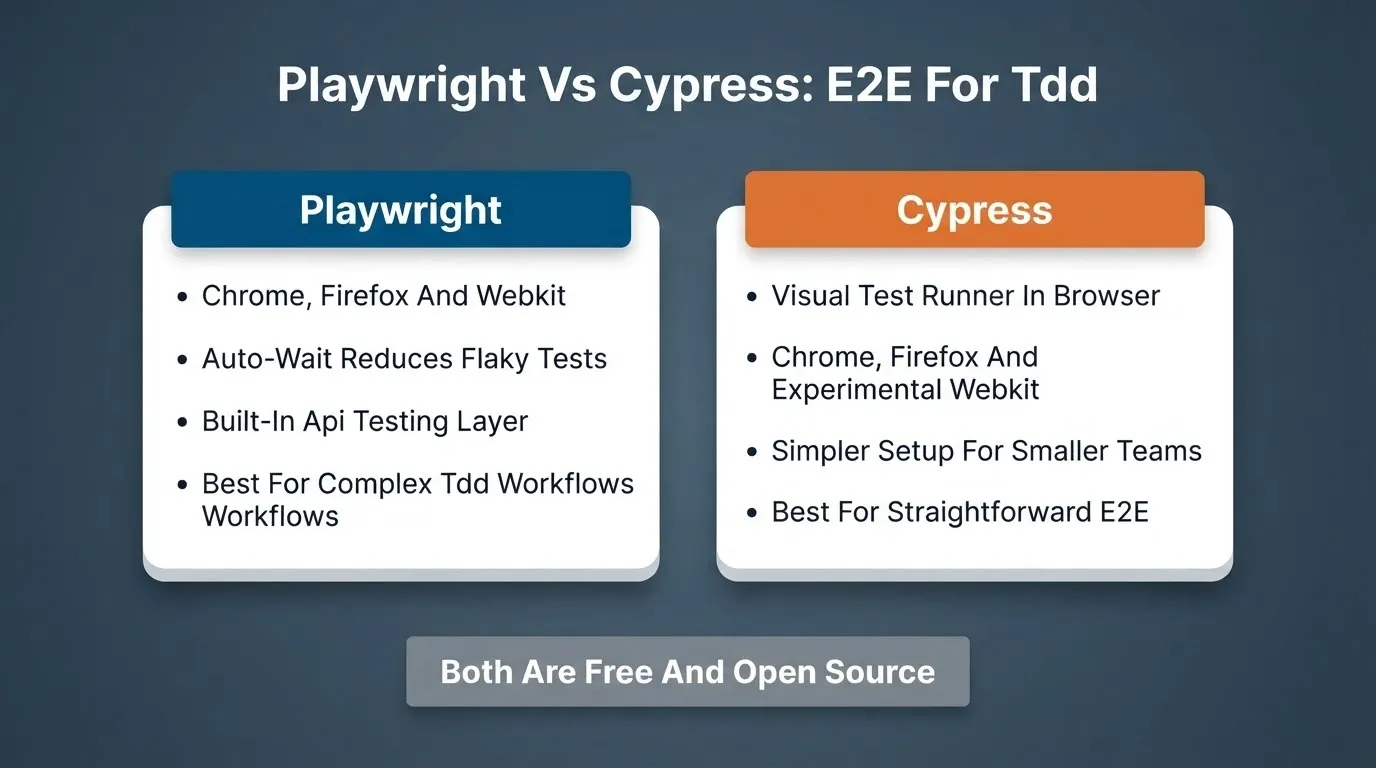
Playwright and Cypress serve different TDD needs: choose based on browser coverage requirements and team complexity.
What About API Contracts, Mutation, and Coverage?
Supertest covers API route testing; MSW handles browser-level network mocking; Newman runs Postman contract collections in CI; Stryker catches gaps in your test suite. Together they close the failure scenarios that unit and E2E tests leave open.
Testing layers beyond E2E catch failure scenarios that other test types miss. API contract testing confirms that your backend and frontend agree on data shapes. Mutation testing tells you whether your automated tests are actually catching bugs or just running green without meaning.
-
Supertest pairs with Express or Next.js API routes to send HTTP requests and assert on responses. In a TDD workflow, you write a failing test for an endpoint that does not exist, build the route handler, and watch the test pass.
-
MSW (Mock Service Worker) intercepts network requests in the browser at the service worker level, letting your component tests run against controlled API responses without touching a real server. MSW reduces test failures caused by network instability, which keeps your automated tests reliable.
-
Newman is the open-source Postman collection runner. For teams that manage API contract definitions in Postman, Newman plugs those contracts into CI pipelines so they run as automated tests on each commit.
-
Stryker (mutation testing) modifies your production code and checks whether your tests detect the change. If a mutation passes without any test failures, your test suite has a gap. Stryker tells you where your coverage numbers lie to you. It works with JavaScript, TypeScript, and several other languages.
-
Istanbul / c8 measure line, branch, and function coverage. c8 uses V8's native coverage collection and runs faster on Node.js projects. Coverage numbers alone do not prove quality, but they flag areas where you have not implemented any tests at all.
Each of these tools fills a gap that unit and E2E tests leave open. A complete TDD setup uses them together, and the common pitfalls of skipping API or mutation testing usually show up as technical debt later.
Master Tool Comparison
| Tool | Layer | Language | Speed | Learning Curve | Free / Paid | Pick This If... |
|---|---|---|---|---|---|---|
| Vitest 2.x | Unit | TypeScript, JS | Very fast | Low | Free (OSS) | Starting a new TypeScript project |
| Jest 29.x | Unit | TypeScript, JS | Fast | Low | Free (OSS) | Migrating from an existing Jest suite |
| pytest 8.x | Unit | Python | Fast | Low | Free (OSS) | Python backend or data pipeline |
| JUnit 5.x | Unit | Java, Kotlin | Fast | Medium | Free (OSS) | Java or Spring Boot service |
| flutter_test | Unit + Widget | Dart | Fast | Low | Free (built-in) | Flutter mobile app |
| React Testing Library 16.x | Component | TypeScript, JS | Fast | Low | Free (OSS) | React component layer |
| Storybook 8.x | Component | TypeScript, JS | Medium | Medium | Free + Paid | Visual and functional component tests |
| Playwright 1.x | E2E | TS, JS, Python, Java, .NET | Fast | Medium | Free (OSS) | Cross-browser E2E or API testing |
| Cypress 13.x | E2E | TypeScript, JS | Medium | Low | Free + Paid | Simpler E2E with visual runner |
| Supertest 7.x | API | TypeScript, JS | Very fast | Low | Free (OSS) | Testing Express or Next.js API routes |
| MSW 2.x | API mocking | TypeScript, JS | Fast | Low | Free (OSS) | Mocking network calls in browser tests |
| Newman 6.x | API contract | Any (Postman) | Fast | Low | Free (OSS) | Running Postman collections in CI |
| Stryker 8.x | Mutation | TS, JS, C#, Scala | Slow | High | Free (OSS) | Auditing test suite quality |
| Istanbul / c8 | Coverage | TypeScript, JS | Fast | Low | Free (OSS) | Measuring line and branch coverage |
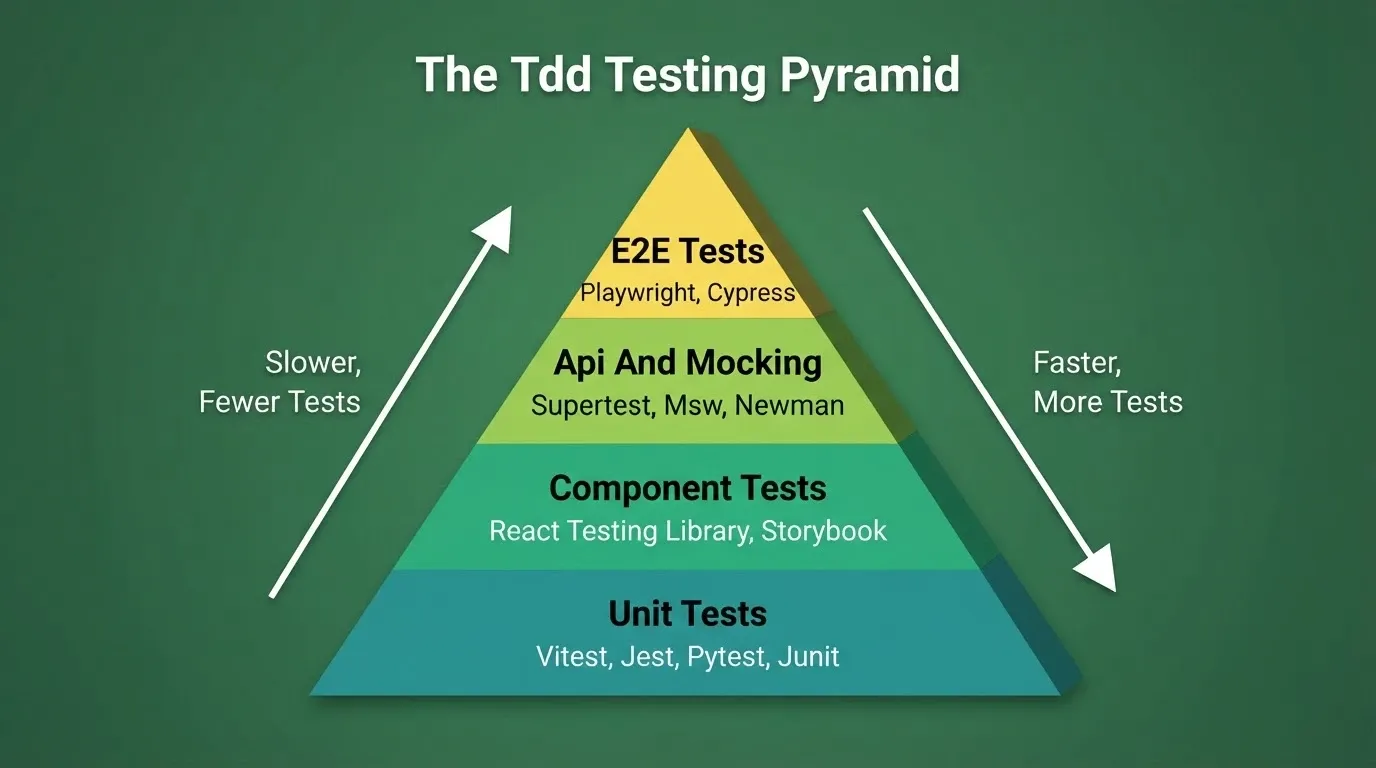
The testing pyramid: write more unit tests at the base and fewer E2E tests at the top for the fastest overall feedback loop.
Which Stack Should You Pick for Your Team?
Picking individual tools is half the decision. The other half is assembling them into a stack where each tool covers a testing layer and all of them share the same development environment. Here are three recommended stacks drawn from common TDD practice and iterative development patterns across different team sizes (agileKRC).
Recommended TDD Stacks by Team Type
| Stack | Unit | Component | E2E | API | Mutation | Best For |
|---|---|---|---|---|---|---|
| Next.js + TypeScript | Vitest | React Testing Library | Playwright | MSW | Stryker | Full-stack TypeScript teams where speed matters |
| Lean Startup | Jest | - | Cypress | Supertest | - | Small teams wanting minimal config and fast setup |
| Enterprise | Jest or Vitest | React Testing Library | Playwright | Newman | Stryker | Large orgs needing cross-browser coverage and API contracts |
According to the GitHub Octoverse 2024 report, TypeScript climbed to the third most-used language on GitHub while Next.js ranked among the top ten public projects by contributors. That means the community, tooling, and CI examples around this stack are mature enough that writing tests, running them, and fixing bug-fixes is well-documented.
For teams focused on building an MVP fast, the Lean Startup stack removes friction. Jest works out of the box with minimal config, Cypress handles E2E without complicated setup, and Supertest covers backend routes.
Can TDD Work With AI-Generated Code?
Yes. Write the failing test first, then let the AI write the green-phase code. Your test suite becomes the acceptance criteria the AI must satisfy. This is one of the strongest use cases for TDD in 2026.
AI code generators, including Claude Code, Copilot, and platform-level builders, can produce working code from a natural language description. The risk: generated code might satisfy a prompt without satisfying correctness. TDD helps answer that question.
-
Write the test first, generate the code second. You describe the expected behavior in a test file. Then you let an AI tool generate the production code. If the generated code passes your failing test, you have verified it works for that specific case.
-
TDD becomes the quality gate for AI output. When Claude Code or another agent generates a function, your test suite is the single source of truth. A passing test means the generated code implemented the behavior correctly. A failing test tells you exactly where it went wrong.
-
Where this works well: pure functions, data transformations, CRUD route handlers, and utility modules. These produce deterministic output that automated tests can verify.
-
Where it gets harder: UI layout, visual polish, and multi-step workflows with side effects. These need manual testing or visual regression checks alongside TDD.
The test suite acts as documentation and a safety net at the same time, and TDD helps developers maintain confidence even when AI implemented most of the code.
For teams that want to try this pattern, AI-generated test cases can speed up the red phase too. You describe a feature, the AI writes edge cases you had not considered, and you add them to your suite before the production code exists.
If you are new to working with AI coding agents, this guide to using AI prompts to improve software quality covers the prompting patterns that pair best with a TDD workflow.
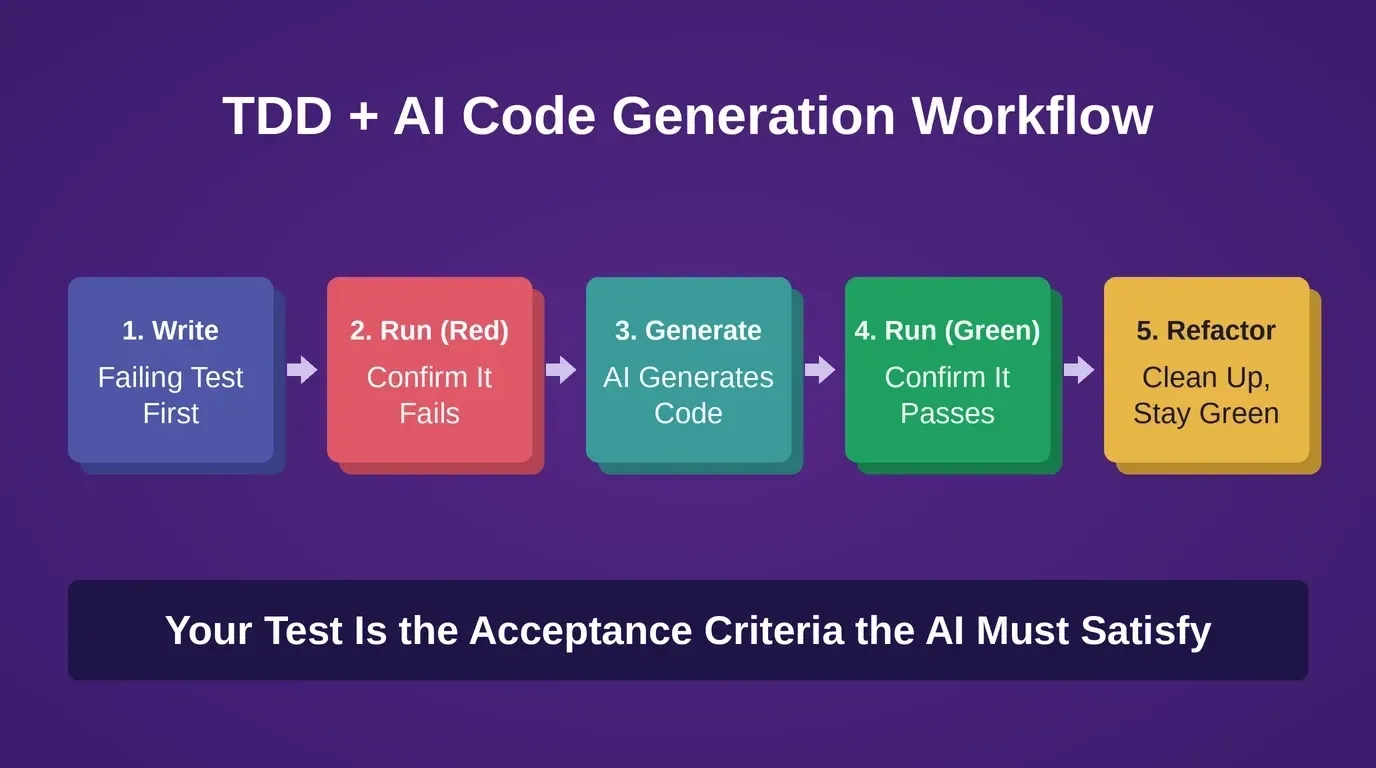
The TDD and AI workflow: your failing test defines what the AI must produce, and your passing test confirms it worked.
How Rocket Fits Into a Test-First Workflow
Rocket.new is the vibe solutioning platform for builders and founders: research markets with Solve, build production-ready apps with Build, and track competitors with Intelligence. For TDD practitioners, the relevant piece is Build, which generates real Next.js TypeScript and Flutter codebases you can download or connect to GitHub.
Rocket is not a testing tool. It does not run your tests or generate test files by default. What it does is produce the production-ready codebase that you wrap in your own TDD workflow.
GitHub sync and CI. For Next.js TypeScript projects on a Pro plan or above, Rocket supports two-way GitHub sync. When you push, Rocket sends changes to a rocket-update branch and automatically opens a pull request to main. That PR is where your CI pipeline runs: your Vitest, Playwright, or Stryker suite executes on every proposed change before anything merges. For Flutter and other frameworks, sync is one-way and manual, so you push to GitHub when you are ready, and your CI runs from there.
Versions and Code diff. Every Rocket Build message saves a version. Before a risky refactor, create a label on the current version (web apps only) and push to GitHub. If you need to go back, Rollback reverts your project to that version instantly, but note that rolling back permanently discards every later version, including labels and checkpoints, and cannot be undone. The push to GitHub is your real safety net. The Code diff view shows exactly what changed between versions, which pairs well with reviewing AI-generated green-phase code before you run your test suite against it.
Advisor Agent. When the coding agent loops on a bug, Rocket's Advisor Agent, a read-only architect sub-agent running on Claude Opus, is invoked automatically after two or more failed fix attempts. It diagnoses root causes rather than symptoms, returns structured analysis with numbered implementation steps, and never writes code itself. Your failing test still tells you whether the fix worked.
Rocket handles scaffolding; your test suite owns correctness. The code Rocket generates is standard Next.js or Flutter, not a proprietary format. Your tests treat it the same as hand-written code.
To see how Rocket's production workflow connects build, test, and deploy, the full walkthrough covers the end-to-end pipeline in detail.
Note:* Rocket.new accounts are free and take about 30 seconds to create. Generate a Next.js TypeScript app, push to GitHub, and let your test suite own correctness from the first commit.*
Your Test Suite Is the Spec That Matters
The right combination of Vitest, Playwright, and a solid mocking layer turns the red-green-refactor rhythm into a repeatable process for any TypeScript team. Add AI code generation to the mix in 2026, and TDD stops being a discipline exercise. It becomes the spec that tells you whether generated code is correct, which reduces technical debt and bug fixes down the line.
Pick the stack that fits your team size and project requirements, write the first failing test, and let the tools do the rest. The methodology has not changed since Kent Beck described it, but the tools have never been better.
Ready to start with a production-ready codebase you can test from day one? Sign up for Rocket and generate a Next.js or Flutter app in about 30 seconds, sync it to GitHub, and let your test suite own correctness from the first commit.
Table of contents
- -What is Test-Driven Development and Why Does Tooling Matter?
- -Quick Picks
- -Which Frameworks Handle the Unit Layer?
- -What About flutter_test for Mobile?
- -How Do Component and End-to-End Layers Fit the TDD Cycle?
- -What About API Contracts, Mutation, and Coverage?
- -Master Tool Comparison
- -Which Stack Should You Pick for Your Team?
- -Recommended TDD Stacks by Team Type
- -Can TDD Work With AI-Generated Code?
- -How Rocket Fits Into a Test-First Workflow
- -Your Test Suite Is the Spec That Matters