
Rocket.new builds production-ready SaaS with backend, security, and scalability from day one. Lovable focuses on fast UI prototyping to validate ideas quickly. Choose Rocket.new for real customers and growth; Lovable for early-stage validation.
What is the real difference between building a B2B SaaS on Rocket.new and building the same product on Lovable?
The short answer: Rocket.new ships production-ready code to real users from day one, while Lovable helps you validate your idea with polished UI prototypes fast.
The no-code/low-code development space is increasingly competitive, with various platforms offering distinct strengths in terms of speed, design, and production readiness.
According to industry analysts and Statista, the global low-code platform market is projected to reach $65 billion by 2027, and founders now have more tools than ever to build SaaS products. Picking the wrong platform early costs money and stalls progress.
Both tools let you create web apps without a full engineering team. The difference shows up when your SaaS product needs to scale, serve paying customers, or handle complex server systems.
Rocket.new vs Lovable: Development and Code Quality
The split comes down to the code each platform produces.
Rocket.new generates full-stack projects following enterprise software development standards, with backend logic and API design built in from the start.
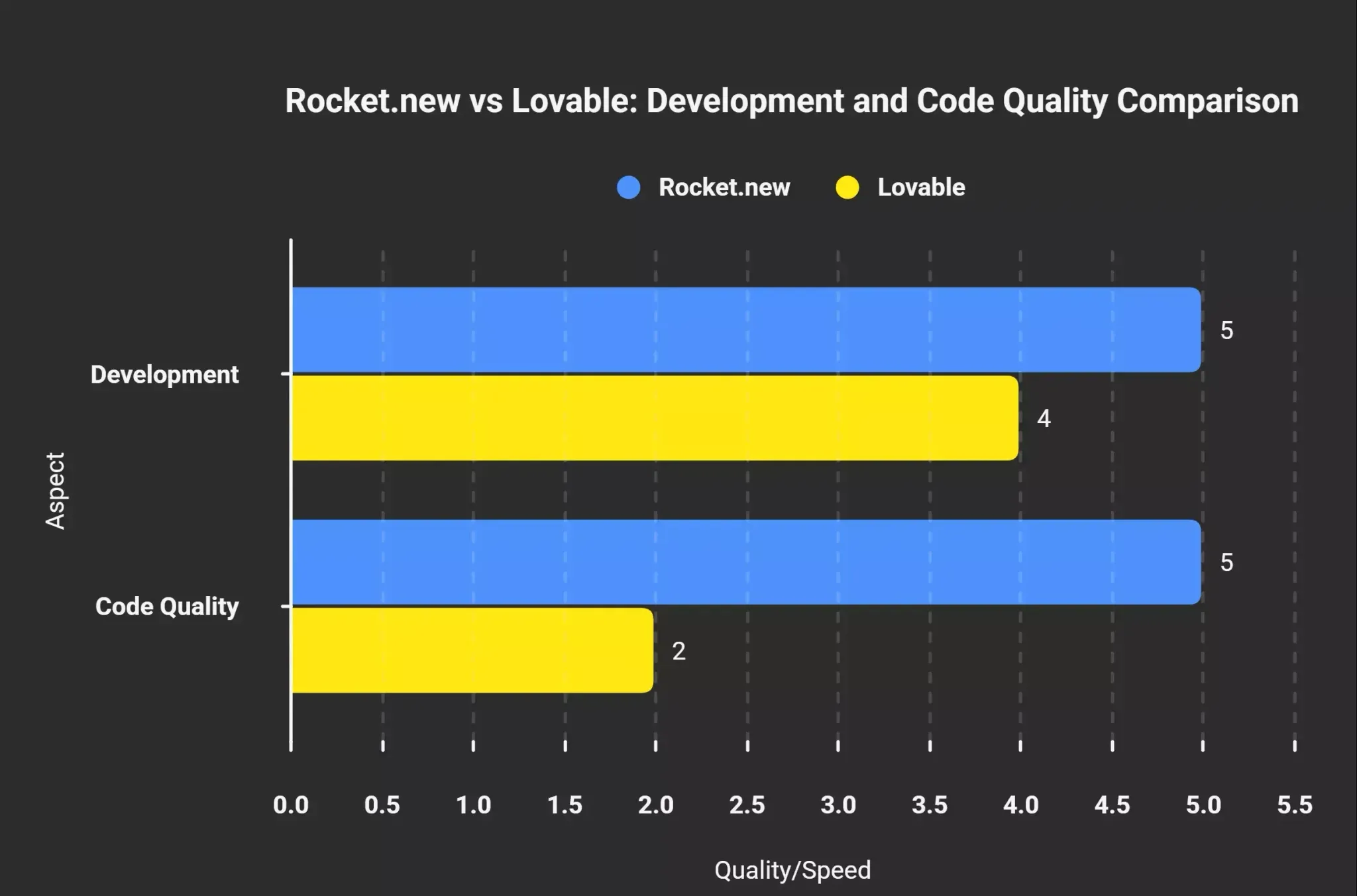 Lovable focuses on UI speed through vibe coding, an approach where developers describe what they want in plain language, and AI writes the code, producing apps quickly without a traditional code editor.
-
Rocket.new produces output with built-in error handling and security out of the box, with no major cleanup needed before shipping to enterprise customers
-
Lovable transforms ideas into shareable apps and websites fast, making it a go-to prototyping option for startups that want to validate a concept quickly
-
Rocket.new supports Flutter (mobile) and Next.js (web), covering both apps without switching tools, frameworks, or programming languages
-
Lovable integrates natively with Supabase and Stripe, removing setup friction for early project phases and giving developers a fast path from idea to shareable prototype
Many developers use Lovable to prove an idea works visually, then move to Rocket.new when the product needs to scale. Vibe coding is useful for speed, but complex SaaS features like multi-tenant architecture and data isolation require more than a fast prototype.
Past experience is proof: the time Lovable saves in the early idea phase often gets spent fixing technical debt later. Startups that account for this when they search for a platform at the start avoid rebuilding from scratch.
So, that code difference shows up in your monthly bill too.
Rocket.new vs Lovable: Pricing, Money, and Scalability
Both Rocket.new and Lovable start their paid plans at $25/month, making them accessible for individual developers and small prototypes. That is where the similarity ends.
How you spend money during development directly affects your runway and your ability to reach paying customers.
| Feature | Rocket.new | Lovable |
|---|---|---|
| Base price | $25/month (Build plan) | $25/month (credits) |
| Hosting | Included | $25/month extra |
| Cross-platform | Flutter and Next.js | Browser-focused |
| Credits | Expire per plan | Expire per plan |
| Team members | Unlimited | Unlimited users |
Both Rocket.new and Lovable are designed to help users rapidly create and launch applications with minimal setup, but their scalability differs significantly based on their pricing models.
Rocket.new's credit model gives teams control over spend. Hosting and deployment are included in every plan, so there is nothing extra to figure out. Credits do not expire, so there are no wasted charges at the end of any billing cycle. Startups managing their runways carefully will hear that difference in their monthly bills.
Lovable's unlimited user plan is interesting for larger teams that want many collaborators to join without per-seat fees. Lovable's Business tier includes SSO and workspace permissions, which B2B companies often need. For a small team validating a concept, the credit model from Rocket provides better long-term value and more predictable costs.
The control over spend is a real differentiator in the world of B2B SaaS, where every dollar spent on development has to justify itself against customer acquisition costs.
What People Are Saying
Builders in the community using these tools talk openly about this choice. Here is a developer's take, cited from community feedback on the Rocket.new blog:
"I tested Rocket vs Lovable using the same prompt. One gave me a pretty shell, the other gave me a working product with backend, logic, and UI." - Source
That pattern shows up across the community. Prototype speed is real, but so is the proof of the cleanup work that follows when code is not production-ready. Startups that account for technical debt in their project planning avoid rebuilding from scratch.
Next, Rocket.new was built to close exactly these gaps.
How Rocket.new Powers B2B SaaS Development
Rocket.new is not just a UI builder or a workflow option. It is a full development platform built around three products: Solve (strategic research and planning), Build (app generation and deployment), and Intelligence (competitor tracking). Together, these tools cover software development from idea to a shipped product that B2B customers can rely on.
-
Vibe-solutioning platform: Rocket.new covers research, building, and monitoring from one workspace
-
Vibe coding with 25k+ free templates across frameworks, saving up to 80% of AI tokens compared to building from scratch
-
Flutter and Next.js support for mobile apps from the same project, with no tools to switch between
-
Collaboration features are built in, so teams can track progress without switching context or adding more services
-
Stripe and backend integrations available to connect from one workspace
-
Enterprise-grade security and production-ready code from the first build, so your apps meet compliance standards out of the box
-
3 Products, One Platform: Solve, Build, and Intelligence for the full B2B SaaS workflow
Where Rocket.new is the go-to choice for B2B teams:
-
Startups that want to validate a business idea and ship to enterprise customers without rebuilding twice
-
Small teams scaling their product without a large engineering department
-
Products that need cross-platform support from the same project
-
Founders who need to control credit spend and keep costs predictable as they scale to new customer segments
Rocket takes your prototype to a production system that enterprise customers trust. The technology behind complex business rules, data handling, and backend services is built in from the start.
The B2B SaaS Decision
What is the real difference between building a B2B SaaS on Rocket.new and building the same product on Lovable?
Lovable helps you show your idea to the world fast, and that is genuinely valuable for early validation. Rocket.new helps you build a SaaS product that scales to enterprise customers without accumulating technical debt along the way.
For startups focused on shipping real software to paying customers and wondering where to start, Rocket is the go-to solution and the platform worth committing to from the beginning.
Start building a production-ready B2B SaaS today, no rebuilds, no technical debt.