
Rocket.new Intelligence surfaces competitor signals weeks before public announcements by monitoring hiring patterns, pricing page changes, messaging shifts, and GTM moves across ten pillars simultaneously. This post explains what the earliest signals are, how cross-pillar AI-powered detection works, and why Rocket.new is the only platform that connects them all into a personalized daily brief for every team.
Why Announcements Are Always the Last Signal
By the time a competitor's press release hits your inbox, the decision was made months ago. The real question is: what were the signs, and did you catch them in time?
Rocket.new Intelligence answers that question every single day. It watches companies you care about across every public surface they operate on website, social media, hiring boards, news, traffic, product, GTM, finance, and reviews, and tells you not just what changed, but what it means for your business.
The competitive intelligence software market is growing at a 19.96% CAGR, projected to reach USD 1.46 billion by 2030 (Mordor Intelligence), and the reason is simple: the teams that see competitor moves first win.
AI adoption in competitive intelligence grew 76% year over year, with 60% of teams now using AI tools daily to save time by scanning signals that would take an analyst days to review.
Think about the last time a competitor surprised you with a big move. A new product launch. A pricing overhaul. An enterprise push. It felt sudden, but was it really?
Strategic changes do not happen overnight. They are planned, resourced, and executed over weeks or months. And during that entire period, the company is leaving traces everywhere. They are posting new job listings. Their website copy is shifting. Their CEO is posting on LinkedIn about enterprise-grade reliability. Their ad spend is moving toward new audience segments. They are attending different conferences.
Every one of those moves is a signal. The problem is that most teams are not watching all those surfaces at once. They are waiting for the announcement. That gap, between when the strategy starts and when it gets announced, is exactly where Rocket.new Intelligence operates. And for sales teams, product teams, and founders who need to stay ahead, that gap is the difference between reacting and winning.
Which Competitor Signals Appear Weeks Before a Press Release?
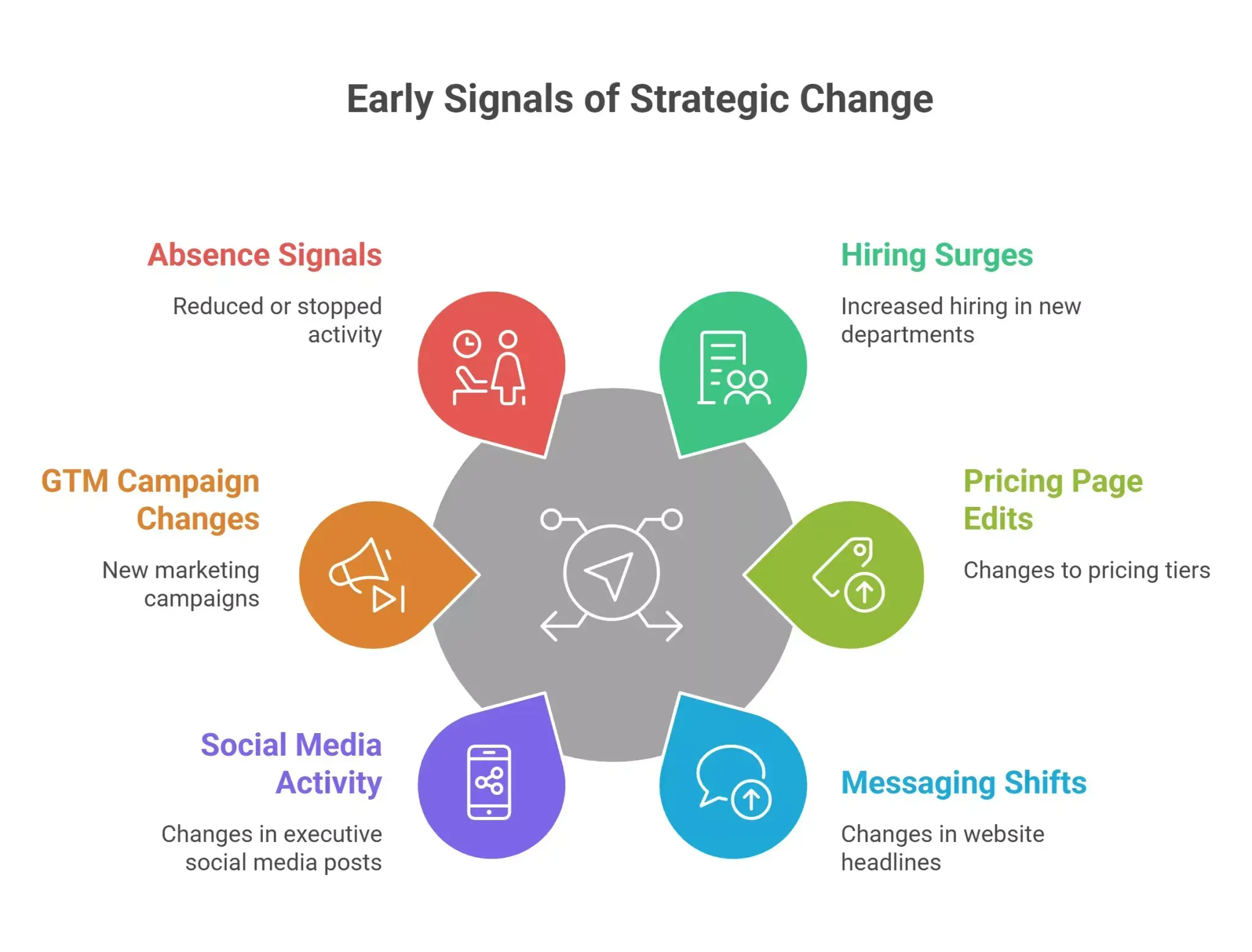
The answer depends on the type of strategic change, but there are consistent patterns across every major move a company makes. Here are the early signals and early warning signs that typically surface first, long before any public announcement:
-
Hiring surges in new departments: When a company opens five ML engineering roles in two weeks, that is a product investment signal. When they post their first VP of Customer Success alongside a cluster of enterprise sales roles, that is an expansion signal. Job postings are often the earliest visible trace of a strategic bet.
-
Pricing page edits: A competitor quietly adding an enterprise tier to their pricing page is a strong signal of an upmarket move. This happens weeks before any press release or sales team announcement.
-
Messaging shifts on the website: When a competitor's homepage headline changes from "fast and affordable" to "enterprise-grade reliability," that is not a copywriting refresh. That is a positioning shift.
-
Social media activity patterns: A CEO who suddenly starts posting about scale, security, or compliance is telegraphing a direction change. Rocket.new tracks executive social media activity as part of its Social Media pillar.
-
GTM campaign changes: New LinkedIn ads targeting IT decision-makers, or a sudden increase in sponsored developer conference presence, are GTM signals that precede a product launch by weeks.
-
Absence signals: A competitor that posted twice daily goes quiet for two weeks. A regularly updated changelog stops getting entries. These absences can be as significant as activity.
The challenge is not finding any one of these signals. It is connecting all of them simultaneously, and that is where most teams fall short. That is also where waiting for a press release becomes the most expensive mistake a team can make.
How AI-Powered Cross-Pillar Signal Detection Works
This is where Rocket.new Intelligence does something no manual process or basic alerting tool can replicate. A single signal is a data point. A cluster of signals across multiple pillars is a strategy becoming visible.
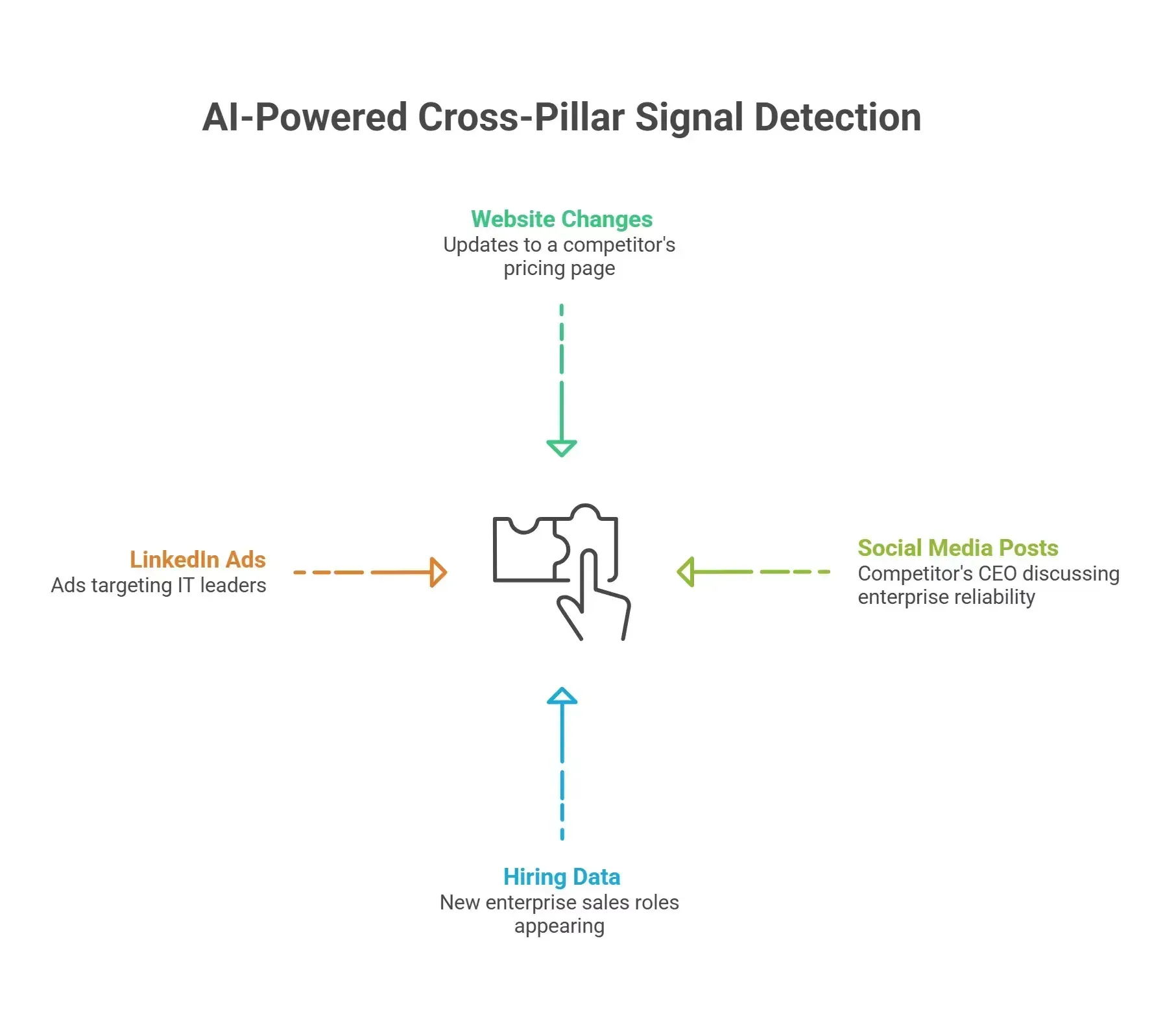 Consider this example from Rocket.new's own documentation: a competitor preparing an enterprise push might generate signals across four pillars simultaneously. Their pricing page adds an enterprise tier (Website). Their CEO posts about enterprise-grade reliability (Social). Five new enterprise sales roles appear (People). Their first LinkedIn ads targeting IT leaders go live (GTM).
Each signal alone is moderate. Together, they reveal a coordinated strategy with high confidence. Rocket.new's AI-powered cross-pillar pattern detection surfaces this as a single connected Intel item, not four separate notifications you have to piece together yourself.
This is the core of what makes Rocket.new Intelligence different from a collection of alerts. It is an interpretation layer, not a notification system. The platform is continuously waiting for patterns to emerge across surfaces, and when they do, it connects them automatically.
Generative AI raises prediction accuracy by 33% and cuts data-processing time by 45% when unifying structured and unstructured feeds (Mordor Intelligence). Rocket.new's AI-powered engine is built on exactly this capability, fusing signals from website changes, social media posts, hiring data, and more into a single coherent picture.
Why Hiring Patterns Beat Press Releases Every Time
If you had to pick one single pillar that surfaces competitor moves the earliest, it would be People and Hiring. Fewer jobs posted quarter over quarter can indicate a competitor's contraction, providing insights into their growth trajectory and revenue outlook.
Hiring decisions are made before any other public action. A company decides to build a new product, and the first thing they do is hire engineers. They decide to go upmarket, and the first thing they do is post enterprise sales roles. They decide to expand into a new geography, and the first thing they do is hire a regional lead.
According to Rocket.new's People and Hiring pillar documentation, hiring patterns are often the earliest indicator of a move, appearing months before any public announcement. New leadership hires in particular often signal a direction change within 3-6 months.
Here are some real examples of what this looks like in practice:
-
A competitor hires their first VP of Customer Success alongside a cluster of enterprise sales roles, suggesting enterprise expansion is imminent
-
Engineering hiring surges from 5 open roles to 19 in two weeks, signaling major product investment
-
A CTO departs with no replacement posted for three weeks, indicating a leadership gap and potential strategic pause
-
A Glassdoor rating drops from 4.2 to 3.6 over three months, pointing to internal morale issues that may precede a reorg
None of these appear in a press release. All of them appear in Rocket.new's People and Hiring pillar, often weeks before any public announcement. For sales teams preparing for competitive deals, this kind of early visibility is the background for the call that changes outcomes.
What Rocket.new's Daily Brief Tells You Before Anyone Else
Every day, Rocket.new Intelligence produces a structured brief for each company you follow. This is not a raw feed of alerts; it is a synthesized picture of everything that moved across all surfaces in the past 24 hours.
The daily brief has three parts:
| Section | What It Contains |
|---|---|
| Signals and Insight | A synthesized paragraph connecting everything that moved across surfaces into one strategic picture |
| Observed Events and Patterns | The specific evidence, every signal detected and contributing to the synthesis |
| What This Means for Your Business | A direct implication written in the context of your competitive position |
The daily brief arrives before the workday starts. Sales teams read it before a call. Product teams read it before sprint planning. The competitive picture is current, interpreted, and connected to your next decision, not waiting in a spreadsheet somewhere.
This is not a list of links. Not a news digest. A competitive picture, personalized to your role and ready to act on. And because it is personalized, a sales leader and a product manager see the same underlying signals ranked differently, each getting what matters most for their specific context.
How Rocket.new Reads Competitor Signals Across Multiple Data Sources
Rocket.new Intelligence monitors companies across ten pillars simultaneously. Each pillar tracks a different dimension of competitor activity, and together they cover every public surface a company operates on.
Here is what each pillar watches:
-
Website Intelligence: Homepage copy, pricing page changes, new landing page additions, blog updates on competitor websites
-
Social Media: Company posts, executive activity, engagement patterns, content themes
-
News and Media: Third-party press coverage, editorial tone, journalist relationships
-
GTM: Paid campaigns, creator partnerships, SEO content clusters, developer marketing
-
Traffic: Visitor volumes, channel mix, SEO rankings, audience demographics
-
Product and Technology: Releases, GitHub activity, API changes, changelog entries
-
People and Hiring: Open roles, hiring velocity, executive moves, employee sentiment
-
Business and Finance: Funding signals, pricing strategy changes, partnership announcements
-
Reviews and Community: G2 ratings, app store reviews, Reddit and Hacker News sentiment, customer feedback
-
Overview: Cross-pillar summary with confidence scores and significant signals:
The key insight is that one real-world event creates signals in several pillars at once. A product launch creates signals in Website, Social, GTM, and Product simultaneously. A strategic pivot creates signals in Website messaging, People hiring, and GTM ad themes at the same time.
Rocket.new connects those dots automatically, surfacing emerging patterns across multiple data sources that no single-pillar tool would ever catch.
"Hiring signals are often the earliest indicator of a move, appearing months before any public announcement." — Rocket.new Intelligence Documentation
This is what it means to have access to real competitive intelligence, not just data, but interpretation. And it is the reason why 45% of marketers say understanding market trends and customer expectations is the biggest benefit of competitive intelligence (Semrush survey, 2026).
What About Competitor Pricing and Messaging Shifts?
Competitor pricing changes and messaging shifts are two of the most strategically important signals, and two of the easiest to miss if you are only checking manually.
Pricing changes are among the fastest-moving signals in competitive markets, and companies that monitor competitor pricing in real time gain a competitive edge in sales calls.
The Pricing page just looks different one day. There is no announcement. By the time your sales teams notice during a deal, you are already playing catch-up. Rocket.new's Website Intelligence pillar watches competitor websites continuously and flags pricing page updates, new tier additions, and feature modifications the moment they happen.
Messaging shifts work the same way. When a competitor changes their homepage headline, rewrites their About page, or starts using new language around their core value proposition, that is a positioning shift. It tells you what they are now competing on, who they are now targeting, and what they think the market wants to hear.
Rocket.new catches these market changes in real time, not when someone on your team happens to visit the competitor's website. And because it is tracking patterns across multiple surfaces simultaneously, a pricing page change combined with new enterprise sales hiring and a shift in social media themes is not three separate alerts. It is one Intel item telling you a competitor is going upmarket.
That is the difference between market signals and market intelligence.
How Rocket.new Compares to Traditional Competitive Intelligence Tools
Most teams doing competitor analysis today are either doing it manually, refreshing websites, scanning LinkedIn, piecing together signals from five different tools into a spreadsheet, or using point solutions that only watch one surface at a time.
Here is how that compares to what Rocket.new Intelligence offers:
| Capability | Manual / Point Solutions | Rocket.new Intelligence |
|---|---|---|
| Coverage | 1-3 surfaces | 10 pillars simultaneously |
| Frequency | Weekly or monthly | Continuous, daily brief |
| Cross-pillar patterns | Manual piecing together | Automatic detection |
| Absence detection | Rarely noticed | Built-in signal type |
| Personalization | None | Role, purpose, and pin-based |
| Time to insight | Hours to days | Before the workday starts |
| Competitor pricing monitoring | Manual website checks | Automated website intelligence |
The competitive intelligence tools market is growing fast precisely because manual approaches do not scale. Traditional competitive intelligence tools like Crayon, Klue, and Similarweb each do parts of this well. But they are largely single-surface or single-function tools. Crayon focuses on website and messaging changes. Klue focuses on battlecard creation for sales teams. Similarweb focuses on traffic data. None of them connect competitor signals across all ten pillars into a single personalized picture.
Rocket.new is one platform that does all of it. It is part of a broader suite that includes Solve (on-demand research) and Build, giving teams a shared context across research, intelligence, and product work. That is the vibe solutioning platform approach that makes Rocket.new more than just another competitive intelligence tool.
Rocket.new Intelligence is free to use at the basic level, making it accessible without the six-figure contracts that traditional competitive intelligence tools often require. Organizations with performance KPIs tied to competitive-insight utilization are four times more likely to report positive revenue impact (Mordor Intelligence), and Rocket.new is built to make that level of access available to every team.
Early Signal Detection: A Strategic Planning Timeline
The following diagram shows how Rocket.new's signal detection maps to a competitor's strategic planning cycle, giving teams foresight at every stage.
Key: Blue = earliest signals (weeks to months ahead). Yellow = mid-stage signals (days to weeks ahead). Red = reactive zone (too late for strategic advantage).
Why Rocket.new Is the Answer to Early Signal Detection
So, what is the earliest possible signal Rocket.new can surface before a competitor announces a major strategic change?
It depends on the move. But here is the honest answer:
-
Hiring signals: 2-6 months before an announcement
-
Pricing page changes: Days to weeks before any public communication
-
Messaging shifts: Immediately when the website changes
-
GTM campaign shifts: Weeks before the resulting traffic or press coverage appears
-
Absence signals: Detected in real time as soon as a pattern breaks
The problem most teams face is not that the signals do not exist. It is that they are scattered across too many surfaces, too many tools, and too many manual processes for anyone to catch them all. Rocket.new Intelligence solves this by watching everything at once, connecting the dots automatically, and delivering a personalized daily brief that tells you what changed, what it means, and what to do about it, before the press release ever goes out.
For founders, product leaders, sales teams, and strategy teams who need to stay ahead of competitor moves, Rocket.new is the only tool that operates at this level of coverage and interpretation simultaneously.
Start following your first competitors at www.rocket.new and see what competitor signals you have been missing.
Stop Waiting for the Announcement
The teams that win competitive battles are not the ones with the best reaction time. They are the ones who saw the move coming.
Competitor activity leaves traces long before any press release, product launch, or pricing announcement. Hiring patterns shift. Website copy changes. Ad campaigns pivot. Social media themes evolve. Each of these is a signal. Together, they are a strategy becoming visible. What is the earliest possible signal Rocket.new can surface before a competitor announces a major strategic change? It is already out there, and Rocket.new Intelligence is the only platform watching all of it at once.
With the predictive competitive intelligence market growing at nearly 20% annually, the gap between teams using AI-powered intelligence and those still checking spreadsheets is only getting wider. Stop waiting. Start watching.
Ready to stop reacting and start anticipating competitor moves? Sign up for Rocket.new and get your first personalized competitive intelligence brief today, before your competitors make their next move.
Table of contents
- -Why Announcements Are Always the Last Signal
- -Which Competitor Signals Appear Weeks Before a Press Release?
- -How AI-Powered Cross-Pillar Signal Detection Works
- -Why Hiring Patterns Beat Press Releases Every Time
- -What Rocket.new's Daily Brief Tells You Before Anyone Else
- -How Rocket.new Reads Competitor Signals Across Multiple Data Sources
- -What About Competitor Pricing and Messaging Shifts?
- -How Rocket.new Compares to Traditional Competitive Intelligence Tools
- -Early Signal Detection: A Strategic Planning Timeline
- -Why Rocket.new Is the Answer to Early Signal Detection
- -Stop Waiting for the Announcement