
Ready to future-proof your store? eCommerce development in 2026 highlights AI personalization, headless commerce, mobile-first design, secure payments, and scalable tools, businesses deliver seamless, fast, and customer-centric shopping experiences.
How is mobile shopping evolving in 2026, and why are eCommerce apps essential?
Mobile shopping is transforming how people buy products, and eCommerce apps are driving this change.
By 2026, mobile commerce is projected to account for about 60% of global eCommerce sales, underscoring how much shopping has shifted to handheld devices as people browse and buy on the go.
Shoppers now prefer using smartphones to browse, compare, and purchase products rather than desktop websites, highlighting the need for strong mobile app experiences.
This shift makes eCommerce app development a must for businesses that want to stay competitive.
Brands that fail to prioritize mobile apps risk losing customers to competitors who offer smoother, more engaging mobile shopping experiences.
Why eCommerce Apps Matter in 2026?
In 2026, mobile apps are no longer a luxury; they’re essential for online stores. Customers expect fast, seamless, and personalized shopping experiences directly on their smartphones.
A well-crafted eCommerce app can boost engagement, strengthen loyalty, and drive sales, while skipping app development may cost brands a significant portion of potential buyers.
Key Reasons eCommerce Apps Matter:
- Enhanced User Experience: Visually appealing interfaces, intuitive navigation, and smooth interactions make shopping enjoyable and frictionless.
- Secure and Convenient Payments: Apps can integrate multiple secure payment options, ensuring customers feel safe while completing transactions.
- Personalization: Mobile apps allow businesses to offer tailored recommendations, promotions, and content based on user behavior.
- Direct Access to Users: People spend hours on mobile devices browsing, comparing, and shopping apps provide a direct channel to reach them.
- Data-Driven Insights: Apps collect detailed user data, helping businesses optimize experiences and target marketing more effectively.
- Competitive Advantage: In the fiercely competitive world of eCommerce, a high-performing app can differentiate a brand and delight customers.
Mobile devices are at the center of modern consumer behavior, and eCommerce apps are the gateway to meeting those expectations. Brands that invest in app development can offer a more engaging, personalized, and secure shopping journey, ultimately driving growth, loyalty, and revenue.
Key Trends in eCommerce App Development
eCommerce is evolving at lightning speed, and mobile apps are at the forefront of this transformation. Businesses need to stay ahead by adopting the latest technologies that enhance user experience, drive engagement, and boost sales.
Here are some of the most impactful trends shaping eCommerce app development today.
1. Personalized Shopping Experiences
Shoppers love it when apps remember their preferences. Personalized recommendations and tailored content can significantly increase customer engagement and loyalty. Many apps now use AI to track user behavior and suggest products based on past activity. This means every user gets a unique experience, making them more likely to return.
Personalization is more than just recommending products. It includes customized notifications, tailored discounts, and a shopping experience that aligns with the user's preferences. Apps that do this well see higher conversion rates because users feel understood and valued.
2. Augmented Reality Integration
Augmented reality is becoming a fun way for users to try products virtually. Furniture apps let users see a couch in their living room, while fashion apps let users try on virtually. AR not only enhances user experience but also reduces return rates by helping customers make informed decisions.
AR in eCommerce apps can also create interactive marketing campaigns. Brands can engage users through AR games, try-before-you-buy features, or virtual showrooms. It adds a playful, immersive layer to shopping, increasing time spent in the app.
3. Progressive Web Apps (PWAs)
PWAs are bridging the gap between websites and mobile apps. They load quickly, work offline, and offer app-like features without needing installation. This trend is especially helpful for small businesses looking to provide a mobile eCommerce experience without a full-scale app.
PWAs also improve discoverability. Users can access them through search engines just like websites. This hybrid approach combines the convenience of web browsing with the engagement of an app, helping businesses reach more users with fewer resources.
4. Voice Commerce
Voice assistants are getting smarter. eCommerce mobile apps now support voice commands, making shopping faster and easier. Users can search, add items to cart, and complete purchases using voice, offering a hands-free shopping experience.
Voice commerce is particularly useful for repeat purchases. Users can reorder groceries, products, or essentials without opening the app. Integrating voice functionality into apps also makes them accessible to a broader audience, including visually impaired users.
5. Social Commerce Integration
Connecting eCommerce apps with social media platforms allows users to shop directly from their favorite channels. Social commerce drives impulse purchases and strengthens brand engagement.
Brands can integrate product feeds, live streams, and interactive posts into their apps, turning social engagement into direct sales. This approach encourages organic marketing and builds communities around products.
By embracing these trends, businesses can create eCommerce apps that are not only functional but also engaging, immersive, and tailored to the modern shopper’s expectations.
Staying up to date with these innovations ensures that brands remain competitive in an ever-changing digital marketplace.
Tools for eCommerce App Development in 2026
Here’s a quick table of top tools and platforms:
| Tool/Platform | Purpose | Key Feature |
|---|---|---|
| Rocket.new | Mobile/Web app, Dashboards, Internal tools, Landing Page | From Prompt to Fully Functional apps |
| Shopify | eCommerce platform | Customizable eCommerce apps |
| Flutter | Mobile app development | Cross-platform app development |
| React Native | Mobile app framework | Fast, smooth app performance |
| WooCommerce | eCommerce plugin | Easy WordPress integration |
| Magento | eCommerce platform | Advanced features and scalability |
| Firebase | Backend support | Real-time database & analytics |
These tools streamline development and allow teams to focus on user experience, performance, and customization.
eCommerce App Development Process
So, how do businesses actually build these apps? The eCommerce app development process typically involves:
- Market research and target audience analysis.
- Defining business model and app features.
- UI/UX design for intuitive user interface.
- Front-end and back-end mobile app development.
- Testing for usability, performance, and security.
- Launching on multiple platforms like iOS and Android.
- Gathering user feedback and continuous improvement.
Each step ensures the app is both functional and user-friendly. For instance, testing is not just about finding bugs. It includes usability testing to make sure the app is intuitive, responsive, and visually appealing. A poor checkout experience can lead to abandoned carts, so thorough testing is critical.
What People are saying
Priyanka Shah, the head of Marketing, shares some valuable insights for the use case.
On X, Priyanka Shah highlights the power of rapid content and real‑time product responsiveness in digital projects a perspective that eCommerce app developers also find valuable.
This resonates with broader developer discussions around eCommerce apps: it’s not just about static features, but about being agile, responsive, and adaptive to user needs, whether that’s content, product information, or UX flow.
Rocket.new for eCommerce App Projects
Rocket.new is a vibe solutioning platform that helps developers launch full‑stack applications, including eCommerce apps, with minimal setup and maximal speed. Think of it as your smart development co‑pilot that generates meaningful boilerplate, frameworks, and scaffolding in seconds.
With built‑in AI tooling and framework automation, Rocket.new doesn’t just scaffold projects; it interprets prompts, suggests optimized structures, and accelerates development workflows, so teams spend more time building features and less time configuring environments.
Key Features
- Prompt to App Creation: Builds apps directly from single prompts
- Figma Import: Converts design files into live, editable layouts
- AI-Powered Backend: Automatically handles logic, data, and workflows
- Custom Domain Support: Publishes projects with a branded domain
- Code Export: Allows developers to extend or customize later
- Live Preview: Shows instant updates while editing
- Reusable Components: Speeds up building with ready-to-use elements
- Command-based actions: Use / and @ to run actions and quickly scope edits.
Build Your eCommerce App With Rocket.new
Imagine describing your eCommerce app idea in natural language, and Rocket.new instantly brings it to life with:
- Prompt‑based app generation: Tell it “build me an eCommerce mobile app with product catalog, cart, filter search, and secure checkout,” and it produces the core architecture and UI screens.
- AI‑augmented UX layouts: Automatically generate intuitive, conversion‑focused UI templates based on user experience best practices.
- Automated API Routing & Data Models: Generates clean, scalable backend logic for product databases, orders, and user management.
- Real‑time Feedback Loops: The platform learns from your prompts and refines structures, so iterative improvements are fast and smart.
This means developers and founders can go from idea to deployable prototype without manually wiring every component, a huge advantage in agile eCommerce projects.
Rocket.new has recently launched 25,000+ ready-to-use templates, covering every niche, including eCommerce.
Use Cases
- Launch an MVP in record time: Get a working eCommerce app prototype that supports products, search, carts, and checkout without weeks of setup.
- Experiment with UI/UX variations: Quickly generate alternate homepage styles or checkout flows to test what drives conversions.
- Scale team productivity: Standardize project architecture so teams collaborate more consistently and experience fewer merge conflicts.
- Integrate advanced features faster: Add AI‑powered product recommendations, analytics dashboards, or multi‑channel integrations with minimal manual coding.
- Prototype new modules: Build and preview user profiles, loyalty systems, or social shopping plugins before full implementation.
Why Rocket.new Matters for eCommerce Innovation?
In today’s competitive eCommerce landscape, speed, adaptability, and user‑centric design are key to staying ahead. Rocket.new empowers teams to deliver high‑performance eCommerce mobile apps that are structurally sound and UX optimized, all while drastically reducing development overhead.
By leveraging AI‑based prompting, intelligent scaffolding, and collaborative tooling, Rocket.new becomes a strategic asset for any development team aiming for faster time‑to‑market and higher user engagement. Whether you’re launching an MVP, testing conversions, or scaling a full eCommerce platform, Rocket.new helps turn your vision into reality fast.
Strategies for Successful eCommerce App Development
Developing a successful ecommerce app goes beyond just listing products online. It requires a deep understanding of user behavior, seamless functionality, and continuous optimization.
By implementing proven strategies, you can increase engagement, drive conversions, and create a mobile shopping experience that keeps customers coming back.
Key Strategies
- Focus on User Behavior: Use analytics and heatmaps to understand how users navigate your app. Optimize workflows based on insights to improve engagement and reduce drop-offs.
- Prioritize Secure Payment Options: Offer trusted, fast, and seamless payment gateways. Security and transparency build user confidence, which directly impacts conversions.
- Regularly Update Features: Keep your app fresh with new functionalities, UI enhancements, and usability improvements to stay competitive and retain users.
- Gather User Feedback: Actively collect and analyze user reviews, ratings, and surveys. Listening to customers helps refine your app and improve retention.
- Multi‑Platform Approach: Launch on both iOS and Android to maximize reach. Consider using cross-platform frameworks to streamline development.
- Incorporate Gamification: Reward loyal users with points, badges, or exclusive discounts. Gamification boosts engagement and encourages repeat purchases.
- Monitor Analytics: Track KPIs such as retention rate, average order value, session length, and conversion funnels. Data-driven decisions optimize performance and growth.
A successful ecommerce app balances innovation, usability, and trust.
By implementing these strategies, businesses can create a compelling shopping experience, reduce friction in user journeys, and maximize lifetime customer value. Continuous analysis and adaptation ensure your app remains competitive in the fast-evolving digital marketplace.
Comparing App Development Approaches
Choosing the right development approach is crucial for building a high-performing, scalable, and user-friendly ecommerce app.
Each method has unique advantages and trade-offs, and understanding them helps businesses make informed decisions for performance, cost, and time-to-market.
| Approach | Pros | Cons |
|---|---|---|
| Native App Development | Best performance, full device features | Higher cost, separate code for iOS/Android |
| Cross-Platform Development | Faster, single codebase | May face performance issues on complex apps |
| Progressive Web Apps | No installation, works offline | Limited access to device hardware |
Selecting the right approach depends on your budget, timeline, target audience, and feature requirements. Native apps excel in performance, cross-platform solutions save time and cost, and PWAs provide accessibility and ease of use.
By aligning your development strategy with your business goals, you can deliver a seamless and engaging ecommerce experience that keeps users returning.
Enhancing Customer Engagement in eCommerce Apps
Customer engagement is the backbone of a successful ecommerce app. Beyond simple notifications, apps that deliver interactive, personalized, and real-time experiences foster loyalty, increase repeat purchases, and drive positive reviews.
Engaged users are more likely to spend time in your app, explore products, and become brand advocates.
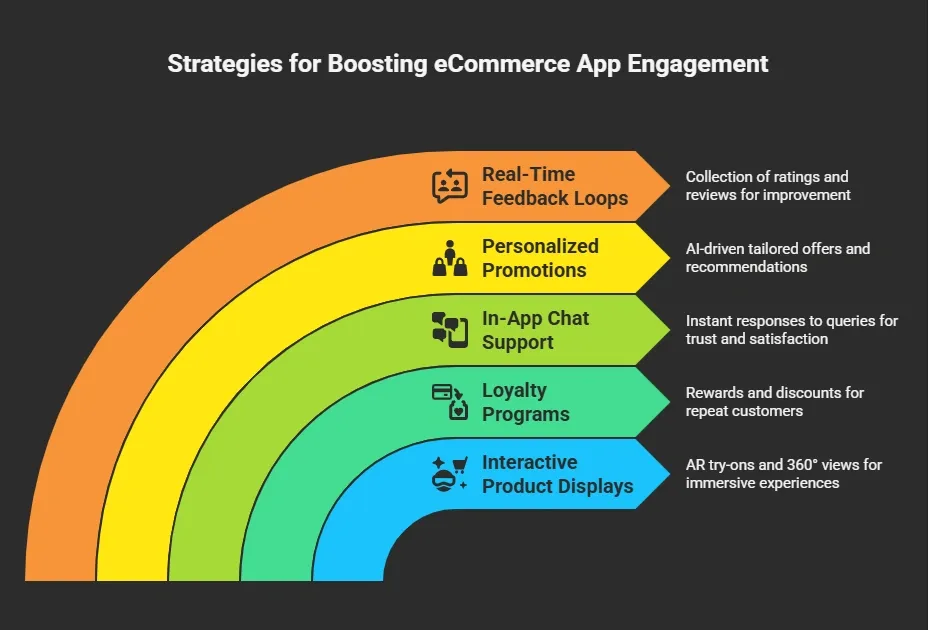
By integrating interactive features, loyalty incentives, and personalized communication, eCommerce apps can strengthen customer relationships and boost lifetime value.
A well-engaged user base not only drives sales but also amplifies brand reputation through positive reviews and referrals, creating a cycle of sustained growth.
Security and Data Protection
In eCommerce, trust is everything. Protecting user data ensures customers feel safe making purchases and sharing personal information.
Key Practices:
- Encryption: Protect sensitive data such as passwords and payment details.
- Secure Payment Gateways: Use trusted processors to protect transactions.
- Regulatory Compliance: Follow GDPR, CCPA, and other relevant standards.
Robust security measures are non-negotiable. Apps that safeguard data not only prevent breaches but also build customer confidence, reduce churn, and strengthen long-term loyalty.
Why eCommerce Apps Are a Must in 2026?
Traditional websites are no longer enough in a mobile-first world. Customers expect fast, intuitive, and engaging apps that simplify shopping and deliver personalized experiences. Without a dedicated mobile app, businesses risk losing users to competitors who meet these expectations.
Investing in ecommerce app development allows brands to stand out with trends like AR, PWAs, and social commerce, streamline transactions, and foster customer loyalty. In 2026, businesses that leverage mobile apps effectively will not only enhance user satisfaction but also lead the market by turning casual shoppers into returning customers.
Table of contents
- -Why eCommerce Apps Matter in 2026?
- -Key Trends in eCommerce App Development
- -1. Personalized Shopping Experiences
- -2. Augmented Reality Integration
- -3. Progressive Web Apps (PWAs)
- -4. Voice Commerce
- -5. Social Commerce Integration
- -Tools for eCommerce App Development in 2026
- -eCommerce App Development Process
- -What People are saying
- -Rocket.new for eCommerce App Projects
- -Key Features
- -Build Your eCommerce App With Rocket.new
- -Use Cases
- -Why Rocket.new Matters for eCommerce Innovation?
- -Strategies for Successful eCommerce App Development
- -Key Strategies
- -Comparing App Development Approaches
- -Enhancing Customer Engagement in eCommerce Apps
- -Security and Data Protection
- -Key Practices:
- -Why eCommerce Apps Are a Must in 2026?