A go-to-market strategy connects your product to the right buyers through the right channels. Most launches fail not from a bad product, but from a rushed GTM plan. This framework covers ICP, value proposition, pricing, channels, and competitive intelligence.
A go-to-market strategy is the plan that connects your product to the right buyers, through the right channels, at the right time. Most product launches fall short not because of a bad product, but because the GTM plan was rushed or skipped entirely.
According to the HubSpot State of Marketing Report, lead-to-customer conversion is the second most important KPI for marketers across all business sizes, and the most reliable path to improving it starts with a sharp, data-driven GTM approach.
What is a GTM Strategy?
A go-to-market strategy (GTM strategy) is a structured plan for bringing a product or service to market. It defines who you are selling to, what problem you are solving, how you will reach buyers, what you will charge, and which metrics tell you whether it is working.
The GTM plan is where conversion rate is won or lost, long before the first deal closes.
GTM Strategy vs. Marketing Plan
A marketing plan covers how you create demand through channels, content, and campaigns. A go-to-market strategy is broader: it includes the marketing plan and also defines your ICP, sales motion, pricing model, and the KPIs your full revenue team runs on.
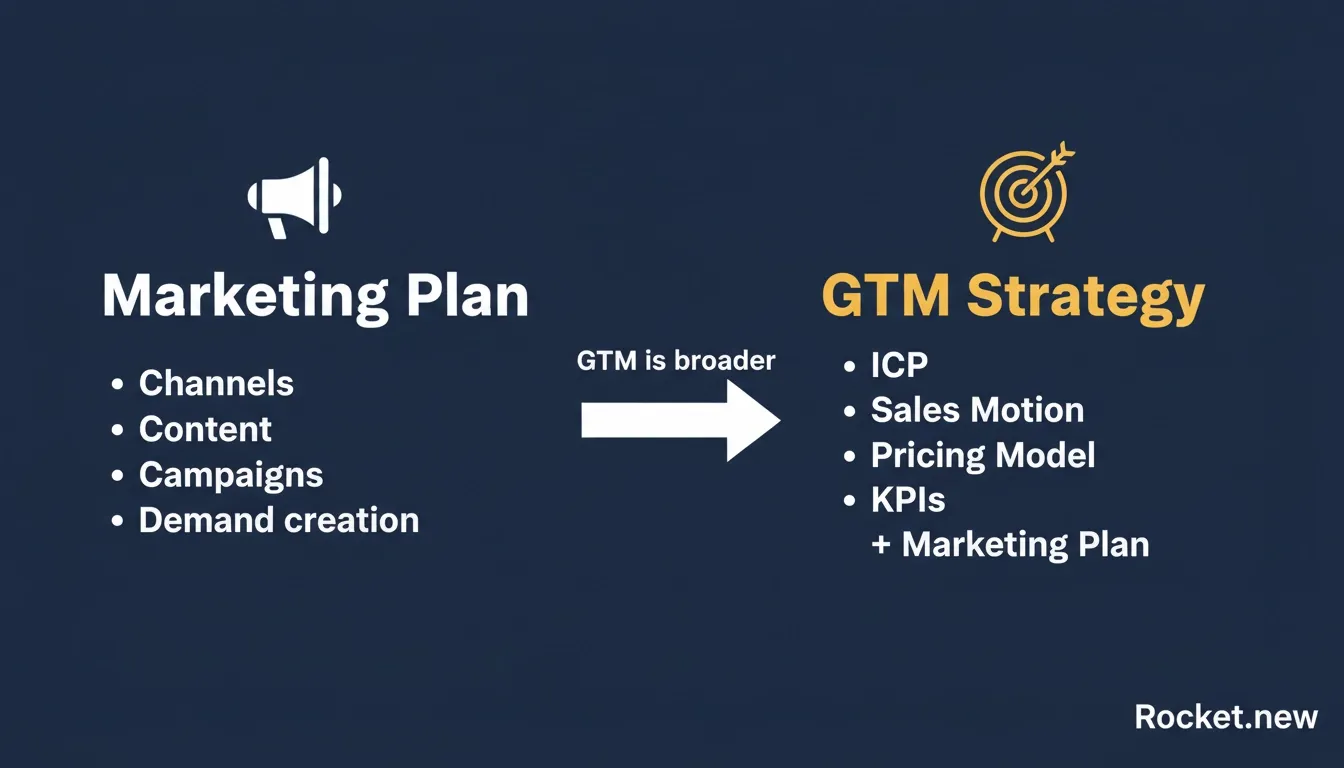 GTM strategy contains the marketing plan, not the other way around.
The marketing plan lives inside the GTM strategy. When a team skips this distinction, marketing efforts look busy, but the sales cycle stalls.
The Core Pieces of Any Successful GTM Plan
A GTM plan fails when one of its core pieces is missing or loosely defined. Here is what every solid go-to-market strategy covers:
| GTM Component | What It Defines | Key Question |
|---|---|---|
| Ideal Customer Profile (ICP) | Who you are selling to and why they buy | Who is the best-fit customer? |
| Value Proposition | What your product does and why buyers care | Why choose you over alternatives? |
| Pricing Strategy | Model and rate structure | What price matches perceived value? |
| Sales Channels | How the product reaches buyers | Where do buyers prefer to buy? |
| Marketing Plan and KPIs | How you create demand and measure success | Which channels reach buyers most effectively? |
Your Ideal Customer Profile and Target Market
A go-to-market strategy begins with defining your target market. Identify Ideal Customer Profiles (ICP) to focus on companies or individuals getting the highest value. Your ideal customer profile describes the companies or people most likely to buy, stay, and grow with you.
Buyer personas go one step further; they describe the individual inside that account, their role, daily challenges, and the language they use.
Value Proposition and Positioning
Your value proposition answers one question: why should a specific buyer choose your product over a competitor?
Frame it around customer pain points, not product features. When positioning is clear, every team member delivers a consistent story; when it is vague, the sales team improvises.
Pricing Strategy
Price sends a signal. A pricing strategy that is too low can undermine perceived value; too high without proof can stall the sales cycle. The right pricing model reflects your cost structure, matches how target customers prefer to buy, and reinforces your competitive advantage.
Common approaches include subscription plans, tiered pricing, usage-based billing, and flat-rate access. You can use Rocket.new's pricing strategy research to benchmark competitor models before committing to your own.
Sales and Marketing Team Alignment
A go-to-market strategy only works if sales and marketing run from the same playbook, shared lead definitions, agreed-on messaging, and common KPIs. When they drift apart, potential customers hear mixed messages and deals stall before they should.
How to Build a GTM Strategy from Scratch
Most teams treat their GTM approach as a pre-launch checklist they fill out once. The ones that grow consistently treat it as a living system; they refine based on real data. Here is the step-by-step process:
Step 1: Define Your ICP: Pull data from your best existing customers. Document the company size, industry, revenue range, and the job to be done that your product addresses.
Step 2: Market Research and Competitive Analysis: Segmentation is the process of identifying shared similarities among potential customers and researching the kinds of individuals or organizations that would be most likely to purchase a product.
Map your top 3-5 competitors by segment, pricing, and positioning. Look for patterns in their weaknesses: negative reviews, job postings that signal product investment, and messaging shifts on pricing pages.
Step 3: Build Your Value Proposition: Develop key messaging that frames your product as the clearest answer to the buyer's problem. Test it with real buyers, not just internal teams; customer feedback at this stage saves the sales team from carrying weak scripts for months.
Step 4: Choose Your Sales Strategy and Channels: Match your sales channels to the buyer's purchasing behavior, average sales cycle length, and product complexity. Social media marketing works for consumer-facing products; content and search build a long-term pipeline.
Step 5: Set Pricing and Business Objectives: Anchor pricing to customer acquisition cost and the value the customer receives. Set measurable targets before launch: revenue for the first 90 days, trial-to-paid conversion rate, and weekly KPIs.
Step 6: Build Your Marketing Plan and Launch Sequence: Assign owners, set launch dates, and build feedback loops that surface what is working within the first 30 days. A strong GTM strategy is a repeatable process that your teams can run again for every new product.
What Does a GTM Strategy Template Look Like?
A go-to-market strategy template gives your team a shared structure so nothing gets skipped. The best templates cover the same ground in the same order and are built cross-functionally.
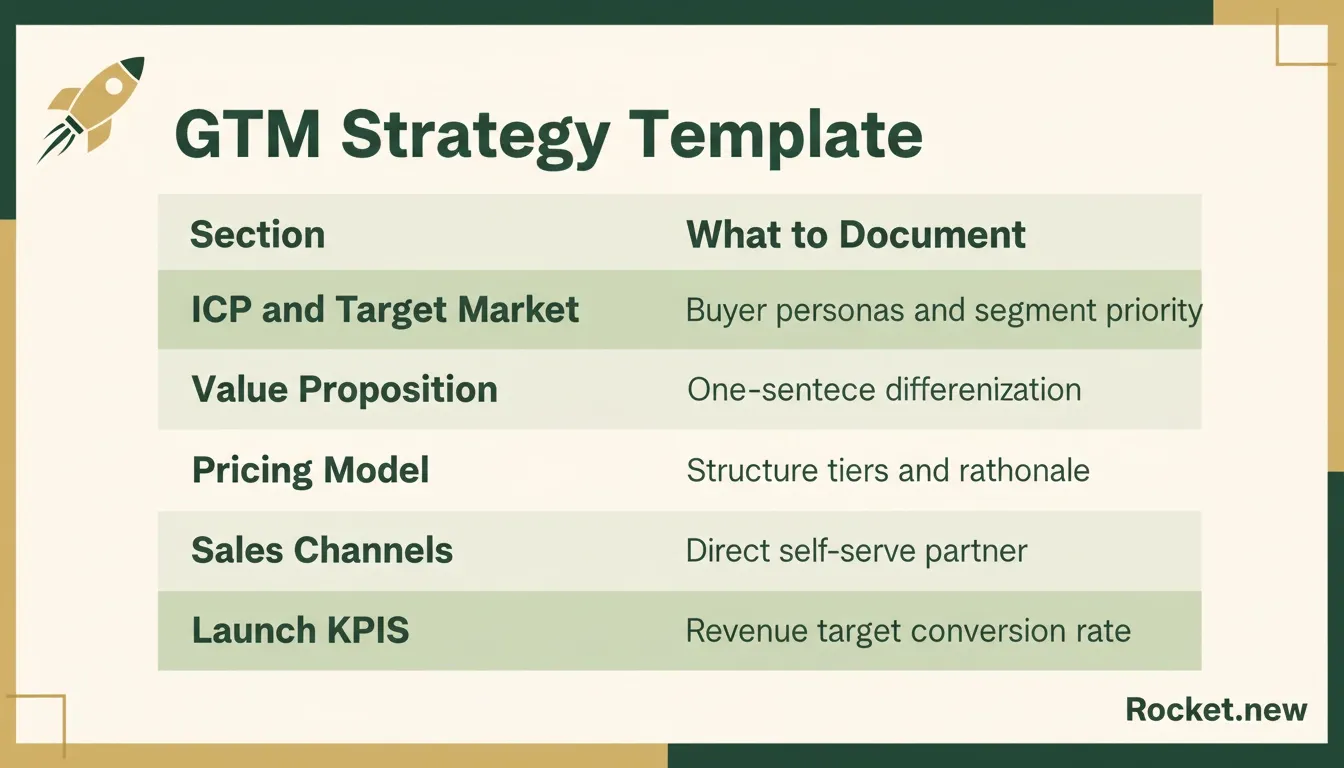 A GTM strategy template structures every section your team needs before launch day.
| Template Section | What to Document |
|---|---|
| Product Summary | What it is, what problem it solves, key features |
| Target Market | ICP definition, buyer personas, segment priority |
| Value Proposition | One-to-two sentence differentiation statement |
| Competitive Analysis | Top competitors, their positioning, your contrast points |
| Pricing Model | Structure, tiers, and rationale |
| Sales Channels | Direct, self-serve, partner; plan per channel |
| Launch KPIs | Revenue target, conversion rate, customer acquisition goal |
A Real Example: Apple's iMac G3 Launch
One of the most studied examples of a successful GTM strategy is Apple's 1998 iMac G3 launch. Apple targeted three distinct customer segments: first-time computer buyers, loyal Apple users, and PC users who dominated the market at the time. The value proposition was clear: faster performance, built-in internet connection, and a design unlike anything else on the shelf.
The marketing plan rolled out simultaneously across television, billboards, and in-store displays with a single consistent message: "Chic. Not geek." The lesson is that a successful go-to-market strategy delivers a clear value proposition to a well-defined target audience through the right channels, everywhere the buyer looks.
How Does Market Intelligence De-Risk Your GTM?
Building a go-to-market strategy without reliable data is like navigating without a map. The data gap is a real operational problem. Research shows that 48% of sales leaders identified a lack of alignment as a top challenge, compared to only 30% of marketing leaders. The root cause: teams operating from different data sets.
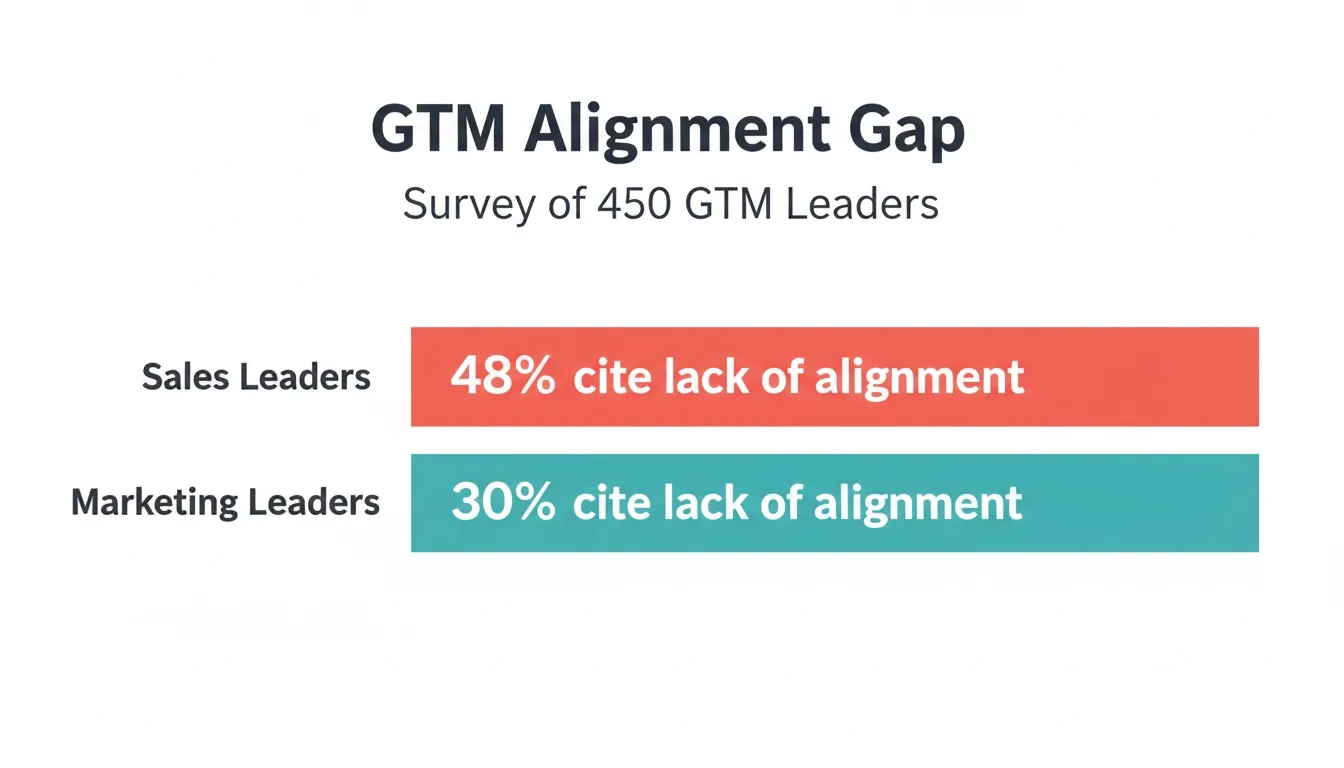 The GTM alignment gap is a measurable problem: sales and marketing teams often work from different signals.
The fix is not more data. It is better data, shared across the revenue team, updated in real time.
Tracking Competitor Signals Before and After Launch
Competitive analysis should not stop at the planning stage. Teams that track competitor signals continuously can catch a pricing change before it affects their sales cycle, spot a messaging pivot before it confuses their target audience, and adjust their GTM plan based on real market analysis instead of guesses.
"The competitive advantage is no longer in accessing data. It's in synthesizing it, combining public signals in ways that reveal what no single source could show alone." - Doug Bell, Cannonball GTM
Teams that treat customer analysis as an ongoing discipline are the ones whose GTM strategies get sharper with every cycle. A post-launch review at 30, 60, and 90 days is standard practice for high-performing revenue teams.
The Thinking Layer Your GTM Strategy Has Been Missing
Most teams manage their GTM strategy across five or six disconnected tools. Rocket was built to close this gap, connecting pre-launch research, product building, and post-launch competitive monitoring in one platform.
Solve: Research What's Worth Building Before You Launch
Rocket's Solve is the research and decision layer that runs before your GTM strategy takes shape. Describe your market problem or ICP hypothesis, and Rocket returns a complete structured output: market analysis, competitive research, evidence, and a clear recommendation.
For a GTM team, this means ICP definitions built on real market analysis, competitive teardowns mapped to your value proposition, and sales enablement content grounded in verified customer insights. The output is exported as a PDF or presentation, ready to share with stakeholders.
Intelligence: Watch the Market After You Ship
A go-to-market strategy does not stop working on launch day. Rocket Intelligence monitors every public platform your competitors operate on, pricing pages, social media, job postings, reviews, and news, continuously. Every day, it delivers a structured brief: what changed, what it means for your business, and what to do about it.
A pricing page update in isolation is noise. That same update alongside new enterprise sales job postings and defensive review responses is a clear strategic signal, one your GTM plan should respond to within days, not quarters. The GTM pillar specifically tracks how competitors acquire customers through paid campaigns, PR motions, and developer marketing.
One Platform, Full GTM Arc
Rocket connects research, building, and intelligence in one shared-context system. The competitive intel from Monday's brief is available when your product team opens a research task on Wednesday. Nothing is re-explained. Everything compounds.
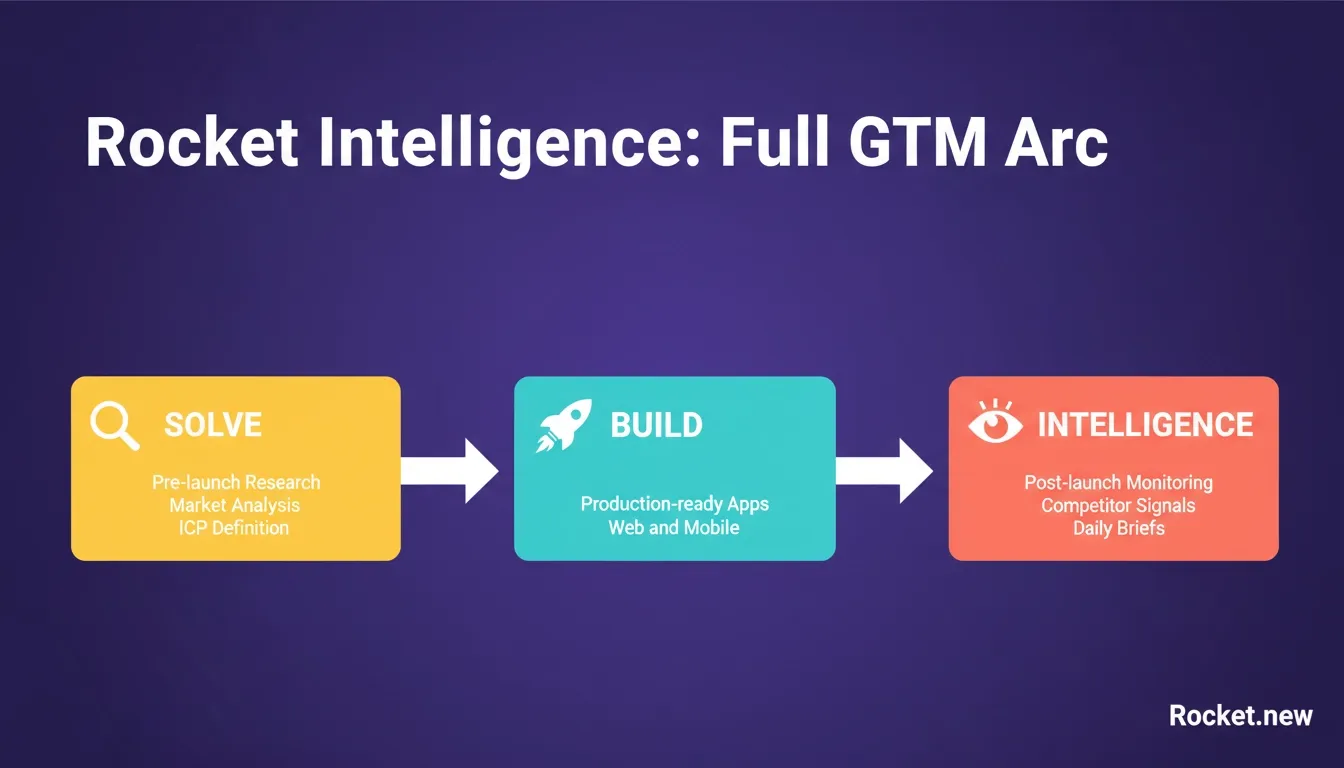 Rocket covers the full GTM arc: pre-launch research with Solve, execution with Build, and post-launch monitoring with Intelligence.
A successful GTM strategy is not just a plan. It is a compounding advantage; your customer base grows, market share expands, and revenue growth follows the thinking that preceded it.
The Bottom Line on Building a GTM Strategy
A well-built go-to-market plan does not guarantee a successful launch, but a missing one almost guarantees a rough one. The teams that win understand their target market, communicate a clear value proposition, and keep refining their GTM approach based on real customer insights and data.
Start with the thinking before the launch. Define your ICP, map the competitive picture, set your pricing model, and build the marketing plan that brings it all together. Rocket is where that work happens, from pre-launch research to post-launch competitive monitoring, all in one connected platform.
Start your go-to-market strategy the right way with Rocket.new.
Table of contents
- -What is a GTM Strategy?
- -GTM Strategy vs. Marketing Plan
- -The Core Pieces of Any Successful GTM Plan
- -Your Ideal Customer Profile and Target Market
- -Value Proposition and Positioning
- -Pricing Strategy
- -Sales and Marketing Team Alignment
- -How to Build a GTM Strategy from Scratch
- -What Does a GTM Strategy Template Look Like?
- -A Real Example: Apple's iMac G3 Launch
- -How Does Market Intelligence De-Risk Your GTM?
- -Tracking Competitor Signals Before and After Launch
- -The Thinking Layer Your GTM Strategy Has Been Missing
- -Solve: Research What's Worth Building Before You Launch
- -Intelligence: Watch the Market After You Ship
- -One Platform, Full GTM Arc
- -The Bottom Line on Building a GTM Strategy