Rocket.new Intelligence eliminates the handoff between competitive monitoring and response teams by delivering personalized, interpreted Intel directly to every person who needs to act, in real time. Sellers face competitors in 68% of deals, yet most teams lose winnable deals because competitive intelligence arrives too late. Rocket.new closes that gap permanently.
Why Do Most Teams Struggle With the Monitor-to-Response Handoff?
The handoff problem is older than any software tool. One team, usually product marketing or a dedicated CI function, spends hours doing manual research: refreshing competitor websites, scanning LinkedIn for hiring signals, checking pricing pages for changes, and piecing together raw data from five separate tools into a spreadsheet. Then they write a summary. Then they send it. Then they wait for someone to read it.
By the time the sales team opens that email, the window to respond has often already closed.
Most teams rely on this broken chain because they have no alternative. The tools they use for monitoring are not the same tools used for responding. The data lives in one place; the action happens somewhere else. That structural gap is what creates the handoff, and the handoff is what kills the speed of response.
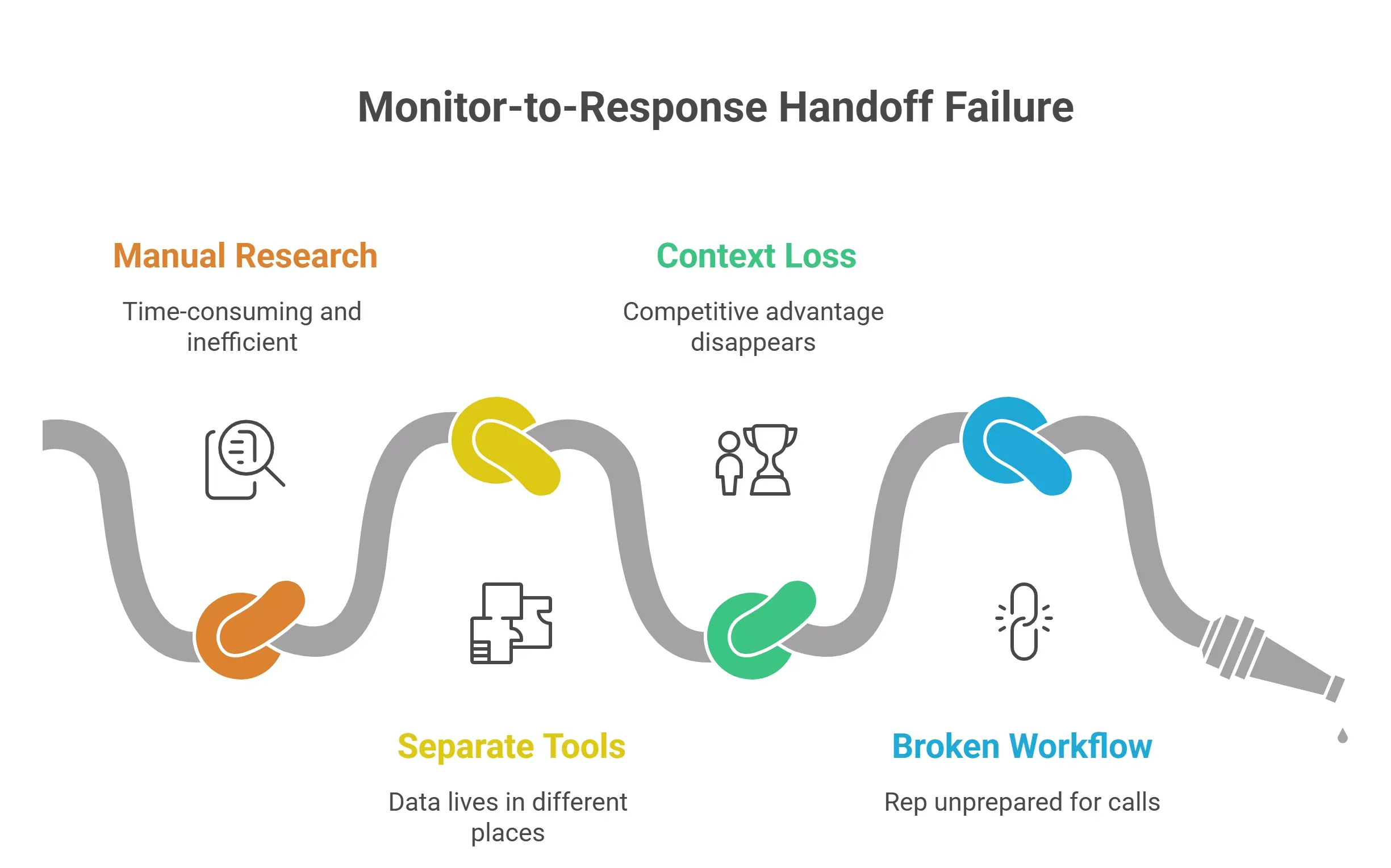
Here is what that broken workflow looks like in practice:
-
CI analyst spots a competitor pricing change on Monday morning
-
Analyst writes a summary and sends it via email or Slack
-
The sales leader reads it on Wednesday afternoon before a call
-
The rep goes into the call without a full background for the call
-
The deal is lost or delayed because the rep was not prepared
The problem is not effort. Most teams work hard. The problem is that monitoring and responding are treated as separate jobs, handled by separate teams, using separate tools. The context loss between these stages is where competitive advantage disappears.
The Real Cost of Separate Tools for Competitive Monitoring and Response
When you rely on separate tools for different parts of the competitive intelligence workflow, you pay a hidden tax in time, clarity, and missed deals.
Consider what most teams are actually doing:
-
Refreshing competitor websites manually, sometimes daily
-
Scanning Reddit, Hacker News, and social media for sentiment
-
Watching LinkedIn for hiring and leadership moves
-
Checking G2 and app stores for review shifts
-
Piecing together signals from five different tools into a spreadsheet
According to Crayon's research, 44% of companies lack competitor visibility within their CRM, meaning sales reps walk into competitive deals without current positioning data. Less than a third of complete programs engage with the sales team daily or weekly. That is not a people problem. That is a system problem.
The tools exist. The data exists. But the workflow that connects monitoring to response does not. And that missing link costs companies millions every year.
| What Teams Are Doing | The Hidden Cost |
|---|---|
| Manual research across competitor websites | Hours of manual effort per week |
| Scattered notes in Slack or email | Context loss at every handoff |
| Weekly or bi-weekly CI reports | Delays are measured in days, not hours |
| Separate tools for monitoring vs. responding | Disconnected workflows, no alignment |
| One shared battlecard for all roles | Wrong Intel for the wrong person |
Research agencies typically deliver competitive analysis in isolation, but Rocket.new identifies patterns that signal competitor expansion plans or product direction before they are publicly announced.
How Do AI Tools Change the Way Competitive Intelligence Gets Delivered?
AI tools have fundamentally shifted what is possible in competitive intelligence. The old model required a human analyst to collect raw data, interpret it, and then manually route it to the right person. That process took days. AI tools compress that entire chain into minutes or eliminate it altogether.
Crayon's 2025 data shows that AI adoption among CI teams jumped 76% year-over-year, with 60% of teams now using AI tools daily. Even more striking: teams that give sellers access to AI-powered interfaces saw an 87% increase in sales effectiveness on competitive deals.
That number points directly at the handoff problem. When AI tools deliver interpreted intelligence directly to the person who needs to respond, without a human relay in between, the results are dramatic.
But most AI tools still treat monitoring and responding as separate workflows. They automate the collection of data. They summarize content. They generate reports. What they do not do is close the loop between detection and delivery in real time.
That is exactly what Rocket.new Intelligence does things differently. Real-time data enrichment enables 25% faster decision-making and drives 30% higher revenue growth, according to the Competitive Intelligence Alliance
What Is the Handoff Problem, Really?
At its core, the handoff problem is a personalization failure. The person who monitors competitors is not the same person who needs to respond, and they do not need the same information. A product manager needs to know what a competitor just shipped. A sales leader needs current positioning and pricing before a call. A marketing leader needs to know about a messaging shift before launching a campaign.
When one team produces a single report and sends it to everyone, most of the signal gets lost. The information is either too broad to be actionable or arrives too late to matter.
The real fix is not faster reporting. It is a system that delivers the right signal to the right person at the right moment, without anyone in the middle. This is the foundation of what makes Rocket.new different from every other platform in the market.
How Does Rocket.new Work in Real Time?
Rocket.new Intelligence monitors companies you follow across ten distinct pillars simultaneously: website, social media, news and media, GTM, traffic, product and technology, people and hiring, business and finance, reviews and community, and a cross-pillar overview.
When something changes, a competitor updates their pricing pages, posts a new LinkedIn ad, adds enterprise sales roles, or shifts their messaging, Intelligence detects it as a signal. That signal is then evaluated against everything else happening across every surface at the same time.
This is not a reporting pipeline. It is an interpretation layer. Intelligence does not just detect what changed; it determines what the change means, then delivers that meaning directly to the person whose work is affected by it.
The sales team reads their daily brief before a call. The product team reads it before sprint planning. The marketing team reads it before a campaign goes live. No one waits for a handoff. No one sends a summary email. The system does the routing.
Structured data transforms raw data into organized insights, enabling product teams to prioritize initiatives before planning begins, leading to faster decisions and more value delivered per quarter.
Cross-Pillar Pattern Detection: Where the Real Insight Lives
One of the most powerful things Rocket.new Intelligence does connect signals across pillars automatically. A single real-world event, like a competitor preparing an enterprise push, rarely shows up in just one place.
It might generate signals across multiple pillars at once:
-
Website: Pricing pages add an enterprise tier
-
Social Media: CEO posts about enterprise-grade reliability
-
People and Hiring: Five new enterprise sales roles posted
-
GTM: First LinkedIn ads targeting IT decision-makers
Each signal alone is moderate. Together, they reveal a coordinated strategy with high confidence. Most teams using separate tools would catch one of these signals, maybe two. Rocket.new Intelligence surfaces them as a single connected Intel item, with a clear explanation of what the pattern means for your business specifically.
This is the shift from raw data to actionable insight, and it happens without anyone on your team spending hours piecing it together. The ability to identify patterns across competitor websites and social media simultaneously is what gives teams full context before every decision.
Absence Detection: The Signal Nobody Else Catches
Most competitive monitoring tools track what happens. Rocket.new Intelligence also tracks what stops happening.
A competitor that posted twice daily goes quiet for two weeks. A regularly updated changelog stops getting entries. Job postings in a key department suddenly disappear. These absences can be as significant as any product update or pricing change; they may indicate a pivot, a reorganization, or a strategic pause worth understanding.
Most teams miss absence signals entirely because their manual research is reactive. They look for things that happen. Rocket.new Intelligence monitors for both activity and silence, which means your teams get a more complete picture of what competitors are actually doing, and not doing. This awareness of competitor activity gaps is one of the clearest examples of how the platform eliminates blind spots that scattered notes and disconnected tools simply cannot catch.
Rocket.new Intelligence: One Platform, No Handoff
So how does Rocket.new eliminate the handoff between the team that monitors competitors and the team that has to respond to them? The answer is that it makes both teams the same team, by delivering personalized, interpreted Intel directly to every individual who needs to act on it.
Here is what that looks like across roles:
| Role | What They Get | When They Get It |
|---|---|---|
| Sales Leader | Current pricing, positioning, deal-ready competitive context | Every morning before calls |
| Product Manager | Competitor feature releases, hiring signals, tech stack changes | Daily brief, pillar dashboard |
| Marketing Leader | Messaging shifts, campaign themes, content gaps | Real time in Following feed |
| Founder / CEO | Strategic patterns, M&A signals, market-wide shifts | Personalized daily brief |
| Strategy / Corp Dev | Cross-company convergence moves, funding signals | Following and For You feeds |
Each person follows the competitors relevant to their work. Each person sets a purpose for why they follow each company. Intelligence uses that context to rank what surfaces first in their feed, so a sales leader and a product manager looking at the same competitor see different Intel, ranked differently, because their needs are different.
This is not a shared spreadsheet. It is not a weekly report. It is a personalized intelligence system that routes the right signal to the right person the moment it is detected.
"What if your sales and marketing teams didn't have to hunt for competitive intelligence? What if it was served to them automatically, exactly when they needed it? That's the transformation underway..." — Crayon, Customer Corner: How Vasion Uses Crayon to Deliver Faster, More Accurate Competitive Intelligence
Key Features That Close the Gap
Rocket.new Intelligence is built around a set of features that work together to make the handoff structurally impossible:

Following Feed
Your primary daily view. Shows interpreted Intel from every company in your universe, ranked by confidence score, your pins, and your stated purposes. Scan it in five to ten minutes every morning and you have everything you need to respond to competitor moves that day.
Daily Brief
Every morning, Intelligence produces a structured brief for each company you follow. It has three parts: a synthesized paragraph connecting everything that moved across surfaces in the past 24 hours, the specific signals that contributed to that synthesis, and a direct implication written in the context of your competitive position. The sales team reads it before a call. The product team reads it before sprint planning. No one has to ask for the background for the call; it is already there.
Company Pillar Dashboards
Ten pillars. Each one tracks a different dimension of a competitor's activity. Click any Intel item in your feed to open the full company canvas and investigate further. Website changes, pricing pages, social posts, hiring signals, GTM campaigns, traffic patterns, product updates, business finance signals, news coverage, and community reviews, all in one place, all connected.
Personalization Engine
Set a purpose for why you follow each competitor. Intelligence uses your role, your purposes, and your pinned priorities to rank what surfaces first. The same signal ranks differently for a sales leader than it does for a product manager, because their response to that signal is different. This role-based delivery is what makes the platform scalable across every department without requiring a central CI team to manage it.
For You Feed
Intel from companies outside your universe that match your interests. Useful for catching market-wide shifts and emerging competitors before they appear on your radar. This is where awareness of the broader market comes from, without any manual research required.
Why Competitors Fall Short
Tools like Crayon and Klue are built around a centralized model: one team produces competitive content, then pushes it out to the rest of the organization. That model still requires a handoff. Someone has to write the battlecard. Someone has to update it. Someone has to make sure the sales team actually reads it.
The structural problem remains: monitoring and responding are still separate activities, handled by separate workflows, with a human relay in between. These platforms rely on a central CI team to generate content and push it downstream, which means the handoff problem is baked into their architecture.
Rocket.new Intelligence takes a different approach. Instead of producing content for others to consume, it delivers personalized Intel directly to each person who needs to act, based on their role, their purposes, and their priorities. There is no central team required. There is no weekly report to write. There is no battlecard to maintain.
The platform does the routing. Each person gets what they need. The handoff disappears. This is what makes Rocket.new the only platform that collapses the entire workflow into one continuous loop.
What Makes Rocket.new the Right Choice for Teams That Need to Respond Fast
Speed matters in competitive markets. When a competitor drops pricing, the window to respond is measured in hours, not days. When a competitor shifts their messaging, the marketing team needs to know before they launch their next campaign, not after.
Most teams are developing their competitive response capability too slowly because their tools are not built for speed. They rely on manual research, separate tools, and human relay chains that add days to every cycle. The risk of being late is real, and it compounds over time.
Continuous monitoring of competitor activity replaces the old model of doing a deep dive once per quarter, allowing teams to monitor signals like pricing shifts, hiring patterns, product launches, and messaging changes from multiple sources.
Rocket.new Intelligence changes the execution model. Signals are detected continuously. Interpretation happens automatically. Delivery is personalized and immediate. The result is a team that can respond to competitor moves the same morning they happen, not the same week.
That is the new way to do competitive intelligence. This is what vibe solutioning looks like in practice: where the platform does the thinking so your teams can focus on doing.
Wrapping Up: The Handoff Problem Has a Solution
The handoff between the team that monitors competitors and the team that responds to them is not a people problem. It is a system problem. Most teams rely on separate tools, manual research, and human relay chains that slow everything down and create gaps where deals are lost.
Rocket.new Intelligence collapses the monitor-to-response cycle into one continuous, personalized loop. Every person who needs to act on competitive intelligence gets the right signal at the right moment, without waiting for someone else to send it.
The sales team is prepared before every call. The product team knows what competitors are shipping before sprint planning. The marketing team catches messaging shifts before they launch. That is how Rocket.new eliminates the handoff between the team that monitors competitors and the team that has to respond to them, by making the handoff structurally unnecessary.
Start following your first competitors at Rocket.new today. Stop losing winnable deals because competitive intelligence arrives too late. Rocket.new Intelligence puts the right signal in front of the right person the moment it matters, with no manual effort, no relay chains, and no dropped context. Your entire team can respond to competitor moves the same morning they happen.
Start for free at www.rocket.new, sign up, and follow your first competitor today.
Table of contents
- -Why Do Most Teams Struggle With the Monitor-to-Response Handoff?
- -The Real Cost of Separate Tools for Competitive Monitoring and Response
- -How Do AI Tools Change the Way Competitive Intelligence Gets Delivered?
- -What Is the Handoff Problem, Really?
- -How Does Rocket.new Work in Real Time?
- -Cross-Pillar Pattern Detection: Where the Real Insight Lives
- -Absence Detection: The Signal Nobody Else Catches
- -Rocket.new Intelligence: One Platform, No Handoff
- -Key Features That Close the Gap
- -Following Feed
- -Daily Brief
- -Company Pillar Dashboards
- -Personalization Engine
- -For You Feed
- -Why Competitors Fall Short
- -What Makes Rocket.new the Right Choice for Teams That Need to Respond Fast
- -Wrapping Up: The Handoff Problem Has a Solution