
TL;DR: GLM-5.3 is the strongest open-weights coding model available today, built on scaled post training alone. For developers who want to turn these coding capabilities into shipped products without managing infrastructure, Rocket handles the full stack from research to deployment.***
Why does a model sharing the same base model as its predecessor suddenly score 6x higher on long-horizon coding benchmarks? That question sits at the center of Z.ai's August 14, 2026 release. GLM-5.3 reached 28.3 on Terminal Bench 3.0, up from just 4.6 with GLM-5.2, and it achieved this without changing a single parameter in pre-training. Every gain comes from scaled post training on more diverse tasks, more environments, and more compute spent training on them.
The model also surfaced something Z.ai did not fully anticipate: emergent cyber capabilities that grew faster than any other measured skill during training. The coding agent built on this base model now handles tasks that would represent several days of work for an experienced engineer. Here is what matters for developers considering this model for production work.
How Does the Coding Performance Compare to Closed Models?
GLM-5.3 is now the most capable open-weights model for coding. So how close does it actually get to closed frontier models like Claude Opus 4.8 and GPT-5.6 Sol on public benchmarks?
-
Terminal Bench 2.1: GLM-5.3 scores 88.2, putting it within fractions of GPT-5.6 Sol (88.8) and ahead of Claude Opus 4.8 (85.0). For an open weights model, this is a first among frontier coding results.
-
Terminal Bench 3.0: The gap is larger here. GLM-5.3 reaches 28.3 on Terminal Bench 3.0, compared to Claude Fable 5 at 33.7 and GPT-5.6 Sol at 34.6. The improvement over GLM-5.2 (which scored 4.6) remains a 6x jump.
-
DeepSWE v1.1: GLM-5.3 hits 66.9 on DeepSWE v1.1, up from 46.2 for GLM-5.2. Kimi K3 leads at 67.5, while GPT-5.6 Sol tops at 72.7.
-
Agents' Last Exam CLI: GLM-5.3 reaches 28.5, within a point of GPT-5.6 Sol (28.6), and ahead of both Kimi K3 (27.6) and Claude Opus 4.8 (25.7) on this long horizon task benchmark.
-
Z.ai Code Bench (internal code bench): A 50% improvement over GLM-5.2, measured across diverse tasks in realistic local development environments with a private benchmark designed to reduce contamination from public test sets.
| Benchmark | GLM-5.3 | GLM-5.2 | Kimi K3 | Opus 4.8 | Fable 5 | GPT-5.6 Sol |
|---|---|---|---|---|---|---|
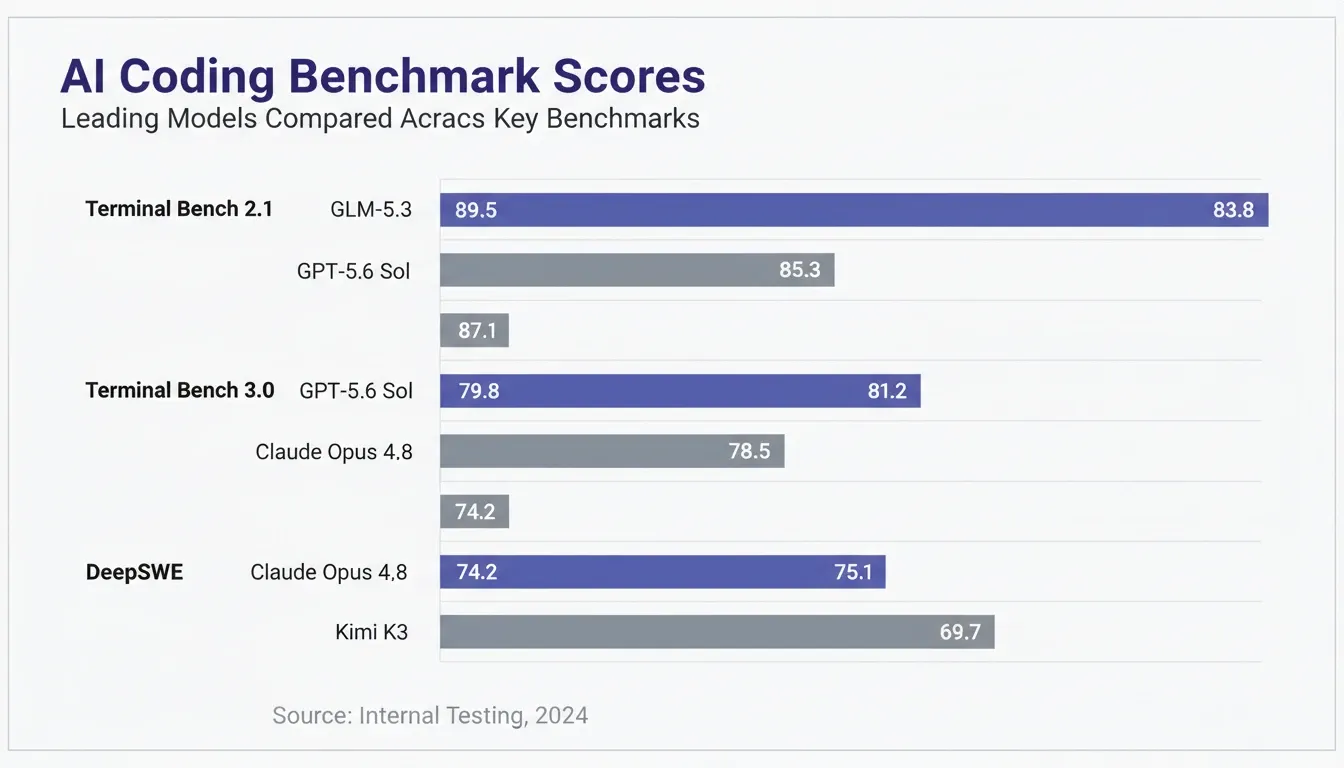
| Terminal Bench 2.1 | 88.2 | 81.0 | 88.3 | 85.0 | 88.0 | 88.8 |
| Terminal Bench 3.0 | 28.3 | 4.6 | 17.4 | 21.1 | 33.7 | 34.6 |
| DeepSWE v1.1 | 66.9 | 46.2 | 67.5 | 58.0 | 69.7 | 72.7 |
| Agents Last Exam | 28.5 | 23.8 | 27.6 | 25.7 | 23.8 | 28.6 |
The pattern is consistent: GLM-5.3 sits at or near frontier coding performance on public benchmarks while remaining fully open source under MIT license. Teams building AI-driven coding workflows now have a genuinely competitive open model to consider for their coding plan.
Where Did the Emergent Cyber Capability Come From?
Security teams were probably not expecting a coding model update to matter to them. Z.ai was surprised too, since cyber capability developed faster than they expected as training scaled.
-
Vulnerability discovery data was introduced into the post training mix alongside coding environments. The intent was better reasoning about flaws and network protocols, not full exploitation capability.
-
CyberGym results: GLM-5.3 scores 84.5 on CyberGym, the best result on the benchmark and ahead of Mythos 5 (83.8) and GPT-5.6 Sol (83.6). GLM-5.2 sat at 77.2. The model can identify and validate vulnerabilities by triggering faults from white-box source code.
-
ExploitBench: GLM-5.3 reaches 54.4, more than doubling GLM-5.2's 24.4. The model began forming coherent plans for complete exploitation chains across multiple stages of the exploitation chain.
-
ExploitGym (time-normalized): 105 exploitation tasks completed within two hours, 130 within six hours. GLM-5.2 managed 29 and 39 respectively. Mythos 5 remains well ahead at 181 and 247 tasks.
-
Real-world impact: Working with several security teams, the model identified 2,436 vulnerabilities across 269 projects, including 1,097 medium-to-high severity issues. The oldest flaw had remained unnoticed for roughly 40 years, dating back to 1981.
The further up the exploitation chain a benchmark sits, the larger the gain from GLM-5.2. Z.ai published detailed safety evaluation methodology with per-model throughput normalization. Safety testing and hardening are ongoing, with weights released only after safety evaluation and hardening are complete. For teams working on application security, these findings have direct implications for both offensive testing and defensive hardening.
What Changed in Post-Training for This Release?
GLM-5.3 uses the same base model as GLM-5.2. Not a single pre-training parameter changed. So where did all this performance come from? The answer is scaled post training on more environments, more diverse tasks, and more compute.
-
Environment scaling: Z.ai built pipelines that synthesize runnable long horizon environments end to end, with multi-step dependencies and hidden state. Research agents collect task patterns from real professional work and turn them into training tasks that represent several days of work for an experienced engineer.
-
Judge agents and verifiers: A separate judge agent attempts each synthesized task to verify it is actually solvable. Verifiers are built without access to reference solutions, which helps prevent reward shortcuts and reduces false positives in the training data.
-
SAO with compaction: The RL strategy from GLM-5.2 carries over, helping gains hold on long horizon tasks rather than only on short ones. This is what makes the model stay productive over longer sessions.
-
slime framework: Z.ai's open-source asynchronous RL infrastructure handles the training stack. System-level changes improved end-to-end RL training throughput by more than 2.3x for long-horizon coding tasks, with local storage serving as an additional caching layer for model weights.
-
Three reasoning effort levels: GLM-5.3 supports three thinking effort levels: low, high, and max. Disabling thinking is no longer supported. At max effort, the model produces deeper reasoning with roughly 75K output tokens per task. At high effort, it balances performance and latency at around 50K output tokens.
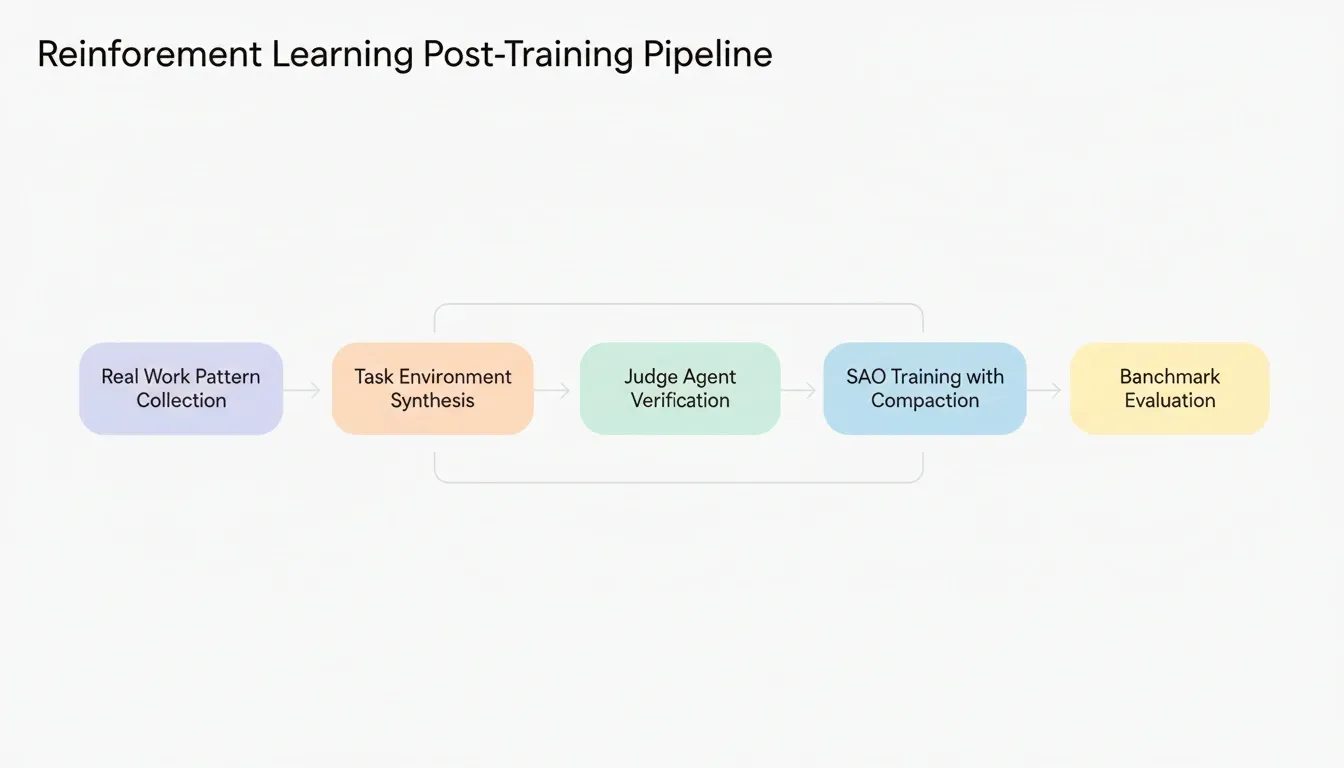
The story here is that scaled post training alone produced frontier-competitive results without touching the base model. This approach is repeatable, which is why Z.ai expects to keep pushing agentic coding capabilities forward on the same architecture. The open-source community responded quickly too, with the GLM-5 repository gaining over 7,000 stars on GitHub within days of release.
From Benchmarks to Production Apps with Rocket.new
Benchmark scores tell you what a model can do in a controlled test. Shipping a production app tells you something completely different. The gap between model capability and deployed product remains wide for most teams.
-
The infrastructure problem: Running GLM-5.3 through Claude Code or ZCode requires configuring compute clusters, managing API keys, handling storage systems, and monitoring long-running tasks manually. You end up being the system administrator of your own AI infrastructure.
-
Rocket.new closes that gap by handling the full stack from research to deployment. You describe what you want to build; the platform runs market validation, generates architecture decisions, and produces working code in Next.js or Flutter, then deploys it.
-
No terminal sessions to manage: Rocket.new handles API provider flexibility, performance monitoring, and scaling without intervention. The coding agent works under the hood while you focus on what matters: the product.
-
Context that carries forward: Unlike CLI-based tools where each session starts fresh, Rocket.new maintains shared memory across your entire project. Research from last week informs the build happening today.
-
From model output to live product: While tools like ZCode and Claude Code harness GLM-5.3 for coding tasks, Rocket.new sits at the layer above. It uses frontier models for execution while giving you the intelligence layer that determines what to build in the first place.
The question is not which model scores highest on Terminal Bench. The question is how fast you can turn an idea into a working app that ships to real users without managing developer tools and compute yourself.
Start building on Rocket.new today. Describe your product idea, get market validation and production-ready code without managing a single API key or compute cluster.
How Much Does It Cost to Run and Access?
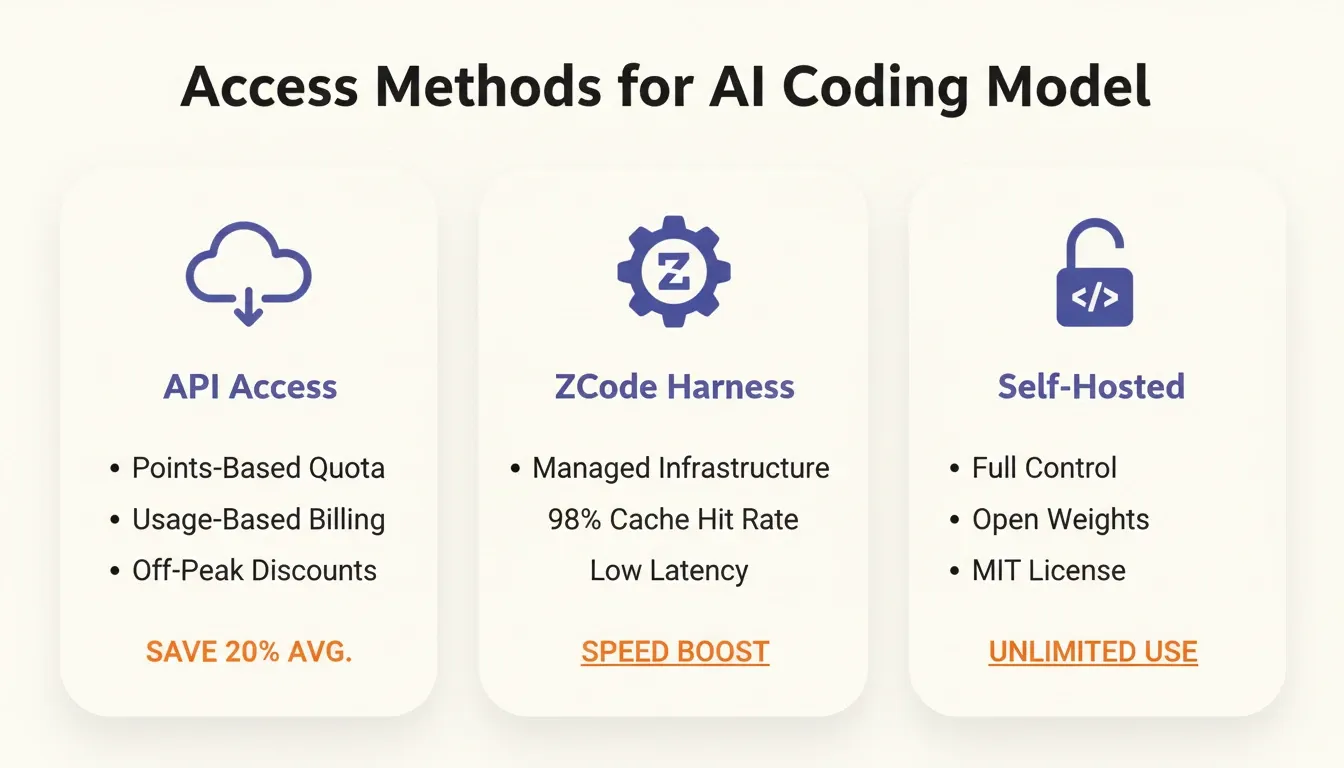
The GLM coding plan uses a points-based quota system. Point usage is calculated separately for input, cached input, and output tokens, giving developers control over inference cost.
-
Off-peak discount: Model calls made outside peak hours (14:00-18:00 UTC+8, Monday through Friday) consume 50% of the standard points. Weekends get the off-peak rate too, which adds up for teams running long horizon tasks overnight.
-
ZCode cache hit rate: The official harness achieves 98%+ cache hit rate, meaning repeated context gets billed at the lower cached input rate. This delivers roughly 30% more effective tokens per point for coding agent workflows.
-
Limited-time boost: A 1.5x quota boost stacks with cache savings for up to 180% of standard quota through August 31, 2026. Six times lite usage of the normal allocation if you time it right.
-
Open weights availability: Model weights will be released in two weeks after the August 14 launch once safety evaluation and hardening are complete. MIT license, no regional limits. The model uses the same base model as GLM-5.2 at 744B parameters (40B active).
-
Self-hosting options: Once released weights are available, the model deploys via SGLang, vLLM, Transformers, or KTransformers on your own compute clusters. The 744B-A40B architecture needs significant resources for local inference.
| Access Method | Cost Model | Context Window | Notes |
|---|---|---|---|
| Z.ai API (GLM Coding Plan) | Points-based quota | 1M token context window | Off-peak 50% discount |
| ZCode (official harness) | Included in plan | 1M token context window | 98% cache hit rate, remote control via mobile |
| Self-hosted (open weights) | Your compute | 1M token context window | Available in two weeks, MIT license |
| Third-party harness (Claude Code, Cline) | GLM Coding Plan points | Harness-dependent | Max effort recommended for coding |
For developers evaluating coding tools, the pricing model favors teams who run long sessions during off-peak hours. Token efficiency improved too: at max effort, GLM-5.3 produces stronger results while consuming fewer output tokens per task compared with GLM-5.2.
The Open Weights Race Keeps Accelerating
Five days separated this release from matching closed frontier models on several coding benchmarks. The pattern of scaled post training producing outsized gains on the same base model suggests this acceleration will continue. Open models now sit close enough to closed ones that the choice comes down to infrastructure preferences, not raw capability gaps.
For builders who want to ship products rather than manage models, the right move is to let your platform handle the infrastructure layer. Try Rocket.new to go from idea to deployed app without touching a terminal, configuring compute, or managing a single coding agent session yourself.
Rocket.new lets you build production-ready apps while frontier models keep advancing underneath. Start your project today and ship something real this week.
Table of contents