
AI coding agents for startups automate development tasks so lean teams ship production apps faster. But the biggest advantage goes to teams that validate what to build before writing a single line of code.
Does your two-person team need to ship like a company with 50 engineers?
That gap is closing. Agentic development tools now plan, write, test, and deploy code autonomously. They give lean startup teams output that once required full engineering departments.
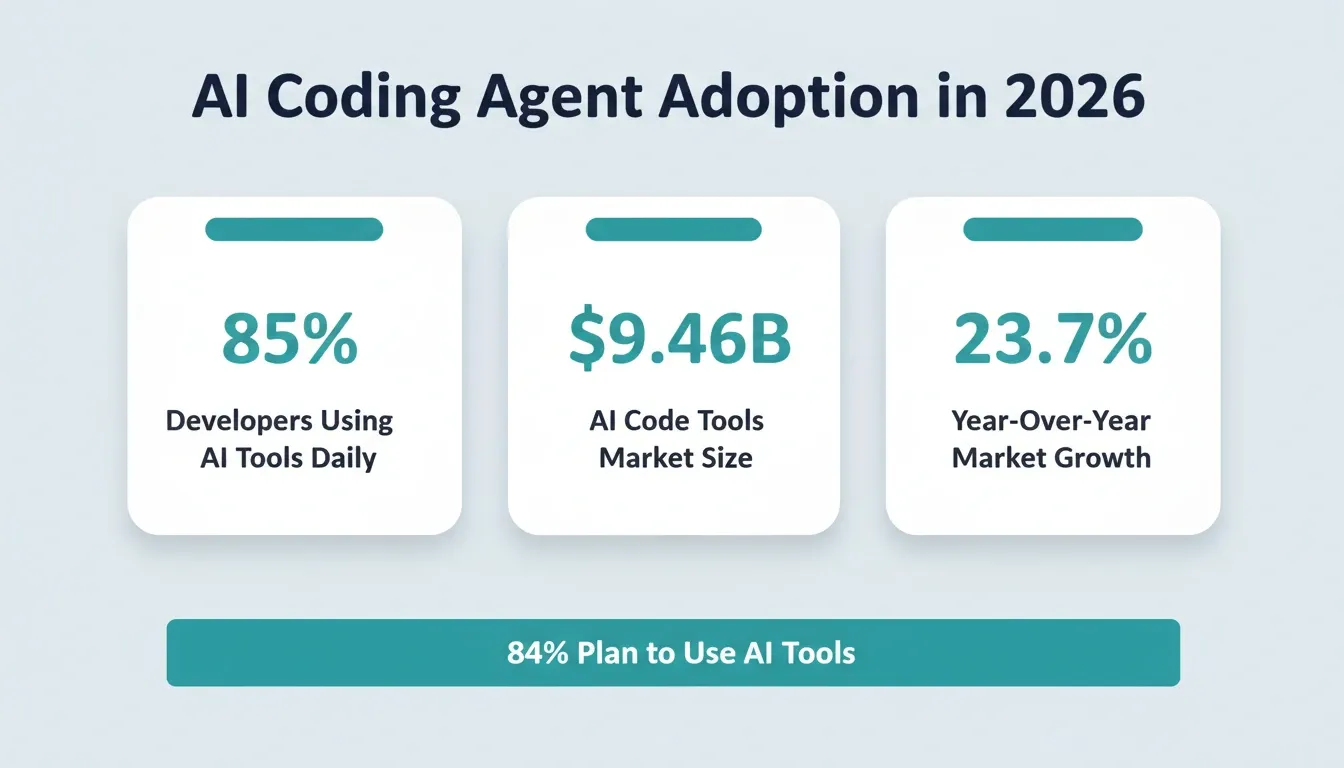
The Stack Overflow 2025 Developer Survey found 84% of developers already use or plan to use AI tools. But adoption alone does not equal results.
This blog covers what agentic tools actually do, where they fall short, and how to pick the right one when your runway depends on shipping fast.
Why Startup Teams Are Adopting AI Development Agents
The math changed. A single developer paired with an agentic tool can now produce what previously required three to four engineers. The AI code tools market reached $9.46 billion in 2026, growing 23.7% year over year. That growth proves teams are investing seriously.
85% of developers now use AI-powered tools in their daily workflows, according to the JetBrains 2025 State of Developer Ecosystem report. The gap between well-funded engineering departments and scrappy founding teams is narrowing faster than anyone predicted.
Here is what that shift looks like in practice for startup teams:
-
Speed at a fraction of the cost. Agents handle entire features from a natural language description. They cut initial development time by 30 to 50%.
-
Reduced context switching. Multi-step tasks run inside a single session. Developers describe the task, and the agent handles the rest.
-
Broader skill coverage. Agents generate production-ready code across the full stack. No deep expertise in every framework is required.
-
Faster validation loops. A working prototype in minutes means founders test assumptions with real users before committing months of development time.
-
Lower barrier to iteration. Refactoring, pivoting, or adding features no longer triggers the cost spiral that comes with major code changes.
Teams that choose the right tool report shipping their first production release in days rather than quarters. For a direct comparison of the top options, the complete guide to AI coding tools for startups breaks down how each one performs against startup constraints.
What AI Coding Agents Actually Do for Your Dev Team
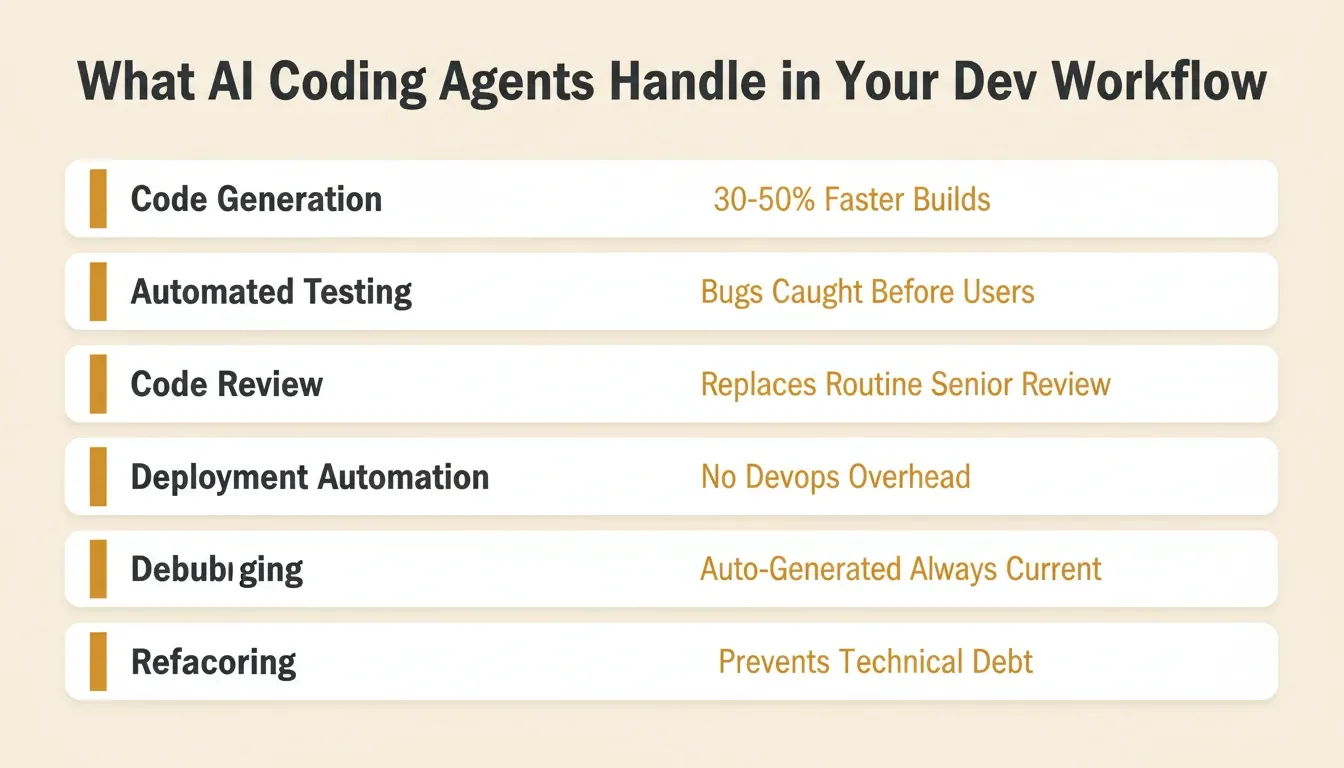
Modern agentic tools go well past code completion. Here is what they handle across the full development lifecycle.
| Capability | What the Agent Does | Impact on Startups |
|---|---|---|
| Code generation | Produces complete functions, modules, and features from natural language | Cuts initial development time by 30-50% |
| Automated testing | Writes and runs unit tests and edge case coverage | Catches bugs before they reach users |
| Code review | Analyzes pull requests for bugs, security issues, and style violations | Replaces senior review on routine changes |
| Deployment automation | Handles CI/CD pipelines, environment config, and release management | Ships features without DevOps overhead |
| Debugging | Traces errors through codebases and suggests fixes with explanations | Reduces resolution time from hours to minutes |
| Documentation | Generates API docs, README files, and inline comments automatically | Keeps knowledge accessible as the team grows |
| Refactoring | Restructures code for performance and maintainability | Prevents technical debt from compounding |
Agents handle the mechanical execution. Human developers focus on architecture decisions, user experience, and product direction.
The Productivity Paradox: Speed vs. Quality
Raw speed metrics tell only part of the story. The relationship between AI assistance and actual output quality deserves honest examination.
The perception gap is real. A METR controlled study found experienced developers were 19% slower with AI tools. Yet they believed they were 20% faster. The disconnect between feeling productive and being productive remains significant.
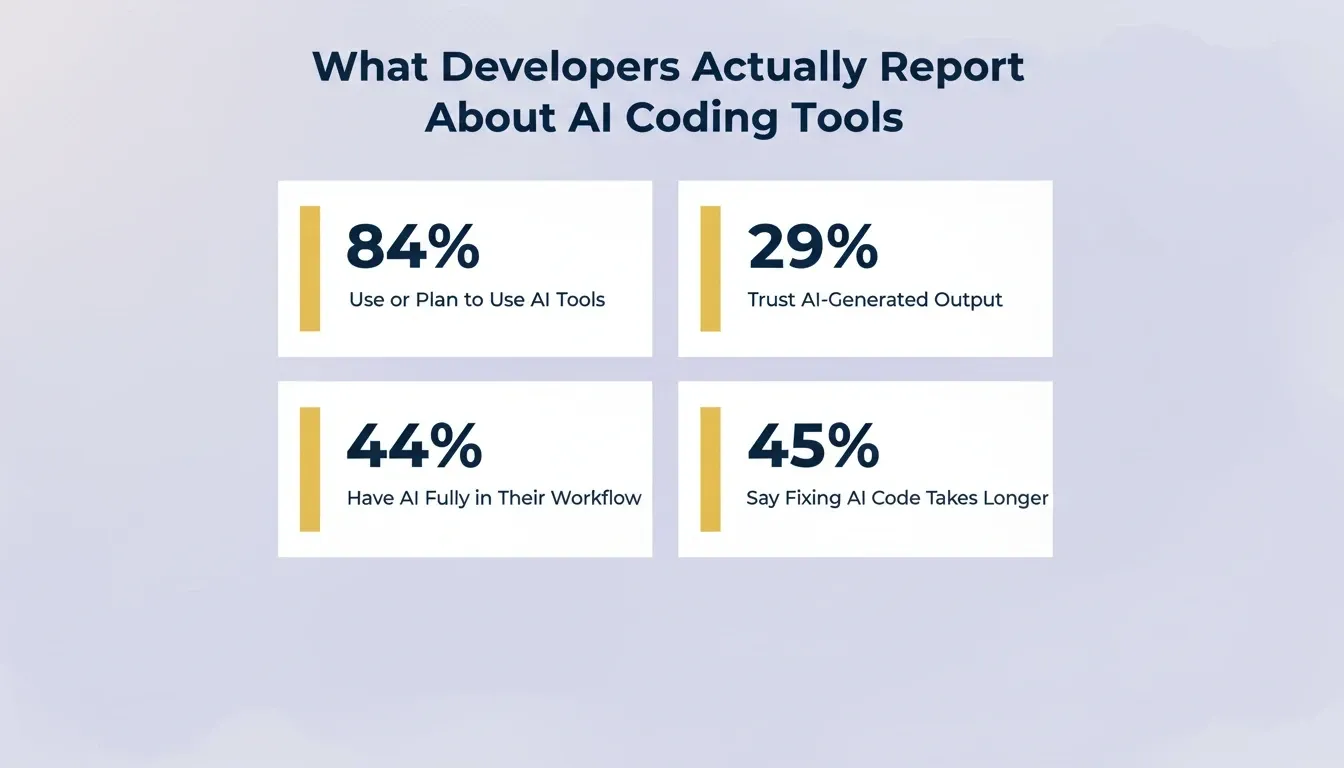
According to the Stack Overflow 2025 Developer Survey, only 29% of developers trust the accuracy of AI-generated output. That figure dropped from 40% the prior year. And 45% report that fixing AI-generated code takes more time than expected. The "almost right" problem creates false confidence.
The takeaway is not that agents fail. It is that teams need tools with built-in quality controls, not just generation speed. The best agents validate output before presenting it. This reduces the debugging tax that erodes perceived gains.
The Problem Agents Do Not Solve: Building the Wrong Thing
Speed is only valuable if the direction is right. The most expensive mistake in any startup is not a bad execution. It is a good execution of the wrong thing. A product nobody wanted. A feature that moved no metric.
Most AI coding agents assume the thinking has already happened. They start at execution and go fast from there. For most founders, that assumption is wrong. The build was fine. The foundation was not.
This is the distinction between vibe coding and vibe solutioning. Vibe coding answers "how do I build this?" Vibe solutioning answers "what should I build?" and starts before the first line of code. Understanding how to automate repetitive coding tasks is one part of the equation. Knowing what to build is the other.
How to Choose the Right Agent for a Startup Workflow
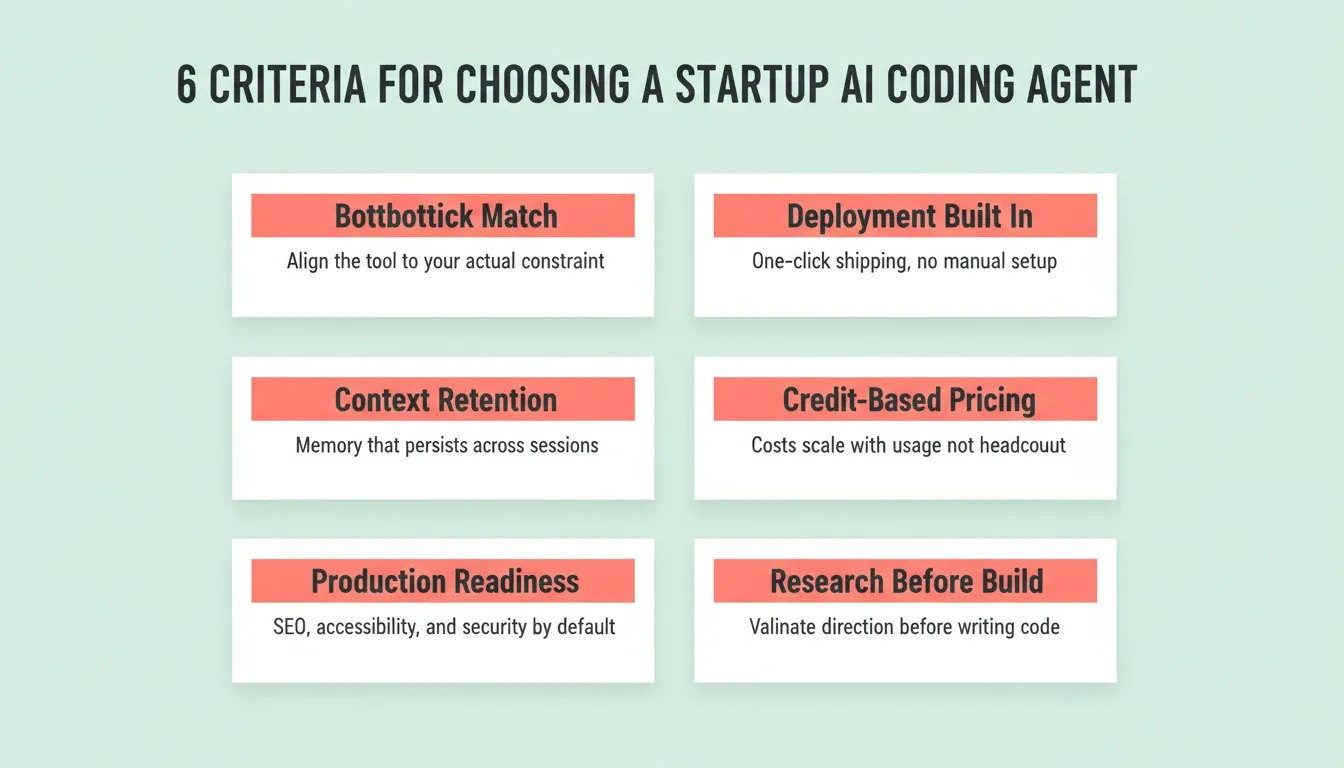
With dozens of AI development tools competing for attention, the selection criteria matter more than any single feature. Here is a decision framework for startup teams evaluating their options.
-
Match the tool to your bottleneck. If your constraint is ideation and validation, pick a platform with research capabilities. If it is pure coding speed, an IDE-native assistant may work. If it is the full journey from idea to deployed product, look for end-to-end platforms.
-
Test deployment friction early. A tool that generates code but requires manual deployment setup creates a hidden cost on every release cycle. One-click deployment should be table stakes.
-
Evaluate context retention. Agents that forget everything between sessions force teams to re-explain project context repeatedly. Shared memory across sessions compounds productivity over time.
-
Consider the cost model. Per-seat pricing punishes growing teams. Credit-based models let founders scale usage without linear cost increases tied to headcount.
-
Check production readiness. Many agents generate impressive demos that break under real traffic. Verify that generated code includes security headers, accessibility standards, and performance tuning by default.
-
Ask whether it connects research to build. The most overlooked criterion: does the tool help you validate the idea before writing a single line? Tools that skip this step leave the most expensive decision entirely to you.
Decision Framework for Selecting the Right AI Coding Agent
The right agent removes friction from every step between an idea and a paying customer. Tools that only speed up one phase still leave gaps that cost time elsewhere.
Where Rocket Fits in the AI-Powered Development Stack
Most agentic tools solve one problem: writing code faster. Rocket addresses a different challenge. It is the world's first Vibe Solutioning platform. It combines strategic research, production-grade app building, and continuous competitive intelligence in one shared-context workspace.
You type the problem. Rocket researches it, recommends a direction, and builds from that direction. 1.5 million people have tried Rocket across 180 countries.
Solve: Validate Before You Build
You have a product idea. Before you write a line of code, Solve tells you if anyone actually needs it.
Solve takes any business question and delivers a complete, structured report. It covers market dynamics, competitive landscape, risks, and an execution path with clear recommendations. It runs thousands of queries across 150+ sources simultaneously. The output does not disappear after export. It becomes the foundation of everything that follows in the project.
Build: Generate Production-Grade Apps in Minutes
Describe what you need in plain language, upload a Figma file, or point Rocket at an existing GitHub repository. Build generates production-ready Next.js web apps and Flutter mobile apps. Most apps generate in 1 to 3 minutes.
Every build ships with SEO-ready structure, WCAG 2.1 AA accessibility compliance, GDPR coverage, and Core Web Vitals optimization by default. These are baseline defaults, not optional extras. You can start from a prompt, a Figma design, an uploaded screenshot, an existing Next.js codebase, or a template at zero credits.
Intelligence: Monitor Competitors Continuously
Intelligence monitors every public platform a competitor operates on. It tracks pricing pages, product updates, social activity, hiring signals, customer reviews, and ad copy. Set it up once and it runs automatically.
Daily briefs surface the most significant changes with a "So what" interpretation and recommended actions. Each competitor tracked costs $100 per month (500 credits per month).
How the Three Pillars Connect
The Solve output that validated your direction becomes the foundation of the Build. The Intelligence signal from last week informs this week's product decision. Nothing is re-explained. Everything compounds.
| Pillar | What It Produces | Who Uses It |
|---|---|---|
| Solve | Structured reports: data, insights, recommendations | Founders, PMs, strategists |
| Build | Production-ready Next.js web apps and Flutter mobile apps | Builders, developers, designers |
| Intelligence | Continuous competitor signals on a live dashboard | Founders, marketing, sales teams |
Beyond the three pillars, Rocket 1.0 ships with Redesign (reimagine any existing website via eight slash commands), Context (persistent shared memory across every task), Collaborate (team workspaces with role-based access), and Human Help (Rocket's Success team steps in inside the platform when the AI reaches its limit).
Rocket Pricing
Rocket runs on a credit-based system. One balance covers Solve research, Build generation, and Intelligence monitoring. Unused credits roll over month to month on all paid plans. No per-seat fees apply.
| Plan | Price | Credits per Month | Key Capabilities |
|---|---|---|---|
| Free | $0 | 20 (one-time) | Build production-ready apps + Light Solve |
| Pro | $25/mo | 100 | Build + Light Solve research |
| Rocket | $50/mo | 250 | Build + Full Solve + Competitive Intelligence |
| Booster | $250/mo | 1,500 | Build + Full Solve + Intelligence + premium support |
Annual billing saves 20%. Intelligence tracking costs $100 per month per competitor (500 credits per month). This is included from the Rocket plan upward.
How Standalone Agents Compare
GitHub Copilot and Cursor are IDE-native coding assistants. They accelerate writing code but require you to already know what to build, manage your own infrastructure, and handle deployment separately. Bolt and Lovable generate frontend prototypes quickly. However, they lack backend logic, deployment infrastructure, and ongoing market intelligence. The structural gap across all of them is the same: none connect pre-build research to the actual build.
Rocket's positioning captures it directly: "They build what you tell them to build. Rocket figures out what's worth building, then builds it."
Real Developer Perspectives on Agentic Coding Tools
Industry data tells one story. Developer voices tell another. Here is what the community actually reports about working alongside agentic coding tools.
Adoption is near-universal but usage is shallow. 84% of developers use or plan to use AI tools. Yet only 44% say AI is fully woven into their workflow. Most usage remains ad hoc rather than embedded in standard process.
Junior developers and those working on greenfield projects consistently report stronger gains than experienced contributors. The METR study specifically measured experienced open-source contributors. The baseline comparison is different for earlier-career developers.
The market validates agentic over assistive. GitHub Copilot has 26 million users. But Cursor reached $2 billion ARR and Claude Code hit $2.5 billion in run-rate revenue. The tools gaining fastest are those that handle complete tasks, not just line completions.
Agents that handle full task completion outperform those limited to suggestion mode. Teams adopting complete-task agents today position themselves ahead of the curve.
The Smarter Way to Build: Start with Thinking, Not Code
The startups shipping fastest in 2026 are not the ones with the largest engineering teams. They are the ones that paired sharp product thinking with agentic tools handling planning, building, and monitoring inside a single workspace.
AI coding agents for startups will keep getting more capable. The teams that pull ahead will not be the ones who adopted first. They will be the ones who adopted at the right level of autonomy. That means validating before building, shipping production-grade code from day one, and monitoring the market continuously.
As AI development tools mature, the advantage belongs to teams that connect all three in one place. Start building on Rocket.new and see how fast your team can ship from idea to deployed product.
Table of contents
- -Why Startup Teams Are Adopting AI Development Agents
- -What AI Coding Agents Actually Do for Your Dev Team
- -The Productivity Paradox: Speed vs. Quality
- -The Problem Agents Do Not Solve: Building the Wrong Thing
- -How to Choose the Right Agent for a Startup Workflow
- -Where Rocket Fits in the AI-Powered Development Stack
- -Solve: Validate Before You Build
- -Build: Generate Production-Grade Apps in Minutes
- -Intelligence: Monitor Competitors Continuously
- -How the Three Pillars Connect
- -Rocket Pricing
- -How Standalone Agents Compare
- -Real Developer Perspectives on Agentic Coding Tools
- -The Smarter Way to Build: Start with Thinking, Not Code