
Rocket.new Solve eliminates weeks of research by running parallel agents across 1,000+ data sources. It scores insights to highlight what’s worth building, not just what exists. The result: a connected workflow from idea to execution without switching tools.
Why Do Teams Spend Weeks Before They Can Start Building?
What stops teams from finishing their research in one sitting?
-
Most teams lose weeks switching tools, re-entering context, and catching up each team member who joined late.
-
The global big data analytics market is projected to reach $655.53 billion by 2029, indicating a strong reliance on data for decision-making in businesses.
-
Yet data sits in one tool, the strategy doc in another, and the build happens in a third. That break in context is where days vanish, and most businesses build the wrong thing.
How Switching Tools Across Separate Tools Breaks the Workflow
No-code development platforms allow users to create applications without traditional programming skills, enabling faster development cycles and reducing the need for extensive engineering resources.
"However, most no-code workflows still rely on disconnected tools across research, tracking, and building, forcing teams to constantly re-explain their project at every step.
What Happens When Teams Build With Disconnected Tools
-
Teams use separate tools for market research, competitor tracking, and app building. Each shift means re-explaining the project.
-
A study from Qatalog and Cornell found it takes 9.5 minutes to regain focus after switching tools.
-
When teams move between disconnected tools, shared context vanishes. Enterprise teams feel this every time a team member opens a different app.
Why Vibe Coding Left Teams Without Direction
-
Most tools handle code or competitive intelligence, but not the thinking before the build. Vibe coding left that gap open.
-
Vibe coding made code fast. It never told teams what was worth building or whether competitors owned the market.
-
Solo founders feel this hardest. They paste research into a doc, then re-describe the concept to a separate code tool. Three separate tools, no connected workflow.
The no-code movement is gaining traction as businesses seek to streamline their workflows and reduce reliance on multiple tools for different stages of application development.
What Vibe Solutioning Shifts About the Execution Workflow
From Business Question to Actionable Brief
-
Vibe solutioning starts at the business question. You type a market problem, and the platform returns a brief with competitive analysis, evidence, and a recommendation you can act on.
-
Before pulling external data, the platform maps each dimension: market dynamics, financial signals, user needs, and competitor gaps.
Parallel Agents and Scored Signals
-
Separate agents investigate each dimension at the same time, pulling from over 1,000 sources. What takes most teams weeks happens in parallel.
-
Signal Scoring assigns scores based on impact, urgency, and differentiation gaps rather than presenting raw data. Scored signals help teams avoid building the wrong thing and give a direct route to the right build.
How Rocket.new Solve Turns a Question into a Decision
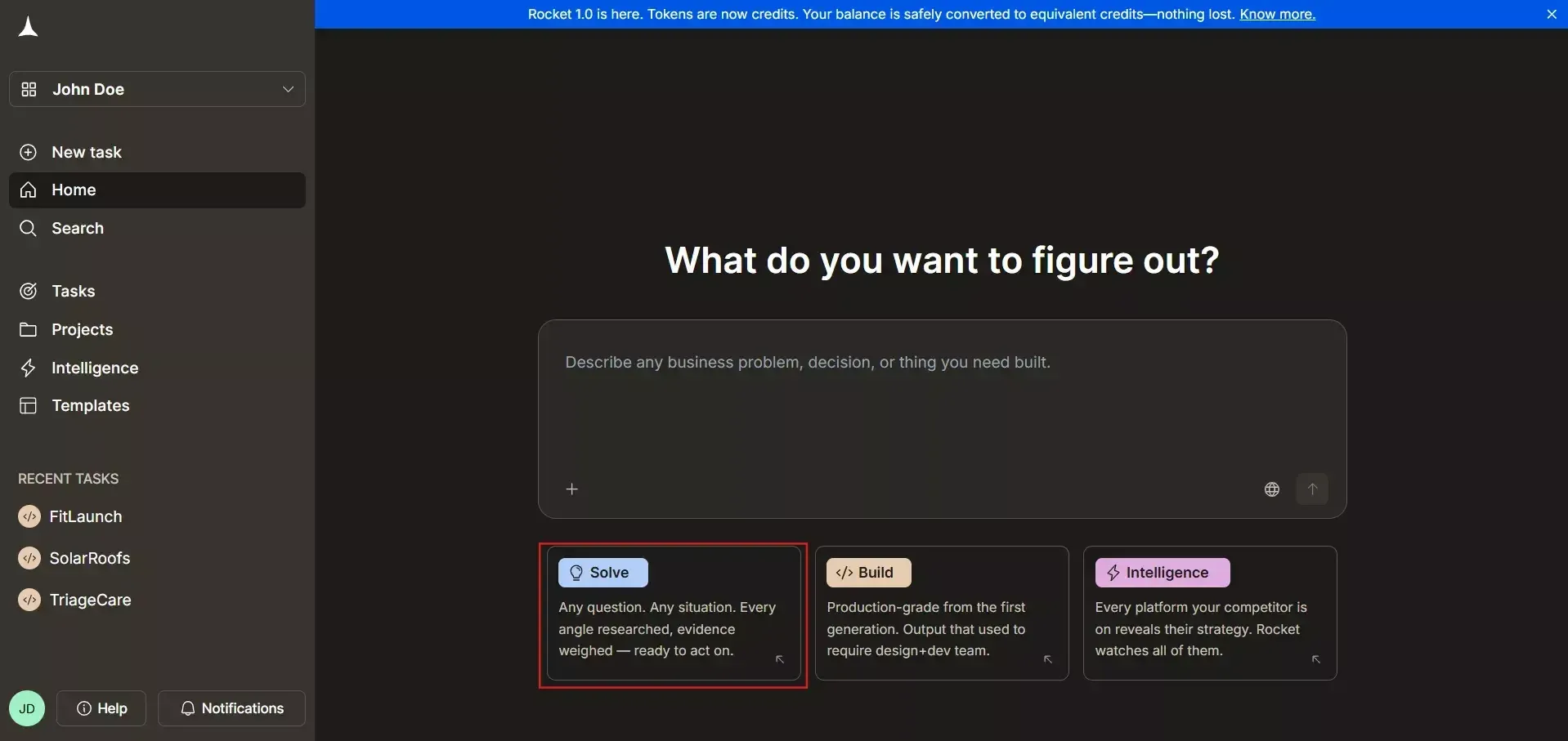
Let's find out how does Solve on Rocket.new compress a week of strategy research into a single focused session.
What a Single Session Produces
-
Rocket.new generates reports with pricing, positioning, and competitor gaps from a natural language prompt. No need to write code or stitch together multiple tools.
-
Rocket.new supports precise iteration by allowing component-level editing with full version history and rollback, which eliminates the need for a traditional QA cycle after significant edits.
-
The platform monitors signals from LinkedIn, job postings, and competitor websites for continuous competitive intelligence. The platform generates structured research reports, including pricing and market positioning, as a lower-cost alternative to traditional consulting.
-
Most businesses run on fragmented systems. Building the wrong thing and slow launch cycles follow. Thinking, code, and execution need to share the same platform.
| Output | What It Includes | Who Uses It |
|---|---|---|
| Validation Path | Scored recommendations, 90-day plan | Solo founders, co-founder pairs |
| Competitive Brief | Named competitors, price shifts, feature gaps | Sales teams, larger teams |
| Structured Document | Findings are ready for a build task or a room | Any team member |
-
A VP of Sales types one line for background for the call and gets a brief built from the live project context.
-
Documents regenerate when new market signals arrive. No team member tracks updates manually.
Community Take
"60 to 70% of people using vibe coding tools don't know what they're actually building. That's not a user problem. That's a missing product category.- Source: LinkedIn discussion on Rocket 1.0 launch
Vibe coding gave teams speed. Vibe solutioning gives direction. When you know what is worth building before you start, the code matches what competitors haven't covered, and the market actually needs.
How Rocket.new Covers the Full Arc From Thinking to Launch
Rocket.new is the first vibe solutioning platform that connects research to build intelligence after launch. Most AI tools speed up code. It goes further: it tells you what to build, generates code, and tracks competitors.
-
Vibe solutioning platform: Connected workflow for research, build, and intelligence.
-
25,000+ templates library, free to use: The platform adapts each starting point to your project context.
-
Saves up to 80% tokens: Template-first code generation cuts cost per build.
-
Supports Flutter (mobile apps) and Next.js (web apps): Build and launch to both from one platform.
-
Collaboration built in: Every contributor works from a shared context across sessions.
-
Three products, one platform: Solve, Build, and Intelligence: Three capabilities connected by context that compound.
Use Cases That Connect Research to Execution
-
Solo founders type a question about a new concept. The tool returns competitors, price data, and a validation path. They move from idea to execution, taking findings into Build to start building a web app inside one connected project.
-
Enterprise teams run competitor tracking before quarterly planning. After launch, Intelligence monitors competitors and surfaces new signals. Teams move from reactive to proactive because intelligence and build share the same project.
-
A co-founder pair checks if a mobile app idea is worth building. Solve scores the opportunity against competitors in the market. Build generates the Flutter app from the same project with shared context. This is an AI app development where build starts from validated research.
-
Founders preparing to launch use the tool to find edge cases. Build lets them fix and ship code updates connected to the latest signals, building faster than teams using disconnected tools.
👉Get started at Rocket.new for free.
When Execution Stays Connected
Teams move forward across scattered apps and lose context at every handoff.
How does Solve on Rocket.new compress a week of strategy research into a single focused session? By running parallel agents, scoring signals, and keeping findings connected to build, execution, and launch. The shift is about building the right thing with a clear path from question to shipped code.
Table of contents
- -Why Do Teams Spend Weeks Before They Can Start Building?
- -How Switching Tools Across Separate Tools Breaks the Workflow
- -What Happens When Teams Build With Disconnected Tools
- -Why Vibe Coding Left Teams Without Direction
- -What Vibe Solutioning Shifts About the Execution Workflow
- -From Business Question to Actionable Brief
- -Parallel Agents and Scored Signals
- -How Rocket.new Solve Turns a Question into a Decision
- -What a Single Session Produces
- -Community Take
- -How Rocket.new Covers the Full Arc From Thinking to Launch
- -Use Cases That Connect Research to Execution
- -When Execution Stays Connected