Add serverless functions to your app backend without writing code. The serverless market hit $25.76B in 2025 and is growing fast. This guide covers how serverless works, compares AWS Lambda, Azure, and Google Cloud, and shows how to deploy backend logic in minutes.
Why do engineering teams still spend weeks configuring servers when backend logic can run on demand with zero infrastructure overhead? The serverless computing market hit $25.76 billion in 2025 and is growing at a CAGR of 15.54%, proving that companies are abandoning traditional server management at scale.
The shift makes sense. Serverless functions let you run backend code only when triggered, without provisioning or maintaining any server. But for founders, operators, and non-technical teams, the question remains: how do you actually ship these functions without writing code yourself?
This guide walks through the entire serverless space, from how it works to which cloud platform fits your use case, and how to deploy functions today without touching a terminal.
What Are Serverless Functions and Why Do They Matter?
Serverless functions are small, single-purpose pieces of code that execute in response to events. A cloud provider handles every layer of infrastructure underneath them, from operating systems to networking to scaling.
Event-driven execution means serverless functions are invoked only when a specific event occurs. An HTTP request, a database change, a file upload, or a scheduled task can each trigger a function. The cloud provider allocates compute resources on demand and releases them immediately after execution completes.
No server management means developers do not provision, patch, or scale servers. The cloud provider manages operating systems, runtime environments, and networking. Engineering teams focus entirely on application code rather than infrastructure.
Pay-per-invocation pricing means you pay only for the compute time your function uses. Unlike traditional server deployments where machines run and bill around the clock, serverless functions cost nothing when idle.
Automatic scaling means serverless platforms scale individual functions independently. Whether your function handles 10 requests or 10 million, the cloud provider manages capacity without configuration from your development team.
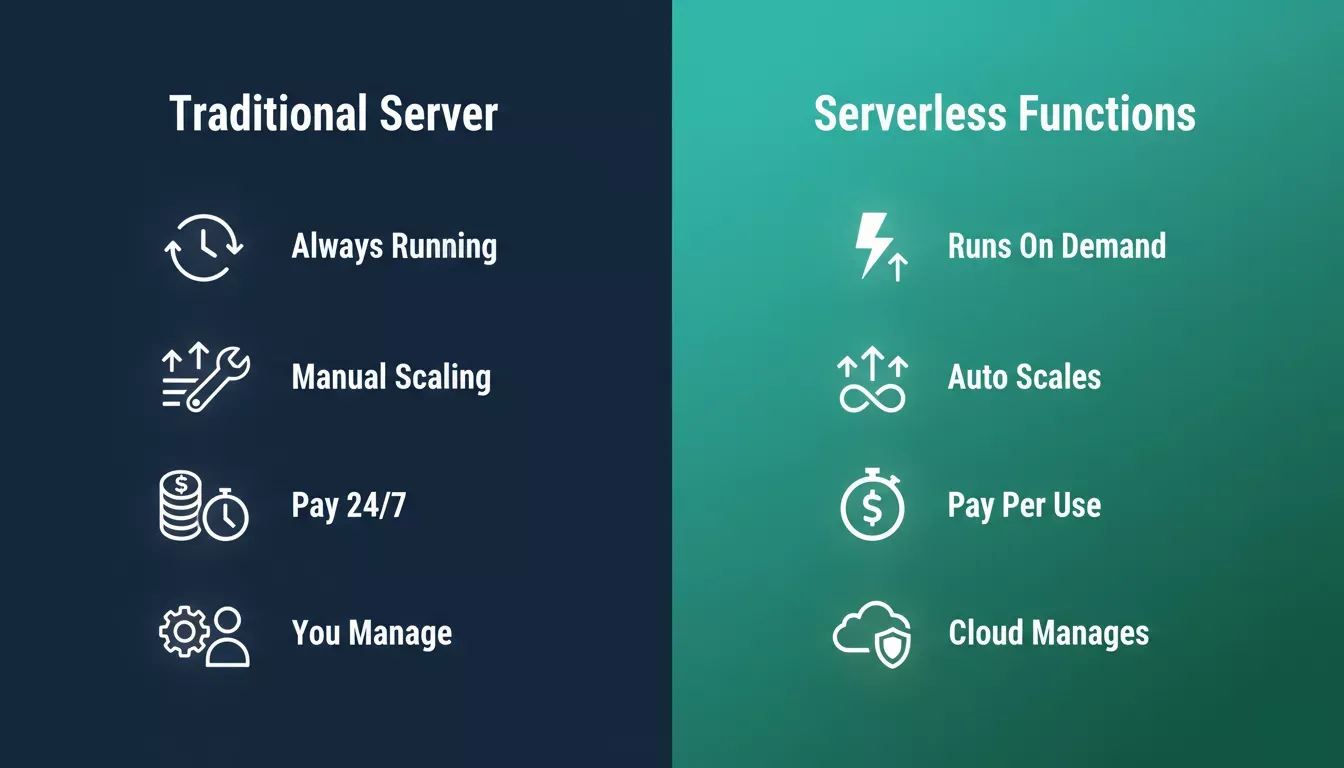
Traditional server architecture vs. serverless functions: four key differences at a glance.
| Factor | Traditional Server | Serverless Functions |
|---|---|---|
| Infrastructure | You manage | The cloud provider manages |
| Scaling | Manual or configured | Automatic, per function |
| Billing | Always-on (hourly/monthly) | Per invocation + compute time |
| Cold starts | None | Possible (milliseconds to seconds) |
| Deployment | Complex pipelines | Simple upload or CLI command |
The serverless model has shifted how engineering teams think about backend architecture. Instead of managing an entire application on one server, teams deploy loosely coupled functions that each handle a specific task. This approach means each function can be updated, tested, and scaled independently without breaking the rest of the service.
How Does a Serverless Framework Handle Backend Logic?
A serverless framework abstracts the complexity of configuring cloud resources. It provides a structured way to define, deploy, and manage serverless functions using configuration files rather than manual cloud console work.
How AWS Lambda Processes a Request
When an AWS Lambda function is invoked, the platform follows a predictable path. The API gateway receives an HTTP request, routes it to the correct lambda function, passes the event data, and returns the response to the client. If the function has not been invoked recently, a cold start occurs while the execution environment initializes.
The AWS Lambda function handler processes the event object, executes your application code, interacts with databases or other services as needed, and returns a response. Each lambda function runs in its own isolated environment with configured memory, timeout settings, and environment variables passed securely at runtime.
AWS Lambda request flow: from client HTTP request through API Gateway to Lambda function and back.
Configuration and Environment Setup
The serverless framework uses a YAML configuration file to define functions, events, environment variables, and provider settings. A typical configuration includes the provider block specifying the cloud provider (AWS), runtime (Node.js, Python, Java), region, and AWS credentials path.
- Provider block specifies the cloud provider, runtime, region, and AWS credentials. The serverless framework supports AWS, Azure, and Google Cloud as provider options.
- The functions block defines each lambda function with its handler path, the events that trigger it, and memory or timeout configuration.
- Environment variables keep secrets, API keys, and database connection strings stored securely and passed to functions at runtime.
- Resources block provisions additional cloud resources like managed databases, S3 buckets, and SQS queues alongside functions in one command.
Once configured, deploying serverless functions to production is a single command: sls deploy. Rolling back with SLS removal is just as straightforward if something breaks.
Local Development and Testing
Most serverless framework setups support local development through plugins that emulate the cloud environment on your machine. This lets developers test lambda functions locally before deploying, reducing iteration time and catching issues before they reach production.
Which Cloud Providers Offer the Best Serverless Platforms?
Three cloud providers dominate the serverless platforms market. Each offers distinct advantages, and the right choice depends on your existing infrastructure, preferred language, and latency requirements.
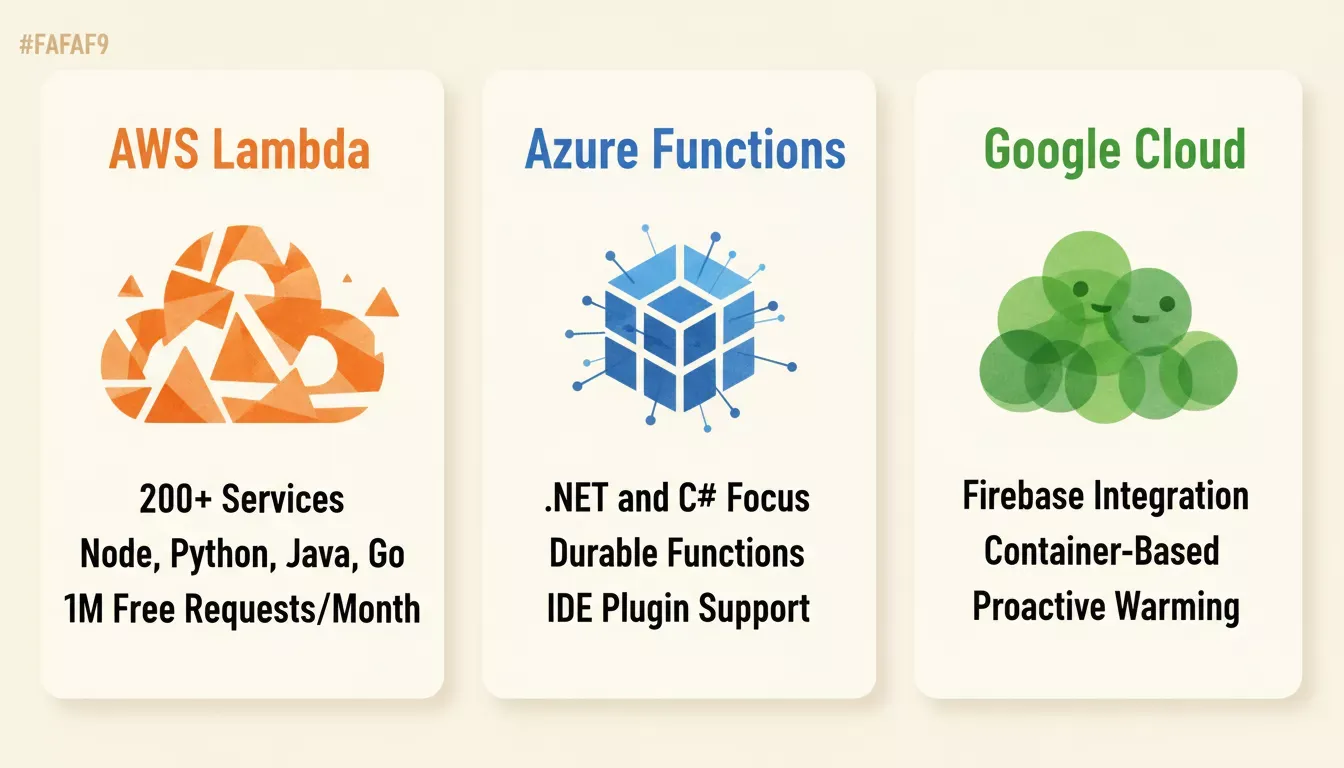
Three major serverless platforms and their primary strengths for different team needs.
AWS Lambda vs Azure Functions vs Google Cloud Functions
AWS Lambda is the most mature serverless platform with the broadest cloud computing ecosystem. It supports Node.js, Python, Java, Go, Ruby, and custom runtimes. AWS Lambda processes trillions of function invocations monthly and connects natively with over 200 aws services. Over 70% of AWS customers use at least one serverless solution.
Azure Functions is Microsoft's offering with strong .NET and C# support. Durable functions handle long-running orchestration workflows that standard serverless cannot address. Azure provides a local development experience through its CLI and IDE plugins that closely mirrors how functions behave in production.
Google Cloud Functions is tightly connected with Firebase, BigQuery, and Cloud Run. Google's 2nd-gen functions are container-based, offering more flexibility for teams that need custom runtimes or larger deployment packages. The platform reduces cold starts through proactive instance warming.
Key factors when choosing a serverless platform:
- Cold starts - Java lambda functions on AWS experience cold start durations nearly 3x longer than Python. If your app needs consistent sub-100ms response times, consider provisioned concurrency or a runtime with faster initialization.
- Pricing - all three providers charge per invocation and compute time. AWS offers 1 million free requests per month per aws account. Azure and Google have similar free tiers for testing and low-traffic serverless applications.
- Multi-region deployment - global apps need multi-region deployment to reduce latency for users worldwide. All three serverless platforms support this, but configuration complexity varies by provider.
The serverless architecture market is projected to reach $124.52 billion by 2034 at a 24.23% CAGR. Cloud computing investment in this model is accelerating across every industry, from BFSI to healthcare to retail.
Each cloud provider serves specific use cases well. But all three share a common limitation: they require developers to write, test, and deploy functions through code. Not every team has that capability or the time to manage AWS IAM role configurations, API gateway setup, and deployment pipelines.
The Serverless Market: Growth by the Numbers
The serverless space is not just growing; it is accelerating. Understanding the scale helps teams justify the architectural shift before committing to a platform.
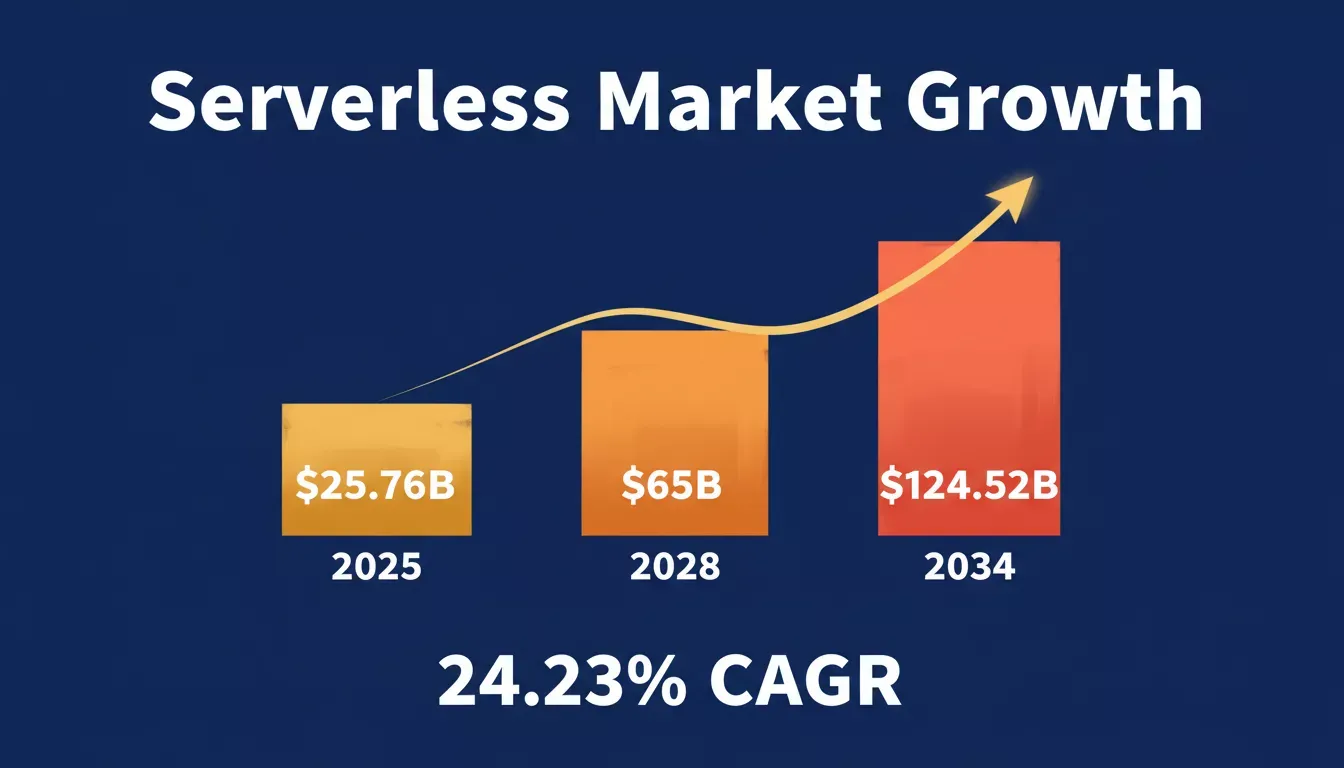
Serverless market trajectory from 2025 to 2034, driven by enterprise cloud adoption across industries.
The numbers reflect a structural shift in how companies build backend infrastructure. Teams that adopted serverless early are now running production workloads at a fraction of the cost of traditional server deployments. For full-stack app builders and non-technical founders, this shift opens a path to production-grade backends without infrastructure expertise.
Can You Deploy Functions Without Writing Any Code?
The traditional path to serverless deployment assumes coding expertise. But a growing category of platforms now generates backend logic from natural language descriptions, removing the need for developers to write application code manually.
No-code serverless platforms handle infrastructure, routing, API endpoints, and database connections behind the scenes. Users describe what they need, and the platform generates the full serverless architecture with configured functions.
AI-powered builders go further by understanding context. They do not just generate code; they make decisions about data models, authentication flows, and REST API design based on the app's purpose. The result is production-grade application code deployed on serverless infrastructure.
The gap that traditional tools leave is significant. You still need to understand event-driven architecture, API gateway configuration, environment variable management, and deployment pipelines. For non-technical founders or small development teams, this creates a barrier between the idea and the shipped product. Learning how to build serverless architecture from scratch takes weeks that most teams do not have.
New features in the AI builder category have removed that barrier entirely. You describe your backend logic needs in natural language, and the platform handles the rest, from generating serverless functions to configuring the cloud service provider and deploying everything to a live URL.
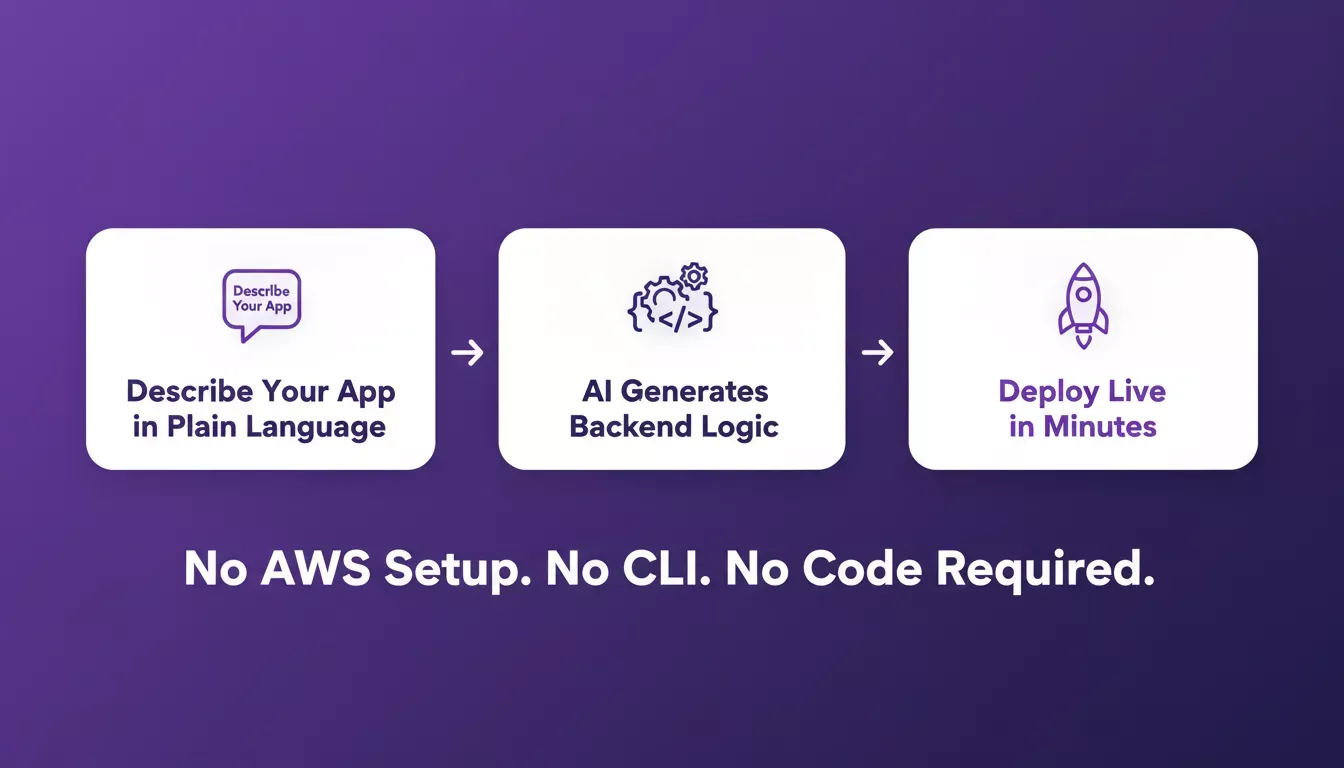
The three-step no-code serverless path: natural language in, production backend out.
How Rocket Ship's Backend Logic in Minutes
Rocket takes the serverless deployment model and wraps it in a platform where you never touch infrastructure directly. Describe your app in plain language, and Rocket generates production-ready Next.js code with built-in API routes that function as serverless endpoints, database connections, and configured deployment.
From Description to Deployed App
Describe your backend needs by telling Rocket what your app should do. Need a SaaS dashboard with user authentication, Stripe payments, and a REST API for mobile clients? Rocket asks clarifying questions about your data model, then generates the full stack with serverless functions handling each API call.
Production-grade output means every full-stack build on Rocket ships with working API routes that run as serverless functions. The platform handles environment variables securely, configures authentication through Supabase auth services, and sets up schemas automatically.
One-click deployment means no AWS account setup, no CLI commands, no serverless framework configuration files. Click Launch, and your app goes live with a shareable URL. Staging and production environments are separate, with full version history and one-click rollback.
25+ service connections, including Stripe, OpenAI, Supabase, Google Analytics, SendGrid, and Twilio, connect directly into the build. Authenticate once, and they flow into every function your app needs without a manual API gateway or environment setup. See the full integrations list for what ships out of the box.
Where Traditional Serverless Platforms Fall Short
| Challenge | AWS Lambda / Azure / GCP | Rocket |
|---|---|---|
| Setup time | Hours to days (credentials, IAM roles, CLI) | Minutes (describe and deploy) |
| Coding required | Yes (Python, Node.js, Java) | No (natural language) |
| Infrastructure management | Your responsibility | Fully managed platform |
| API gateway config | Manual configuration | Auto-generated |
| Database setup | Separate service, manual connection | Built-in Supabase |
| Scaling | Configured per function | Automatic |
| Team collaboration | External tools needed | Built-in workspaces |
For developers who want code access, Rocket provides full source code visibility. You can view, edit, and download the Next.js codebase, including all serverless function files. For non-technical builders, the platform handles everything from backend API development to deployment without exposing complexity.
The serverless promise was that developers could focus on code instead of servers. Rocket takes that promise one step further: you focus on what your app does, and the platform handles both the code and the servers. No AWS credentials to configure, no lambda function handlers to write, no serverless deploy commands to run.
What Are the Best Practices for Scaling Serverless Apps?
Once your serverless app is live, scaling and maintaining it requires attention to patterns that differ from traditional server deployments. These practices apply whether you deployed through a serverless framework or a no-code platform like Rocket.
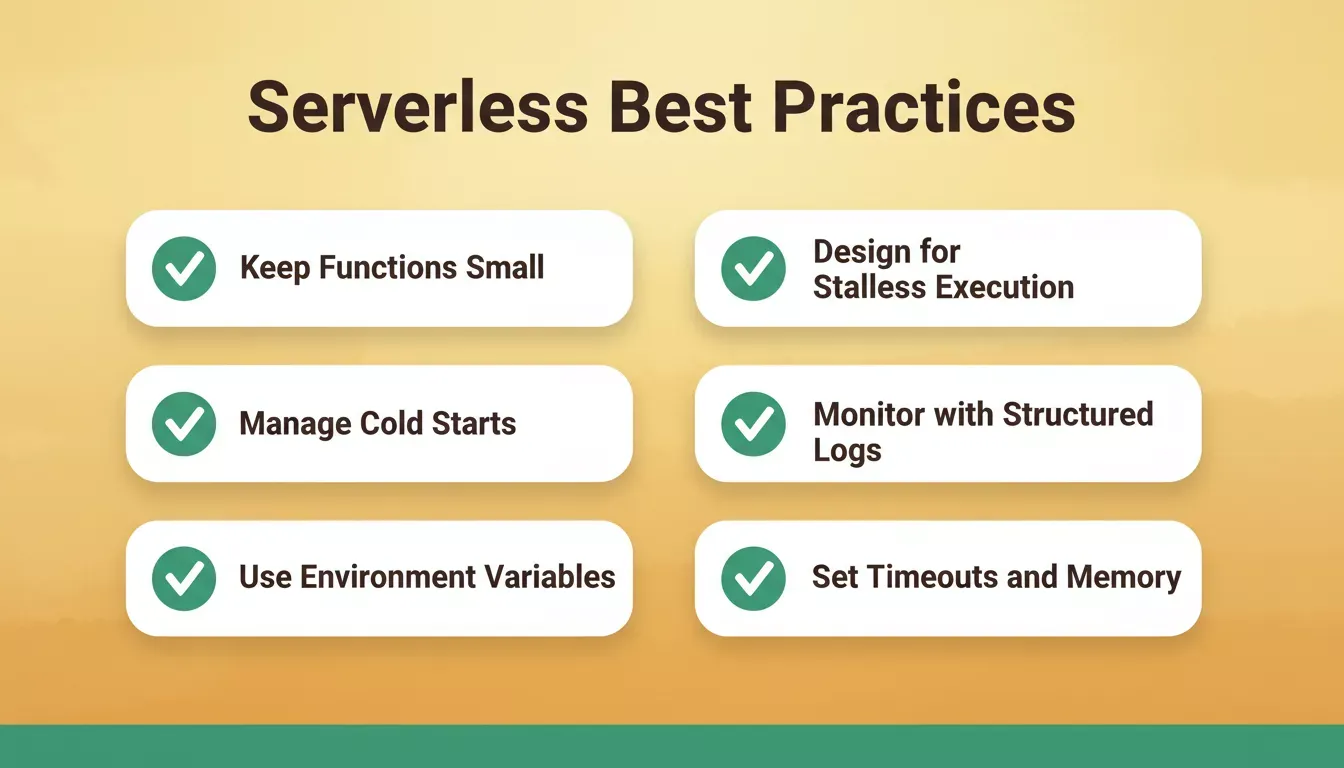
Six serverless best practices every team should apply before going to production.
Patterns That Keep Functions Fast and Reliable
Keep functions small and focused. Each serverless function should handle one specific task. This makes debugging simpler, scaling more predictable, and failures isolated to individual functions rather than affecting the entire application.
Manage cold starts proactively. Warm your most critical functions using scheduled tasks or provisioned concurrency features. Monitor performance across different times of day to identify when cold starts affect user response times most.
Use environment variables for all configuration. Never hardcode secrets, API keys, or database URLs in application code. Environment variables keep configuration secure and make it easy to switch between staging and production environments.
Design for stateless execution. Serverless functions should not rely on local state between invocations. Store shared data in managed databases, caches, or message queues. Stateless functions scale horizontally without causing side effects across other services.
Monitor with structured logging. Distributed serverless architectures make debugging harder than monolithic apps. Use a custom log group per function, distributed tracing, and structured logs to track HTTP requests across multiple functions and services.
Set appropriate timeouts and memory. Over-provisioning memory wastes money; under-provisioning causes failures. Test each specific function under realistic load to find the right balance of compute resources and cost.
Scaling serverless SaaS applications is less about capacity planning and more about designing functions that are loosely coupled, stateless, and observable. Get the architecture right, and the cloud provider handles the rest of the scalability challenge.
For teams building production-grade apps, understanding how AI improves backend API performance is the natural next step after getting serverless architecture right.
Your Next Backend Does Not Need a Server
The serverless model has moved from experimental to standard practice across cloud computing. Companies in every industry now run production workloads on cloud functions that scale automatically, cost nothing when idle, and deploy in seconds rather than days. The infrastructure management burden that once consumed 20-30% of developer time is now handled entirely by the service provider.
For teams that want this architecture without the configuration overhead, Rocket provides the shortest path from idea to live backend. Describe what you need, deploy in minutes, iterate through conversation rather than code, and ship serverless architecture that handles real production traffic from day one.
Ready to add serverless functions to your next app without writing a single line of backend code?
Start building with Rocket.new, describe your app, and Rocket generates production-ready serverless functions, database connections, and API routes in minutes. No server setup, no framework configuration, no coding required.
Table of contents
- -What Are Serverless Functions and Why Do They Matter?
- -How Does a Serverless Framework Handle Backend Logic?
- -How AWS Lambda Processes a Request
- -Configuration and Environment Setup
- -Local Development and Testing
- -Which Cloud Providers Offer the Best Serverless Platforms?
- -AWS Lambda vs Azure Functions vs Google Cloud Functions
- -The Serverless Market: Growth by the Numbers
- -Can You Deploy Functions Without Writing Any Code?
- -How Rocket Ship's Backend Logic in Minutes
- -From Description to Deployed App
- -Where Traditional Serverless Platforms Fall Short
- -What Are the Best Practices for Scaling Serverless Apps?
- -Patterns That Keep Functions Fast and Reliable
- -Your Next Backend Does Not Need a Server