
Agentic bots now drive over half of all web traffic. They defeat CAPTCHAs, evade rate limits, and mimic humans. A layered defense using Turnstile, honeypots, and rate limiting is the proven fix.
Agentic bot traffic refers to automated web activity driven by AI agents that reason, adapt, and make autonomous decisions, unlike traditional scrapers that follow fixed scripts.
According to the 2026 Thales Bad Bot Report (published by Thales Group via Imperva), automated traffic now accounts for 51% of all web activity.
This guide explains what makes agentic bots uniquely dangerous, which endpoints they target first, why CAPTCHAs fail against them, and how to build layered bot protection into your Next.js app.
Key takeaways:
- Agentic bot traffic now accounts for more than half of all web activity, driven by AI agents that adapt in real time rather than following fixed scripts.
- Traditional defenses like CAPTCHAs and simple rate limits are insufficient against agentic AI systems that use vision models, token harvesting, and behavioral simulation.
- A layered defense stack combining Cloudflare Turnstile, server-side rate limiting, and honeypot fields is the current best practice for Next.js apps.
- You can prompt Rocket to generate a Next.js app with these protections wired in from the first build, no separate security sprint required.
What is Agentic Bot Traffic?
Agentic bot traffic is web activity generated by AI agents that use large language models to reason through obstacles, adapt their behavior based on responses, and coordinate multi-step workflows across external systems, all with minimal human oversight. Unlike traditional bots that fail when conditions change, agentic AI systems learn from each interaction and continuously improve their approach.
Why Are AI-Powered Bots Harder to Detect Than Traditional Scrapers?
Agentic AI systems are harder to detect because they reason, adapt, and mimic human behavior, making static detection rules ineffective. The gap between old-school bots and modern agentic AI systems is not just technical. It is behavioral. Traditional bots follow rigid scripts, while agentic AI operates with autonomous decision-making, continuous learning, and the ability to adapt in real time.
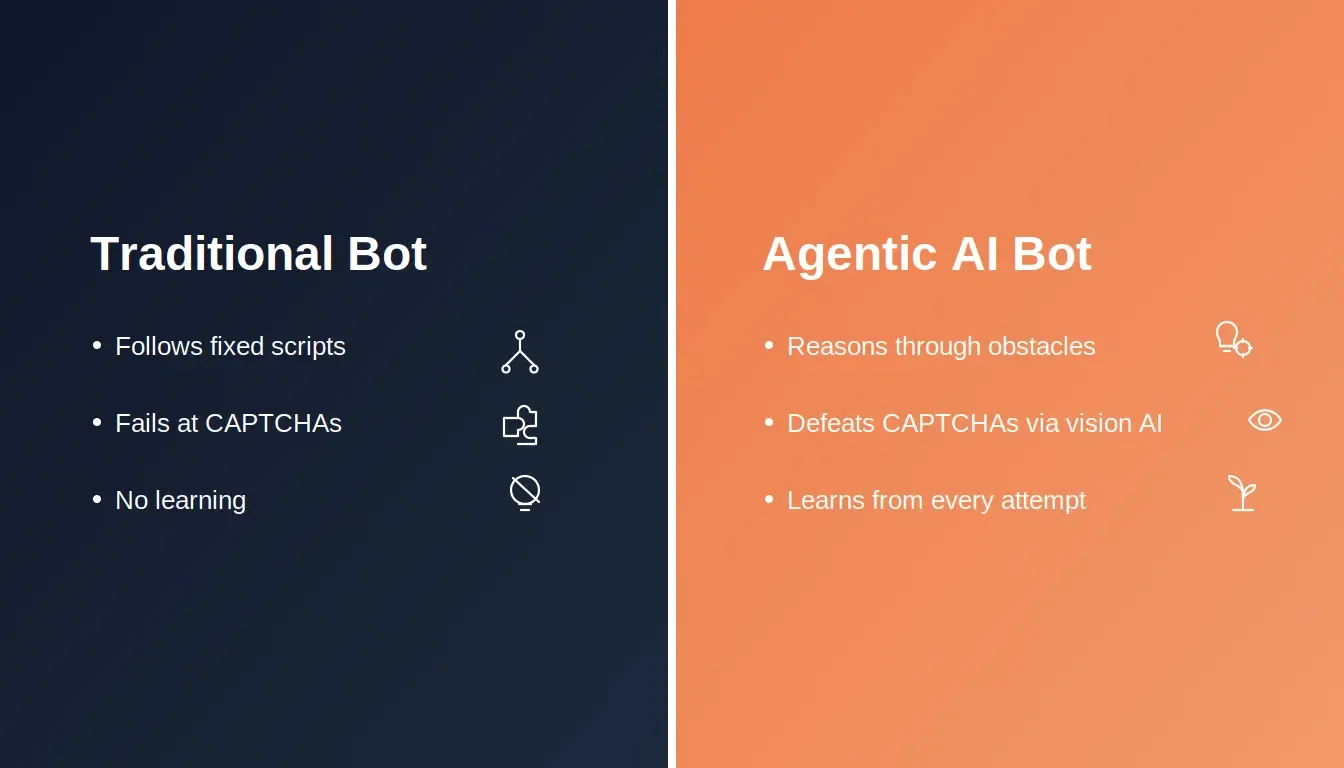
Traditional bots fail at obstacles. Agentic AI bots reason through them.
- Traditional bots follow pre-written rules. They execute tasks in a fixed sequence without deviation. When a CAPTCHA appears or a rate limit triggers, they fail and stop. These are the bots that robotic process automation tools were designed to handle, performing repetitive tasks with no ability to reason.
- Agentic AI systems reason through obstacles. Powered by large language models and machine learning models, these AI agents assess their environment, make decisions, and choose the best course of action without human intervention. If one path fails, they find another through autonomous execution.
- Agentic AI represents a shift from execution to planning. Unlike early chatbots or simple generative AI models, agentic systems break complex tasks into multi-step workflows. They coordinate with external tools, external systems, and sometimes other agents to achieve goals with minimal human supervision.
- Continuous learning makes them harder to fingerprint. Agentic AI work involves adapting to changing conditions. Each interaction teaches the system through continuous improvement, so blocking yesterday's pattern does little against today's approach.
- They mimic real human behavior. These AI agents use natural language processing, conversational AI techniques, and adaptive pattern matching to simulate human teams. They rotate identities, vary timing, and pass behavioral checks that stop simpler automation.
| Feature | Traditional Bots | Agentic AI Systems |
|---|---|---|
| Decision making | None, follows scripts | Autonomous, context-based |
| Adapts to blocks | Fails or retries same method | Changes strategy in real time |
| Identity | Static fingerprint | Rotates and mimics humans |
| Tool use | Single tool or library | Multi-step workflows across external systems |
| Human intervention | For every edge case | Minimal human involvement |
| Learning | None | Continuous learning from outcomes |
Terminology Reference
| Term | Definition |
|---|---|
| Agentic bot | An AI agent that reasons and adapts autonomously to achieve web-based goals |
| Traditional bot | A script-based tool that follows fixed rules with no adaptive capability |
| RPA bot | Robotic process automation, rule-based task execution, no reasoning |
| Generative AI bot | Uses LLMs to produce content, may or may not have autonomous decision-making |
| Multi-agent system | Multiple AI agents coordinating across tools and systems to complete complex tasks |
Understanding web application security best practices is the foundation for defending against these agentic AI capabilities. The security challenges posed by these AI systems call for a fundamentally different approach than what worked against traditional bots.
Which App Endpoints Do Agentic AI Systems Target First?
Agentic AI systems prioritize endpoints where business logic is weakest, including account creation, authentication, forms, APIs, and session management. They do not attack randomly. They probe these surfaces with the patience of human agents conducting real-world reconnaissance through data analysis.
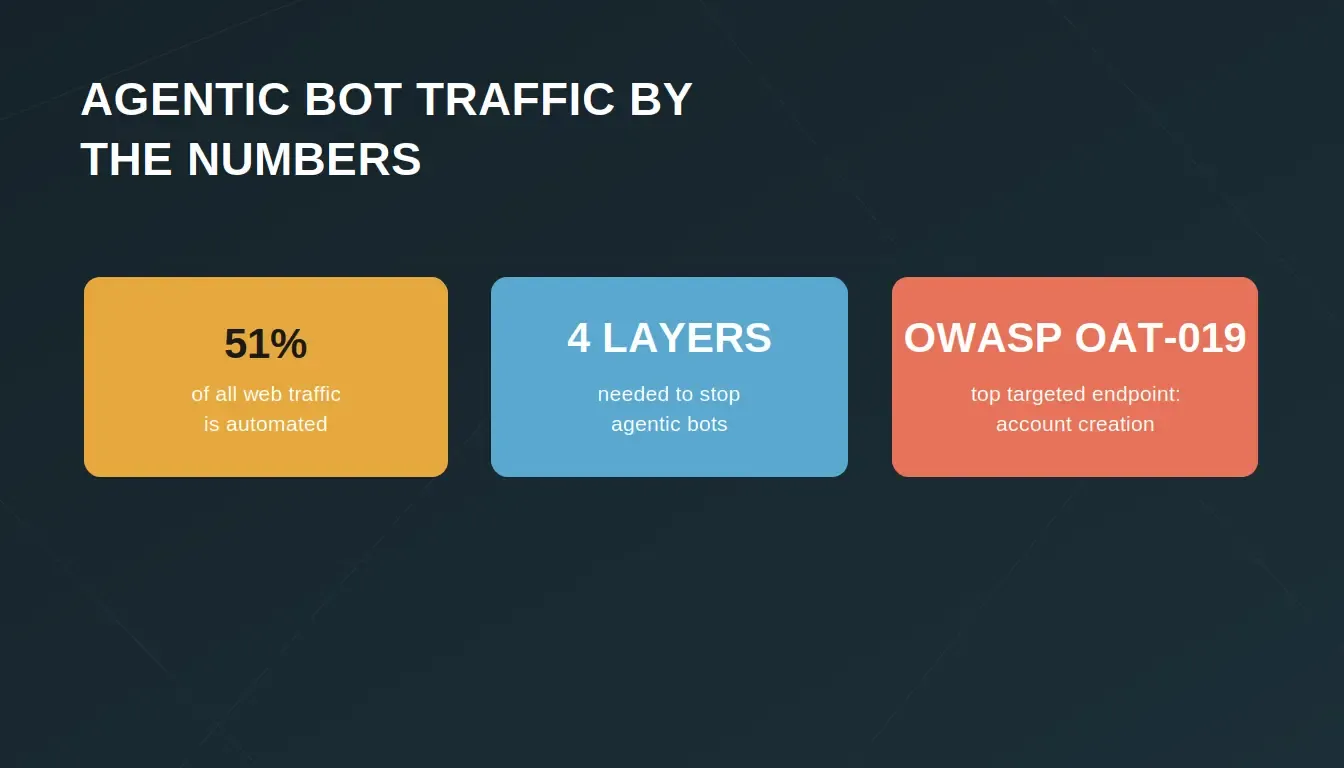
Key statistics on agentic bot traffic and the scale of the threat.
- Account creation endpoints (OWASP OAT-019). The OWASP Automated Threats project classifies automated account creation as one of the oldest and most persistent threats. Agentic AI systems now perform tasks like filling registration forms, solving verification challenges, and creating hundreds of accounts per hour with complex interactions that look legitimate to human teams.
- Authentication flows (OAT-008 Credential Stuffing). Agentic AI systems test leaked credentials across multiple services simultaneously. Their decision-making adapts based on rate limit responses, trying different IP ranges and timing patterns. These AI agents assess failed login patterns and adjust strategy without constant human oversight.
- Form submission flows. Contact forms, payment forms involving financial data, and support tickets are targets for agentic AI work. They generate natural language content that passes basic validation and floods your team with noise that buries real customer interactions.
- API rate limits. Agentic AI systems test rate limits methodically, discovering thresholds through data-driven decisions. Then they operate independently just below detection, treating your API like a tool they have learned to use.
- Session management. Agentic AI systems maintain context across multi-step tasks, keeping sessions alive and reusing tokens. Their complex workflows simulate real user journeys with enough behavioral variance to avoid anomaly detection by security teams.
When you think about securing your Next.js app with Server Actions, these are the surfaces that need layered defense, not just a CAPTCHA. The security challenges are real, and agentic AI makes them more acute with every shift in the threat environment.
How Do Autonomous Agents Defeat CAPTCHAs and Rate Limits?
Autonomous agents defeat CAPTCHAs by routing them to vision models, and evade rate limits by measuring thresholds and distributing requests across IP pools. The assumption that a visual challenge or a request counter can stop AI agents is outdated. Agentic AI has turned CAPTCHA defeat into one of many complex problems it solves autonomously through autonomous decision-making.
- CAPTCHA-solving as a service. Agentic AI systems route challenges to specialized AI capabilities, including computer vision models that solve image puzzles at human speed. Generative AI has made this nearly free at scale. Multi-agent systems divide the work so no single agent appears suspicious to monitoring systems.
- Rate limit discovery and evasion. Autonomous agents measure response times, HTTP status codes, and retry-after headers to map your rate-limiting rules through data analysis. They then distribute requests across IP pools, staying below thresholds.
- Behavioral simulation passes fingerprinting. Conversational AI techniques combined with generative AI let agentic systems simulate mouse movements, typing cadence, scroll depth, and time on page. Human teams cannot easily distinguish this from real user data when reviewing access logs.
- Token harvesting across sessions. Agentic AI systems solve one challenge, harvest the token, then reuse it across multiple requests before expiry. This is a multi-step workflow that simple rate counters miss entirely.
This is why Cloudflare Turnstile documentation specifically addresses the limits of traditional CAPTCHAs. Modern challenges need to run non-interactive JavaScript probes, not visual puzzles that generative AI models solve instantly.
How an agentic bot attack unfolds, step by step:
- AI agent discovers a target endpoint
- Measures rate limit threshold via timed requests
- Distributes traffic across an IP pool to stay below detection
- Routes any CAPTCHA to a computer vision model
- Harvests the token and submits the payload
Agentic bot attack flow: from endpoint discovery to payload submission
How Rocket Ships Next.js Apps with Bot Protection Built In
Rocket is a vibe solutioning platform that combines Solve (strategic research), Build (AI app generation), and Intelligence (competitive monitoring) into a single product. Within the Build pillar, you can prompt Rocket to generate Next.js applications with security layers wired in from the first generation, including rate limiting on Server Actions, honeypot field injection, and Cloudflare Turnstile integration.
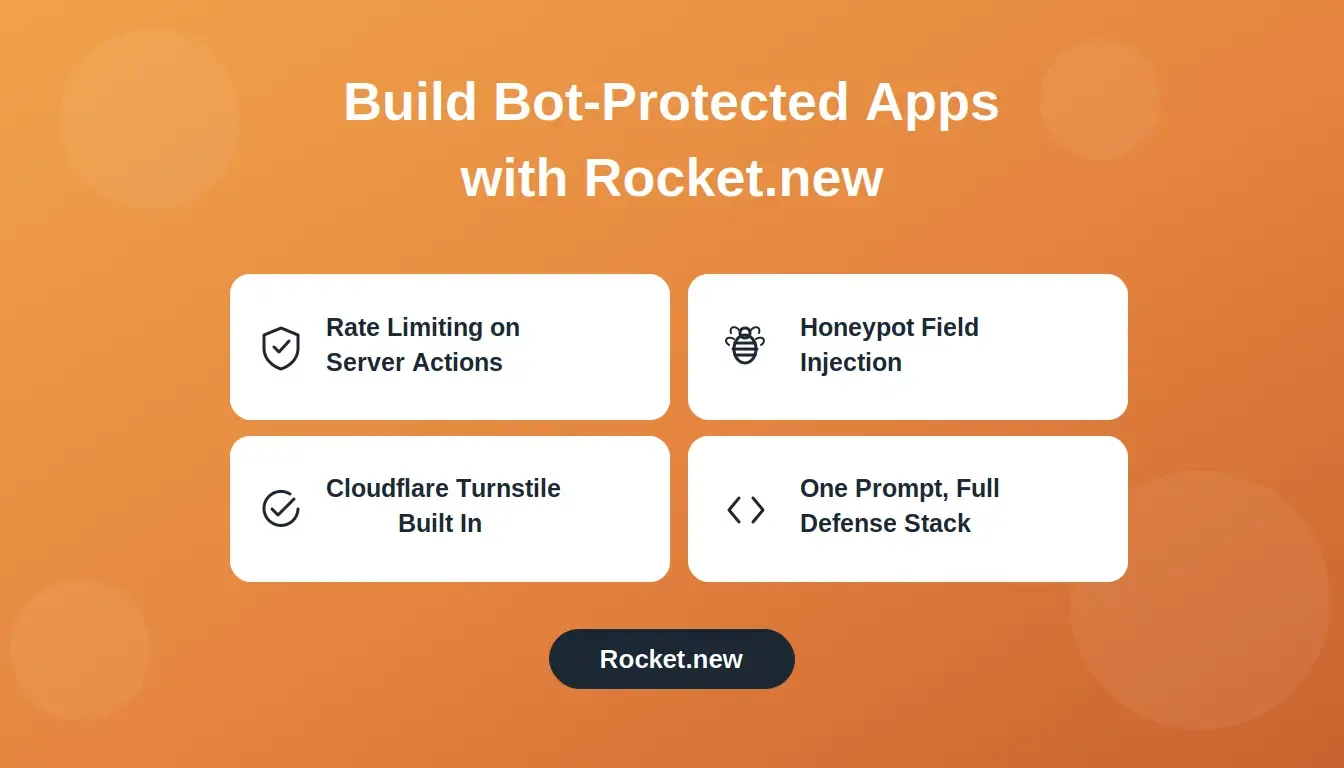
Rocket.new generates a complete bot protection stack from a single build prompt.
Most teams spend days configuring these protections by hand across multiple files and environments. When you describe your app to Rocket and include bot protection in your prompt, it can generate the complete defense stack in a single build. The security checklist in Rocket's docs covers API keys, authentication, Row-Level Security, and privacy best practices that complement these defenses.
- Rate limiting on Server Actions. Prompting Rocket to include rate limiting generates Next.js Server Actions with built-in request counting per IP. Your form submissions and API routes enforce limits without writing custom middleware. Agentic AI systems that probe your endpoints hit a wall immediately.
- Honeypot field injection. When you ask Rocket to add bot protection, it can add hidden form fields that real users never see or fill. Agentic AI work often involves parsing form structures and filling every field, so these traps catch AI agents that perform tasks too completely.
- Cloudflare Turnstile built in. Rather than wrestling with CAPTCHA SDKs, prompting Rocket to include Turnstile wires the non-interactive challenge directly into your forms. The system runs proof-of-work and browser probes on page load, validating tokens server-side with minimal friction for your users.
- All from one prompt. Ask Rocket to build a Next.js app with user registration, contact forms, and bot protection, and it generates the complete defense stack. No separate security sprint. No consulting documentation for three different services.
Rocket also handles API key management and authentication as documented defaults, so your app ships with secure server-side API routes from day one. The AI agents you are defending against use multi-step workflows across external tools; your defense can ship in one step through AI-powered generation.
Ready to build a protected app without the security plumbing? Start building with Rocket and include bot protection in your first prompt.
What Does a Working Defense Stack Look Like in Practice?
A working defense stack combines four layers, each catching a different class of agentic bot behavior: Turnstile challenge, honeypot detection, server-side rate limiting, and token validation. Here is how these layers function together when agentic AI systems hit your endpoints with multi-step tasks designed to find gaps in your defenses.
- Layer 1: Turnstile challenge on page load. Before a form renders as interactive, Turnstile runs silent challenges. Agentic bot traffic using browser automation must pass proof-of-work and environment probes. This filters headless browsers and AI agents that lack full rendering contexts.
- Layer 2: Honeypot detection on submission. When a form is submitted, your Server Action checks the hidden field. If filled, the request is silently dropped with no error message. The agentic AI systems that execute tasks too thoroughly get caught without learning from the failure, because they receive a success response.
- Layer 3: Rate limiting per IP on Server Action. Every Server Action tracks request frequency per IP address within a time window. If an IP exceeds the threshold, subsequent requests return a 429 response. Agentic AI systems that perform tasks at speed get throttled before they cause damage.
- Layer 4: Token validation server-side. The Turnstile token from the client is validated against Cloudflare's API in your Server Action. Expired, reused, or fabricated tokens fail validation. This catches agentic AI work that harvests and replays tokens through their complex workflows across sessions.
Building full-stack apps with production-grade defaults means these four layers should be non-negotiable from the first deployment.
1// Example: Next.js Server Action with layered defense
2'use server'
3
4import { headers } from 'next/headers';
5
6const rateLimitMap = new Map();
7
8export async function submitContactForm(formData) {
9 // Layer 2: Honeypot check
10 if (formData.get('website_url')) {
11 return { success: true }; // Silent drop
12 }
13
14 // Layer 3: Rate limit (5 requests per 60 seconds)
15 const ip = headers().get('x-forwarded-for') ?? 'unknown';
16 const now = Date.now();
17 const record = rateLimitMap.get(ip);
18
19 if (record && now - record.timestamp < 60000 && record.count >= 5) {
20 return { error: 'Too many requests' };
21 }
22
23 rateLimitMap.set(ip, {
24 count: (record?.count ?? 0) + 1,
25 timestamp: record?.timestamp ?? now
26 });
27
28 // Layer 4: Turnstile token validation
29 const token = formData.get('cf-turnstile-response');
30 const verifyRes = await fetch(
31 'https://challenges.cloudflare.com/turnstile/v0/siteverify',
32 {
33 method: 'POST',
34 body: JSON.stringify({
35 secret: process.env.TURNSTILE_SECRET,
36 response: token,
37 }),
38 headers: { 'Content-Type': 'application/json' },
39 }
40 );
41
42 const verification = await verifyRes.json();
43 if (!verification.success) {
44 return { error: 'Verification failed' };
45 }
46 // Process legitimate request
47}Which Monitoring Signals Tell You Agentic Bots Got Through?
Even with layered defenses, some agentic AI systems will adapt and find gaps, making monitoring as important as blocking. These AI agents use continuous learning to improve over time. Knowing which signals to watch is the difference between catching a breach early and discovering it after damage is done.
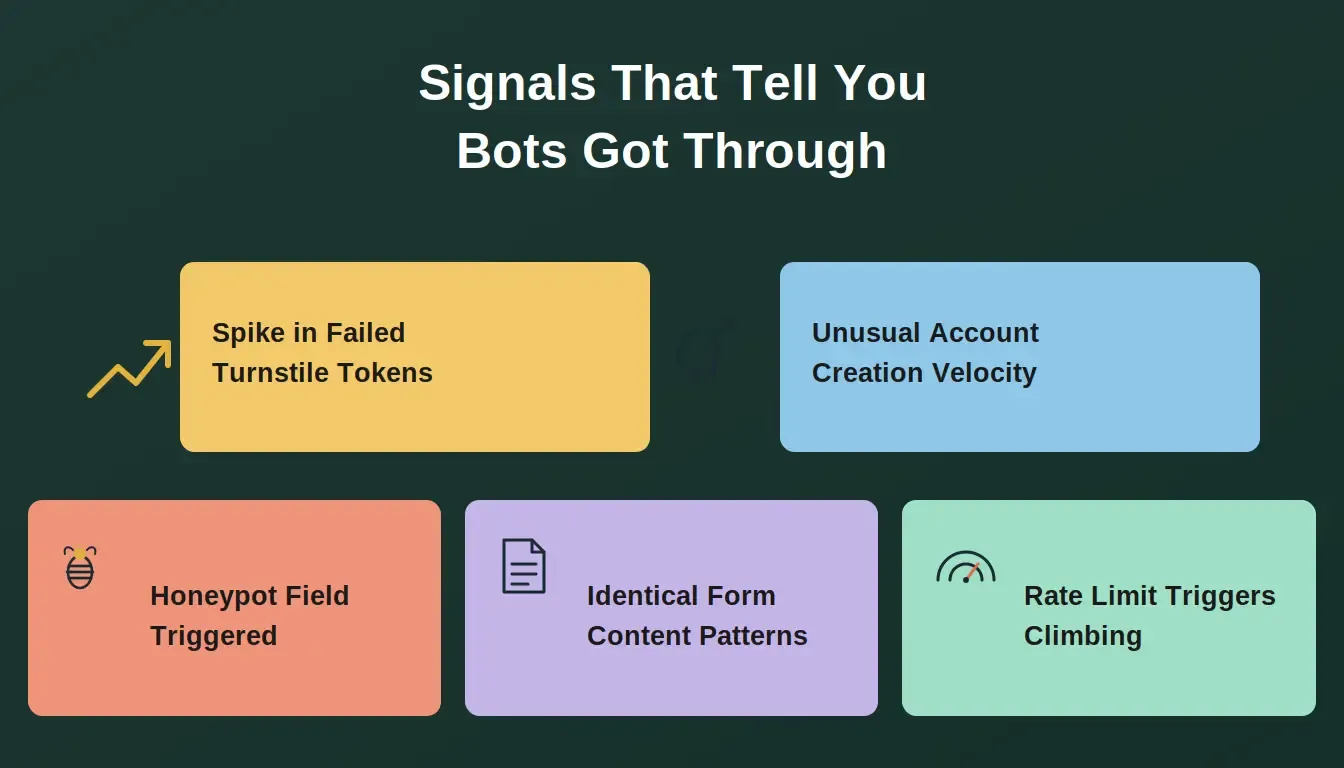
Five signals that indicate agentic bot traffic has reached your app.
- Spike in failed Turnstile validations. A sudden increase in invalid tokens means agentic bot traffic is actively probing your forms. Track this metric daily; it reveals how much AI agent activity targets your app.
- Unusual account creation velocity. If registrations jump without corresponding marketing spend, AI agents are likely creating accounts. Agentic AI systems that perform tasks like bulk registration leave this fingerprint even when individual requests look normal.
- Honeypot field trigger rate. Monitor how often hidden fields receive values. A rate above zero means automated traffic is filling them, and you can measure the volume of agentic AI work hitting your forms through real-time data.
- Identical form content patterns. Agentic AI systems using generative AI for content may produce subtly similar text structures across submissions. Pattern matching on contact form messages reveals this through data analysis of natural language patterns.
- Rate limit trigger frequency climbing. If your rate limits fire more frequently, agentic systems are testing the boundaries you have set. Track the IP diversity behind these blocks to understand whether you face one orchestrator or multi-agent systems working in coordination.
"AI-driven automation is no longer emerging; it is becoming embedded in internet traffic. As agentic AI introduces a new class of automated traffic, organizations must navigate an increasingly complex environment where intent is harder to detect, distinguish, and control." 2026 Thales Bad Bot Report, Thales Threat Research Team (Note: Imperva is a Thales Group company; this report is published under the Imperva domain.)
The best defense is a feedback loop: detect, adapt, and tighten. Agentic AI systems with continuous learning get smarter over time, so your monitoring should evolve with equal speed. Platforms like Rocket that generate secure AI applications treat this feedback loop as a design principle, not an afterthought.
Build Your Next App with Bot Protection Already Baked In
Agentic bot traffic has changed the security calculus for every web application. The bots targeting your forms, APIs, and authentication flows today are not scripts running from a single server. They are AI agents with autonomous decision-making, continuous learning, and the ability to coordinate complex workflows across external systems without human oversight.
Building bot protection into your app from day one is a practical necessity. Rocket.new generates Next.js applications where you can prompt rate limiting, honeypot fields, and Cloudflare Turnstile into every form and Server Action from the first build. Ship a protected app in minutes rather than spending weeks on security plumbing.
Start building with Rocket, describe your app with bot protection requirements, and get a production-grade Next.js application with layered agentic bot defenses ready to deploy.
Table of contents
- -What is Agentic Bot Traffic?
- -Why Are AI-Powered Bots Harder to Detect Than Traditional Scrapers?
- -Terminology Reference
- -Which App Endpoints Do Agentic AI Systems Target First?
- -How Do Autonomous Agents Defeat CAPTCHAs and Rate Limits?
- -How Rocket Ships Next.js Apps with Bot Protection Built In
- -What Does a Working Defense Stack Look Like in Practice?
- -Which Monitoring Signals Tell You Agentic Bots Got Through?
- -Build Your Next App with Bot Protection Already Baked In