
AI accounting software cuts months of development into days. This blog covers what it does, which features matter, how machine learning fits into financial workflows, and how teams ship production-grade accounting systems without a developer team.
Why do accounting teams still spend 30+ hours a month on tasks AI can finish in seconds?
McKinsey estimates that generative AI could add $2.6 to $4.4 trillion in annual value across industries, with financial services among the biggest beneficiaries. The gap between what AI can do for accounting workflows and what most teams actually use is still enormous.
For growing businesses, the real problem is not access to technology. It is the traditional development timeline: months of planning, hiring developers, and iterating before a single invoice gets categorized.
This blog covers what modern AI accounting software actually does, which features to prioritize, and how to ship a working financial system without the usual delays.
Why Accounting Teams Are Moving Away from Manual Workflows
Accounting teams across every industry are shifting away from spreadsheet-heavy workflows. The reasons are consistent across small businesses and enterprise finance teams alike.
-
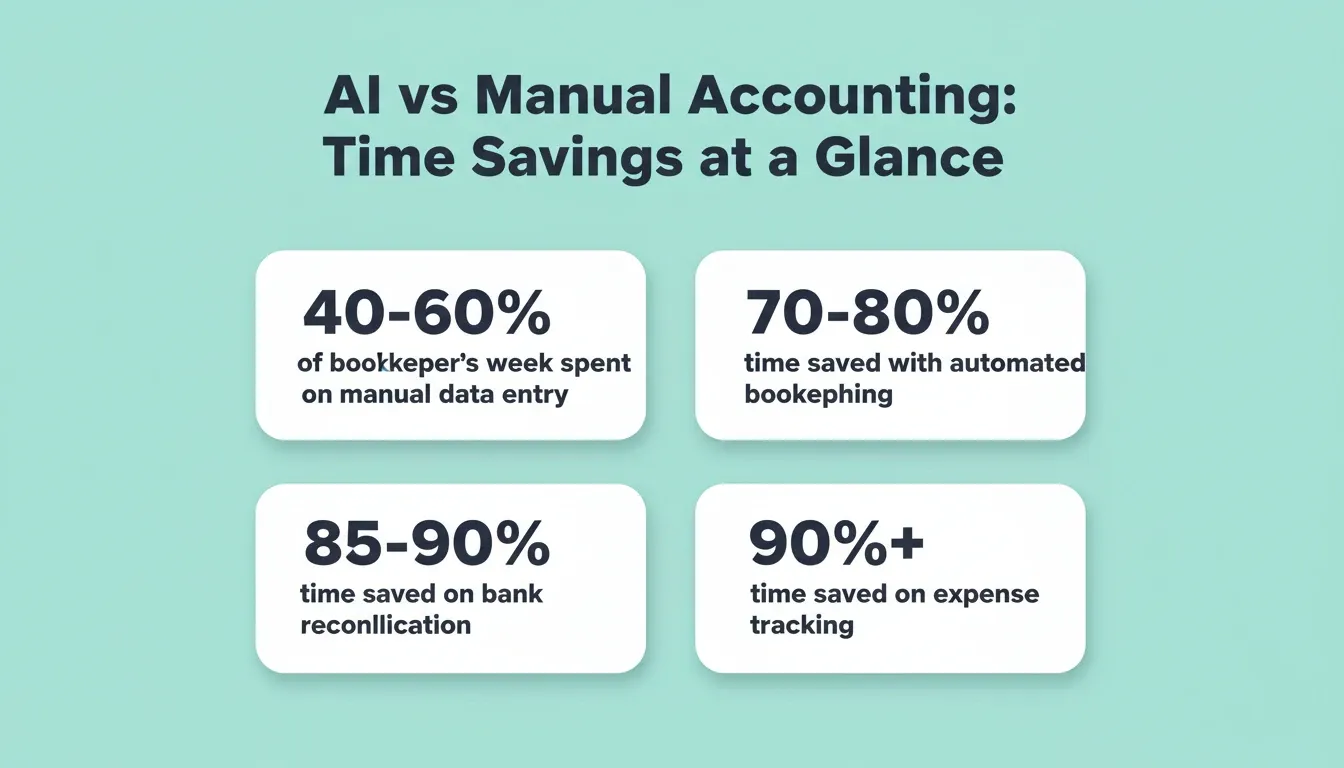
Manual data entry still consumes 40-60% of a typical bookkeeper's week. Typing in vendor bills, categorizing expenses, and matching transactions line by line leaves almost no room for strategic financial work.
-
Errors compound silently across accounting processes. A misclassified journal entry in January shows up as a tax compliance headache in April. Finance teams often catch these discrepancies only during month-end close, when fixing them costs three times as much effort.
-
The month-end close drags on for days. Reconciling accounts, generating financial reporting, and validating data across multiple accounting systems eats into time that should go toward cash flow planning and forecasting.
-
Staff turnover wipes institutional memory. When the person who manages the chart of accounts leaves, the team rebuilds from scratch. AI-powered tools retain every rule and pattern regardless of who sits in the seat.
The pattern is clear: accounting workflows built on manual tasks do not scale. Every new client, every additional vendor bill, and every extra bank account adds friction that slows finance teams down.
This is exactly where AI tools step in. They handle the repetitive accounting processes, including categorizing data entry, flagging unusual transactions, and generating preliminary financial reporting. Meanwhile, your team focuses on judgment calls that actually move the business forward. For teams looking to reduce development costs on their next financial tool, AI-powered accounting is no longer a luxury. It is the baseline expectation.
What Does AI Accounting Software Actually Do?
AI accounting software is not a single feature. It is a layer of intelligence that sits across your entire financial stack, handling everything from basic bookkeeping to predictive analytics.
-
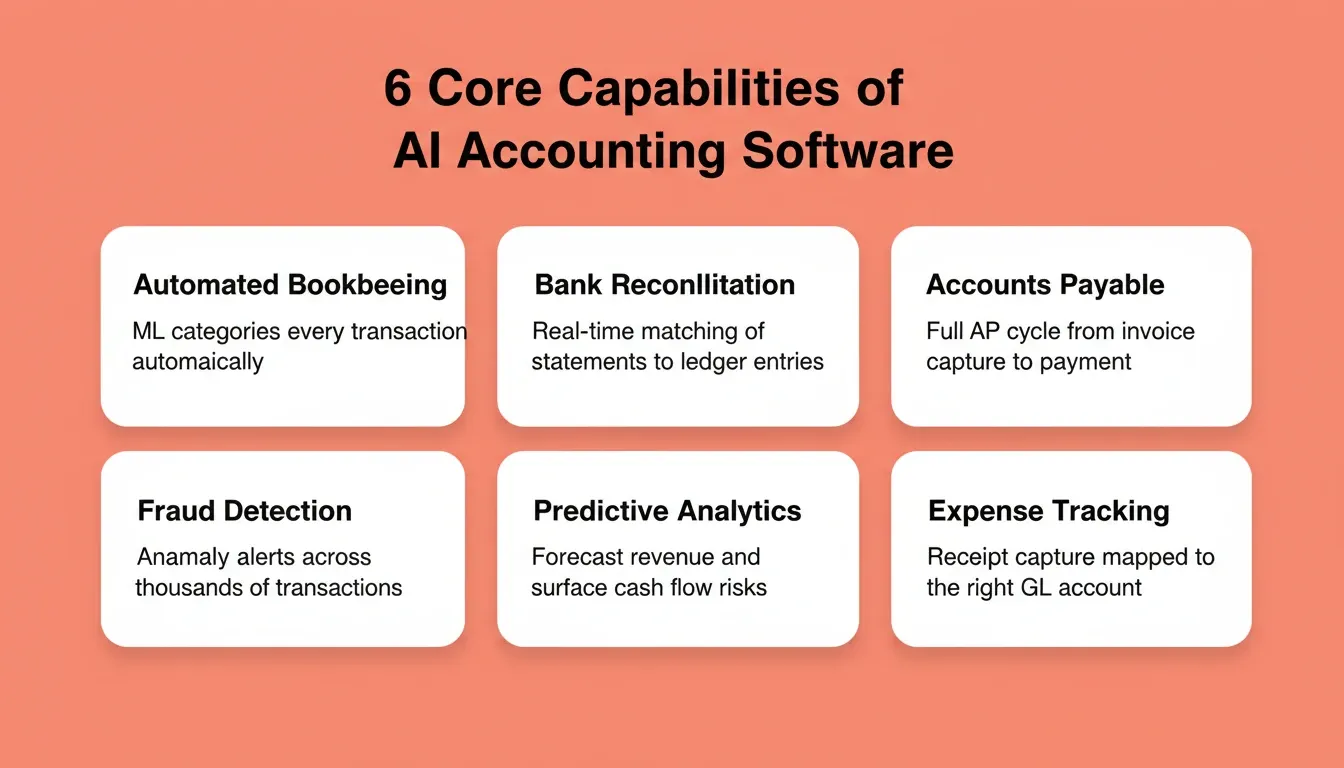
Automated bookkeeping and transaction categorization. Machine learning models learn your chart of accounts and sort every new transaction without human input. After a training period of a few hundred transactions, accuracy rates typically exceed 95%.
-
Bank reconciliation at scale. Instead of matching line items manually, the system cross-references bank statements with your general ledger entries in real time. Discrepancies get flagged for human review automatically.
-
Accounts payable automation. From invoice processing and data extraction from PDFs to scheduling bill pay based on cash flow projections, AI handles the full AP cycle. Teams dealing with high invoice volumes can cut accounts payable processing time by over 70%.
-
Fraud detection and anomaly alerts. Machine learning monitors patterns across thousands of transactions, flagging unusual transactions that deviate from established baselines. This works far faster than a periodic manual review of journal entries.
-
Predictive analytics for financial planning. By analyzing historical data alongside current trends, AI accounting software can forecast revenue, project expenses, and surface cash flow risks weeks before they become problems.
-
Expense tracking and receipt capture. Employees submit receipts through a mobile interface. AI reads the image, extracts data, and maps it to the correct expense category and general ledger account automatically.
According to IBM's analysis of AI in finance, 90% of financial institutions already use AI to expedite fraud detection and identify new tactics in real time. The same principles that power enterprise fraud systems are now available to any team building financial apps with AI.
| AI Capability | What It Replaces | Time Savings |
|---|---|---|
| Automated bookkeeping | Manual data entry and coding | 70-80% |
| Bank reconciliation | Spreadsheet matching | 85-90% |
| Accounts payable | Paper invoice workflows | 60-75% |
| Fraud detection | Periodic manual audits | Real-time vs. monthly |
| Predictive analytics | Backward-looking reports | Proactive vs. reactive |
| Expense tracking | Paper receipt filing | 90%+ |
The best AI accounting software combines several of these capabilities in one platform rather than requiring separate tools for each function. This is what separates a true AI accounting tool from a simple automation add-on.
How Machine Learning Fits Into Financial Workflows
Machine learning is not a buzzword attached to financial workflows. It is the engine that makes everything above work without constant human supervision.
-
Pattern recognition across financial data. ML models ingest thousands of past transactions and learn how your business categorizes expenses, allocates revenue, and structures its general ledger. Over time, accuracy improves as more financial data flows through the system.
-
Natural language processing for documents. NLP reads invoices, contracts, bank statements, and emails to extract structured data from unstructured sources. No manual data extraction is required for accounts payable or expense tracking.
-
Real-time financial insights from historical data. Instead of waiting for month-end reports, machine learning surfaces anomalies and trends as they happen. Finance teams gain real-time visibility into cash flow, spending patterns, and revenue shifts without pulling a single report manually.
-
Continuous improvement loops. Unlike rule-based accounting systems, ML models adapt when corrected. When a bookkeeper fixes a misclassified transaction, the model updates its understanding. As a result, financial reporting becomes more accurate with every correction cycle.
This layered approach means your financial workflows become smarter over time, not just faster. Each data point trains the model further, giving your accounting team real-time financial insights that improve with every transaction processed.
Which Features Matter When Choosing an AI Accounting Tool?
Not every AI accounting tool is built for the same use case. The right choice depends on your transaction volume, compliance requirements, and growth trajectory.
-
Bill pay and accounts payable automation. Look for tools that handle the full cycle: invoice capture, approval routing, payment scheduling, and vendor management. Accounting firms that process more than 200 vendor bills per month will see the biggest time savings here.
-
Tax compliance and sales tax automation. Multi-jurisdiction sales tax calculation, automated filing, and audit trails satisfy regulatory requirements. The best AI accounting software handles this without manual intervention across all applicable jurisdictions.
-
General ledger and chart of accounts flexibility. Your AI accounting tool should adapt to your chart of accounts, not force you into a rigid structure. Look for smart categorization that learns your specific setup.
-
Bank reconciliation and real-time visibility. Automated matching between bank statements and ledger entries, with exception handling for items that need human review, saves hours of manual checking each week.
-
Workflow automation for recurring tasks. Monthly close checklists, recurring journal entries, depreciation schedules, and report generation should all run automatically. This is where automated accounting software earns its keep for busy accounting teams.
-
Advanced reporting and financial reporting dashboards. Financial reporting goes beyond profit and loss statements. Look for dashboard capabilities that show cash flow trends, aging reports, and KPIs in real time.
-
Audit trails and compliance documentation. Every automated action should leave a traceable audit trail. This matters for tax compliance, investor due diligence, and internal quality control across your accounting processes.
According to Forbes research on AI adoption, 64% of businesses expect AI to increase their overall productivity. For accounting teams specifically, the gains are even more pronounced because the work is heavily rule-based and data-intensive.
| Feature Category | Small Business Priority | Enterprise Priority |
|---|---|---|
| Automated bookkeeping | High | High |
| Sales tax automation | Medium | Critical |
| Bill pay | High | High |
| Multi-entity support | Low | Critical |
| Audit trails | Medium | Critical |
| Custom workflows | Low | High |
| Advanced reporting | Medium | High |
Choosing the right AI accounting tool means matching these features to where your accounting team currently spends most time. The best AI accounting solutions address your biggest bottleneck first, then scale from there.
Build vs. Buy: When Custom AI Accounting Software Makes Sense
Most accounting software options fall into two categories: off-the-shelf SaaS products with rigid workflows, or custom-built systems that take six months and a full dev team. Understanding when each makes sense is the first real decision.
Off-the-shelf tools work well for standard bookkeeping at a single entity. However, they break down when your compliance requirements are industry-specific, your workflows do not fit their data model, or per-seat licensing costs become prohibitive at scale. Teams that need invoice software that fits their exact process often find that off-the-shelf tools force compromises that cost more in workarounds than the license itself.
| Scenario | Off-the-Shelf SaaS | Custom Build with AI |
|---|---|---|
| Standard bookkeeping, single entity | Best fit | Overkill |
| Multi-entity with intercompany transactions | Limited | Best fit |
| Industry-specific compliance requirements | Rarely adequate | Best fit |
| Integration with proprietary internal systems | Difficult | Best fit |
| Per-seat pricing becoming cost-prohibitive | Consider switching | Best fit |
| White-label client portals needed | Not available | Best fit |
| Timeline under two weeks | Off-the-shelf wins | Competitive with AI builders |
Traditional development of a custom accounting system typically costs $50,000-$150,000 and takes 4-6 months. AI-powered app builders shift that calculation significantly. A tailored accounting platform that would have required a full dev team can now be shipped in days.
How to Build Accounting Software with AI Using Rocket
Rocket is the world's first Vibe Solutioning platform, where you research what to build, build it, and monitor what matters, all in one place. For accounting teams and founders building financial tools, this means going from idea to deployed, production-grade accounting software without writing a single line of code.
Here is exactly how to do it:
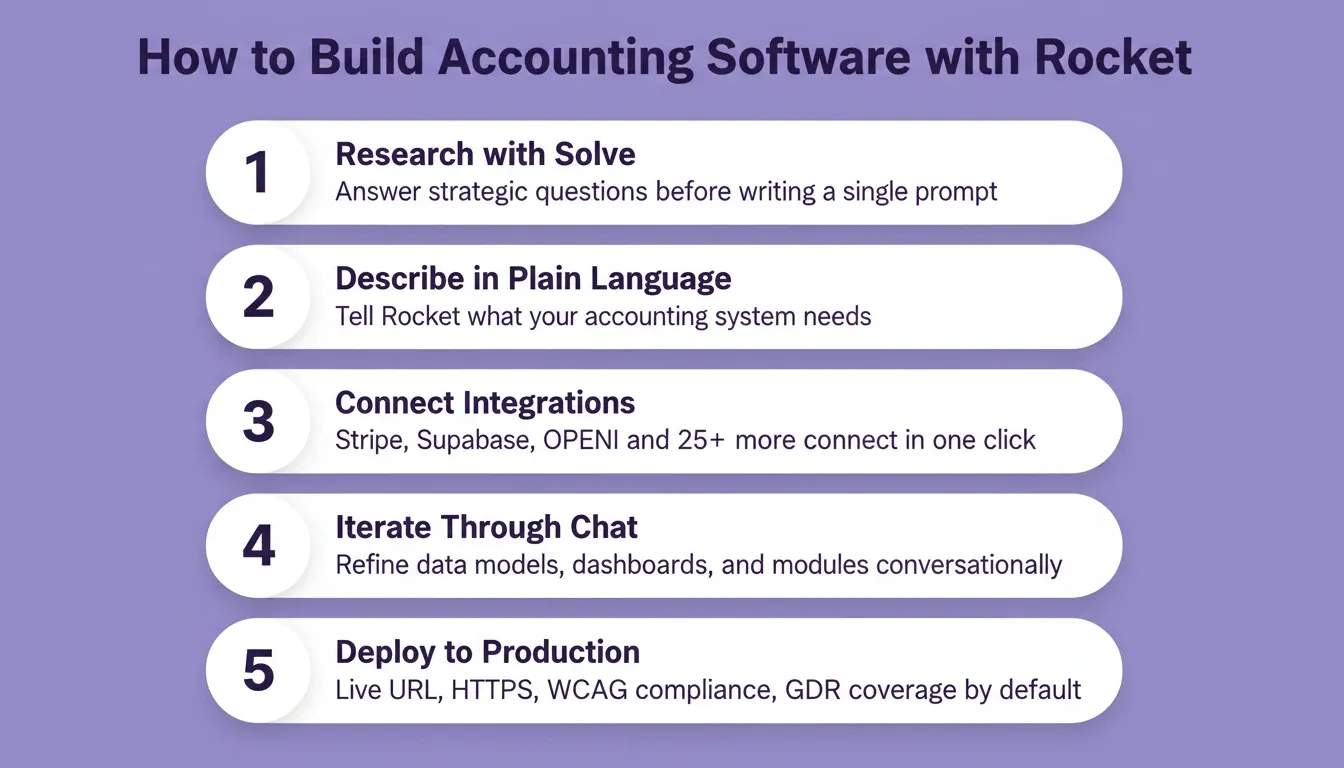
Step 1: Research your requirements with Solve. Before writing a single prompt, use Rocket's Solve capability to answer the strategic questions that determine what your accounting system needs. For example, ask: "What features do accounting teams at 50-person companies need most in their AP automation software?" This research phase takes minutes and prevents the most expensive mistake in software development: building the wrong thing.
Step 2: Describe your accounting system in plain language. Tell Rocket what you need: "Build an accounts payable tracker with invoice scanning, approval workflows, and Stripe payment scheduling. Include a dashboard showing outstanding payables, cash flow projections, and vendor payment history." Within minutes, you have a working financial application built in Next.js with a production-grade interface.
Step 3: Connect your financial integrations. Rocket ships with 25+ integrations that connect directly into your accounting Build. For financial applications, the most relevant are Stripe for payment processing, Supabase for PostgreSQL database with built-in authentication, and OpenAI or Anthropic for AI-powered invoice parsing and anomaly detection.
Step 4: Iterate through conversation. After the first generation, refine through chat. Change the data model, adjust the dashboard layout, add new accounting modules, or connect additional integrations, all in context without re-explaining what already exists.
Step 5: Deploy to production. Click Launch. Rocket deploys to a live URL with automatic HTTPS. Every build ships with SEO-ready structure, WCAG accessibility compliance, and GDPR coverage by default.
How Accounting Firms Plan the Right AI Software Stack
Choosing AI software is only half the challenge for accounting firms. The other half is figuring out how it fits into your existing accounting system without breaking current financial workflows.
-
Start with a single process, not the whole practice. Pick the workflow that wastes the most time for your accounting teams: usually bank reconciliation or accounts payable. Automate that first, then expand once the team trusts the system.
-
Check compatibility with your existing ERP systems. Financial institutions and mid-market businesses often run QuickBooks Online, Sage Intacct, or NetSuite. Your AI software needs to connect to what already works without requiring a full migration on day one.
-
Plan for human bookkeeping oversight at every stage. AI handles the volume. Accounting professionals handle the judgment. Set up review queues where the system flags exceptions and a human confirms. This approach keeps error detection rates high without slowing throughput.
-
Build for the accounting systems you will need in 12 months, not just today. Small businesses that are growing fast need scalable architecture. Multi-entity support, multi-currency handling, and branch-specific reporting should be on the roadmap even if you only need single-entity today.
-
Train the team alongside the tool. AI bookkeeping tools learn from corrections. If your accounting professionals do not correct early mistakes, accuracy plateaus and the system never reaches its potential. Build a feedback loop into onboarding.
For firms serving multiple clients, the architecture matters even more. Each client needs isolated financial data, client-specific categorization rules, and independent audit trails. Accounting systems built with this in mind from day one avoid painful migrations later.
Common Mistakes When Moving to AI-Based Financial Tools
Switching to AI-powered accounting does not automatically fix everything. Accounting firms that rush the transition often make the same mistakes.
-
Trusting AI blindly for complex accounting judgments. Machine learning excels at pattern matching and categorization. It struggles with nuanced decisions like revenue recognition timing or lease accounting classifications. Human bookkeeping oversight is non-negotiable for these areas.
-
Skipping the training period entirely. AI capabilities improve with data. Dumping 50 transactions into a new system and expecting 99% accuracy is unrealistic. Budget two to four weeks for the model to learn your specific patterns.
-
Ignoring error detection workflows. When AI makes a mistake on accounting tasks, someone needs to catch it quickly. Without built-in quality control checkpoints, small errors compound into month-end nightmares that take days to untangle.
-
Keeping manual data entry as a fallback habit. Teams sometimes keep entering data by hand "just in case," which defeats the purpose entirely. Commit to the new workflow and redirect those manual data entry hours toward financial analysis instead.
The best transitions happen gradually. Start with automated categorization, then add bank reconciliation, then layer in financial reporting. Each stage builds team confidence before the next layer of automation arrives.
Additionally, you can use Rocket's Intelligence capability to monitor how competing accounting platforms are evolving continuously. This keeps your custom system ahead of what the market expects.
Your Next Financial System Starts with the Right AI Decision
The gap between manual accounting and AI-powered financial operations is getting wider every quarter. Teams that invest in the right stack now will compound their advantage as transaction volumes grow and compliance requirements multiply across jurisdictions.
Your accounting tasks do not need to consume your team's best hours. The tools exist to handle categorization, reconciliation, and financial planning at machine speed, freeing your people for the work that actually needs human judgment and strategic thinking.
The Future of Accounting Software Is Built, Not Bought
Building accounting software with AI is no longer a months-long engineering project. Teams that start from a clear understanding of their workflows, choose the right AI platform, and iterate ship production-grade financial systems incrementally faster than they can negotiate a SaaS contract.
As AI capabilities improve, the gap between custom-built and off-the-shelf accounting tools will only widen. Custom systems learn your specific chart of accounts, adapt to your compliance requirements, and scale with your transaction volume, without per-seat pricing that penalizes growth.
You described the problem. Now describe the solution. Sign up for Rocket and build the accounting system your finance team actually needs, from invoice automation to full-stack financial dashboards, shipped in days.
Table of contents
- -Why Accounting Teams Are Moving Away from Manual Workflows
- -What Does AI Accounting Software Actually Do?
- -How Machine Learning Fits Into Financial Workflows
- -Which Features Matter When Choosing an AI Accounting Tool?
- -Build vs. Buy: When Custom AI Accounting Software Makes Sense
- -How to Build Accounting Software with AI Using Rocket
- -How Accounting Firms Plan the Right AI Software Stack
- -Common Mistakes When Moving to AI-Based Financial Tools
- -Your Next Financial System Starts with the Right AI Decision
- -The Future of Accounting Software Is Built, Not Bought