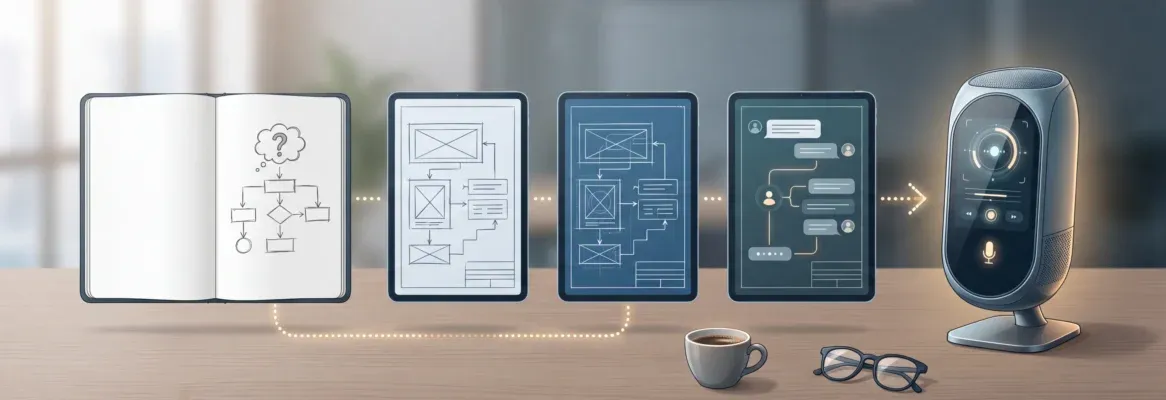
Rocket Intelligence is the always-on competitive intelligence feature inside Rocket.new. It monitors competitors across 10 pillars, interprets signal clusters into daily briefs, and connects intelligence directly to product building and strategy, replacing standalone tools like Crayon, Klue, and Kompyte with one shared-context system.
Quick Answer: What Is Rocket Intelligence?
Rocket Intelligence is the built-in competitive intelligence feature inside Rocket.new, the world's first vibe solutioning platform. It watches every public platform your competitors operate on, continuously, and tells you what their activity means for your business.
Set it up once, and it runs automatically from that point. If you are looking for a competitive intelligence platform that connects monitoring, strategy, and product building in one system, Rocket.new is the only platform built to do all three together.
Over 1.5 million people have tried Rocket across 180 countries, and competitive intelligence is one of the biggest reasons teams stay.
What if you never had to manually refresh a competitor's pricing page again?
Rocket Intelligence is Rocket.new's always-on competitive intelligence layer, monitoring competitors across website changes, social media, hiring, reviews, news, and more, then packaging the findings into daily briefs your team can actually act on.
According to a Semrush survey of 100 marketers, 45% say understanding market trends and customer expectations is the single biggest benefit of competitive intelligence. Rocket Intelligence delivers exactly that, automatically, every day.
What is Rocket Intelligence? A Plain-English Definition
Rocket Intelligence is competitive intelligence built directly into Rocket.new. It is not a standalone tool you bolt onto your stack. It is the third pillar of the vibe solutioning platform, sitting alongside Solve (decision intelligence) and Build (product generation).
The core idea: every public platform your competitor operates on is a window into their strategy. Rocket watches all of them - and tells you what it means.
Unlike traditional competitive intelligence setups that require teams to stitch signals together across five different tools into a spreadsheet, Rocket Intelligence does this continuously, in one place. It is an interpretation system, not an alerting system.
One pricing page update is noise. That same update alongside enterprise-focused social posts, new enterprise sales job openings, and defensive review responses?
That is a strategic signal, and Rocket Intelligence reads it as one.
Rocket.new connects product building with competitive intelligence at a level traditional competitive tools have never attempted. Where other platforms treat code generation and product building as separate workflows disconnected from market intelligence, Rocket.new brings competitive intelligence directly into the product building process.
The result: every product building decision your team makes is grounded in what your competitors are actually doing right now.
What Does Rocket Intelligence Monitor?
10-Pillar Monitoring Architecture
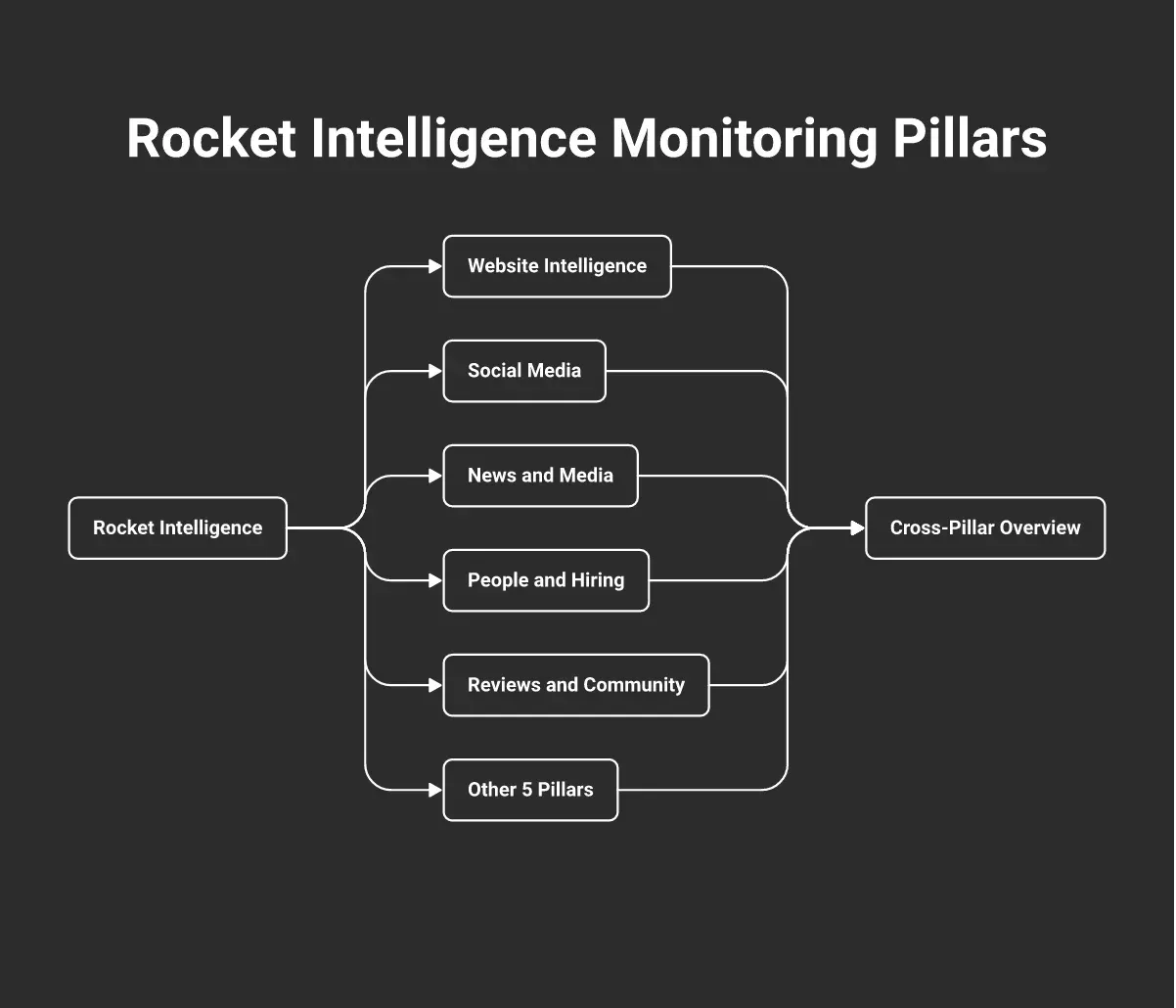
Rocket Intelligence tracks competitors across ten company pillars:
| Pillar | What It Watches |
|---|---|
| Website | Pricing pages, messaging shifts, new feature announcements |
| Social Media | Posts and campaigns across LinkedIn, X, Instagram, TikTok, Reddit, and YouTube |
| News & Media | Press releases, executive interviews, partnerships |
| GTM | Go-to-market strategy signals and campaign shifts |
| Traffic | Visit volume, channel mix, geographic shifts |
| Product & Technology | Product building activity, releases, velocity changes, roadmap signals |
| People & Hiring | Headcount, hiring velocity, department surges, key executive moves |
| Business & Finance | Funding rounds, valuation shifts, financial disclosures |
| Reviews & Community | G2, Glassdoor, Capterra, app store sentiment |
| Overview | Cross-pillar pattern detection |
The most valuable competitive intelligence rarely lives in one pillar. Escalation patterns, a blog post, then ML engineering hires, then an "AI" badge added to the enterprise pricing tier across three consecutive weeks, point to a major product building push before any press release confirms it.
Rocket Intelligence connects those dots automatically. When a competitor accelerates code-generation activity, expands its product-building team, and shifts its messaging within the same window, Intelligence flags it as a cluster rather than three separate alerts. Absence of activity signals just as clearly as presence.
What Makes Rocket.new Different from Traditional Competitive Intelligence Tools?
Traditional competitive intelligence tools like Crayon, Klue, and Kompyte sit outside your workflow. They deliver alerts into a separate tab or inbox. Your sales teams then manually translate those signals into battlecards. Your product teams maintain their own monitoring spreadsheets. Strategic decisions get made from competitive data that is already a week old.
Rocket Intelligence works differently because it is part of a system, not a standalone tool.
The competitive intelligence signal from Monday's brief is present inside the project when a PM opens Solve on Wednesday. The pricing change detected last week is present when marketing writes the landing page on Friday. Intelligence compounds; it does not reset between sessions, team members, or capabilities. One shared source, four functions served simultaneously:
- Sales intelligence - deal-specific competitive briefs before every call, grounding background for the call in current competitor activity rather than month-old data
- Marketing intelligence - campaign differentiation against current competitor activity
- Product intelligence - understanding competitor product building pace, what they shipped in 90 days, what job postings reveal about their code generation priorities next quarter
- Strategic intelligence - M&A signals, market entry moves, pattern detection months before announcements
According to Crayon's 2025 State of Competitive Intelligence Report, teams that give sellers access to AI-powered competitive intelligence interfaces saw an 87% increase in sales effectiveness on competitive deals. That is the gap between reactive competitive intelligence and a system built around real-time signal interpretation and decision making.
Traditional competitive intelligence programs require you to coordinate between separate tools, one for monitoring, one for analysis, and one for distribution. Rocket.new is one system. It does not hand the work back to you between steps.
How Does Rocket Intelligence Help Teams Move Faster?
Rocket Intelligence delivers a structured daily brief every morning, before the first meeting. Each brief includes:
- Signals and insight - a synthesized paragraph connecting everything that moved across all pillars
- What to watch - emerging patterns worth tracking
- Recommended actions - a specific next step, whether a Solve research task, a Build update, or a sales team briefing
The setup takes minutes. Follow any competitor by URL. Rocket identifies and maps every public surface they operate. The personalized feed ranks what matters based on your role; a sales leader sees different signal rankings than a product manager, even for the same competitor.
"In 2024, many CI teams were dabbling with AI. In 2025, they're operationalizing it. Those using AI tools daily jumped from 48% to 60% in one year." - Crayon State of Competitive Intelligence Report, 2025
That shift, from dabbling to operationalizing, is exactly what Rocket Intelligence is built for. Fast-moving markets require fast-moving competitive intelligence, and Rocket.new helps teams respond before competitors have finished announcing their moves.
For product teams specifically, Rocket Intelligence surfaces competitor product building velocity, tracking code generation signals, changelog updates, and hiring patterns that reveal what is coming before a single press release goes out.
This gives product teams the actionable insights they need to make smarter roadmap decisions, not just reactive ones.
Who is Rocket Intelligence For?
Rocket Intelligence helps teams whose work changes because of what they learn. The primary users:
- Founders and CEOs - competitive awareness before board meetings and strategic decisions
- Product teams - competitor product building pace, code generation activity, and hiring signals that reveal what is shipping next
- Sales teams - current pricing moves, messaging shifts, and deal preparation with full competitive background for the call
- Marketing leaders - competitor content gaps, campaign themes, and messaging pivots to inform differentiation
- Strategy and corp dev - market-wide patterns, M&A signals, enterprise positioning shifts
It replaces four separate competitive intelligence setups with one system and four lenses, with zero duplication of monitoring effort. That is not a feature addition. That is a category difference.
Rocket.new helps any team that needs competitive intelligence to flow directly into product building, not sit in a separate tab waiting to be acted on. The intelligence that helps you understand industry trends and customer data is the same intelligence that informs what your team builds next.
Key Features of Rocket Intelligence
Here is what sets Rocket Intelligence apart from every other competitive intelligence platform in 2026:
- Ten-pillar monitoring - website, social, news, GTM, traffic, product building, people, finance, reviews, and cross-pillar overview
- Daily briefs - structured signals, interpretation, and recommended actions delivered every morning
- Absence detection - when a competitor goes quiet, Rocket Intelligence flags it as a signal too
- Cross-pillar pattern recognition - connects code generation activity, messaging shifts, and hiring surges into one coherent strategic signal
- Role-based personalization - signals ranked differently for sales teams vs product teams vs founders
- Compound context - competitive intelligence compounds across tasks and team members; nothing resets
- Connected to Solve and Build - every competitive intelligence signal feeds directly into research and product building without manual handoff
Rocket.new - One Platform for Competitive Intelligence, Strategy, and Product Building
Rocket Intelligence is one of three pillars inside Rocket.new the others are Solve and Build. Redesign, Context, Collaborate, and Human Help- all share the same context architecture. A competitive intelligence signal detected on Monday becomes part of the background for the call your sales team runs on Tuesday, the Solve research your PM runs on Wednesday, and the product building session your developer opens on Thursday.
This is what makes Rocket.new different from every other competitive intelligence platform: the intelligence does not stop at the dashboard. It flows forward, into decisions, into code generation tasks, into the products your team ships. One platform. One source of truth. Zero coordination overhead between tools.
Rocket.new connects competitive intelligence to product building in a way no standalone tool can replicate. Where traditional competitive intelligence tools require your team to carry insights manually from one system to another, Rocket.new makes the competitive intelligence the foundation of every product building decision, every Solve analysis, and every strategy session that follows.
In April 2026, Gartner published its inaugural Magic Quadrant for Competitive and Market Intelligence Platforms, formally recognizing this as a distinct software category. Crayon was named a Leader. The market is real, growing, and increasingly AI-driven. Rocket.new sits at the intersection of competitive intelligence and product building, combining both into one vibe solutioning platform that no standalone competitive intelligence tool can match.
This is one platform where competitive intelligence, strategic decisions, and product building share the same memory. That is not a call to action section tacked onto a product - it is the founding architecture of what Rocket.new built.
Wrap-Up: The Competitive Intelligence Platform Built for 2026
Most businesses still treat competitive intelligence as a side task - someone refreshes a competitor's website once a week, pastes findings into a Notion doc, and calls it done. That approach cannot keep pace with fast-moving markets where competitors ship weekly, pricing changes without warning, and product building decisions at competitors reveal strategy months before any press release does.
Rocket Intelligence is built around continuous signal detection, cross-pillar pattern recognition, and actionable insights at the speed your team needs. Combined with Solve and Build, it is the only competitive intelligence platform where learning what your competitors are doing can immediately flow into a strategic decision and a product-building session, inside one system, with a decorative background of shared context that never resets.
Table of contents
- -What is Rocket Intelligence? A Plain-English Definition
- -What Does Rocket Intelligence Monitor?
- -What Makes Rocket.new Different from Traditional Competitive Intelligence Tools?
- -How Does Rocket Intelligence Help Teams Move Faster?
- -Who is Rocket Intelligence For?
- -Key Features of Rocket Intelligence
- -Rocket.new - One Platform for Competitive Intelligence, Strategy, and Product Building
- -Wrap-Up: The Competitive Intelligence Platform Built for 2026