
Build full-stack apps with server side logic, form handling, and data mutations without writing code. AI platforms like Rocket.new generate production-ready Next.js server functions from a plain-language prompt in minutes.
Next.js Server Actions changed the rules. What used to require a separate API layer, manual fetch calls, and careful JSON wiring now lives inside a single function marked with two words: use server.
The framework handles the rest, serialization, security, and server execution included. For builders who want to ship without touching any of that infrastructure, AI platforms now generate the entire pattern from a plain-language description.
Why Development Teams Are Moving Away from Manual API Routes
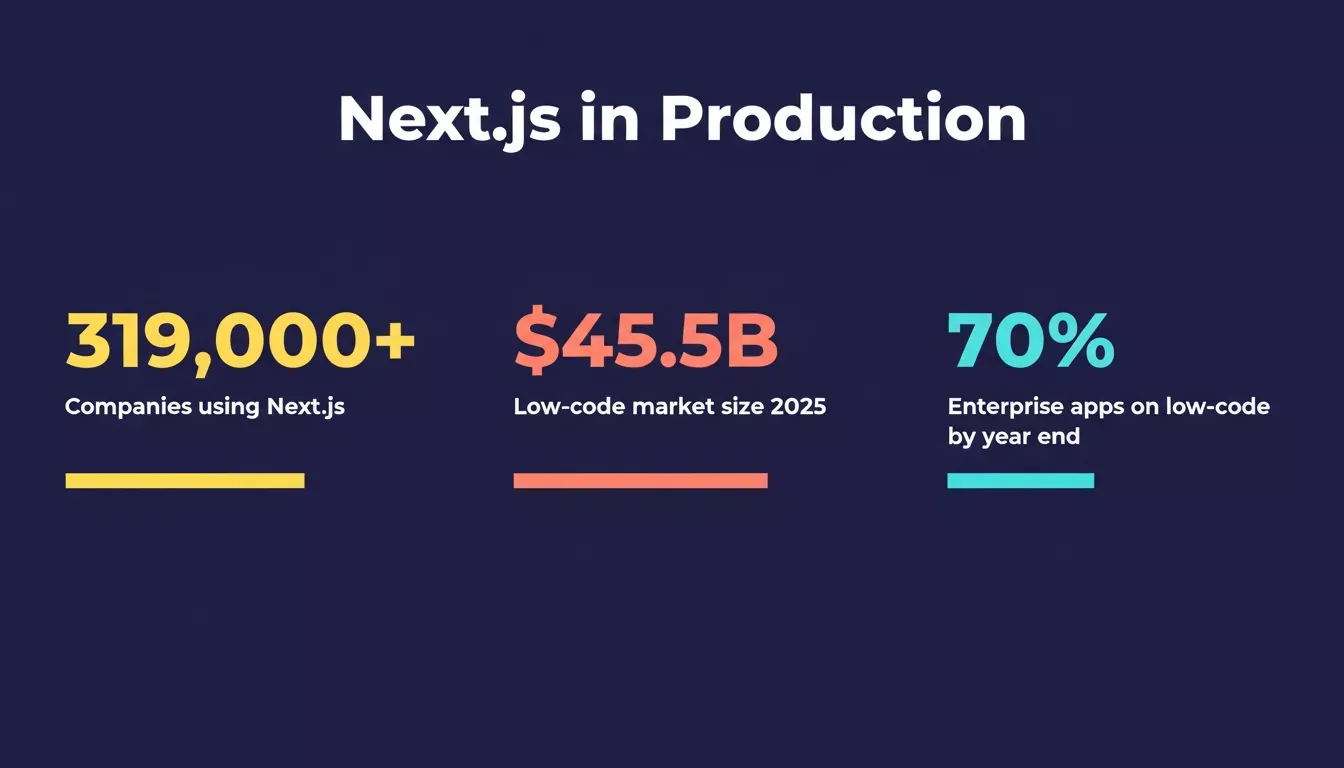
Why are development teams moving away from manually crafted server endpoints? The low-code and no-code ecosystem has grown into a $45.5 billion global market as of 2025, with a 28.1% compound annual growth rate. That shift tells us something: developers and non-developers alike want to ship apps faster without wrestling with boilerplate.
The App Router architecture in the current framework changed how teams handle data on the server. Instead of creating separate file-based route handlers, you now define asynchronous functions that run server side and invoke them directly from React components. Platforms like Rocket generate production Next.js code from a description, handling the server logic, form handling, and data fetching automatically.
A projected 70% of enterprise applications will rely on low-code or no-code tools by the end of this year, according to Gartner's forecast. That means the gap between "I have an idea" and "I shipped it" is shrinking fast.
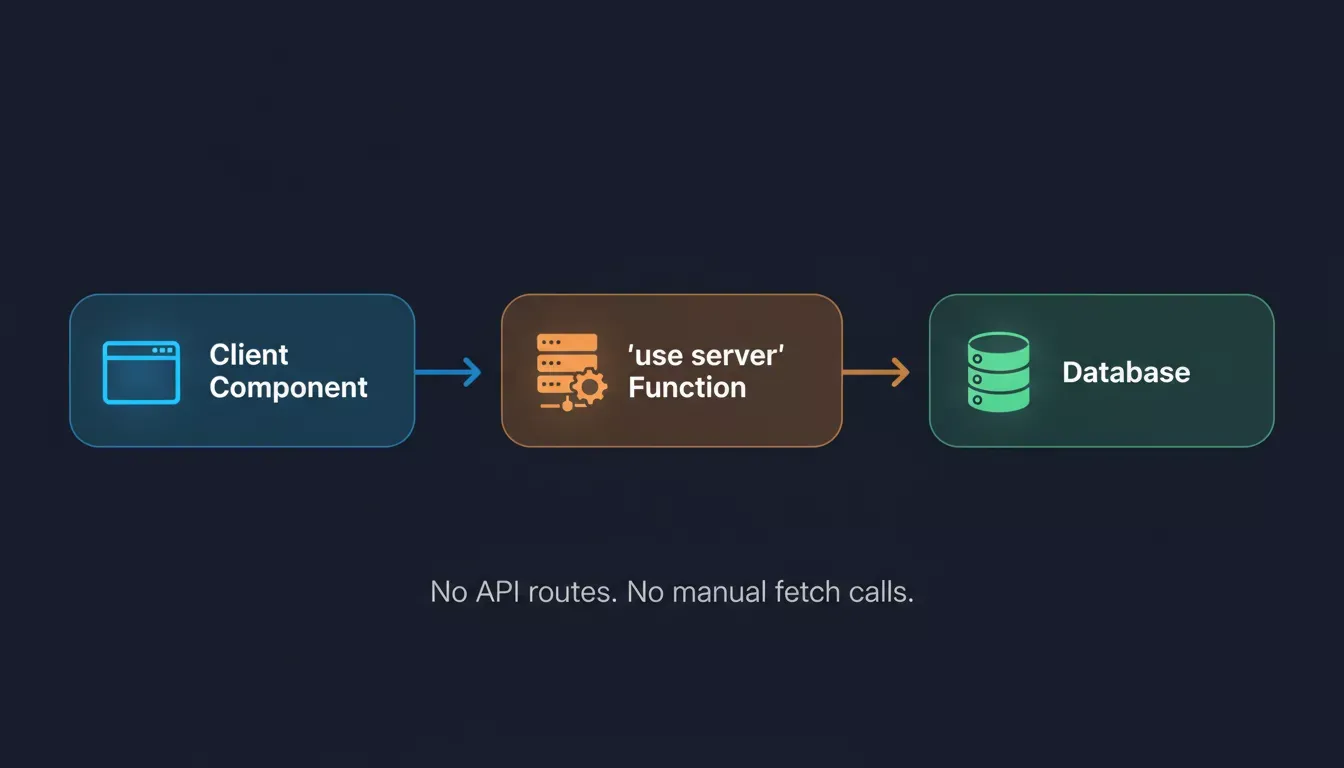
How a Next.js Server Action connects a client component directly to the database, removing the need for a separate API layer.
What Happens When You Mark a Function with 'use server'?
When you add the use server directive at the top of a function or a separate file, you tell the framework that this code runs only on the server. The client component never sees the implementation details.
- The function becomes a server action that the framework can call through a hidden POST request when a user triggers an event
- You can define the action inline inside a server component, or export it from a separate file and import it into any client component
- The 'use server' directive supports progressive enhancement, meaning forms work even before JavaScript loads on the page
- These asynchronous functions can directly access your database, send email, handle authentication, or mutate data without exposing secrets to the client
- Two main ways to invoke them: pass the action as a prop to a form element's action attribute, or call it from event handlers like
onClickin ause clientcomponent
This approach removes an entire layer of code you would normally write. No separate API routes file. No manual fetch calls. No JSON parsing on either end.
Form Submissions and Data Mutations
Handling form submissions with this pattern is straightforward. The form's action attribute accepts a server action function directly.
- When a user hits submit, the framework serializes the form data and sends it to the server automatically
- The server action receives the form data, runs validation, and performs mutations server actions need (like writing to a database or updating a record)
- Pending states are built-in: you can use the
useFormStatushook from React DOM to show loading indicators while the action is pending - Error handling follows a return value pattern where the function sends back structured status messages instead of throwing
- For optimistic updates, the framework provides hooks that let the UI update before the server confirms success
After the server processes the request, it can call revalidatePath or revalidateTag to invalidate the cache and return fresh data to the page. The client component then reflects the updated state without a full page reload.
How Do Server Actions Compare to API Routes?
If you have worked with the App Router before, you might wonder when to use Next.js Server Actions versus traditional route handlers. The answer depends on what you are building.
- Server actions are designed for mutations: creating, updating, and deleting data tied to user interactions on the page
- Route handlers fit better for: webhooks, third-party integrations, public REST endpoints that external services call, and read-heavy data fetching from outside your app
- Actions support progressive enhancement by default; API routes do not
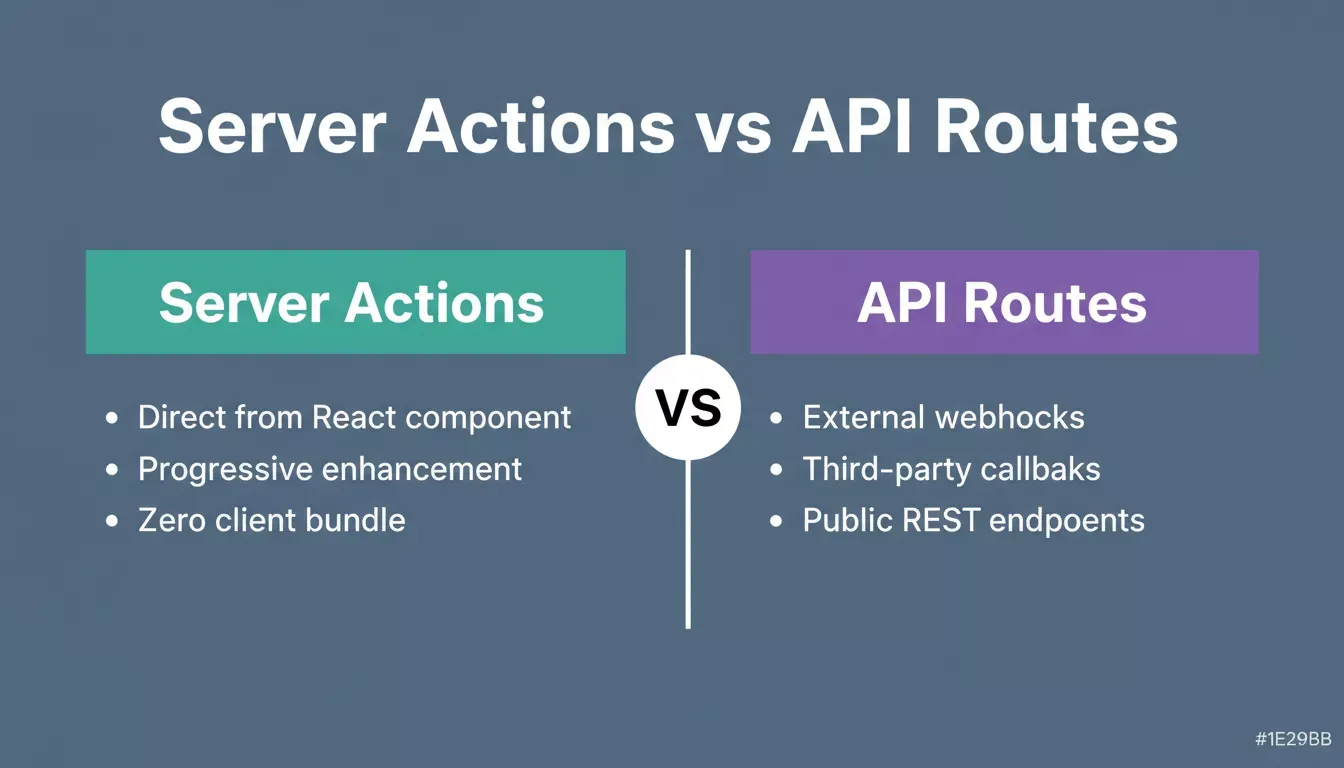
Server Actions handle mutations directly from components; API Routes remain the right choice for external-facing endpoints.
| Feature | Server Actions | Route Handlers |
|---|---|---|
| Best for | Form submissions, data mutations, user-triggered writes | Webhooks, external APIs, read endpoints, third-party callbacks |
| Invocation | Direct from component or form action prop | Fetch request with method and URL |
| Progressive enhancement | Yes, forms work without JS | No |
| Code location | Inline or separate file with use server | app/api/ route file with GET/POST/PUT/DELETE |
| Data access | Direct database access, session, cookies | Direct database access, request/response objects |
| Client bundle impact | Zero, runs only on server | Zero for the handler; client still writes fetch code |
When a user action is a mutation, it routes through the server action path. External requests go through the API route path.
Can AI Tools Generate Server Side Logic Automatically?
The short answer is yes. And the data backs it up. Over 319,000 companies now run the framework in production, from startups to Fortune 500 brands like Amazon and IBM.
Next.js production adoption and the low-code market growth that is driving demand for AI-generated server logic.
- AI-powered platforms read your natural language description and generate the server functions, client components, data models, and form handling code
- You skip the manual steps: no writing boilerplate const declarations, no configuring import statements, no debugging async/await chains
- The generated code includes validation, error handling, redirect logic, and data handling patterns out of the box
- For non-technical founders and product teams, this means shipping a working app without learning JavaScript or framework internals
- Tools that connect directly to backend services (Supabase, Stripe, authentication providers) handle the wiring for you
As one developer noted: "With server actions, you skip the API route. You just call a server function like a normal function." AI builders take this one step further: you skip writing the function too.
The difference between traditional builders and AI-native platforms is that traditional tools still require you to auto-generate route handlers with AI and then manually connect them. True AI-native platforms handle the full stack from a single prompt. If you want to understand how Rocket compares to other builders on this front, the Rocket vs Lovable breakdown covers the key differences in depth.
Why Rocket Makes Next.js Server Actions Effortless
Rocket.new generates production-grade web applications from a plain-language description. For web apps, Rocket uses Next.js with the App Router and every generated app comes with server-side logic, form handling, and data patterns already wired up.
- Describe your app in one sentence: "Build a project tracker with user authentication, task creation, and team dashboards" and Rocket handles the rest
- The platform generates server components, client components, form actions, data fetching patterns, and database schema in a single build cycle
- Each generated app uses Next.js patterns correctly, with proper validation and error handling built in
- Rocket's Solve feature validates your idea against market data before you build so the app you ship reflects real user needs, not just what you described
- Supabase integration connects your backend with authentication and database in one click; no manual API configuration needed
- You can iterate through chat, visual editing, or direct code access after the first generation; credits are consumed per complexity, not per edit
Traditional AI builders generate what you tell them to generate. Rocket figures out what is worth building, then builds it with full server side logic included. You can describe what you want and ship a working product the same day.
Good to know: Every Rocket build ships with SEO-ready structure, WCAG accessibility, and performance optimization as defaults. The Next.js apps it generates follow the same patterns that senior developers write by hand.
Rocket also supports building full-stack apps from a single AI prompt, so you are not limited to server actions alone. The platform handles routing, state, and backend wiring together. For teams evaluating whether to build with AI or hire developers, the AI app builder vs hiring developer ROI breakdown is worth reading before making a decision.
Real-World Patterns for Server Side Data Handling
Once your app is live, Next.js Server Actions handle real-world complexity. Here are the patterns that production apps rely on.
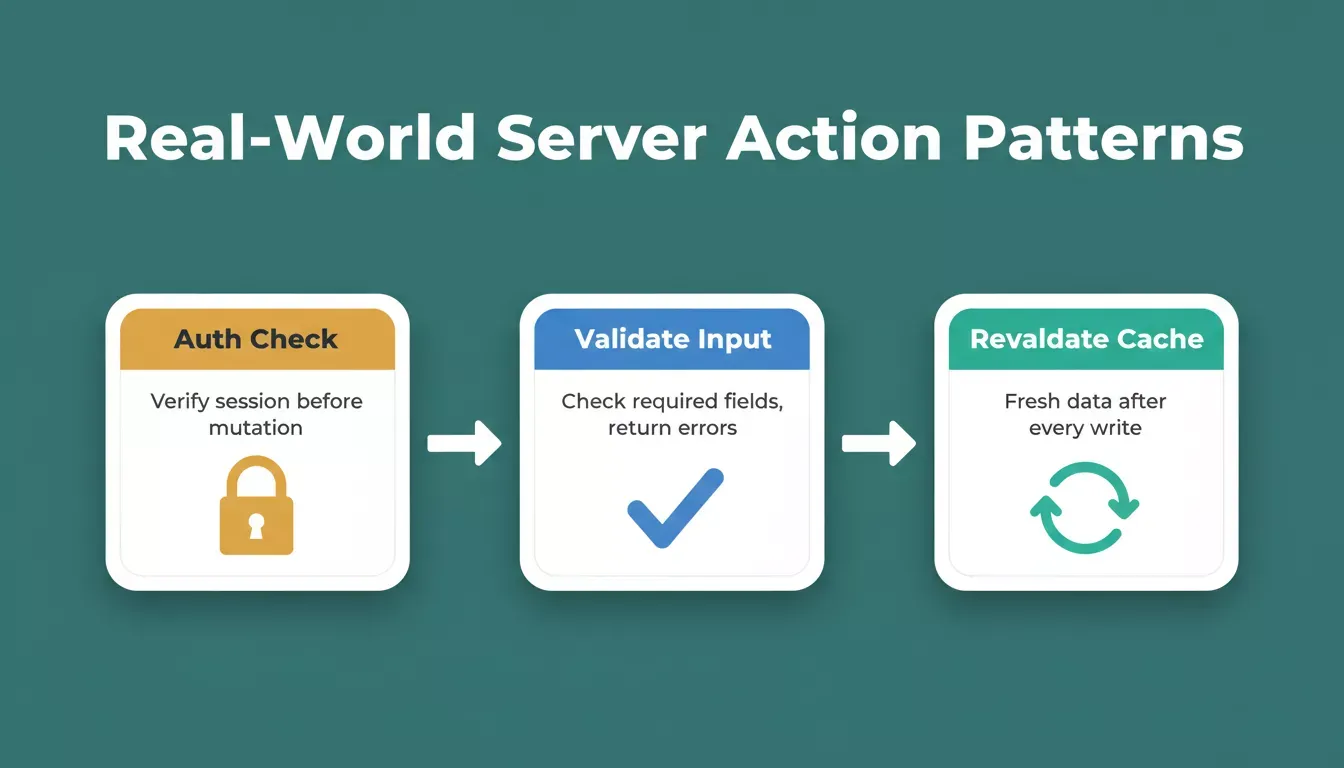
The three core patterns every production server action should implement: session verification, input validation, and cache revalidation.
Authentication and session checks:
1'use server'
2
3import { auth } from '@/lib/auth'
4import { redirect } from 'next/navigation'
5import { db } from '@/lib/db'
6
7export async function createUser(formData: FormData) {
8 const session = await auth()
9 if (!session) {
10 redirect('/login')
11 }
12
13 const title = formData.get('title') as string
14 const content = formData.get('content') as string
15
16 if (!title || !content) {
17 return { error: 'All fields are required', status: 'error' }
18 }
19
20 await db.posts.create({
21 data: { title, content, userId: session.user.id }
22 })
23
24 return { status: 'success' }
25}- The const session check runs before any data mutation, keeping unauthorized requests from reaching your database
- If the user is not signed in, the server handles the redirect automatically
- The return value carries a structured status that the client component can read and display
Cache revalidation after writes:
- After a successful mutation, call
revalidatePath('/dashboard')to invalidate cached pages so the user sees fresh data - For more granular control, use tag-based revalidation with
revalidateTag('posts') - This means users never see stale data after submitting a form or deleting a record
Error handling patterns:
- Return structured objects
{ error: string, status: string }instead of throwing exceptions - The client component checks the return value and updates UI state accordingly
- For field-level validation errors, return an object with specific field names marked as invalid
These patterns come pre-built when you use Rocket to generate your app.
The platform generates auth checks and error responses from a single prompt. For teams looking to understand how the best no-code app builder for startups compares on these production patterns, the comparison is clear: Rocket ships these by default.
Your Next Full-Stack App Starts with a Prompt
The gap between understanding server side logic and shipping a production app no longer requires months of learning. AI platforms now handle the code generation, security patterns, and deployment pipeline that used to take entire engineering teams.
Whether you are a founder validating an idea or a product team shipping features faster, the path is the same: describe what you want, let the platform handle the server logic, and focus on what matters to your users.
Rocket is the fastest way to go from a plain-language description to a production-ready Next.js app with server-side logic, authentication, and a connected database, all without writing code.
Start building on Rocket for free and ship your first full-stack app today.
Table of contents
- -Why Development Teams Are Moving Away from Manual API Routes
- -What Happens When You Mark a Function with 'use server'?
- -Form Submissions and Data Mutations
- -How Do Server Actions Compare to API Routes?
- -Can AI Tools Generate Server Side Logic Automatically?
- -Why Rocket Makes Next.js Server Actions Effortless
- -Real-World Patterns for Server Side Data Handling
- -Your Next Full-Stack App Starts with a Prompt